Genesis Chapter 1
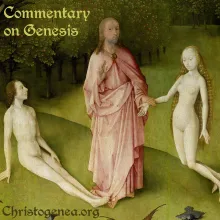
The following points are an incomplete synopsis from our commentary On Genesis, Part 1: The Creation Account through Christian Eyes:
- A brief explanation of why only Christians may understand Genesis and the other writings of Moses, which we have also already discussed here in earlier pages of this Overview.
- The meaning of the word, genesis.
- Some of the other incorrect approaches to interpreting Genesis, since it was not intended to be scientific. Rather, "it is a treatise which provides a preliminary foundation for the organization and functioning of an orderly Society, the “world” of the children of Israel as they are being organized into a Kingdom."
- Genesis is a refutation of the pagan religions of the surrounding nations. Common and contrary elements of those myths with Genesis.
- A brief explanation of the world.
- The use of the plural word elohim to describe a singular God, Yahweh.
- An exhibition that the reference to light in Genesis 1:3 is a reference to Christ, and that Christ is the Word made Flesh, which is the very same word in Genesis which had declared the Creation and called it into existence.
- Definitions of the terms heaven and firmament, as Genesis declares that the firmament was called heaven.
- Why vegetation was declared to have been created before the sun.
- The creation of the sun in the fourth day of the Creation serves to prove that the days of Genesis were actually eons, or periods of time, and not literal, twenty-four hour days. The Hebrew word designates either. The "days" of Genesis Chapter 1 cannot possibly be interpreted as literal, 24-hour periods of time.
Genesis chapter 1 is a poetic explanation of the Creation, organized for a specific purpose, since it was the foundation for the civic organization of the Kingdom of the children of Israel. It certainly does not attempt to account in detail for everything which we see in existence today. It begins with the evidently unformed mass of the planet that we know as Earth, and ends in the creation of Adamic man, who is therefore the pinnacle of the Creation.
The word usually translated "day" where it appears here in Genesis, the Hebrew yom (Strong's number 3117), can also refer to an age, or an unspecified but lengthy period of time. Understanding this first, then the Genesis creation account is easily reconciled with everything that we know from observable science concerning the age of the planet as it now exists. The six "day" periods of the Genesis creation are indeed ages, some of which may well have been quite long in duration.
That this is a proper interpretation is also recognizable later Scripture, such as where it becomes evident in Genesis chapters 6, 14 and 15 that there are other races of men on earth, which had not descended from either Adam or Noah, and yet their presence is unaccounted for in Genesis. It is, however, explained in Matthew chapter 13 and Revelation chapter 12, in the words of Christ Himself.
Then, in Hebrews chapter 4 Paul of tarsus had written concerning Yahweh God's ongoing period of rest, which Genesis simply refers to as the "seventh day" (i.e. Gen. 2:2), and which had actually begun thousands of years before Paul wrote. That period of rest cannot be taken too literally either. It only indicates that Yahweh rested from the creation of His works, or in other words, that no new species have been created on the planet since that period began. Of course, some new types that have appeared since then have done so through hybridization, which is a violation of Yahweh's law of "kind after kind" repeated quite often in these early chapters of Genesis.
Some people assert that Genesis 1:2 should state that the earth "became without form and void", yet this assertion defies the usage of the Hebrew words that the verse was written in, and has been covered in detail in a paper written by this author several years ago and available here as a PDF file entitled Genesis 1 and 2 Overview. In this same essay is also addressed the fact that the "man" of the 6th-day creation in Genesis chapter 1 is also the "Adam" whose creation is described in greater detail in Genesis chapter 2. This will be discussed at length in the next section of this overview, which discusses Genesis Chapter 2.
Resources:
On Genesis, Part 1: The Creation Account through Christian Eyes
An Index of papers discussing Yahweh (God)
Genesis Chapters 1 through 11 2 were discussed at length by William Finck with Sword Brethren on the recent Pragmatic Genesis series.