August 2026 Open Forum Discussion

Hopefully I will get time to post a topic list this weekend!

Hopefully I will get time to post a topic list this weekend!
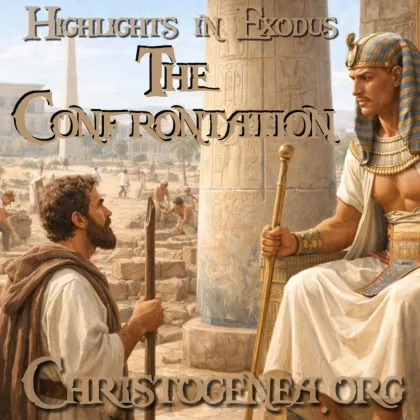
Highlights in Exodus: The Confrontation
In Exodus chapter 3, Moses had received his appointment from the “angel” in the burning bush. Notice that while the apparition of burning in the bush was called “the angel of Yahweh” in verse 2 of the chapter, Yahweh Himself is characterized as having done all of the speaking. This should broaden our concept of the use of the word angel. The corresponding Hebrew and Greek words simply mean messenger. While an angel may be a man, and it may be a supernatural entity or being, it may also be anything which Yahweh God wants to utilize in order to send a message to men. So the burning in the bush was an angel, insofar as it was a physical apparition by which Yahweh had gotten the attention of Moses, so that He may speak to him. Since Yahweh God Himself is invisible to men, basically any physical apparition representing His presence is an angel, such as the pillars of smoke and fire which shall be manifest later in this Exodus account. This changes with the advent of Yahshua Christ, whom Paul of Tarsus had described as the image of the person of Yahweh in the opening verses of his epistle to the Hebrews.
With that event at the burning bush, we also learned from the ensuing dialogue why it is that Moses had called Him Yahweh, since when he asked God what He should be called, he was told, in verse 14 of that chapter, that “I AM THAT I AM: and he said, Thus shalt thou say unto the children of Israel, I AM hath sent me unto you.” Here we explained that the phrase which translates as “I AM” is אהוה or ahavah, which is the Hebrew word הוה or havah (# 1961), a verb which means to be, prefixed with the letter א or aleph, so that it becomes a first person verb meaning I am. So Moses, from his own perspective, understood the Name given by God to mean He is, and in proper Hebrew grammar the aleph is replaced with a י or iota, by which the verb is converted to the third person and the spelling is יהוה, which may be pronounced Yahweh or perhaps Yahavah. While we shall never really know how the verbs were enunciated in ancient Hebrew, the oldest testimony is that of Flavius Josephus, who had said in Book 5 (5:235) of his Wars of the Judaeans that the Name of God “consists of four vowels”. Since Josephus was writing in Greek, he must have meant four Greek vowels, and we can pronounce the name Yahweh with four Greek vowels, but that does not work for Yahavah.
This evening I appeared for one hour with Etta Volk of Critical Review. The conversation was mostly about the racial aspects of Scripture. Click here for the program page.
It’ll Be More Blessed to Be “Left Behind”! A Review of a Paper by Clifton Emahiser
The past few weeks have been difficult, and I had been compelled to miss a few podcasts, which I really hate having to do. Aside from some health issues I have had to address, for which I should be limiting the time I spend sitting at my desk, on the afternoon of Wednesday July 29th the computer I had used every day for the last eight and a half years needed to be rebooted, and it never came back on. Once I get the time, I am sure I can fix it, but in the meantime it was a lot quicker to replace.
Then on Wednesday August 7th, not long after 5:00 PM, the main Christogenea website suddenly went offline. The server was the victim of a purposeful hacking, and while a couple of things are going to remain unexplained, an exploit had been published for some of the software used by the server, and that exploit allowed a hacker a way into the system. The hacking was perpetrated through a sophisticated set of scripts, and while the target might have been random, which is less likely, to get past the firewall the hackers must have significant internet resources. But it is easier to move on and rebuild than to sit around and cry about what had been done, so by Friday afternoon Christogenea was back up and running on a new and better server. Doing that, I also took many additional precautions with the hope of making another hacking attempt even far less likely.
So this week I have decided to offer some lighter fare, and present and critique a paper by Clifton Emahiser, the title of which is a stab at a popular book series which had been published for a decade beginning in the late 1990’s, and generally titled Left Behind. The book series capitalized on the evangelical belief in a so-called rapture, a heresy which was evidently developed by John Darby, and later popularized by the Scofield Reference Bible, as well as books such as the Left Behind series. So here in the American South we often see these corny rapture bumper stickers, stating things such as “Warning in Case of Rapture This Car Will Be Unmanned” or “Your Choice: Rapture Ready or Left Behind”, among a hundred other childish and pretentious sentences.
"If my people, which are called by my name, shall humble themselves, and pray, and seek my face, and turn from their wicked ways; then will I hear from heaven, and will forgive their sin, and will heal their land." - 2 Chronicles 7:14
Click HERE listen to our streams.
There is now a completely new schedule with different programs for each stream every day. Click here for Radio info. Last update: September 17th, 2024
Click here for Radio Albion.
William Finck on the Delingpod June 28th, 2025 (Sorry, currently subscriber-only).
Are the Jews God’s ‘Chosen’ People? - William Finck with Jerm Warfare at UKColumn May 28th, 2025
 The audio archive for the MEIN KAMPF PROJECT at Christogenea.org houses many programs related to the history of the 19th and 20th centuries which are not found here at the main Christogenea website.
 The Christogenea archive site contains older material produced at Christogenea and elsewhere that has been retired from our main website but which we certainly feel should remain available.
Christogenea is reader supported. This month's support level is reflected in the graph below. See our Contact page for a mailing address and other ways to support Christogenea.
57 %






Recent comments