Image
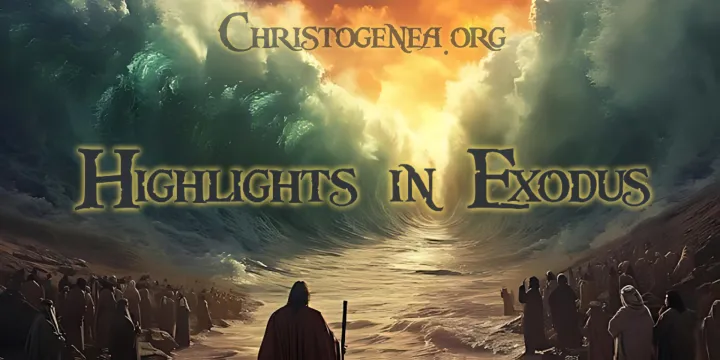

Highlights in Exodus: The Exodus In Controversy and History
Here I am going to endeavor a discussion of the Book of Exodus. This will not be a verse-by-verse commentary. Rather, I will focus on the historical details of the Exodus, on an outline of the history of the children of Israel in the Book of Exodus, and also on the Law, as Christians are often confused concerning the Law, in reference to which commandments are those that Christ expects His disciples to keep, and which commandments are the rituals and civic laws of Israel which are now obsolete under the New Covenant. I may interject comments on other passages where it is fitting. As we always have done in our Old Testament commentaries, we shall follow the King James Version, and do our best to note the significant differences which may be found in the Septuagint, the Dead Sea Scrolls and even the early translations found in the Hexapla of Origen.
On the history of the Exodus, most Christians who pay attention to the mainstream academic jargon, especially when it is echoed in popular media, should already be aware that this is always under attack by one academic scholar or another, and there are always fascinating new “discoveries” which seek to discredit the Exodus account. However sometimes there are discoveries which demonstrate its historicity, and hopefully we shall discuss the more significant of those here.
Highlights in Exodus: The Life, and Wife, of Moses
In our last discussion of Exodus, titled The Exodus In Controversy and History, we illustrated how the children of Israel in their nomadic post-Exodus period were described as the “Shasu of Yahweh”, which is to say, “Nomads of Yahweh”, by pharaoh Amenhotep III in inscriptions which had been made some time around 1390 BC. This correlates very well with our general estimations of the time of the event of the Exodus from 1450 BC. After over forty years of wandering in the Sinai desert, an event which the Egyptians must have spied out somewhat regularly, even if the children of Israel had gone north to the plains of Moab, and began to invade Canaan at that time, Amenhotep III must have known of their presence wandering in the wilderness, and recorded it as he had known it. This, beyond all doubt, proves the general veracity of the Exodus account.
The memory among the nobility of the Name Yahweh, a Name with which Moses had confronted the pharaoh in subsequent chapters of Exodus, also serves to corroborate the Exodus account of the plagues of Egypt and the ultimate release of Israel. So those events must have been sufficiently notable that the house of the pharaoh remember the Name of Yahweh.
Now here I am going to take an opportunity to take this proof of the historicity of the Exodus account a step further in Egyptian archaeology. While there is much academic debate as to whether the habiru or hapiru of the Tel el Amarna tablets are the Hebrews of Scripture, I would certainly insist that they are. But academic scholars point to the apparent use of the similar Akkadian word hapiru to describe groups of outlaws, brigands or robbers, or also marginalized outsiders or refugees. With this I disagree.
My first contention is this: a marginalized ethnic group taken to living outside of the fringes of society may naturally be perceived in such a manner, and the Hebrews, whether in Egypt or in Padanaram, do seem to have been marginalized and disenfranchised, having had no distinct land of their own. Then we should consider colloquialisms. For example, in Medieval Europe the word Slav, describing the people of Eastern Europe, became synonymous with slave in English, as the Vikings regularly traded Slavs as slaves in the West, whereby we have our word slave. In America today, if someone, even a friend, burdens you with undue requests, you may look at him and say something like “What am I, your nigger?” Of course, you are not making a statement that you are black, but blacks had been slaves for several hundred years, and they are the most recent slaves in our historical experience, so blacks are still associated with slavery in parts of our vernacular. The Israelites having escaped Egypt may easily have been seen in that same manner.
Highlights in Exodus: The Appointment
In our last presentation in Exodus, titled The Life, and Wife, of Moses, we had also taken some time discussing the Tel el Amarna tablets, which contain a cache of correspondence from the various rulers of the city-states of Canaan, most of them written to the Egyptian Pharaoh Akhenaton. This was expedient to do, since in our first presentation, The Exodus In Controversy and History, we discussed inscriptions left behind by his immediate predecessor, Amenhotep III, which mentioned a people whom he had described as the “nomads of Yahweh”, and as having been in the land of Canaan in his time.
We have dated the Exodus event to about 1450 BC. Amenhotep III ruled Egypt from about 1391 to 1353 BC, and Akhenaten from about 1353 to 1336 BC, according to the general chronologies which sometimes differ by a few years. So after forty years of wandering in the desert of Sinai, the children of Israel, the only group who could possibly have been called the “nomads of Yahweh”, are in Canaan, which is consistent with the Biblical account of the book of Joshua. Then some time later the rulers of the various cities in Canaan are appealing to help from Egypt to ward off the invading hapiru, or habiru, a group which academic scholars are resistant to identifying as Hebrews, in spite of the consistency of the reports in the Amarna tablets with the events recorded in the books of Joshua and the early chapters of Judges.
Highlights in Exodus: The Confrontation
In Exodus chapter 3, Moses had received his appointment from the “angel” in the burning bush. Notice that while the apparition of burning in the bush was called “the angel of Yahweh” in verse 2 of the chapter, Yahweh Himself is characterized as having done all of the speaking. This should broaden our concept of the use of the word angel. The corresponding Hebrew and Greek words simply mean messenger. While an angel may be a man, and it may be a supernatural entity or being, it may also be anything which Yahweh God wants to utilize in order to send a message to men. So the burning in the bush was an angel, insofar as it was a physical apparition by which Yahweh had gotten the attention of Moses, so that He may speak to him. Since Yahweh God Himself is invisible to men, basically any physical apparition representing His presence is an angel, such as the pillars of smoke and fire which shall be manifest later in this Exodus account. This changes with the advent of Yahshua Christ, whom Paul of Tarsus had described as the image of the person of Yahweh in the opening verses of his epistle to the Hebrews.
With that event at the burning bush, we also learned from the ensuing dialogue why it is that Moses had called Him Yahweh, since when he asked God what He should be called, he was told, in verse 14 of that chapter, that “I AM THAT I AM: and he said, Thus shalt thou say unto the children of Israel, I AM hath sent me unto you.” Here we explained that the phrase which translates as “I AM” is אהוה or ahavah, which is the Hebrew word הוה or havah (# 1961), a verb which means to be, prefixed with the letter א or aleph, so that it becomes a first person verb meaning I am. So Moses, from his own perspective, understood the Name given by God to mean He is, and in proper Hebrew grammar the aleph is replaced with a י or iota, by which the verb is converted to the third person and the spelling is יהוה, which may be pronounced Yahweh or perhaps Yahavah. While we shall never really know how the verbs were enunciated in ancient Hebrew, the oldest testimony is that of Flavius Josephus, who had said in Book 5 (5:235) of his Wars of the Judaeans that the Name of God “consists of four vowels”. Since Josephus was writing in Greek, he must have meant four Greek vowels, and we can pronounce the name Yahweh with four Greek vowels, but that does not work for Yahavah.

Highlights in Exodus: The Plagues of Egypt
In our last segment of Highlights in Exodus, The Confrontation, Moses had finally accepted his commission from Yahweh, and returning to Egypt he met with Aaron along the way. With that meeting, it is important to observe the fact that they had met at Sinai, the “mountain of God”, and by that we know that the Mount Sinai of the Exodus was in the northern part of the Sinai peninsula, and could not have been far from the common route that was customarily traveled between Midian and Egypt. We know this because Moses had embarked on a routine journey with his family to return to Egypt, where no precautions had made it necessary to use any alternate routes, and the common route would have been the most comfortable, as there had been at least one inn where he had stopped in along the way. Likewise, Aaron was sent by Yahweh to meet Moses on his way, so Aaron also must have taken the common route and traveled until he encountered him coming in the opposite direction. With this simple understanding of this chapter, all of the insane theories about the location of Sinai having been in the extremely mountainous southern part of the peninsula are entirely discredited.
Now we shall discuss the plagues of Egypt, but first we shall have a presentation of a section of the Wisdom of Solomon. This is because many Bible commentators have for a long time connected these plagues of Egypt to the idols of ancient Egypt, and often attest that Yahweh God is mocking the idols of the Egyptians by having natural phenomena related to their own idols turn against them. Those connections are highly creditable, and to a great extent I agree, but far too often those commentators do not reveal the original source of that assessment, which is the Wisdom of Solomon. In his Wisdom, Solomon made that exact association, as the greater scope of the work compared the fate of the impious, for which Egypt was an example, with the fate of the pious, for which the children of Israel were his example.
"If my people, which are called by my name, shall humble themselves, and pray, and seek my face, and turn from their wicked ways; then will I hear from heaven, and will forgive their sin, and will heal their land." - 2 Chronicles 7:14

Click HERE listen to our streams.
There is now a completely new schedule with different programs for each stream every day. Click here for Radio info. Last update: September 17th, 2024
Click here for Radio Albion.
William Finck on the Delingpod June 28th, 2025 (Sorry, currently subscriber-only).
Are the Jews God’s ‘Chosen’ People? - William Finck with Jerm Warfare at UKColumn May 28th, 2025
 The audio archive for the MEIN KAMPF PROJECT at Christogenea.org houses many programs related to the history of the 19th and 20th centuries which are not found here at the main Christogenea website.
 The Christogenea archive site contains older material produced at Christogenea and elsewhere that has been retired from our main website but which we certainly feel should remain available.
Christogenea is reader supported. This month's support level is reflected in the graph below. See our Contact page for a mailing address and other ways to support Christogenea.
85 %