February 2026 Open Forum Discussion

  • The recent commentary on Isaiah chapter 57 and how it agrees with Two-Seedline and the parables of the Wheat and Tares, and Sheep and Goats.

  • Real Jews and Khazars, the mistakes of Tucker Carlson, Candace Owens and others in blindly accepting the so-called “Khazar theory”, which did not start with Arthur Koestler and which is only half true.

  • Jewish and muslim gaslighting, while there is really only one Abrahamic religion: Christianity.

  • Mystery Babylon, where we are in the Revelation, the Camp of the Saints, etc.

  • All empires have always had aspects of what we call liberalism today, especially egalitarianism.

  • The early development of the Roman empire outside of Italy was for seemingly benevolent purposes.

  • Varieties of and possible ancestors of sub-Saharan Africans. Homo ergaster, Australopithecus Africanus.

  • Amish men on a beach vacation in north Florida?

  • Short discussion of forced conversions of Edomites under John Hycanus, Aristobulus I and Alexander Jannaeus.

  • Was Alexander of Macedon a sodomite? Was Nero a sodomite? The differences between the veracity of the two accounts.

  • Should Christians seek or requests signs from God? The examples of Gideon and others.

  • The Tyler Oliveira exposure of Jews in New Jersey, Nick Shirley videos as possible vehicles to awaken more Whites to Jewish treachery.

  • Mohammad was at least part Jewish, Islam was a product of Jews. Discussions on the impact of Islam on Europe.

  • Chronology fiddlers who claim that 700 years or longer were somehow surreptitiously added to the calendars, so that they did not really exist, are absolutely false and absurd, even ridiculous, and a brief explanation as to why.

  • Where was Jesus from ages 12 to 30? The Gospel says He was with His parents.

  • How Roman popes bribed early Christian bishops in Britain with the relics of the saints in order to allure them into the Catholic fold.

  • Sin, confessions, and the organization of the priesthood around sacraments, contrary to Christianity… and more!
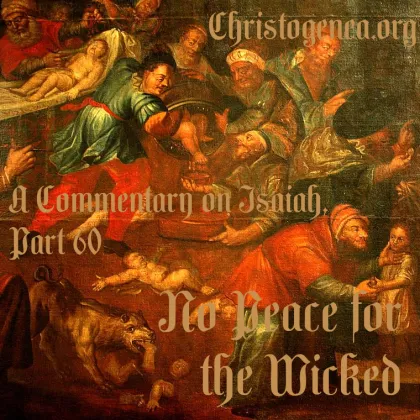
A Commentary on Isaiah, Part 60: No Peace for the Wicked

Isaiah 57:1-21

A Commentary on Isaiah, Part 60: No Peace for the Wicked

In our last discussion, where in Isaiah chapter 56 Yahweh had described Himself as “the Lord Yahweh which gathereth the outcasts of Israel”, we cannot imagine that Yahweh had intended to violate His covenants and promises which He had made to the patriarchs, Abraham, Isaac and Jacob, in order to gather to Israel any other people but “lost sheep” Israelites. So where verse 8 of that chapter continues and the Word of Yahweh says “Yet will I gather others to him, beside those that are gathered unto him”, we would make the assertion that here, it is the children of Israel in Assyrian captivity who are being addressed, yet other Israelites had long been scattered elsewhere throughout the οἰκουμένη, or the world of that time, and they would also be gathered to Israel.

Over the nine centuries prior to the Assyrian captivities, many Israelites had been departing from the main body of Israel, and settling colonies abroad, throughout the coasts of the Mediterranean Sea and the rivers and coasts of Europe. In relation to Isaiah chapters 23 and 24 we had discussed The Burden of Tyre, and how the words of the prophet help serve to elucidate the fact that the Phoenicians of the historical records were indeed Israelites. In that prophecy, Yahweh had promised not to lose sight of those Israelites who had fled from the Assyrians by sea. However Phoenicians had been colonizing the world of the Mediterranean Basin and points beyond long before the time of Isaiah, and even before Judah got involved, where Solomon had employed ships to join Hiram in his mercantile endeavors. One notable example of those early colonies is Thebes in Greece, which was recognized as a Phoenician city throughout the classical Greek writings. The people of Thebes were described as having been fair and blond, especially by the Tragic Poets. Another notable Phoenician settlement in the Greek world was ancient Miletus, and there were others in Thessaly.

A Commentary on Isaiah, Part 59: The Outcasts of Israel

Isaiah 56:1-12

A Commentary on Isaiah, Part 59: The Outcasts of Israel

Since the description of the Suffering Servant in Isaiah chapter 53, the prophet has offered many Promises of Comfort to the children of Israel in captivity, and especially for the obedient among them. Among these promises, they had even been told that they would expand their dwelling space and “inherit the nations”, which we read in Isaiah 54:3:

3 For thou shalt break forth on the right hand and on the left; and thy seed shall inherit the [Nations], and make the desolate cities to be inhabited.

There should be no doubt that these words were intended for the children of Israel in captivity, and that they were meant for Israel exclusively, since we read in verses which follow that promise:

5 For thy Maker is thine husband; the LORD of hosts is his name; and thy Redeemer the Holy One of Israel; The God of the whole earth shall he be called. 6 For the LORD hath called thee as a woman forsaken and grieved in spirit, and a wife of youth, when thou wast refused, saith thy God. 7 For a small moment have I forsaken thee; but with great mercies will I gather thee. 8 In a little wrath I hid my face from thee for a moment; but with everlasting kindness will I have mercy on thee, saith the LORD thy Redeemer.

This promise is corroborated by a somewhat earlier promise given to the children of Israel in captivity, in Hosea chapter 2 where they were told:

19 And I will betroth thee unto me for ever; yea, I will betroth thee unto me in righteousness, and in judgment, and in lovingkindness, and in mercies. 20 I will even betroth thee unto me in faithfulness: and thou shalt know the LORD.

A Commentary on Isaiah, Part 58: Promises of Comfort

Isaiah 54:9 - 55:13

A Commentary on Isaiah, Part 58: Promises of Comfort

The first portion of our discussion of Isaiah chapter 54 had primarily focused on the promise to the children of Israel which is made here in verse 3, that they would “... break forth on the right hand and on the left”, where we had spoken about the expansion of their οἰκουμένη or dwelling space, and “thy seed shall inherit the [Nations], and make the desolate cities to be inhabited,” where we hope to have explained how the Adamic nations of Genesis chapter 10, at least those which had survived to this point in history, would ultimately be dominated and subsumed by the many nations which had been promised to come of the children of Israel. By the time of Christ, there were scarcely any of the original nations of Genesis chapter 10 which remained in any recognizable form, even if there were pockets of people who had retained their original names. The people who ruled the world at the time of His ministry, chiefly the Romans, Parthians, Phoenicians and Scythians, which would include both Gauls and Germans, had mainly descended from the children of Israel, and they were unheard of at the time when Yahweh had made promises and covenants for Abraham, Isaac and Jacob. Parthians and Scythians, Germans and Gauls were still unheard of when Isaiah had first begun to write his book of prophecy, before 743 BC. 

As a digression, over the course of our studies these past 25 or so years, many friends have asked questions concerning the fate of those other Adamic nations, imagining them to still be with us today, and ostensibly many of them are, in one way or another but not by their original names. Many of their descendants may be among people of European descent, but it does not really matter, and this is why it does not matter: because Abraham was promised to be The Heir of the World, as Paul of Tarsus had described him in Romans chapter 4, and those words must have been at least partly inspired by this promise here in Isaiah, that Israel would “inherit the nations”. Nations are people groups, and not geographical entities. The desolate cities may have been considered desolate by Yahweh simply because they had not His law, living in the decadence which may justly be associated with varieties of ancient paganism. For this reason we read in verse 5 of the chapter, in reference to Yahweh: “The God of the whole earth shall he be called”, because Abraham is the heir of the world and Israel will inhabit the whole earth. In the Christian era, for better or worse, for right or wrong, all European nations ultimately accepted Christianity, and Yahweh certainly is considered the “God of the whole earth”. Of course, the unfortunate aspect of that is that the goats are often led to believe that they can somehow become sheep, but Christ had also warned that the wheat and the tares must coexist until the time of the end, and Isaiah will warn of that same thing here in chapter 56 of his prophecy, but in a somewhat different manner.