Gaymangate with Elijah Hansen

Gaymangate with Elijah Hansen

Here we are going to discuss a very uncomfortable subject, but I feel as if since I know about the subject, that I have an obligation to bring it into the open, so that our friends may also know. From what I gather, most old-time Identity Christians already despise me for upsetting quite a few of their apple carts, and view me as a trouble-maker, so why stop there?

In Scripture, when a soul sins, and a witness does not testify to the sin when he is called to do so, then he also bears the iniquity of the sinner. This is found in a rather poorly translated passage, in Leviticus chapter 5. As Christ had said in Luke chapter 12:

1 In the mean time, when there were gathered together an innumerable multitude of people, insomuch that they trode one upon another, he began to say unto his disciples first of all, Beware ye of the leaven of the Pharisees, which is hypocrisy. 2 For there is nothing covered, that shall not be revealed; neither hid, that shall not be known. 3 Therefore whatsoever ye have spoken in darkness shall be heard in the light; and that which ye have spoken in the ear in closets shall be proclaimed upon the housetops. 4 And I say unto you my friends, Be not afraid of them that kill the body, and after that have no more that they can do. 5 But I will forewarn you whom ye shall fear: Fear him, which after he hath killed hath power to cast into hell; yea, I say unto you, Fear him.

Thomas Sewell Hears about White Christianity

We thought this was a quite constructive conversation with Thomas Sewell, the former leader of Australia's now-proscribed National Socialist Network, a persecuted political organization in Australia. We appreciated Thomas' inquisitiveness and candor. But of course, like all of these encounters we have experienced with others, the discussions go in many different directions as answered questions only raise more questions. 

The Jews and Islam

The Jews and Islam

I imagine that this presentation should really be called an infocast, because for the most part I am only going to convey information from others, rather than my own first-hand research and conclusions. But then again, some things are beyond our reach, and that is all we can do in this case, which is to learn history through the eyes of others who can go places where we ourselves will never tread. So unfortunately, in order to attain first or even second-hand information concerning jewish history, one must employ jewish sources, and it seems that there was a complete dearth of medieval Western Christian scholars who even had access to penetrate jewish and islamic society in order to study their archives and develop a sense of their internal history. Political, social and linguistic isolation between the two worlds for many centuries had created an environment in which jews alone had a peculiar monopoly on any bridges between them. The few European scholars who did learn Hebrew or Arabic throughout the centuries, had done so strictly for theological reasons rather than for the investigation and writing of history.

In the past, both myself and Clifton Emahiser had cited Gibbon’s History of the Decline and Fall of the Roman Empire and Alzog’s Manual of Universal Church History in order to elucidate Muhammad’s jewish relations, however I am not going to repeat those here. Rather, here we are going to discuss much more extensive aspects of the relationship between jews and muslims, or really, some ancient sources which attest to the role of jews in the formulation of islam, and then how jews had facilitated its spread throughout the medieval world.

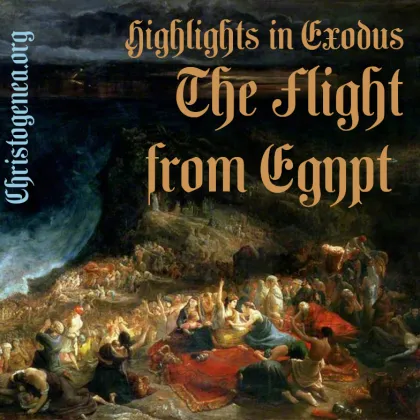
Highlights in Exodus: The Flight from Egypt

Exodus 12:37 - 14:31

Highlights in Exodus: The Flight from Egypt

In our last presentation in Exodus, The Death of the Firstborn, we had of course discussed the last plague to come upon the Egyptians before the event of the exodus itself, which was the death of all the firstborn of the Egyptians, both of man and of beast, in a single night which was then commemorated each year by the children of Israel as the Passover, at the command of Yahweh their God. Making that presentation, we declined to discuss many of the details of the Passover feast itself, because we shall encounter it once again in the later portions of Exodus which begin to present the Law, the commandments and ordinances of Yahweh our God. So even here, where the Passover feast is described in Exodus chapter 13, we shall defer speaking of the details until we reach Exodus chapter 34, and then we hope to make a more detailed commentary, comparing the descriptions in these earlier chapters. Here we instead focused upon the death of the firstborn of Egypt, and the one significant indication in Egyptian archaeology which supports the Exodus narrative. Now, after a brief discussion of that and some of the subsequent history of Egypt, we shall focus on the actual flight from Egypt without the distraction of the details of the Passover law.

Throughout their history, the pharaohs of the Egyptians were inclined to erase memory of people and events which they found uncomplimentary or uncomfortable. This practice is called damnatio memoriae by archaeologists and historians, which is the damnation of memory, and there is a notable example of it at this very time in ancient Egypt, where this same pharaoh of the Exodus, Thutmose III, is known to have ordered the erasure of the memory of Hatshepsut, his queen regent for over twenty years early in his life. So her name and her images were chiseled from walls and other inscriptions, her statues were smashed, and her obelisks were concealed behind walls. Evidence for this has been discovered by various archaeologists since the nineteenth century, and especially where Hatshepsut’s mortuary temple was excavated, since they found it filled with fragments of her smashed statues [1]. They have also found evidence that this happened late in the reign of Thutmose III, years after the date of the Exodus, so that he could assure the unchallenged ascension of his second son, Amenhotep II, to the throne [2]. So if Thutmose III eradicated the memory of his step-mother and fellow-ruler of Egypt, Hatshepsut, for political reasons, why wouldn’t he also seek to eradicate the memory of the presence of Israel in Egypt, since it had ended in the disaster of the plagues suffered by all Egyptians?