
Highlights in Exodus: The Flight from Egypt
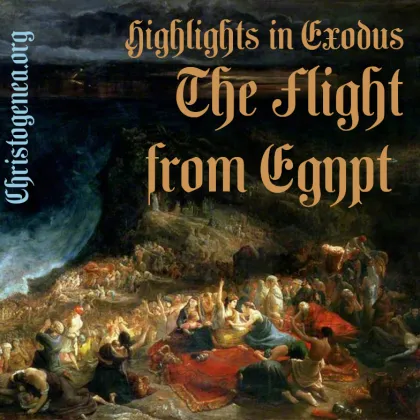
Highlights in Exodus: The Flight from Egypt
In our last presentation in Exodus, The Death of the Firstborn, we had of course discussed the last plague to come upon the Egyptians before the event of the exodus itself, which was the death of all the firstborn of the Egyptians, both of man and of beast, in a single night which was then commemorated each year by the children of Israel as the Passover, at the command of Yahweh their God. Making that presentation, we declined to discuss many of the details of the Passover feast itself, because we shall encounter it once again in the later portions of Exodus which begin to present the Law, the commandments and ordinances of Yahweh our God. So even here, where the Passover feast is described in Exodus chapter 13, we shall defer speaking of the details until we reach Exodus chapter 34, and then we hope to make a more detailed commentary, comparing the descriptions in these earlier chapters. Here we instead focused upon the death of the firstborn of Egypt, and the one significant indication in Egyptian archaeology which supports the Exodus narrative. Now, after a brief discussion of that and some of the subsequent history of Egypt, we shall focus on the actual flight from Egypt without the distraction of the details of the Passover law.
Throughout their history, the pharaohs of the Egyptians were inclined to erase memory of people and events which they found uncomplimentary or uncomfortable. This practice is called damnatio memoriae by archaeologists and historians, which is the damnation of memory, and there is a notable example of it at this very time in ancient Egypt, where this same pharaoh of the Exodus, Thutmose III, is known to have ordered the erasure of the memory of Hatshepsut, his queen regent for over twenty years early in his life. So her name and her images were chiseled from walls and other inscriptions, her statues were smashed, and her obelisks were concealed behind walls. Evidence for this has been discovered by various archaeologists since the nineteenth century, and especially where Hatshepsut’s mortuary temple was excavated, since they found it filled with fragments of her smashed statues [1]. They have also found evidence that this happened late in the reign of Thutmose III, years after the date of the Exodus, so that he could assure the unchallenged ascension of his second son, Amenhotep II, to the throne [2]. So if Thutmose III eradicated the memory of his step-mother and fellow-ruler of Egypt, Hatshepsut, for political reasons, why wouldn’t he also seek to eradicate the memory of the presence of Israel in Egypt, since it had ended in the disaster of the plagues suffered by all Egyptians?











Recent comments