European Fellowship Forum, September 2025
There was more participation from Europeans in this European Fellowship Forum than we usually have, so we are grateful for that. The following is a list of topics, probably not as complete as it could have been, which were discussed throughout the day:

  • Morality as a wedge to force people into agreeing with the system, often through false flags, such as the “Remember the Maine” slogan of the 19th century.
  • Media creates all dissident opposition leaders, simply by giving them publicity, whether good or bad.
  • AI and manipulation of people by upholding narratives favorable to jews or government. The prospect of any acceptance of truth in society.
  • Jewish mercantile success. “Maritime Law” and the Babylonian Shetar.
  • Jud Suss, and how Jewish usurers infect nations and kingdoms. Henry VIII’s
  • Government and the future kingdom of God. Anglo-centric interpretations of prophecy in Christian Identity.
  • Moses as prophet who had foreseen the future sins of Israel.
  • Inversion of morality in modern society, reverting to the sins of the ancient pagan world. Acceptance of Sodomy today.
  • No relief from troubles today until White Christians repent of their sins and turn back to their God. Other races have flooded Christian lands as a punishment for our collective sins.
  • General American ignorance of the evils committed by jews in the Bolshevik Revolution and subsequent Communist oppression in Europe. Life under communism, some participants live in formerly communist nations.
  • The poor value of education in modern society.
  • Feminism in society and Scripture. Adam as a feminist, the feminism of Barak (Judges chapter 4).
  • Attitudes towards non-Whites in Germany and other places in Europe.
  • Recent weather disasters and judgments from God.
  • Police and ongoing anti-immigration demonstrations in Europe.
  • The dismantling of the USSR and the role of “The Jewish Mafia”, a book by French author Hervé Ryssen translated by Carlos Whitlock Porter.
  • German inventions and inventors stolen by the United States after the war.
  • AI and the control of truth. Usefulness of AI and limitations in which it should be employed.
  • The prevalence of Christian Identity among Whites in Europe and America.

And more!

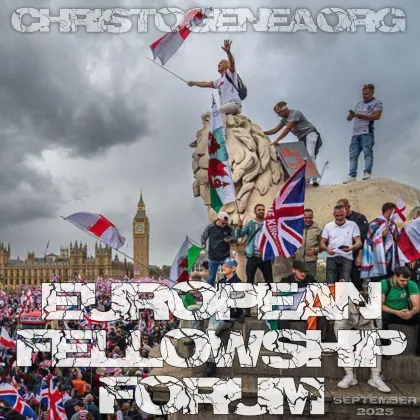
Note: At the beginning of the discussion, one British friend had stated that the thumbnail image is from a "Tommy Robinson" event, of which I was unaware. Robinson is certainly a Jew, something we had discussed over seven years ago in our Forum. As I had discussed in this Open Forum, the jewish-controlled media chooses "far right" leaders simply by singling out the individuals to whom they give "news" coverage or other attention. In that manner, they create their own corrals where they hold people seeking truth, and steer them away from finding Truth. 

However on more complete information, we have learned that the particular demonstration pictured in our thumbnail was not organized by Robinson. But Robinson merely attended the event, and the jewish-controlled British media gave him all the attention, so he became the "face" of the event. The facts serve to establish the truth of my comments concerning the media and presumed "far right" leaders, who in reality only serve jews. 
A Commentary on Isaiah, Part 45: The Promises of Salvation

Isaiah 45:7-25

A Commentary on Isaiah, Part 45: The Promises of Salvation

In the closing verses of Isaiah chapter 44 and the beginning verses of this chapter, Yahweh God had addressed a certain Cyrus by name, and it is quite evident, from our perspective, that the accompanying description of Cyrus was indeed a prophecy of the king later known as Cyrus II, or Cyrus the Great, as he is commonly called, who was not even born for at least another hundred years after these chapters were first written, and who would not fulfill this prophecy in Isaiah for at least another hundred and sixty years. Then speaking to this Cyrus, and prophesying things which would later be fulfilled in the history of the life of Cyrus II, Yahweh is portrayed as having informed him, albeit indirectly, that the things which he would accomplish had come from Him, and that he would accomplish those things for the benefit of the children of Israel. Yahweh was indeed addressing Cyrus where we read: “4 For Jacob my servant's sake, and Israel mine elect, I have even called thee by thy name: I have surnamed thee, though thou hast not known me.”

Then, after the Word of Yahweh had made the assertion that there is no other God beside Him, whether Cyrus himself had later understood that or not, we read, in verses 7 and 8: “7 I form the light, and create darkness: I make peace, and create evil: I the LORD do all these things. 8 Drop down, ye heavens, from above, and let the skies pour down righteousness: let the earth open, and let them bring forth salvation, and let righteousness spring up together; I the LORD have created it.” From this point, the focus shifts away from Cyrus, and he is no longer addressed, but instead in verse 9 Yahweh warns those who strive with their Creator, and in verse 13 Cyrus is spoken of in the third person, which is explicit in the Hebrew language throughout that verse. So while from verse 9 it is apparent that the Word of Yahweh here in Isaiah begins to once again address the children of Israel, as the chapter progresses it is made absolutely clear that it is Israel who is being addressed. However, before we commence from where we had last paused our commentary, we should discuss verses 7 and 8 of Isaiah chapter 45 from a different perspective.

A Commentary on Isaiah, Part 44: Cyrus, the Man of Gold

Isaiah 45:1-8

A Commentary on Isaiah, Part 44: Cyrus, the Man of Gold

Discussing Isaiah chapter 44, we had explained that Yahweh God is The Shepherd of the Blind on account of the fact that He leads men to do His will, even when men do not know or acknowledge Him, or even when they are purposely blinded by Him so that they cannot see the consequences of their own actions. This last sort of blindness was imposed on the children of Israel in the declaration of Isaiah chapter 6. There Yahweh had spoken to the prophet Isaiah and we read: “9 And he said, Go, and tell this people, Hear ye indeed, but understand not; and see ye indeed, but perceive not. 10 Make the heart of this people fat, and make their ears heavy, and shut their eyes; lest they see with their eyes, and hear with their ears, and understand with their heart, and convert, and be healed. 11 Then said I, Lord, how long? And he answered, Until the cities be wasted without inhabitant, and the houses without man, and the land be utterly desolate, 12 And the LORD have removed men far away, and there be a great forsaking in the midst of the land.”

However as we hope to have explained in that same discussion, once they had been removed from the land the children of Israel had been stricken with a different sort of blindness, on account of what had been declared in Hosea chapter 3: “4 For the children of Israel shall abide many days without a king, and without a prince, and without a sacrifice, and without an image, and without an ephod, and without teraphim: 5 Afterward shall the children of Israel return, and seek the LORD their God, and David their king; and shall fear the LORD and his goodness in the latter days.” Having none of the trappings of their former nationhood, they would ultimately forget their own history as Israel, even if they fulfilled the promises which Yahweh had made to Abraham, by becoming many nations and a company of nations in the long process of their captivity.

A Commentary on Isaiah, Part 43: The Shepherd of the Blind

Isaiah 44:1-28

A Commentary on Isaiah, Part 43: The Shepherd of the Blind

As we have said at least several times earlier in this commentary on Isaiah, the prophet was not necessarily writing for his own time. He did address certain contemporary events with near-vision prophecies and accompanying accounts, and they certainly established his credibility as a prophet of Yahweh. However his primary purpose was to prophesy concerning the captivity of the children of Israel, to provide some early records of that process, and to provide visions which described what would become of them in the future, including how they would ultimately be granted mercy, forgiven, redeemed and reconciled to Yahweh their God. For this reason, Isaiah is also the second most frequently cited book of the Old Testament in the writings of the New Testament, surpassed only by the Psalms. Then, out of the citations of Isaiah, these last twenty-six chapters, which address Israel in captivity, are cited more often than the first forty chapters which are mostly focused on Jerusalem and the nations bordering on Judah.

While many of these over-arching far-vision prophecies in Isaiah pertain to the children of Israel in captivity, there are also many Messianic prophecies which had been fulfilled in Christ, or also in John the Baptist or the spread of the Gospel by the apostles of Christ. But some of the Messianic prophecies have not yet been fulfilled, and those which are not are later echoed in one way or another in the Revelation of Yahshua Christ. However there are other things which are described here in Isaiah that are not necessarily intentional prophecies with any definite far-vision fulfillment, but which do represent patterns that may be found to have been repeated in history, because they are the inevitable results of certain sins in which men have repeatedly become ensnared. One of these is found here in Isaiah chapter 43, where the Word of Yahweh addressed the children of Israel and said: “3 For I am the LORD thy God, the Holy One of Israel, thy Saviour: I gave Egypt for thy ransom, Ethiopia and Seba for thee. 4 Since thou wast precious in my sight, thou hast been honourable, and I have loved thee: therefore will I give men for thee, and people for thy life.” This prophecy did indeed have a near-vision fulfillment, as something which had already begun to happen as the very words had been uttered, and the process of its fulfillment is evident in ancient history. This process, as we had described it, represents entire nations which had been Given Up to Darkness.

A Commentary on Isaiah, Part 42: Given Up to Darkness

Isaiah 43:1-28

A Commentary on Isaiah, Part 42: Given Up to Darkness

In our last presentation in Isaiah, The Way of the Blind, we endeavored to discuss both the implications and the outcome of the fact that the ancient children of Israel were sent off into captivity for their sins, but that they were accompanied by promises of preservation, along with mercy as well as a future recovery and reconciliation. Here in these last twenty-six chapters of his prophecy, Isaiah had announced and recorded many of those promises, and he had done so in the course of an address to the people dwelling in the isles and the coastlands of the west. In the course of those announcements, and in the wake of the Messianic prophecies in the early verses of Isaiah chapter 42, he had also professed that those who would give glory to Yahweh would go down to the sea, in order to announce His praise in those same islands and coastlands. In this it is fully evident, that while Isaiah had made this prophesy in relation to his prophecy of the Gospel of Christ, that the later apostles of Christ had done just what Isaiah had prophesied, when they brought that Gospel to the islands of the Mediterranean Sea and the coastlands of Europe, while at the same time they had also sung the praises of Yahweh in Christ. Then while they brought the Gospel to those coastlands, they cited these very passages of Isaiah in order to demonstrate the fulfillment of his words found in that Gospel. Then, as we had also asserted, the understanding of these things leads to an inevitable conclusion that our Christian Identity profession is true, and that it is the only Christian understanding which fully accepts the literal meanings of the words of both the apostles and the prophets of God. The prophets pointed the apostles to the way of the blind, and the apostles followed along, so that true Israel was ultimately revealed in the early development of Christendom.