Gesenius's Hebrew and Chaldee Lexicon to the Old Testament Scriptures, by Samuel P Tregelles, 1857 edition
This is an index to twenty-five files, a Preface and twenty-three sections, one for each Hebrew letter, followed by an Index

This is an index to twenty-five files, a Preface and twenty-three sections, one for each Hebrew letter, followed by an Index
Founded Upon The Seventh Edition of Liddell and Scott's Greek-English Lexicon. After 25 years, I still use my copy of this lexicon as my primary Greek reference, referring to the large 9th edition only on occasion.
A Commentary on Isaiah, Part 38: The Beginning of Encouragement
As we had discussed introducing our last presentation of Isaiah, the commentary on chapter 40 which was titled The Comfort in Judgement, that chapter serves as a bridge to this exclusively prophetic portion of Isaiah which has a different perspective than the first thirty-nine historical chapters, and it also serves as a conclusion to those historical chapters. While there are many significant prophecies in those historical chapters which would not be fulfilled until long after Isaiah’s own time, they were interspersed with prophecies and records of events which had occurred in his own time, events which are now all transpired. Examples of those prophecies which have not yet transpired at this point in the life of Isaiah are the still-future fall of Assyria, which happened around 612 BC, and the rise and fall of Babylon as an empire, which began around 605 BC and lasted until about 530 BC. Those events were both prophesied by Isaiah in chapters 10 through 14. Then there was the prophesied destruction of Tyre, which would not be completed until 330 BC, in Isaiah chapters 23 through 25.
Speaking of ancient Tyre, we shall take a brief digression. The mainland city of Tyre was called Ushu by the Assyrians and Uzu by the Egyptians. It was evidently destroyed by the Babylonians (Ezekiel chapter 29) but the island city was not destroyed until the time of Alexander of Macedon around 330 BC. However much earlier, in the time of Ashurbanipal, in his ninth campaign, which must have been some time around 660 BC, we read: “On my return march [from Arabia] I captured the city of Ushu, which is located on the shore of the sea. The people of Ushu, who had not cowered before their governor(s), and had not paid their tribute, their yearly gifts, I slew. Among (those) insubmissive people I applied the rod(?). Their gods, their people, I carried off to Assyria. The insubmissive people of Akkû (Acre) I slaughtered. Their corpses I hung on stakes, surrounding the city (with them). Those who were left I carried away to Assyria, joined them to (my) military organization, adding them to the many troops which Assur had given me.” Therefore it is evident that Israelites continued to be taken into captivity, or slaughtered by the Assyrians, long after the destruction of Samaria by Sargon II. The fulfillments of many prophecies often occur in processes extended over many years, or even centuries.
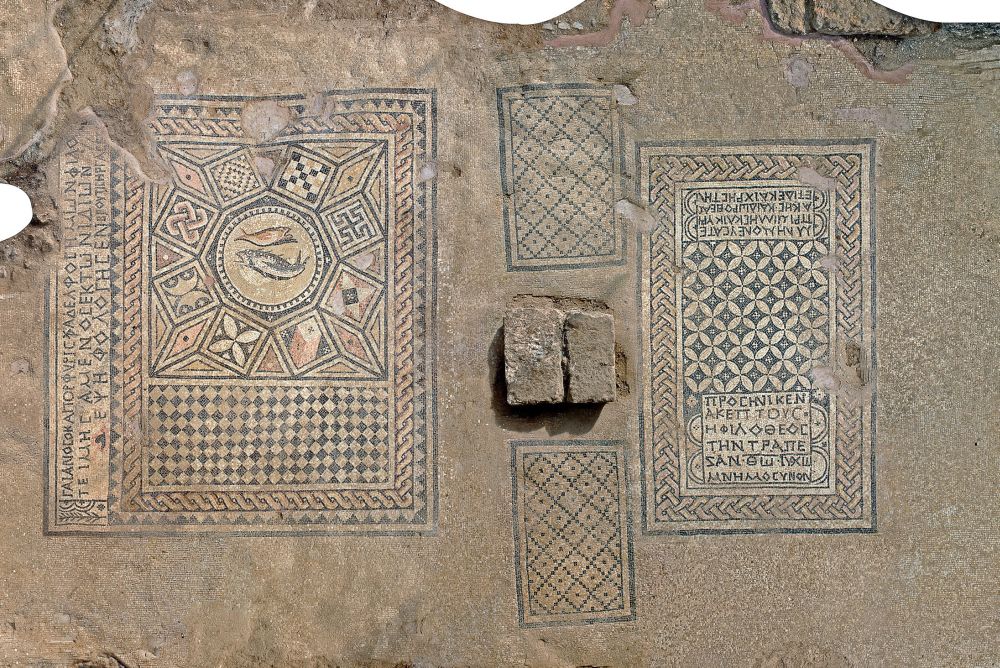
The Megiddo Mosaic was discovered under the floor of an Israeli prison in Megiddo, in 2005.
The video posted here contains the same audio as the podcast. Here I also left James' advertising and announcements uncut, for which is the courteous thing to do. I very much appreciated the honest questions and the opportunity to answer them. Find James at https://jamesdelingpole.co.uk/ or https://delingpole.substack.com/
A Commentary on Isaiah, Part 37: The Comfort in Judgement
As we had explained in our last presentation of Isaiah, which was titled Pride and Humility in reference to the character and experiences of king Hezekiah of Judah, this 40th chapter of Isaiah concludes the mainly historical portion of his prophesy, which is the portion that coincides with events that had occurred during Isaiah’s own lifetime. But only because at this time, Jerusalem still stands, and its inhabitants are destined to continue for another hundred and fifteen or so years, and therefore the prophecy of this chapter has an immediate or near-vision fulfillment as well as an over-arching far-vision fulfillment, would I even count the message of comfort in this chapter with that historical aspect of Isaiah which we have seen thus far.
In that manner, this chapter also serves as a bridge to the prophetic portion of Isaiah which we shall encounter in the final twenty-six chapters of the book. While there are many far-vision prophecies interspersed among the historic events of these first forty chapters of Isaiah, the last twenty-six chapters are entirely prophetic of from Isaiah’s future, addressing Israel and Judah in captivity as well as containing many promises of their preservation, and their future redemption and reconciliation to Yahweh their God. So while there are also references to things which had already occurred, there are no further descriptions of any other historical events subsequent to what we have already seen here at this point in Isaiah. There are no further mentions of Isaiah himself, or of Hezekiah, or any other historical figure of Judah who had lived in that time, which is now about 700 BC. So if Azariah, or Uzziah, the first king under whom Isaiah had prophesied, had lived until 743 BC, since Isaiah began prophesying while Uzziah was still king, as he attested in the opening verses of this book, then the prophet has already been prophesying for at least 43 years at this point, and he could easily be as old as seventy-five or eighty years.
A Commentary on Isaiah, Part 36: Pride and Humility
As we proceed with our commentary on Isaiah, it is fitting to note that at this point there are only three chapters left to what we would consider the historical portion of Isaiah, which is that portion which pertains to the events of the prophet’s own time. From Isaiah chapter 41 and through to the end of Isaiah in chapter 66, the entire purpose of the prophet is to relate the will of God concerning the children of Israel in captivity, and their future preservation, along with their redemption and ultimate salvation in the coming of their Messiah, who is indeed revealed as the incarnation of Yahweh God Himself in the words of the prophet. But for now, the first two of these last three chapters describe events in the life of Hezekiah had apparently occurred both during and after the failed siege, and then chapter 40 contains a message of comfort for the remaining inhabitants of Judah in Jerusalem.
In our last commentary on Isaiah, where we had left off at the end of chapter 37, Yahweh had defended Jerusalem As Birds Flying, as He had promised in a prophecy found in Isaiah chapter 31, a promise which had been uttered no more than a few years earlier than the failed Assyrian siege. Now we are at Isaiah chapter 38, and Hezekiah is described as having been deathly ill “in those days”, which also seems to be a reference to the time of the Assyrian siege, and as the chapter progresses it becomes evident that this chapter actually contains an account which is parallel to chapter 37, that it describes events which had transpired at the same time as the events of the later portion of chapter 37. However while the people of Jerusalem had every reason for the celebration and praise of Yahweh their God, having been threatened by and delivered from the hand of the Assyrians, the narrative following the last verses of both 2 Kings chapter 19 and Isaiah chapter 37, where Sennacherib was described as returning to Assyria, only focuses on Hezekiah’s concurrent illness. There is nothing recorded of the mood in Jerusalem following the lifting of the siege and the withdrawal of Sennacherib, and nothing concerning the attitude of Hezekiah immediately after the delivery of Jerusalem from the hand of the Assyrians.
"If my people, which are called by my name, shall humble themselves, and pray, and seek my face, and turn from their wicked ways; then will I hear from heaven, and will forgive their sin, and will heal their land." - 2 Chronicles 7:14

Click HERE listen to our streams.
There is now a completely new schedule with different programs for each stream every day. Click here for Radio info. Last update: September 17th, 2024
Click here for Radio Albion.
William Finck on the Delingpod June 28th, 2025 (Sorry, currently subscriber-only).
Are the Jews God’s ‘Chosen’ People? - William Finck with Jerm Warfare at UKColumn May 28th, 2025
 The audio archive for the MEIN KAMPF PROJECT at Christogenea.org houses many programs related to the history of the 19th and 20th centuries which are not found here at the main Christogenea website.
 The Christogenea archive site contains older material produced at Christogenea and elsewhere that has been retired from our main website but which we certainly feel should remain available.
Christogenea is reader supported. This month's support level is reflected in the graph below. See our Contact page for a mailing address and other ways to support Christogenea.
57 %







Recent comments