
Jesus Christ is God - The Megiddo Mosaic
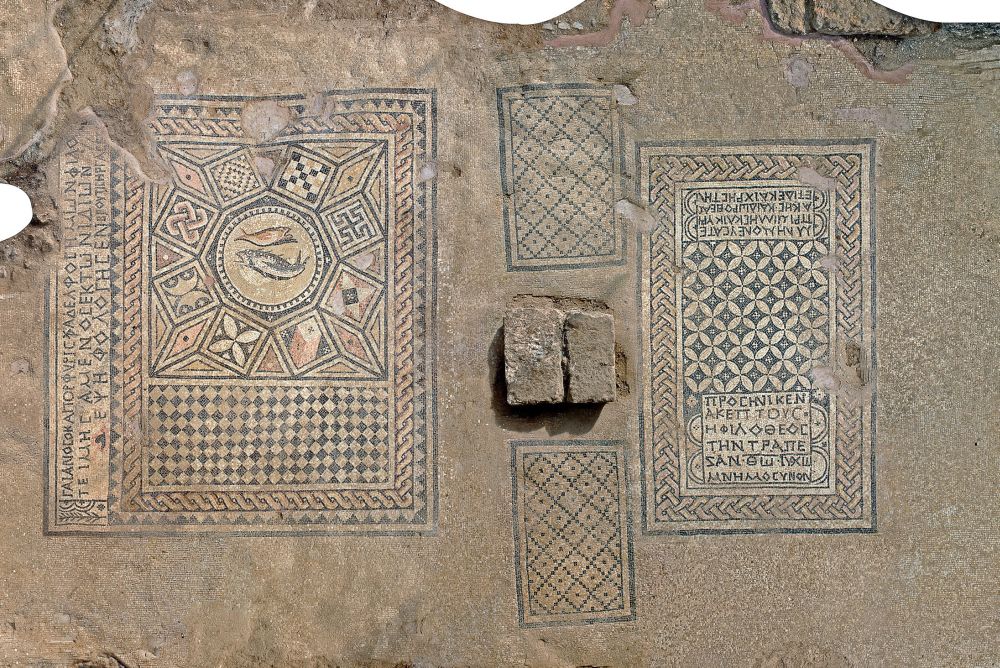
The Megiddo Mosaic was discovered under the floor of an Israeli prison in Megiddo, in 2005. It's recent display at the Museum of the Bible in Washington, DC, has brought it back into archaeology news. The mosaic contains three significant inscriptions, which are called the Akeptous Inscription, the Gaianos Inscription, and the Women's Inscription, so-called because it commemorates the names of four women who must have been prominent members of the Christian assembly in which the mosaic was originally installed.
The Akeptous Inscription
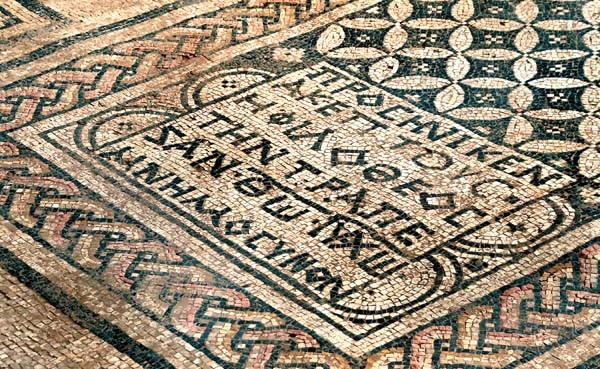
Akeptous, the friend of God, has offered the table to God Jesus Christ for remembrance.
In this inscription, the words "God Jesus Christ" are represented in abbreviations which were also common in ancient Greek manuscripts. This is in the later portion of line 5 where we read: Θω ΙΥ Χω, a letter sequence which stands for the words θεῷ Ἰησοῦ Χριστῷ or "to God Jesus Christ". This Christian author of this Greek inscription, which is esteemed to have been made in the 3rd century AD, clearly considered Jesus Christ to be God.
There is also significance here in the words "has offered this table... for remembrance". Early Christians were instructed by Paul of Tarsus to remember Christ at every meal, where he wrote in 1 Corinthians chapter 11: "26 For as often as ye eat this bread, and drink this cup, ye do shew the Lord's death till he come." So communion is not something for sabbaths, of for church, but for every meal on every day.
The Gaianus Inscription

Gaianos, who is also called Porphyry, a centurion, our brother, having earnestly desired to do so, has commissioned this mosaic-inscription. Brutus has done the work.
On the first line of this inscription, between the words πορφυρις, or Porphyry in this translation, and αδελφος, or brother, is a symbol which was used to represent a centurion. The Χ above the Ρ in interpreted in this context as being shorthand for the word ἑκατοντάρχης, which is the Greek equivalent to the Latin term centurion. So it is believed that Gaianos was a centurion, and he is said to have been the benefactor of the mosaic.
The Women's Inscription
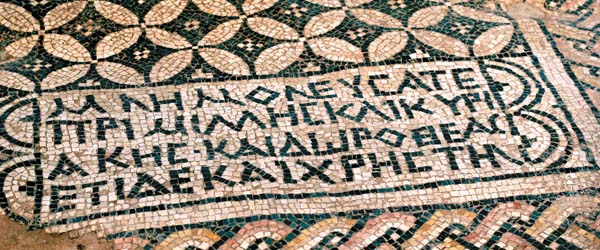
Remember Primilla and Cyriaca and Dorothea, and moreover also Chreste.
The name Primilla is apparently Latin and appears to be a feminine form of the Latin word primo, or first. So perhaps she was a first-born child. Cyriaca is a feminine genitive form of the word κύριος or lord, and therefore it describes a female who is of the Lord, whereby it is apparent that this woman was born into a Christian household. Likewise, Dorothea means Gift of God and Chreste is useful or generally, good and was used in other senses to mean beneficial or worthy, among other things.











Recent comments