A Commentary on Isaiah, Part 46: The Failure of Idols
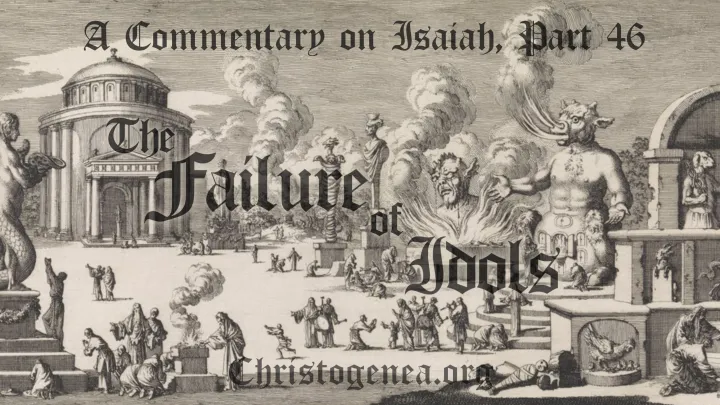
A Commentary on Isaiah, Part 46: The Failure of Idols
We might understand the attitudes and the poor understanding of judaized Christians who have been imbued with the lies of the Church and all of the denominations it has spawned over these last 1800 years. However there is nothing more disappointing than to see Identity Christians reject the notion that all Israel shall be saved, in spite of their sins. However this is much more than a mere notion: It is an explicit promise which is expressed in various ways in many passages of Scripture, and especially in the words of the prophets. So here in Isaiah chapter 45, there are two unequivocal promises of universal salvation for the children of Israel, which are first evidenced in the words: “17 But Israel shall be saved in the LORD with an everlasting salvation: ye shall not be ashamed nor confounded world without end.” Then in the final verse of the chapter we read: “25 In the LORD shall all the seed of Israel be justified, and shall glory.” Only a rebellious soul could twist these words into something other than what they plainly mean.
However in the development of Roman Catholicism, there were many such rebellious souls even when they did not mean to be rebellious. Over the centuries, doctrines had been contrived of heaven and hell and purgatory which are not founded in the Scriptures, and they have been used to control people as well as for men to profit from them. The priesthood set themselves up as idols, proclaiming that their baptism and their rituals alone can save men and grant them an entry to heaven. Essentially, they claim that their authority must rule over men, for men to continue in the salvation which they purport to bestow upon them with their rituals. Then in order to help maintain their pretense of authority, they offer actual idols, representations of the creation found in so-called “saints”, unto which men prostrate themselves and pray for mercy or forgiveness, as if God Himself cannot hear our unworthy voices, and we need some plaster statue intercessor, artificial representations of men or women who could not even save themselves.
Thereby the denizens of the professional priesthood had created an endless vocation for themselves, and a fount of power and authority which was never ordained by God. The is the essence of the meaning of the term Nicolaitans, which describes men who would rule over the people, which is something which Christ Himself has professed to hate. Today, it should be fully apparent in history that all of these idols of the Church and the denominations which it has spawned, have failed to save men, they have failed to maintain a truly Christian society. They have failed to manifest any shadow of the Kingdom of Heaven which Christ had admonished His followers to seek above everything else. But many of the false conceptions which Christians have of Christianity today are vestiges of the false paradigms of the professional priests, and they are not at all actually Christian, they are not rooted in the Word of God.
In our 2019 commentary on the Gospel of John, we cited this very passage of Isaiah, that “all the seed of Israel be justified, and shall glory”, in our discussion of verses 27 through 29 of John chapter 10 where we read, in the words of Christ Himself: “27 My sheep hear my voice, and I know them, and they follow me: 28 And I give unto them eternal life; and they shall never perish, neither shall any man pluck them out of my hand. 29 My Father, which gave them me, is greater than all; and no man is able to pluck them out of my Father's hand. 30 I and my Father are one.” Here, we often muse that even by his own actions, a man cannot pluck himself from the Hand of God. Man has no power over his own destiny, whether he is destined for heaven, or destined for destruction. Man can do nothing to save himself, and beyond this life, man can do nothing to destroy Himself. But Christians should keep the commandments of God and love one another, in the hope of rewards beyond this life, rather than shame.
In the eyes of man, this seems unfair, and we hear cries that “it is not my fault I was born this way”, but as Paul had written in Romans chapter 9, “20 Nay but, O man, who art thou that repliest against God? Shall the thing formed say to him that formed it, Why hast thou made me thus? 21 Hath not the potter power over the clay, of the same lump to make one vessel unto honour, and another unto dishonour?” God alone is Sovereign, and in His Word He has informed us as to what He shall destroy, and what He shall keep. We cannot even blame Him if we fail to understand the distinctions. If we fail to hear His words, that is also His Will, for either our good or our evil, for whether we are kept, or whether we are destroyed. Only in that manner will those who survive this world understand that Yahweh alone is God.
The professional priests and modern pastors would baptize dogs, pigs and goats if they thought it would augment themselves or their “ministries”, and they often do, to the detriment of the sheep.
At that point in our commentary on John, we had also cited Matthew chapter 15 where Christ is recorded as having attested that “I am not sent but unto the lost sheep of the house of Israel,” and then we had explained that those so-called “lost sheep” are described:
… in various Psalms, in Jeremiah chapter 50, and in Ezekiel chapter 34 as the ancient children of Israel scattered in the Assyrian and Babylonian captivities, as well as in earlier migrations of the people [of Israel] into Europe and the Mediterranean basin. But there are also sheep in Judaea, the remnant of true Israelites and not Edomites or other converts, and it is they to whom Paul referred when he prayed for his “kinsmen according to the flesh”. That is only one way that we see how to determine the identity of the sheep, but the meaning is clear.
In relation to this, in the 74th Psalm, which is attributed to Asaph and which was written in the time of the captivity in Babylon, we read: “1 O God, why hast thou cast us off for ever? why doth thine anger smoke against the sheep of thy pasture? 2 Remember thy congregation, which thou hast purchased of old; the rod of thine inheritance, which thou hast redeemed; this mount Zion, wherein thou hast dwelt.” In the 95th Psalm, attributed to David, we read “7 For he is our God; and we are the people of his pasture, and the sheep of his hand….” Likewise, in the unattributed 100th Psalm, we read: “3 Know ye that the LORD he is God: it is he that hath made us, and not we ourselves; we are his people, and the sheep of his pasture.” This last verse evokes the words of Isaiah here in the opening verse of chapter 43: “1 But now thus saith the LORD that created thee, O Jacob, and he that formed thee, O Israel, Fear not: for I have redeemed thee, I have called thee by thy name; thou art mine.” Only the children of Israel are called the sheep of Yahweh’s pasture, and this must be just as true in the New Testament as it had been in the Old Testament. The sheep He had come for were already sheep, and they were already lost.
But here we must also ask, which of the children of Israel are not in the hand of God? Which of the seed of Jacob are not of His sheep? Could an Israelite become a goat, if Yahweh had made him a sheep, and then promised that “no man is able to pluck them out of my Father's hand”, as we see in the words of Christ in John chapter 10? Moreover, shortly after the promise of a New Covenant, in Jeremiah chapter 33 we read: “7 And I will cause the captivity of Judah and the captivity of Israel to return, and will build them, as at the first. 8 And I will cleanse them from all their iniquity, whereby they have sinned against me; and I will pardon all their iniquities, whereby they have sinned, and whereby they have transgressed against me.” Then, in Matthew chapter 1, we read of the purpose of the Messiah, in words spoken of Mary: “21 And she shall bring forth a son, and thou shalt call his name JESUS: for he shall save his people from their sins.” So once again we must ask, which of the sins of Judah and Israel did Yahweh not promise to cleanse? From which sins is Christ not able to save any of His sheep? How can we, being sinners ourselves, make additions to His words in order to exclude any of our own brethren, whom we may happen to disdain?
Our brethren which we may disdain are the very enemies which Christ had commanded us to forgive, in the sermon on the mount in Matthew chapter 5: “43 Ye have heard that it hath been said, Thou shalt love thy neighbour, and hate thine enemy. 44 But I say unto you, Love your enemies, bless them that curse you, do good to them that hate you, and pray for them which despitefully use you, and persecute you; 45 That ye may be the children of your Father which is in heaven: for he maketh his sun to rise on the evil and on the good, and sendeth rain on the just and on the unjust.” But of course, that sermon was intended for the sheep, and not for wolves, pigs, dogs or goats. So Christians are otherwise informed to reject God’s enemies, and all those who reject Christ. Today, the idolatrous churches are all complicit in the fact that the sheepfolds of Christ are now overrun with wolves, dogs, pigs and goats, as Christ Himself had warned in His Revelation.
In Romans chapter 9, Paul of Tarsus began to discuss the divergent fates of Jacob and Esau, beginning with a prayer in which he had voiced concern only for his “brethren according to the flesh”, the true Israelites in Judaea, because as he had also explained, not all of Israel were actually of Israel, for which reason he had then proceeded to contrast Jacob and Esau. Making that distinction, Paul also explained that Yahweh God hated Esau, citing Malachi chapter 1, and described the Israelites as vessels of mercy, but the Edomites as vessels of destruction. In the process of that, he also explained how children of the flesh of Abraham were not necessarily children of the promises, since only the children of Jacob had inherited the promises. Therefore we cannot imagine that Paul had any of the Edomite Judaeans in mind where he spoke about the fall and reconciliation of Israelites in the subsequent chapters.
So in Romans chapter 11, Paul was speaking only of true Israelites where he had asked “1 I say then, Hath God cast away his people? God forbid. For I also am an Israelite, of the seed of Abraham, of the tribe of Benjamin”, and in the context which he himself had provided in Romans chapter 9, he was only speaking of those Israelites in Judaea who had not yet accepted the Gospel of Christ. The Edomites were never God’s people in the first place. Then later in that chapter, in his allegory of the olive tree and the broken and grafted branches, he was only speaking in the context of his epistle to the Romans, who were Israelites which had been scattered abroad even before the giving of the law, and they were the wild olives being reconciled to God, compared to the Israelites in Judaea who continued to reject the Gospel of Christ, who faced the danger of becoming alienated from God. However even after that, in Romans 11:25 Paul had expressed the understanding “… that blindness in part is happened to Israel, until the fulness of the [Nations] be come in.” That blindness was not spoken only of Israel in Judaea, but also of the Israelites in captivity, as Yahweh God had also stated here in Isaiah, for example in chapter 42 (42:19), where there is a rhetorical question pertaining to Israel which reads “Who is blind, but my servant?”
Like the children of Israel in captivity, the Israelites of Judaea were also blinded by God, which is found in the words of Christ himself where He cited Isaiah chapter 6 as His reason for having spoken to them in parables. This is recorded in Matthew chapter 13 where He said “15 For this people's heart is waxed gross, and their ears are dull of hearing, and their eyes they have closed; lest at any time they should see with their eyes, and hear with their ears, and should understand with their heart, and should be converted, and I should heal them.” When Isaiah had spoken those words, in chapter 6 of his prophecy, they were for all of Israel, and that is the blindness to which Paul had referred in Romans chapter 11, where he then wrote: “26 And so all Israel shall be saved: as it is written, There shall come out of Sion the Deliverer, and shall turn away ungodliness from Jacob: 27 For this is my covenant unto them, when I shall take away their sins.” So all Israel was blinded, and all Israel shall be saved, in spite of their disbelief, and in spite of their sins. In the meantime, the only cure for that blindness is in Christ.
Furthermore, here in the closing verses of Isaiah chapter 45 we read “23 I have sworn by myself, the word is gone out of my mouth in righteousness, and shall not return, That unto me every knee shall bow, every tongue shall swear.” So Paul had also cited this verse in Romans chapter 14, but his words here in Romans chapter 11 also help serve to explain the meaning of that prophecy where, in verse 26, after he professed that “… all Israel shall be saved” he also cited Isaiah 59:20 and wrote “There shall come out of Sion the Deliverer, and shall turn away ungodliness from Jacob.” The idolatrous churches have men bending the knee to priests and to plaster or wooden statues, rather than to God.
We would rather interpret the purpose of the Christ according to the words of the prophets, rather than the words of the priests. Just as Paul had interpreted them in that epistle, where he then wrote further on in Romans chapter 11: “29 For the gifts and calling of God are without repentance. 30 For as ye in times past have not believed God, yet have now obtained mercy through their unbelief: 31 Even so have these also now not believed, that through your mercy they also may obtain mercy. 32 For God hath concluded them all in unbelief, that he might have mercy upon all.” Therefore all of Israel shall be saved even if they do not believe, and if they do not believe in this life, they certainly shall believe in the next, where “every knee shall bow”, although it is far better that men bow to Christ in this life.
Then, in his own wisdom Paul must have also understood that at least some of his own readers would remain incredulous at the fact that all Israel shall be saved, and he wrote, further on in that same chapter of Romans: “33 O the depth of the riches both of the wisdom and knowledge of God! how unsearchable are his judgments, and his ways past finding out! 34 For who hath known the mind of the Lord? or who hath been his counsellor? 35 Or who hath first given to him, and it shall be recompensed unto him again? 36 For of him, and through him, and to him, are all things: to whom be glory for ever. Amen.” There Paul had alluded to several passages of Scripture, and cited Isaiah once again, from chapter 40 where we read in the King James Version: “13 Who hath directed the Spirit of the LORD, or being his counsellor hath taught him?”
Therefore, to argue against the fact that “In the LORD shall all the seed of Israel be justified, and shall glory”, and to doubt that “Israel shall be saved in the LORD with an everlasting salvation”, is to argue with God Himself, and to pretend to be able to counsel God, for which reason Paul had cited that passage. Being Christians, we should not be found arguing with God.
So returning to our immediate purpose here, which is Isaiah, as we have already explained, the overall context of the last 26 chapters of Isaiah is a series of prophecies concerning the fate of the children of Israel in captivity, as well as the means of their reconciliation. However a more immediate context here in chapters 44 and 45 of Isaiah is the prophecy of Cyrus and, as Isaiah had written these words, the still-future captivity of the remnant of Judah in Babylon, whereafter they would be released by Cyrus from their impending captivity in Babylon, and be free to return and build the seventy-weeks kingdom which is prophesied in Daniel chapter 9.
But here we must note, that technically speaking, that remnant of Judah was also in captivity even if many of them returned to Judaea. That is evident because they remained under Persian rule, then under Greek rule, and even though they had liberated themselves from the Greeks for a time, after about eighty years they were subjected once again under Roman rule. Then speaking of another aspect of these events, we must also note that just like the rest of Israel in captivity, the remnant of Judah in the seventy-weeks kingdom had never had any true propitiation for their sins. The second temple was built, but it never contained the necessary ark of the covenant, with the mercy seat upon which the blood of the sacrifices for sin had been poured out by the priests, in accordance with law. Rather, in the Provenance of God the second temple was built only as a way by which He would provide the sacrifice of Christ as a propitiation for all of the sins of all of Israel, either Israel spread abroad in captivity, or Israel in Judaea. This was also the stated purpose of the seventy weeks kingdom as it was prophesied by Daniel.
So as we commence with Isaiah chapter 46, what follows refers to the idols of Babylon, as it was in them that Nebuchadnezzar had boasted when he had destroyed Jerusalem:
1 Bel boweth down, Nebo stoopeth, their idols were upon the beasts, and upon the cattle: your carriages were heavy loaden; they are a burden to the weary beast. 2 They stoop, they bow down together; they could not deliver the burden, but themselves are gone into captivity.
The nuance in these words is that men had customarily bowed to these idols, but when Babylon falls, the idols themselves shall be forced to bow, and even face the indignity of being moved upon beasts. One example of the extent to which men had prostrated themselves to worship their idols is found in an event recorded in Daniel chapter 3, where we read: “8 Wherefore at that time certain Chaldeans came near, and accused the [Judahites]. 9 They spake and said to the king Nebuchadnezzar, O king, live for ever. 10 Thou, O king, hast made a decree, that every man that shall hear the sound of the cornet, flute, harp, sackbut, psaltery, and dulcimer, and all kinds of musick, shall fall down and worship the golden image: 11 And whoso falleth not down and worshippeth, that he should be cast into the midst of a burning fiery furnace.”
From the earliest times, even ancient kings fell down before their idols, and the idols of other peoples. In a very ancient Akkadian inscription recording some of the deeds of Sargon of Akkad, a ruler of the Akkadian empire in the 24th century BC, upon certain of his conquests we read in part:
Sargon, king of Kish, was victorious in 34 campaigns and dismantled (all) the cities, as far as the shore of the sea. At the wharf of Agade he made moor ships from Meluhha [Ethiopia or Cush in Africa], ships from Magan, (and) ships from Tilmun, Sargon, the king, prostrated (himself) in prayer before the god Dagan in Tutul (and) he gave (him) the Upper Region (i.e.) Mari, Iarmuti (and) Ibla as far as the Cedar Forest and the Silver Mountain. Enlil did not let anybody oppose Sargon, the king. 5,400 soldiers ate daily in his palace (lit.: presence). [1]
The city Tutul was in Syria, so evidently Sargon had prayed and prostrated himself before a foreign god, thanking the native god for giving him victory over it’s own people. However in his inscription recording the event, he also gave his own god a significant portion of the credit.
The idol Bel was called by the name Marduk by Assyrians, Babylonians and Persians, as Bel, or Baal, is merely a title which means lord. The name Marduk is even found in Scripture, where a certain king of Babylon is called Evilmerodach in 2 Kings chapter 25 and Jeremiah chapter 52. As the names of Israelites often bore references to Yahweh, so the names of Babylonians bore references to their idols. As a digression, we see another variant of the name of this idol in the Mordecai character of the spurious book of Esther, who was depicted as a hero, and the name is also popular in the Babylonian Talmud and among modern jews, the descendants of the ancient Edomites. The name Mordecai in Hebrew actually means “my Mardok”.
Here we see that these idols, Bel and Nebo, would be carried upon beasts and go into captivity. Being the chief deities of the Babylonians, they certainly did endure a form of captivity under the rule of the Persians and later Greeks and Parthians, and they could not save the Babylonians from conquest, nor could they save any of the other surrounding nations which had worshipped them among their idols.
But the Persian policy was generally one of religious tolerance, as we see also in the case of Judaea. So while subsequent Persian kings, such as Darius, had worshipped the Persian idol Ahuramazdā, and invoked that idol in their inscriptions, Cyrus worshipped and invoked the names of these idols, Bēl, or Marduk, and Nebo, or Nabû. This name Nebo is found as a component in the Babylonian names Nebuchadnezzar and Nabonidus, among many similar others found in the relevant ancient inscriptions.
So while not all of these idols of Bel and Nebo had been moved out of their places on account of Cyrus, it is evident that they had very likely been moved from their places in the time of Belshazzar, who was the last Chaldaean ruler of Babylon, and also his Babylonians and Assyrian predecessors who had relocated many idols. This we shall read from the somewhat fragmented inscription of Cyrus known as the Cyrus Cylinder:
1) [When the god Mard]uk, the king of all of heaven and earth, [... who] lays to waste his [...] ... [through] his ..., [... bro]ad in intelligence, ... [..., the one who inspects the (four) qu]arters (of the world), [...], his eldest [off]spring (Belshazzar), a lowly person, was installed as the ruler of his land, [...] he caused [..., a re]plica, to be set up over them. He bu[ilt] a replica of Esagil [and ...] for (the city) Ur and the rest of the cult-center(s).
(6) Daily, he devised cultic rites that were not befitting them, [impure] food of[ferings, ..., dis]respectful [...] and, as a spiteful act, he brought sattukku-offering to a halt, int[erfered with pelludû-rites (and) est]ablished [...] inside cult-centers. Reverence for the god Marduk, the king of the gods, c[ame to an en]d in his mind. Daily, [he was pe]rforming evil deeds against his city (Babylon); ... [...] his [pe]ople, he brought ruin on all of them with an unrelenting yoke.
(9) The Enlil of the gods became furiously angry at their complaints an[d ...] their territory. The gods living inside them abandoned their shrines, angry that he had made (them) enter Šuanna (Babylon). The god Marduk, the ex[alted one, the Enlil of the god]s, relented; [his] (hostile) attit[ude] changed towards all of the inhabited settlements whose dwellings were in ruins and the people of the land of Sumer and Akkad who had become like corpses; he became forgiving. [2]
The language here does indeed indicate that on account of Belshazzar, at least some of the idols of Babylon were removed. If the worship of Marduk had come to an end, then the idols of Marduk would have been removed from their places. A replica of Esagila in Ur is a replica of the temple of Bel, or Marduk, since Esagila was the name of the temple of that idol in Babylon. So while the text is fragmented, it is apparent that cultic rituals were interrupted, and at least some images of these idols were moved to Ur and elsewhere from Babylon. Continuing with the inscription, it is also evident that many idols were moved to Babylon in the same general period. So after explaining that Cyrus had been chosen by Marduk to be the king of Babylon, further on in the same inscription we see that from elsewhere, other images of these and other idols and were also moved, where we read:
(30b) From [Šuanna (Babylon)] to Aššur and Susa, Agade, Ešnunna, Zabbān, Mê-Turān, Dēr, as far as the border of the land of the Gutians, (and) cult-centers on the opposite side of the Tigris River whose dwellings had previous been in ruins — I returned the deities who live inside them to their (proper) places and I made (them) reside in (their) eternal dwelling(s). I gathered (together) all of their people and returned (them to) their settlements. [3]
Throughout the entire region, Cyrus had restored the cult-centers which had been damaged by the Babylonians, and perhaps also by the earlier Assyrians, and that initiative had also included his decrees to restore Jerusalem, as we have already explained earlier in this Commentary. It is also evident in Assyrian inscriptions that Marduk was worshipped by them under the alternate title Bel. So in an earlier inscription of Esarhaddon we read, in part:
Property of Esarhaddon, great king, legitimate king, king of the world, king of Assyria, regent of Babylon, king of Sumer and Akkad, king of the four rims (of the earth), the true shepherd, favorite of the great gods, whom Ashur, Shamash, Bel and Nebo, the Ishtar of Nineveh (and) the Ishtar of Arbela have pronounced king of Assyria (ever) since he was a youngster. [4]
In other inscriptions we see that the Assyrians had also made references to Nebo, or Nabu, one of which is found in a Psalm to Marduk which says in part “May… Nabu say to thee ‘How long’” [5]. In another inscription, which records oracles for Esarhaddon, we read in part: “The future is like the past! I am the god Nabu, lord of the tablet stylus, praise me!” [6]
Our purpose in this is to demonstrate the fact that even if the idols of Babylon were not removed, these same idols having been taken both to and from other cities of the region where they had also been worshipped, and later returned by Cyrus, this prophecy of Isaiah was indeed fulfilled as it is written. With these idols having been returned to temples in diverse places, certainly images of both Bel and Nebo, the primary gods of Babylon, had ridden upon beasts and carriages during the reign of Cyrus II, and probably also during the earlier time of his Babylonian predecessors, and, as we have already said, under the rule of Cyrus the so-called gods of Babylon were also in captivity.
Before continuing, it may be fitting to note the Septuagint translation of these first two verses of Isaiah chapter 46, where according to Brenton we read:
1 Bel has fallen, Nabo is broken to pieces, their graven images are gone to the wild beasts and the cattle: ye take them packed up as a burden to the weary, exhausted, hungry, and at the same time helpless man; 2 who will not be able to save themselves from war, but they themselves are led away captive.
Here Brenton had taken a liberty, and translated the Greek word for Dagon, the idol of the Syrians and Philistines, as Nabo. We have not found any precedent for that association. Even if we have already seen evidence here in an inscription that the ancient Mesopotamian king Sargon of Akkad had made prayers and prostrated himself before Dagon, that alone does not prove that the two names describe the same idol. Rather, Sargon was thanking a foreign god for giving him the victory over that god’s own people, which was probably a great reproach to the people who worshipped the idol. In like manner, the Assyrians boasted in Yahweh, however Yahweh is God, and therefore He had punished them for their insolence, which is evident in Isaiah chapter 37. So Brenton, rendering the Greek word for Dagon as “Nabo”, following the Masoretic Text, had sought to correct the original Septuagint translators, which he had perceived were mistaken. That is not a proper way to make a translation, in my opinion.
This is another difference we must note, which Identity Christians should have with the denominational churches. The idolaters must take care for their idols. They stand them up when they fall, because the idols cannot pick themselves up. They dust them off, because they cannot dust themselves. They burn incense for them, because the idols cannot burn their own incense. But Yahweh God cares for Himself, and man certainly cannot care for Him, so Christ tells us to love one another, and to do so in His Name. That is the essence of Christianity, explained by Christ Himself in John chapters 14 and 15. He informs us that we need only keep His commandments, and love one another, and doing those things alone, we shall please Him. Idols help neither us nor our brethren, so it is pointless and vanity to care for them.
Returning to this passage as it is in the Septuagint, where Brenton wrote burdensome in his translation of this passage, the form of the Greek word καταδέομαι would have better been translated as bound up, and that meaning is evident in the context. But the Septuagint translators evidently took the word קרס or qaras (# 7164), which is defined by Brown-Driver-Briggs as “bend down, stoop, crouch” [7], to mean broken to pieces, where Brenton is faithful to the meaning in the Greek of the Septuagint. So there is an apparent error on the part of the Septuagint translators, but not on the part of Brenton.
Rather strangely, in the Septuagint the same Hebrew word which they translated as broken to pieces at the beginning of verse 1 is translated with a Greek verb meaning to hunger later in verse 1, where the King James Version once again has stoop in verse 2, the verse divisions also being different. In both of these contexts, stoop is the logical meaning, since where the word appears elsewhere, in Exodus chapters 26 through 39, it is translated as taches, an archaic word which evidently describes something hooked or rounded.
This passage is highly representative of many of the differences in Isaiah which are found throughout the Septuagint, where words are defined with different meanings, and most of them are so odd or trivial I simply ignore them. While another commentator might find some such difference to be of greater importance, that is usually only a matter of opinion. The differences in the Septuagint here are not supported by readings in the Dead Sea Scrolls Bible, the Vulgate, or the variations in the Hexapla of Origen.
Now there is yet another assurance of deliverance for Israel, and the language in the Septuagint for the balance of this chapter is agreeable to what we shall see here from the King James Version:
3 Hearken unto me, O house of Jacob, and all the remnant of the house of Israel, which are borne by me from the belly, which are carried from the womb: 4 And even to your old age I am he; and even to hoar hairs will I carry you: I have made, and I will bear; even I will carry, and will deliver you.
As a digression, passages such as this inform us that men are what they are in the womb, so that abortion is indeed murder. However Christians should also know that without such an exhibition. Of course this also evokes the words of Isaiah chapter 43 where we read: “1 But now thus saith the LORD that created thee, O Jacob, and he that formed thee, O Israel, Fear not: for I have redeemed thee, I have called thee by thy name; thou art mine.” It also evokes another verse later in that chapter, where it is speaking in reference to a future regathering of scattered Israel and says: “7 Even every one that is called by my name: for I have created him for my glory, I have formed him; yea, I have made him.”
But this also evokes the words of Christ, as they are recorded in Luke chapter 12: “6 Are not five sparrows sold for two farthings, and not one of them is forgotten before God? 7 But even the very hairs of your head are all numbered. Fear not therefore: ye are of more value than many sparrows.” Then, where it is still speaking of worldly cares further on in that chapter: “28 If then God so clothe the grass, which is to day in the field, and to morrow is cast into the oven; how much more will he clothe you, O ye of little faith?” So Yahweh has promised salvation for all of Israel, and both here as well as in the Gospel of Christ, He has promised to provide for all of Israel, although that does not preclude any occasion for which He must chastise them for their sins.
So all of this is indicates that Yahweh has watched over His people in the times of their estrangement and apostasy just as Christ had promised that He watches over them in the times of their obedience to Him. It makes no difference as to their state of being, just as the Word of Yahweh had also promised Israel in chapter 43, and said: “2 When thou passest through the waters, I will be with thee; and through the rivers, they shall not overflow thee: when thou walkest through the fire, thou shalt not be burned; neither shall the flame kindle upon thee.” Yahweh is a true God who cares for His people in obedience or in apostasy, so that He may lead them unto Himself. The priests in the temples of Baal care only up to the point that collections are taken and it is time to count the profits.
So now, on account of the fact that Yahweh is true, there is another admonition concerning idolatry:
5 To whom will ye liken me, and make me equal, and compare me, that we may be like?
While this message was meant for all of the children of Israel, and especially those in captivity, it is difficult to say how many people were ever able to read it outside of the remnant of Judah in Jerusalem. Therefore, as Paul had written in Romans chapter 15, “4 For whatsoever things were written aforetime were written for our learning, that we through patience and comfort of the scriptures might have hope.” So in hindsight, by the time any of them had read this, they should have known that the Word of Yahweh spoken through His prophets is true, and that whatever prophecy was meant for Judah and Israel by that time certainly had come to pass. So with all of that, those who had witnessed these things should have known that there is no God like Yahweh, that He is incomparable, and once again, this is a repetition of The Test of God which we had seen earlier in Isaiah, in chapter 41 where Yahweh had challenged the idols of Israel and said “23 Shew the things that are to come hereafter, that we may know that ye are gods….” The test is reiterated again a little further on in this chapter.
Yet, in spite of the proofs of the faith which such a test would offer those who had observed these times in which Isaiah had written, as well as to us, who are looking back and comparing these prophecies to their fulfillments in history, Israel evidently continued in their idolatry, just as modern Christians continue in theirs:
6 They lavish gold out of the bag, and weigh silver in the balance, and hire a goldsmith; and he maketh it a god: they fall down, yea, they worship. 7 They bear him upon the shoulder, they carry him, and set him in his place, and he standeth; from his place shall he not remove: yea, one shall cry unto him, yet can he not answer, nor save him out of his trouble.
Many statues of votive figures, which are representations of the people worshipping their gods, have been uncovered by archaeologists from sites in Mesopotamia and elsewhere in the Near East. However the gold and other precious metals or gemstones used to make figures of the idols themselves are long gone, evidently having been repurposed in subsequent ages. But this does indeed represent how the ancient pagan nations had cared for their idols. In the inscriptions which have preserved the Oracles of Esarhaddon which we have already cited here, we read:
(13) (Oracle) of the woman Rimute-allate of the city Darahuya (15) which is in the midst of the mountains. (16) Fear not, Esarhaddon! I, the god Bel, speak to you. The beams of your heart (20) I strengthen, like your mother, who caused you to exist. Sixty great gods are standing together with me and protect you. The god Sin is at your right, the god Shamash at your left; (25) sixty great gods stand round about you, ranged for battle. Do not trust men! Turn your eyes to me, look at me! (30) I am Ishtar of Arbela; I have turned Ashur's favor unto you. When you were small, I sustained you. Fear not, praise me! Where is that enemy (35) which blew over you when I did not notice The future is like the past! I am the god Nabu, lord of the tablet stylus, praise me! [8]
This was evidently a scene in a temple at Darahuya, and the “sixty great gods” must have been images of the gods as they were arranged in the temple. The god was esteemed to have spoken through the woman, a practice later seen in the oracles of the Greek gods, such as those of the temple of Apollo at Delphi, which was the most famous of the Greek oracles.
Today, there are actually supply outlets for modern churches which can be found on the internet. One such company, which calls itself “Trinity Church Supply”, is selling a six-foot marble statue of the so-called “Holy Family” for $19,700. A 6-foot bronze statue which claims to depict Christ as king is $14,000. An abominable “Custom lifesize Saint Mother Theresa Statue” can be had for about $17,000. An even more abominable statue of Pope John Paul II, carved from wood, is nearly $119,000, and a five-foot bronze version of the same is $38,000. This is no better than the pagan idols described here in Isaiah, and the money invested could be much better spent for the sustenance of the people, rather than the creation of idols. None of them can remove themselves, none can answer a cry, and none can save or be saved, for which there is now another warning:
8 Remember this, and shew yourselves men: bring it again to mind, O ye transgressors. 9 Remember the former things of old: for I am God, and there is none else; I am God, and there is none like me, 10 Declaring the end from the beginning, and from ancient times the things that are not yet done, saying, My counsel shall stand, and I will do all my pleasure:
Throughout the first 45 chapters of Isaiah, we had seen many prophecies which had clearly been fulfilled within a few years, or a few decades, of the prophet’s own lifetime. We have also seen many of his prophecies fulfilled in the near term not long after his lifetime, such as the fall of Assyria, and then Jerusalem, Tyre, and Babylon, in that order, from about 612 to 539 BC, while some aspects of the prophecy concerning Tyre were not fulfilled until 330 BC. Then the many prophecies of a Messiah, a Savior for Israel, had been fulfilled much later, at the coming of Christ about seven hundred years after the prophet had written, and some prophecies relating to the destruction of the enemies of God still await fulfillment unto this very day, which were in many ways repeated in the Revelation of Christ.
To this we may compare an oracle, or prophecy, given to Esarhaddon king of Assyria, in the name of the Mesopotamian goddess Ishtar in a temple in Arbela, a place in Adiabene which was not far southeast of ancient Nineveh:
(40) (Oracle) from the lips of the woman Baia of Arbela. (iii 15) I am Ishtar of Arbela, O Esarhaddon king of Assyria. In the cities of Ashur, Nineveh, Calah, Arbela, protracted days, (20) everlasting years, unto Esarhaddon my king shall I grant. I am your great protector. (25) Your gracious leader am I, who unto protracted days, everlasting years (30) have fixed your throne under the wide heavens; with golden nails, in the midst of the heavens I made it firm. The light of the diamond before Esarhaddon king of Assyria (35) I cause to shine. Like the crown of my head I guard him. "Fear not, O king," I said to you, (40) "I have not abandoned you." (iv 1) I have given you confidence, I shall not let you be disgraced. With assurance I have made you cross the river. (5) O Esarhaddon, legitimate son, offspring of the goddess Ninlil, hero, For you, with my own hands, your foes (10) shall I crush. Esarhaddon, king of Assyria .. . (lines 11 and 12 are obscure). Esarhaddon in the city Ashur (15) protracted days, everlasting years shall I grant you. Esarhaddon, in Arbela my mercy is your shield. (20) Esarhaddon, [legitimate] son, offspring of the goddess Nin[lil], [your] mind is sagacious. I love you (25) greatly . .. (lines 26-39 are fragmentary). [9]
In another of the inscriptions of Esarhaddon we read:
Property of Esarhaddon, great king, legitimate king, king of the world, king of Assyria, regent of Babylon, king of Sumer and Akkad, king of the four rims (of the earth), the true shepherd, favorite of the great gods, whom Ashur, Shamash, Bel and Nebo, the Ishtar of Nineveh (and) the Ishtar of Arbela have pronounced king of Assyria (ever) since he was a youngster. [10]
So Esarhaddon evidently had great faith in these oracles, and as he lived, he had also been granted “everlasting years”, he was told that he would not be abandoned, and that his enemies would be crushed. Yet Esarhaddon ruled for only twelve years, and died suddenly while on an ill-fated military campaign to put down a rebellion in Egypt. [11]
In contrast, during the Assyrian siege of Jerusalem, Hezekiah had fallen sick, and was near to death. At that time Yahweh, the God of Israel, told him that Jerusalem would be saved from the siege, and also that he would be healed of his sickness and rule for another fifteen years. Subsequent Scripture both here in Isaiah and in the other books as well as the history of the period all demonstrate that the Word of Yahweh had indeed come true, while the word of the priestess of the oracle at Arbela had deceived and plainly lied to Esarhaddon.
Now the subject is still Babylon, and its being taken by Cyrus, as we have seen this prophecy spoken of the idols of Babylon and their failure to protect the city. So here Cyrus is described from another perspective, where Yahweh the God of Israel is also once again taking credit for the rise of Cyrus:
11 Calling a ravenous bird from the east, the man that executeth my counsel from a far country: yea, I have spoken it, I will also bring it to pass; I have purposed it, I will also do it.
In the closing verse of Isaiah chapter 44 we read, speaking of Yahweh: “28 That saith of Cyrus, He is my shepherd, and shall perform all my pleasure: even saying to Jerusalem, Thou shalt be built; and to the temple, Thy foundation shall be laid.” But here the same Cyrus is called a “ravenous bird”, as he was also just a man, who was an idolater and a tyrant, and no better than any other king of the time who sought to rule over the rest of men. For that reason, from the Babylonian perspective, Cyrus would justly be seen as a ravenous bird, even if he was called a “man of gold” and “My shepherd” elsewhere by Yahweh, because he was the vehicle by which Jerusalem would ultimately be rebuilt, as it would be destroyed by the Babylonians.
Now there is a conclusion, which once again exhibits the far-vision plan of Yahweh as this prophecy unfolds and turns into history:
12 Hearken unto me, ye stouthearted, that are far from righteousness: 13 I bring near my righteousness; it shall not be far off, and my salvation shall not tarry: and I will place salvation in Zion for Israel my glory.
The stouthearted must be the children of Israel, who should put away their idols and believe and obey Yahweh their God, because He proves by His Word that He is true. As subsequent chapters of Isaiah are read and understood, it becomes evident that His righteousness is placed in Jerusalem in the person of Yahshua Christ, and through Christ His plan of salvation for all of Israel, for all of the seed of Jacob, shall ultimately be fulfilled. In Isaiah chapter 62 we read: “11 Behold, the LORD hath proclaimed unto the end of the world, Say ye to the daughter of Zion, Behold, thy salvation cometh; behold, his reward is with him, and his work before him. 12 And they shall call them, The holy people, The redeemed of the LORD: and thou shalt be called, Sought out, A city not forsaken.”
Therefore, especially since we are all still stouthearted in one way or another, we should all put away our idols, even the idols we may find in the poorly-conceived church doctrines in which we had all been raised, because traditionally, the churches have all been idolaters, and most of them are still. For this very reason, the apostle John had written in the very closing verses of his first epistle, in 1 John chapter 5: “ 20 And we know that the Son of God is come, and hath given us an understanding, that we may know him that is true, and we are in him that is true, even in his Son Jesus Christ. This is the true God, and eternal life. 21 Little children, keep yourselves from idols. Amen.”
This concludes our commentary on Isaiah through chapter 46.
FOOTNOTES:
1 Ancient Near Eastern Texts Relating to the Old Testament, 3rd edition, James Pritchard, editor, 1969, Harvard University Press, pp. 267-68.
2 Cyrus II 1, also known as CB²a or the Cyrus Cylinder, lines 1 to 11a, Achaemenid Royal Inscriptions online, Open Richly Annotated Cuneiform Corpus, https://oracc.museum.upenn.edu/ario/Q006653, accessed October 9th, 2025.
3 ibid., lines 30b to 32.
4 Ancient Near Eastern Texts Relating to the Old Testament, pp. 237, 289.
5 ibid., pp. 389-90.
6 ibid., pp. 449-50.
7 The Brown-Driver-Briggs Hebrew and English Lexicon, F. Brown, S. Driver and C. Briggs, 1906, reprinted in 2021, Hendrickson Publishers, p. 902.
8 Ancient Near Eastern Texts Relating to the Old Testament, pp. 449-50.
9 ibid.
10 ibid., p. 289.
11 Esarhaddon, Wikipedia, https://en.wikipedia.org/wiki/Esarhaddon, accessed October 10th, 2025.