Image

A Commentary on Isaiah, Part 41: The Way of the Blind
In our last presentation in Isaiah we had discussed only five verses in Isaiah chapter 42, and in that effort, our endeavor was to explain why the nations in the coastlands and isles of the west would even need The Light of Judgment found in the promised Gospel of Christ. In the first four verses of this chapter there is a Messianic prophecy which concludes in verse 4 by stating: “He shall not fail nor be discouraged, till he have set judgment in the earth: and the isles shall wait for his law. ” Then the purpose of this Messianic figure is further expounded upon, and we read in part: “6 I the LORD have called thee in righteousness, and will hold thine hand, and will keep thee, and give thee for a covenant of the people, for a light of the [Nations]; 7 To open the blind eyes, to bring out the prisoners from the prison, and them that sit in darkness out of the prison house.”
Of course, the people and nations which were to receive this light and this covenant are the children of Israel in captivity, and they were sent into captivity, which also signified their alienation from Yahweh, on account of their sins. In the warnings of the punishments for disobedience found in Deuteronomy chapter 28, we read in part: “28 The LORD shall smite thee with madness, and blindness, and astonishment of heart: 29 And thou shalt grope at noonday, as the blind gropeth in darkness, and thou shalt not prosper in thy ways: and thou shalt be only oppressed and spoiled evermore, and no man shall save thee.” Their foremost sin was idolatry, the worship of Baal and the other pagan idols of the surrounding nations, and idolatry led them to commit many more grievous sins. In Deuteronomy chapter 8 we read a commandment repeated on at least several other occasions to the children of Israel: “19 And it shall be, if thou do at all forget the LORD thy God, and walk after other gods, and serve them, and worship them, I testify against you this day that ye shall surely perish.”
A Commentary on Isaiah, Part 42: Given Up to Darkness
In our last presentation in Isaiah, The Way of the Blind, we endeavored to discuss both the implications and the outcome of the fact that the ancient children of Israel were sent off into captivity for their sins, but that they were accompanied by promises of preservation, along with mercy as well as a future recovery and reconciliation. Here in these last twenty-six chapters of his prophecy, Isaiah had announced and recorded many of those promises, and he had done so in the course of an address to the people dwelling in the isles and the coastlands of the west. In the course of those announcements, and in the wake of the Messianic prophecies in the early verses of Isaiah chapter 42, he had also professed that those who would give glory to Yahweh would go down to the sea, in order to announce His praise in those same islands and coastlands. In this it is fully evident, that while Isaiah had made this prophesy in relation to his prophecy of the Gospel of Christ, that the later apostles of Christ had done just what Isaiah had prophesied, when they brought that Gospel to the islands of the Mediterranean Sea and the coastlands of Europe, while at the same time they had also sung the praises of Yahweh in Christ. Then while they brought the Gospel to those coastlands, they cited these very passages of Isaiah in order to demonstrate the fulfillment of his words found in that Gospel. Then, as we had also asserted, the understanding of these things leads to an inevitable conclusion that our Christian Identity profession is true, and that it is the only Christian understanding which fully accepts the literal meanings of the words of both the apostles and the prophets of God. The prophets pointed the apostles to the way of the blind, and the apostles followed along, so that true Israel was ultimately revealed in the early development of Christendom.
A Commentary on Isaiah, Part 43: The Shepherd of the Blind
As we have said at least several times earlier in this commentary on Isaiah, the prophet was not necessarily writing for his own time. He did address certain contemporary events with near-vision prophecies and accompanying accounts, and they certainly established his credibility as a prophet of Yahweh. However his primary purpose was to prophesy concerning the captivity of the children of Israel, to provide some early records of that process, and to provide visions which described what would become of them in the future, including how they would ultimately be granted mercy, forgiven, redeemed and reconciled to Yahweh their God. For this reason, Isaiah is also the second most frequently cited book of the Old Testament in the writings of the New Testament, surpassed only by the Psalms. Then, out of the citations of Isaiah, these last twenty-six chapters, which address Israel in captivity, are cited more often than the first forty chapters which are mostly focused on Jerusalem and the nations bordering on Judah.
While many of these over-arching far-vision prophecies in Isaiah pertain to the children of Israel in captivity, there are also many Messianic prophecies which had been fulfilled in Christ, or also in John the Baptist or the spread of the Gospel by the apostles of Christ. But some of the Messianic prophecies have not yet been fulfilled, and those which are not are later echoed in one way or another in the Revelation of Yahshua Christ. However there are other things which are described here in Isaiah that are not necessarily intentional prophecies with any definite far-vision fulfillment, but which do represent patterns that may be found to have been repeated in history, because they are the inevitable results of certain sins in which men have repeatedly become ensnared. One of these is found here in Isaiah chapter 43, where the Word of Yahweh addressed the children of Israel and said: “3 For I am the LORD thy God, the Holy One of Israel, thy Saviour: I gave Egypt for thy ransom, Ethiopia and Seba for thee. 4 Since thou wast precious in my sight, thou hast been honourable, and I have loved thee: therefore will I give men for thee, and people for thy life.” This prophecy did indeed have a near-vision fulfillment, as something which had already begun to happen as the very words had been uttered, and the process of its fulfillment is evident in ancient history. This process, as we had described it, represents entire nations which had been Given Up to Darkness.
A Commentary on Isaiah, Part 44: Cyrus, the Man of Gold
Discussing Isaiah chapter 44, we had explained that Yahweh God is The Shepherd of the Blind on account of the fact that He leads men to do His will, even when men do not know or acknowledge Him, or even when they are purposely blinded by Him so that they cannot see the consequences of their own actions. This last sort of blindness was imposed on the children of Israel in the declaration of Isaiah chapter 6. There Yahweh had spoken to the prophet Isaiah and we read: “9 And he said, Go, and tell this people, Hear ye indeed, but understand not; and see ye indeed, but perceive not. 10 Make the heart of this people fat, and make their ears heavy, and shut their eyes; lest they see with their eyes, and hear with their ears, and understand with their heart, and convert, and be healed. 11 Then said I, Lord, how long? And he answered, Until the cities be wasted without inhabitant, and the houses without man, and the land be utterly desolate, 12 And the LORD have removed men far away, and there be a great forsaking in the midst of the land.”
However as we hope to have explained in that same discussion, once they had been removed from the land the children of Israel had been stricken with a different sort of blindness, on account of what had been declared in Hosea chapter 3: “4 For the children of Israel shall abide many days without a king, and without a prince, and without a sacrifice, and without an image, and without an ephod, and without teraphim: 5 Afterward shall the children of Israel return, and seek the LORD their God, and David their king; and shall fear the LORD and his goodness in the latter days.” Having none of the trappings of their former nationhood, they would ultimately forget their own history as Israel, even if they fulfilled the promises which Yahweh had made to Abraham, by becoming many nations and a company of nations in the long process of their captivity.
A Commentary on Isaiah, Part 45: The Promises of Salvation
In the closing verses of Isaiah chapter 44 and the beginning verses of this chapter, Yahweh God had addressed a certain Cyrus by name, and it is quite evident, from our perspective, that the accompanying description of Cyrus was indeed a prophecy of the king later known as Cyrus II, or Cyrus the Great, as he is commonly called, who was not even born for at least another hundred years after these chapters were first written, and who would not fulfill this prophecy in Isaiah for at least another hundred and sixty years. Then speaking to this Cyrus, and prophesying things which would later be fulfilled in the history of the life of Cyrus II, Yahweh is portrayed as having informed him, albeit indirectly, that the things which he would accomplish had come from Him, and that he would accomplish those things for the benefit of the children of Israel. Yahweh was indeed addressing Cyrus where we read: “4 For Jacob my servant's sake, and Israel mine elect, I have even called thee by thy name: I have surnamed thee, though thou hast not known me.”
Then, after the Word of Yahweh had made the assertion that there is no other God beside Him, whether Cyrus himself had later understood that or not, we read, in verses 7 and 8: “7 I form the light, and create darkness: I make peace, and create evil: I the LORD do all these things. 8 Drop down, ye heavens, from above, and let the skies pour down righteousness: let the earth open, and let them bring forth salvation, and let righteousness spring up together; I the LORD have created it.” From this point, the focus shifts away from Cyrus, and he is no longer addressed, but instead in verse 9 Yahweh warns those who strive with their Creator, and in verse 13 Cyrus is spoken of in the third person, which is explicit in the Hebrew language throughout that verse. So while from verse 9 it is apparent that the Word of Yahweh here in Isaiah begins to once again address the children of Israel, as the chapter progresses it is made absolutely clear that it is Israel who is being addressed. However, before we commence from where we had last paused our commentary, we should discuss verses 7 and 8 of Isaiah chapter 45 from a different perspective.
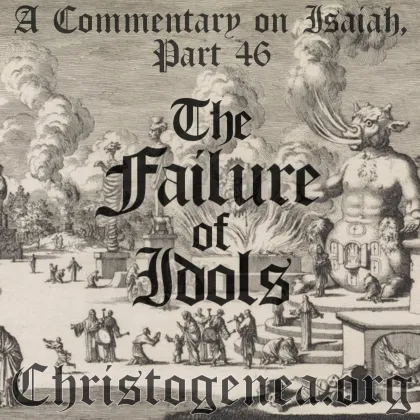
A Commentary on Isaiah, Part 46: The Failure of Idols
We might understand the attitudes and the poor understanding of judaized Christians who have been imbued with the lies of the Church and all of the denominations it has spawned over these last 1800 years. However there is nothing more disappointing than to see Identity Christians reject the notion that all Israel shall be saved, in spite of their sins. However this is much more than a mere notion: It is an explicit promise which is expressed in various ways in many passages of Scripture, and especially in the words of the prophets. So here in Isaiah chapter 45, there are two unequivocal promises of universal salvation for the children of Israel, which are first evidenced in the words: “17 But Israel shall be saved in the LORD with an everlasting salvation: ye shall not be ashamed nor confounded world without end.” Then in the final verse of the chapter we read: “25 In the LORD shall all the seed of Israel be justified, and shall glory.” Only a rebellious soul could twist these words into something other than what they plainly mean.
However in the development of Roman Catholicism, there were many such rebellious souls even when they did not mean to be rebellious. Over the centuries, doctrines had been contrived of heaven and hell and purgatory which are not founded in the Scriptures, and they have been used to control people as well as for men to profit from them. The priesthood set themselves up as idols, proclaiming that their baptism and their rituals alone can save men and grant them an entry to heaven. Essentially, they claim that their authority must rule over men, for men to continue in the salvation which they purport to bestow upon them with their rituals. Then in order to help maintain their pretense of authority, they offer actual idols, representations of the creation found in so-called “saints”, unto which men prostrate themselves and pray for mercy or forgiveness, as if God Himself cannot hear our unworthy voices, and we need some plaster statue intercessor, artificial representations of men or women who could not even save themselves.
A Commentary on Isaiah, Part 47: Visions of Babylon
In our last presentation in Isaiah, we had explained that from the message of comfort for Jerusalem which is found in chapter 40, the overall context in the remaining chapters of Isaiah is a series of prophecies concerning the fate of the children of Israel in captivity, as well as the means of their reconciliation in the promises of a coming Savior and Redeemer of Israel, or, to use a word which Isaiah had not used in that context, the coming Messiah. However a more immediate context here in these chapters of Isaiah, from chapter 44, is the prophecy of Cyrus, the then-future Persian king who conquered Babylon about a hundred and sixty years after Isaiah had written these chapters.
Here Babylon has not been mentioned since Isaiah chapter 43, where the Word of Yahweh had stated that “14 Thus saith the LORD, your redeemer, the Holy One of Israel; For your sake I have sent to Babylon, and have brought down all their nobles, and the Chaldeans, whose cry is in the ships.” There we asserted that those words have more significance as a far-vision prophecy, comparing language concerning shipping and merchants in the prophecy of the fall of Mystery Babylon in Revelation chapter 18. But of course, there is also a near-vision fulfillment, although that could not have been fulfilled until some time in Isaiah’s future, since Babylon was not a threat to the kingdom of Judah in Isaiah’s lifetime. The act of the Babylonians having sent an embassy to Jerusalem to meet with Hezekiah is indicative of Babylonian intentions to break from the Assyrian empire, which is also evident in other historical records, however that did not occur for at least another seventy years.
A Commentary on Isaiah, Part 48: The Furnace of Affliction
Discussing the Visions of Babylon in our last presentation in Isaiah we had made several assertions concerning the interpretation of prophecy. The Bible offers us very little direct instruction in this area, outside of the examples which are found in the interpretations of the prophets in the words of Christ and the writings of His apostles. Therefore, I can only offer my own opinion, and attempt to explain my own methods. But as I have also tried to warn, attempts to determine the course of future events from prophecies of events which may or may not have already been fulfilled in the past is in itself a form of idolatry, especially if they are used to develop concrete expectations, which, in turn, may even become points of doctrine. That is because men having such expectations may plan and build their lives around them, and if the expected events do not come to pass, or at least, if they do not happen as expected, then those men have labored in vain. We should not want to cause any of our brethren to labor in vain, even if vanity is ultimately inevitable, to one degree or another and in one aspect of life or another.
However the truth of the assertion that there are prophecies in scripture which have more than one fulfillment is indeed demonstrable in may ways even if, lacking a full knowledge of history, we may not be able to determine every one of the precise details by which certain prophecies have already been fulfilled. So while there are always some things to which we may remain blind, because our knowledge of the remote past is not perfect or complete, there are also other things that we may see clearly with what knowledge which we do have of the past, and know how certain prophecies had been fulfilled.
A Commentary on Isaiah, Part 49: The Light of the Nations
Discussing the last six chapters of Isaiah, from the middle of chapter 43, Babylon and its fall to the Persians, as well as the related issue of the Persian policy which had paved the way for the rebuilding of Jerusalem, is the significant theme throughout all of them. The fall of ancient Babylon is certainly the central event in the near-vision fulfillment of this prophecy since Cyrus, the then-future king of Persia, was explicitly named and his role in its fall was described. But as we have also explained, those events did not fulfill all of the descriptions found concerning the fall of Babylon in these prophecies of Isaiah. Therefore, as we had further explained, it is evident that these prophesies of Isaiah have a greater purpose than the end of the relatively short-lived Neo-Babylonian empire, and for that, much of the language concerning Babylon here is repeated in reference to the fall of the entity which is called Mystery Babylon in the Revelation of Yahshua Christ.
So in that manner, Babylon becomes more than the name of the ancient city, as it is often used as an allegory representing the captivity of Israel as well as the series of world empires which would rule over the children of Israel in their time of punishment, a time which would last for many centuries. For that reason, at a time when the children of Judah were in captivity in Babylon, Nebuchadnezzar the king of Babylon had a dream where he had seen a fearsome vision of a beast made of four different metals. So the prophet Daniel had described and interpreted that vision for Nebuchadnezzar, where we read in part, from Daniel chapter 2:
36 This is the dream; and we will tell the interpretation thereof before the king. 37 Thou, O king, art a king of kings: for the God of heaven hath given thee a kingdom, power, and strength, and glory. 38 And wheresoever the children of men dwell, the beasts of the field and the fowls of the heaven hath he given into thine hand, and hath made thee ruler over them all. Thou art this head of gold. 39 And after thee shall arise another kingdom inferior to thee, and another third kingdom of brass, which shall bear rule over all the earth. 40 And the fourth kingdom shall be strong as iron: forasmuch as iron breaketh in pieces and subdueth all things: and as iron that breaketh all these, shall it break in pieces and bruise.
A Commentary on Isaiah, Part 50: A Place of Their Own
In the first portion of Isaiah chapter 49 we discussed The Light of the Nations in relation to both the Gospel of Christ, and those for whom the Gospel had been intended, who are the children of Israel and Judah who were in captivity in the islands and coastlands of the West. It is they who were explicitly addressed in the opening verses of the chapter. Then in the course of that discussion, we also hope to have demonstrated the fact that Paul of Tarsus had received a notable commission from Christ Himself to bring the Gospel to those nations, who were the greater number of the scattered children of Israel, not only from the Assyrian captivity, but from as early as the captivity of Egypt, and all of the people who had left by sea to settle abroad during the intervening periods of the Judges and the kingdoms of Israel and Judah.
In the 8th century BC, western Europe as well as the rivers and seas to the north, were an object of exploration for both Greeks and Phoenicians, but the Phoenicians had already dominated the western Mediterranean, so the Greeks were constrained from that area and from safely reaching the Ocean. The Romans were not yet sailors, as the Roman historian Titus Livius explained in his History of Rome, that they learned ship-building and sailing rather late, in the 3rd century BC, so that they could fight a war against the Carthaginians. So in the later portion of the 7th century BC the Greeks founded a colony at Cyrene, on the coast of Egypt near the Nile Delta, and then at Marseilles, on the Mediterranean coast of France. At Marseilles, there is evidence of an earlier Phoenician presence. In that same century, Greeks had also founded colonies on the coast of the Black Sea both in the Crimea and at the mouth of the Danube River.

A Commentary on Isaiah, Part 51: Your Mother’s Divorcement
In our last discussion of Isaiah and the final portion of Isaiah chapter 49, we hope to have demonstrated how the children of Israel had moved to A Place of Their Own, as the prophet Nathan had much earlier communicated to king David, in 2 Samuel chapter 7, and as Isaiah had prophesied in that chapter, where he also indicated that in captivity, the children of Israel would multiply greatly, and their enemies would shrink from them, in verse 19 where we read: “19 For thy waste and thy desolate places, and the land of thy destruction, shall even now be too narrow by reason of the inhabitants, and they that swallowed thee up shall be far away.” Then he indicated that they would seek to migrate to a different location, where we then read: “20 The children which thou shalt have, after thou hast lost the other, shall say again in thine ears, The place is too strait for me: give place to me that I may dwell.” The subsequent verses then describe Israel as “desolate, a captive, and removing to and fro”, which is also indicative of their becoming a migratory people and leaving the places of their captivity and making a new home in another land.
In recent portions of this Commentary, we have already cited Isaiah chapter 66 in reference to this outcome, where we read in reference to these same people: “19 And I will set a sign among them, and I will send those that escape of them unto the nations, to Tarshish, Pul, and Lud, that draw the bow, to Tubal, and Javan, to the isles afar off, that have not heard my fame, neither have seen my glory; and they shall declare my glory among the [Nations].” As we had said, all of these places are located in the north and west, from the coasts of the Black Sea to Anatolia and then west to modern Italy and Iberia. Historically, beginning about a hundred years after the time of Isaiah, from the fall of Assyria the people known as Khumri or Kimmerians did migrate in that direction, and they were followed by their kindred for several centuries, who were also known by the names Sakae, Scythian and Galatae, but later as Saxons, Goths, Alans or or by numerous other and later names.
A Commentary on Isaiah, Part 52: The Comfort of Zion
While discussing Your Mother’s Divorcement, where we had taken a phrase that is found in the opening verse of Isaiah chapter 50 for the title of our discussion of the chapter, we had seen that even in their state of bereavement, having been put away by Yahweh their God, who had been the Husband of their nation, the children of Israel had nevertheless been given hopes of redemption and deliverance. Then, for most of the balance of that chapter, there is a description which, in hindsight, is clearly a Messianic prophecy describing a man who would suffer shame and reproach, but who would ultimately overcome his enemies by the power of God. In the final verses of the chapter, those who fear Yahweh and obey His servant, the promised Messiah, would have hope, but those who were self-reliant and would attempt to walk in their own light, rather than await the light of God, would die in sorrow.
In the course of our discussion of that chapter, we hope to have illustrated the fact that the allegory of the marriage relationship between Yahweh God and the children of Israel as a nation is really much more than an allegory: it is a fact of history which transcends history itself. It is certain in many ways in Scripture, that Yahweh God does not care for the standards set by men. According to His Word, He is both the Husband and the King of the children of Israel, and that arrangement began in the wedding vows taken at Sinai which are described in the Book of Exodus.
A Commentary on Isaiah, Part 53: The Redeemed of Yahweh
In Isaiah chapter 41 the Word of Yahweh turned from the events surrounding Judah and Jerusalem, and began to address the isles and coastlands, which are the places where the children of Israel would be found after the time of the Assyrian captivities. Many had also escaped Palestine by sea, and others had settled the Mediterranean coasts much sooner, which we had discussed in relation to The Burden of Tyre much earlier in Isaiah’s writing, where Yahweh had also admonished them, that they would not be forgotten. However, from that chapter forward, the context in the narrative of Isaiah really has no clear break until the opening verse of chapter 49, where the Word of Yahweh once again begins to addresses the same people and says “Listen, O isles, unto me; and hearken, ye people, from far,” so even that is not really a break in the context at all but seems to be more of a reminder of who it is that He is addressing. Then, while He had addressed the isles and coastlands, at the same time Yahweh continually addressed Jacob and Israel, so they remain His subject and concern throughout Isaiah, and it cannot be imagined that He is speaking to any people other than Israel in captivity. None of the promises found throughout these chapters of Isaiah are relevant to any other people. The isles or coastlands who would await His law and His light are the places where He had expected to find the children of Israel.
This is illustrated even further where chapter 50 opens, and the children of Israel in captivity are challenged to produce their mother’s bill of divorcement, their mother being an allegory for their nation, and again here in chapter 51 where in the opening verses they are told to look to their ancestors, Abraham and Sarah. So nearly eight hundred years after the time of Isaiah, when Paul of Tarsus had written his epistle to the Romans, he explained in Romans chapter 4 that the promise the Abraham’s seed had already become many nations by his time was fulfilled “as it is written”, and he told his readers that Abraham was their forefather, according to the older Greek manuscripts, or their father, in the medieval Byzantine manuscripts, “as pertaining to the flesh”, so Abraham was their natural, genetic forefather, as well as the forefather of the remnant of Judah in Judaea. The Israelites of the captivity who had forsaken the law, for which reason they were sent into captivity, had become the “uncircumcision” of Paul’s epistles, while the Israelites of Judaea who had aspired to keep the law were the “circumcision” of his epistles.
A Commentary on Isaiah, Part 54: Behold, it is I!
Here we are only about halfway into Isaiah chapter 51, and we tarried for two weeks on the first half of the chapter, because we find it necessary to properly correlate these promises which had been made to the children of Israel in captivity, after they had been divorced and alienated from Yahweh their God, to the messages of redemption, salvation and reconciliation which are found in the Gospel of Christ. As Paul of Tarsus had written in Ephesians chapter 2, the Church of God is “20 … built upon the foundation of the apostles and prophets, Jesus Christ himself being the chief corner stone”, and speaking of a mystery in Ephesians chapter 3, he declared:
5 Which in other ages was not made known unto the sons of men, as it is now revealed unto his holy apostles and prophets by the Spirit; 6 That the [Nations] should be fellow heirs, and of the same body, and partakers of his promise in Christ by the gospel.
This is where we differ from all denominational Christians and from the eighteen-hundred-year-old interpretations of the traditional churches, which do not agree with the writings of the apostles. The promises to Abraham, Sarah, Isaac, Rebekah and Jacob all indicate that only the seed of Jacob would inherit the promises and blessings of Abraham, and that through Jacob the seed of Abraham found in the later twelve tribes of Israel would become a great nation, and a company of nations, which would be eternally blessed by God. In Luke chapter 11, Christ Himself expressed the Divine commission of both prophets and apostles alike, implying that the messages of both groups would be harmonious, where He said “49 Therefore also said the wisdom of God, I will send them prophets and apostles, and some of them they shall slay and persecute”, so they would both be equally hated for their common message. Therefore, we cannot interpret the words of the apostles in any manner which is contrary to the words of the prophets, and if there is an alternate, harmonious interpretation, that is the only interpretation which we may accept, so long as we are honest and seek truth.
A Commentary on Isaiah, Part 55: The Report of the Gospel
In our last presentation, Behold, it is I!, we focused on statements found in Isaiah chapter 51, where the Word of Yahweh had said “I, even I, am he that comforteth you” (51:12) and here in Isaiah chapter 52 where He said: “Therefore my people shall know my name: therefore they shall know in that day that I am he that doth speak: behold, it is I” (52:6). These passages we sought to cross-reference to many similar statements which are found elsewhere here in Isaiah, and in the words of Christ in the accounts of the Gospel, which together serve to establish the fact that Yahshua Christ is indeed Yahweh God incarnate. In support of these assertions, in 1 Timothy chapter 3 we read:
14 These things write I unto thee, hoping to come unto thee shortly: 15 But if I tarry long, that thou mayest know how thou oughtest to behave thyself in the house of God, which is the church of the living God, the pillar and ground of the truth. 16 And without controversy great is the mystery of godliness: God was manifest in the flesh, justified in the Spirit, seen of angels, preached unto the [Nations], believed on in the world, received up into glory.
A Commentary on Isaiah, Part 56: The Suffering Servant
The figure who is described here in Isaiah chapters 52 and 53 is commonly called the Suffering Servant by Christians in general, and they correctly and appropriately identify that servant with Yahshua Christ, as the apostles of Christ had also done in their epistles and Gospel accounts. Many of the longstanding, traditional interpretations of the words of the prophets are correct, however quite sadly they are only correct in relation to certain aspects of those prophecies, and then they have accepted a false narrative of the consequences of their fulfillment in other aspects.
This prophecy of the suffering servant cannot be separated from its context within a prophesy of the announcement of the Gospel of Christ, but it also cannot be separated from the call which we had seen in Isaiah chapter 52, for the people of the captivities of Israel to touch not the unclean, and to come out from among them, which is evidently a reference to the people of the nations to where they had been scattered. We had seen that in 2 Corinthians chapter 6, Paul of Tarsus had interpreted that passage and beckoned Christians of his time to separate themselves from all those who did not have and follow the calling of Christ, to be separate from all of those who had not been cleansed on the cross of Christ. This is how the ancient Israelites spread abroad, the true children of God, were separated from His enemies and from all the bastards in the ancient Roman world in the early centuries of Christianity.
As a digression, the acceptance and organization of the churches in the councils of the time of Constantine and subsequent emperors, which resulted in the emergence of the later Roman Catholic Church in the 6th century and with the laws of Justinian, of which the eastern Orthodox churches had also been a part, was a vastly different, imperial form of Christianity which is contrary to Christ, which redefined the meanings of many Biblical terms, and which ignored or dismissed the meanings of most of the words of the prophets. So neither Roman Catholicism nor modern Orthodoxy have ever truly been Christian.
A Commentary on Isaiah, Part 57: The Heir of the World
From Genesis chapter 12 and the initial promises to Abraham, and throughout the Bible to the very end of the Book of Revelation, the entirety of Scripture may be summarized in one simple declaration: on account of the Word of God, the seed of Abraham through Jacob were given promises that they would ultimately inherit and inhabit the entire earth. There are more general promises to the entire race of Adam, and the Adamic man was created to be immortal, as the Scripture inform us, however these issues are peripheral to the more immediate promises made to this one man and his family, as we shall also see here in Isaiah chapter 54, and the the focal point of the apostles of Christ is the fulfillment of the promises to Abraham, Isaac and Jacob.
Here in Isaiah, as well as in the other books of the prophets, it is evident that these promises were never retracted or nullified, and they were never transferred to any other people. In their captivity, the children of Israel would become those many nations which had been promised to Abraham as well as in subsequent promises made to his wife Sarah, and to Isaac, Rebekah and Jacob. As Paul had written in Romans chapter 9, the children of Isaac through Jacob are counted as the seed of Abraham which is destined to inherit the promises. There Paul had repeated the promise to Abraham that “In Isaac shall thy seed be called” and then he attested that “the children of the promise are counted for the seed.” So the seed of the inheritance which is in Christ was determined in the promises to Abraham in Genesis, which Christ had come to fulfill.

A Commentary on Isaiah, Part 58: Promises of Comfort
The first portion of our discussion of Isaiah chapter 54 had primarily focused on the promise to the children of Israel which is made here in verse 3, that they would “... break forth on the right hand and on the left”, where we had spoken about the expansion of their οἰκουμένη or dwelling space, and “thy seed shall inherit the [Nations], and make the desolate cities to be inhabited,” where we hope to have explained how the Adamic nations of Genesis chapter 10, at least those which had survived to this point in history, would ultimately be dominated and subsumed by the many nations which had been promised to come of the children of Israel. By the time of Christ, there were scarcely any of the original nations of Genesis chapter 10 which remained in any recognizable form, even if there were pockets of people who had retained their original names. The people who ruled the world at the time of His ministry, chiefly the Romans, Parthians, Phoenicians and Scythians, which would include both Gauls and Germans, had mainly descended from the children of Israel, and they were unheard of at the time when Yahweh had made promises and covenants for Abraham, Isaac and Jacob. Parthians and Scythians, Germans and Gauls were still unheard of when Isaiah had first begun to write his book of prophecy, before 743 BC.
As a digression, over the course of our studies these past 25 or so years, many friends have asked questions concerning the fate of those other Adamic nations, imagining them to still be with us today, and ostensibly many of them are, in one way or another but not by their original names. Many of their descendants may be among people of European descent, but it does not really matter, and this is why it does not matter: because Abraham was promised to be The Heir of the World, as Paul of Tarsus had described him in Romans chapter 4, and those words must have been at least partly inspired by this promise here in Isaiah, that Israel would “inherit the nations”. Nations are people groups, and not geographical entities. The desolate cities may have been considered desolate by Yahweh simply because they had not His law, living in the decadence which may justly be associated with varieties of ancient paganism. For this reason we read in verse 5 of the chapter, in reference to Yahweh: “The God of the whole earth shall he be called”, because Abraham is the heir of the world and Israel will inhabit the whole earth. In the Christian era, for better or worse, for right or wrong, all European nations ultimately accepted Christianity, and Yahweh certainly is considered the “God of the whole earth”. Of course, the unfortunate aspect of that is that the goats are often led to believe that they can somehow become sheep, but Christ had also warned that the wheat and the tares must coexist until the time of the end, and Isaiah will warn of that same thing here in chapter 56 of his prophecy, but in a somewhat different manner.
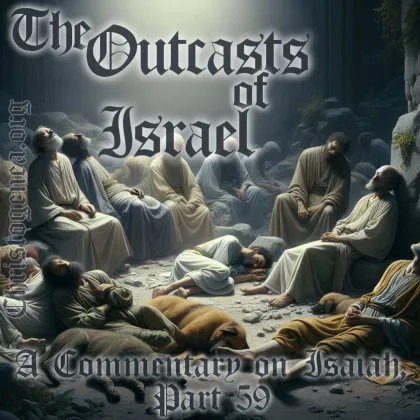
A Commentary on Isaiah, Part 59: The Outcasts of Israel
Since the description of the Suffering Servant in Isaiah chapter 53, the prophet has offered many Promises of Comfort to the children of Israel in captivity, and especially for the obedient among them. Among these promises, they had even been told that they would expand their dwelling space and “inherit the nations”, which we read in Isaiah 54:3:
3 For thou shalt break forth on the right hand and on the left; and thy seed shall inherit the [Nations], and make the desolate cities to be inhabited.
There should be no doubt that these words were intended for the children of Israel in captivity, and that they were meant for Israel exclusively, since we read in verses which follow that promise:
5 For thy Maker is thine husband; the LORD of hosts is his name; and thy Redeemer the Holy One of Israel; The God of the whole earth shall he be called. 6 For the LORD hath called thee as a woman forsaken and grieved in spirit, and a wife of youth, when thou wast refused, saith thy God. 7 For a small moment have I forsaken thee; but with great mercies will I gather thee. 8 In a little wrath I hid my face from thee for a moment; but with everlasting kindness will I have mercy on thee, saith the LORD thy Redeemer.
This promise is corroborated by a somewhat earlier promise given to the children of Israel in captivity, in Hosea chapter 2 where they were told:
19 And I will betroth thee unto me for ever; yea, I will betroth thee unto me in righteousness, and in judgment, and in lovingkindness, and in mercies. 20 I will even betroth thee unto me in faithfulness: and thou shalt know the LORD.
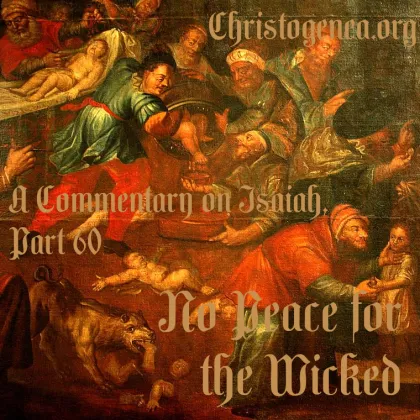
A Commentary on Isaiah, Part 60: No Peace for the Wicked
In our last discussion, where in Isaiah chapter 56 Yahweh had described Himself as “the Lord Yahweh which gathereth the outcasts of Israel”, we cannot imagine that Yahweh had intended to violate His covenants and promises which He had made to the patriarchs, Abraham, Isaac and Jacob, in order to gather to Israel any other people but “lost sheep” Israelites. So where verse 8 of that chapter continues and the Word of Yahweh says “Yet will I gather others to him, beside those that are gathered unto him”, we would make the assertion that here, it is the children of Israel in Assyrian captivity who are being addressed, yet other Israelites had long been scattered elsewhere throughout the οἰκουμένη, or the world of that time, and they would also be gathered to Israel.
Over the nine centuries prior to the Assyrian captivities, many Israelites had been departing from the main body of Israel, and settling colonies abroad, throughout the coasts of the Mediterranean Sea and the rivers and coasts of Europe. In relation to Isaiah chapters 23 and 24 we had discussed The Burden of Tyre, and how the words of the prophet help serve to elucidate the fact that the Phoenicians of the historical records were indeed Israelites. In that prophecy, Yahweh had promised not to lose sight of those Israelites who had fled from the Assyrians by sea. However Phoenicians had been colonizing the world of the Mediterranean Basin and points beyond long before the time of Isaiah, and even before Judah got involved, where Solomon had employed ships to join Hiram in his mercantile endeavors. One notable example of those early colonies is Thebes in Greece, which was recognized as a Phoenician city throughout the classical Greek writings. The people of Thebes were described as having been fair and blond, especially by the Tragic Poets. Another notable Phoenician settlement in the Greek world was ancient Miletus, and there were others in Thessaly.
"If my people, which are called by my name, shall humble themselves, and pray, and seek my face, and turn from their wicked ways; then will I hear from heaven, and will forgive their sin, and will heal their land." - 2 Chronicles 7:14

Click HERE listen to our streams.
There is now a completely new schedule with different programs for each stream every day. Click here for Radio info. Last update: September 17th, 2024
Click here for Radio Albion.
William Finck on the Delingpod June 28th, 2025 (Sorry, currently subscriber-only).
Are the Jews God’s ‘Chosen’ People? - William Finck with Jerm Warfare at UKColumn May 28th, 2025
100 Proofs the Israelites were White - Full Documentary - Truthvids' 14-hour documentary based on our 2020-2022 podcast series of the same title.
 The audio archive for the MEIN KAMPF PROJECT at Christogenea.org houses many programs related to the history of the 19th and 20th centuries which are not found here at the main Christogenea website.
 The Christogenea archive site contains older material produced at Christogenea and elsewhere that has been retired from our main website but which we certainly feel should remain available.
Christogenea is reader supported. This month's support level is reflected in the graph below. See our Contact page for a mailing address and other ways to support Christogenea.
83 %