July, 2026 Topical Discussions: Muddy Theories
July, 2026 Topical Discussions: Muddy Theories
Tonight we shall discuss the folly of “Tartaria” and other chronology gimmicks, and also the folly of building a Nationalist worldview based on DNA “Science!” which denies the existence of race as a biological entity.
Establishing the truth behind our general perceptions of historical chronology: the folly of “Tartaria” and other chronology gimmicks.
Some of this evidence, I had discussed in a recent podcast on 88streams.com, but I wanted to present a more complete version of the evidence against the so-called Tartaria theory.
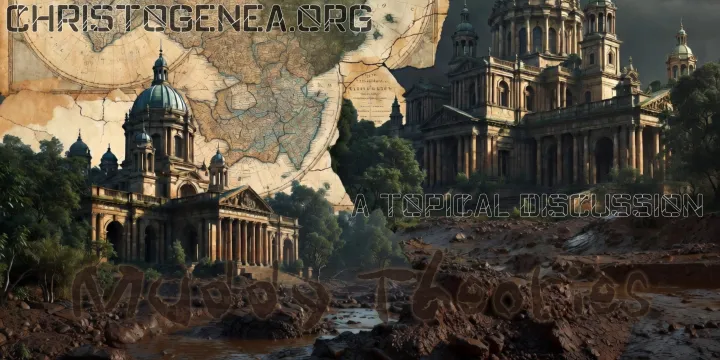
There are conspiracy theories of some ancient, advanced kingdom called Tartaria, which often include sub-conspiracies claiming that centuries had somehow been added to the calendar, centuries which never actually existed in some grand conspiracy to make antiquity seem even more remote. The proponents of these theories take advantage of the historical ignorance of their listeners, and are even ignorant themselves. Some claims even assert that the “Tartarian Empire” was global, that even buildings in America are the products of a bygone civilization which somehow disappeared in “mud floods” and natural disasters. All of these claims are patently absurd, and absolutely false.
The older European maps labelled most of the interior of Asia as “Tartary” only because Europeans were familiar with the people called Tatars who had entered Russia from the East in the Middle Ages. But the entire land east of Russia was unexplored, so they used that name to describe the entire unexplored region. This practice was evidently begun when the label Tartary first appeared on a map by a Venetian cartographer Giovanni Contarini in 1506, and then by Dutch explorer and cartographer Johannes Ruysch in 1507. The British and others continued the practice of labelling the quite vast but unexplored land as Tartary. But Magellan’s famous expedition circumnavigating the earth did not begin until 1519, Magellan himself died in 1521, and it was completed without him in 1522. But Russia did not conquer Siberia until the 17th century, and the rest of its territories in Asia until the 18th and 19th centuries.
The western portion of the unexplored interior of Asia was sometimes “Independent Tartary” on European maps, and then a much larger eastern portion was “Chinese Tartary”, and it included much of the lands belonging to Russia, China, Korea and other adjacent nations today. As the Europeans were able to explore the land, new maps were made and Tartary gradually shrank, until it had practically disappeared. But the label never really disappeared completely. To this day there is a Republic of Tartarstan, sometimes called Tartaria, the western border of which is about 410 miles east of Moscow. It is only slightly larger than West Virginia, at about 26,000 square miles, and its people are mostly Turkic muslims.
The only reason why depictions of Tartary had shrunk on maps to such a small area is because over time, Europeans had acquired a knowledge of what was actually there, and they were able to describe regions and their people with more precise and correct terms. We have to understand that in the late Middle Ages, men such as Ferdinand Magellan, the British captain James Cook, Henry Hudson and others explored had first encountered new lands by sea, so the coasts were charted first, and the interiors of those new lands only became known gradually, and frequently only with future expeditions conducted over many decades. Until the voyage of Magellan, the extent of Asia was practically unknown to Europeans. When Columbus reached the Caribbean a few decades before Magallen, he thought he had reached the eastern extremities of Asia. Thinking he was in the East Indies, he called the natives Indians, and the misnomer has stuck to this very day. But even at that time, the East Indies were only known from the Arabs, who had long traded there, and the first Europeans to reach them were the Portuguese, in 1498.
But aside from the Mongol Golden Horde, which is generally identified as a Tatar entity, and which had invaded Medieval Europe and even had parts of Russia and Ukraine under tribute for about two hundred and fifty years, there is no “Tartaria” as a single government, nation or culture which had any lasting visible role in world history. If it had such a visible role, then it would not have almost entirely disappeared from maps as Europeans explored Asia and learned more about it. There is also no good reason why it would have been kept from early histories, yet the ancient Greeks who wrote of Scythia wrote only of pastoral, migratory peoples when they wrote of the Steppes of eastern Europe and Central Asia. The ancient Greeks were not ignorant of those peoples. Alexander established forts along the trade routes all the way to the Indus River and practically to Tibet. From as early as the 8th century BC, the Greeks had port towns established around the coasts of the Black Sea. As for actual Golden Horde architecture, archaeology reveals multiple-story mud-brick buildings which have not endured time and which can only be reconstructed today from their ruins. [1] They are believed to have been inspired by architecture from Anatolia, which had been conquered by Turks beginning in the 11th century. These mud-brick buildings are nothing like the spectacular European architecture of the Middle Ages which the Tartaria conspiracy theorists claim had been built by the Tartarian Empire.
The Greek historians wrote of the Massagetae in the Oxus and Jaxartes River valleys long before the time of Christ. This land would be at the heart of what Medieval cartographers would later call “Tartaria”, but it was not Tartaria, nor was in inhabited by Tatars in the time of the Greeks. These river valleys were part of the Greek Seleucid empire, and then later the ancient Greco-Bactrian kingdom which spanned the area from the southern end of the Caspian Sea to the Pamir Plateau in the east, and includes the Hindu-Kush mountain range, bordering on Tibet. These were the former Persian satrapies of Bactria and Sogdiana which Alexander had conquered. The inhabitants were described as branches of the Scythians by Herodotus in the 5th century BC, and their later migrations westward into Europe as Germanic and Hunnic tribes is recorded in ancient histories. Much later, the Greek historian Procopius had explained that the Huns and the Goths had both come from divisions of the Massagetae.
So if an advanced, technological empire called Tartaria existed in Central Asia, is it a wonder that the Greeks ruled over portions of it, while never having mentioned it? The Greco-Bactrian Kingdom endured for nearly a hundred and fifty years, was first ruled by the Seleucids for about 80 years, and before them it was ruled by the Persians for a couple of centuries, at least. However the only ancient description of its people may be those found in the writings of Herodotus, who attested that they were very much like all the other Scythians. Yet the proponents of this theory of a Tartarian society, or even a civilization, claim that as many as a thousand years were added to our calendars by the Roman Catholic Church, and that the Church just “made up” history to fill in those years, in order to somehow hide the existence of this advanced Empire of Tartaria. The claim is reflected by remarks made in a Joe Rogan podcast recorded by allthatsinteresting.com:
Roger Avary parroted this theory to Joe Rogan, saying, “Everything has been falsified before the year 1600… about a thousand years have been added to the timeline in order to justify land claims.”
Nikolai Levashov, a Russian occultist, popularized the idea that Tartaria was the true name of Russia and that a great Tartarian Empire once existed in Central Asia. The Russian Geographical Society debunked both men’s theories and called Levashov’s ideas an “extremist fantasy.”
The modern internet version of the theory took shape around 2016, when YouTubers began combining Fomenko and Levashov’s ideas with other alternative history threads, including claims about basement windows in old buildings, photographs of muddy 19th-century streets, and the ornate architecture of Gilded Age buildings. [2]
While Joe Rogan is just an internet clown, he is a clown with a considerably large audience, having a combined 35 million subscribers on his Youtube and Spotify accounts. This concept of fake centuries having been added to chronology had evidently first came from a Russian mathematician named Anatoly Fomenko, who in the 1970’s had claimed that Christ lived in what we know as the 12th century AD, that the history of Greece and Rome happened in the Middle Ages, and that Jesuits had also fabricated Chinese and Arab history. He would erase eleven hundred years from the calendar. While he was an accomplished mathematician, he should have stayed in that field.
So essentially, according to this theory, the Reformation didn’t even happen, or it must have begun in 517 AD rather than 1517, as Luther’s act of publishing his famous theses happened at Wittenburg that year. The Hussite rebellion must have happened in 419 AD, which is little more than a hundred years after the Edict of Toleration issued by Constantine in 313 AD. The obvious problem with that assertion is that ancient Rome had never conquered Bohemia, where Jan Hus was a theologian and philosopher at a time when Bohemia had come to be called Czechia, a name which the Romans never knew. Neither did Rome ever conquer the Electorate of Saxony, the modern Saxony-Anhalt in Germany, where Luther worked at a church in Wittenburg. The Saxons were not converted to Christianity until the time of Charlemagne, nearly four hundred years after Rome had fallen.
Furthermore, there was no pope with any control of a Roman Catholic Church outside of Rome until the laws of Justinian were codified after 530 AD. Until that time, all Christian bishops were completely independent of any other bishop. So who were Jan Huss and the Hussites rebelling against, and who was Luther protesting if his protest began in 517? And even more ludicrous, how could a pope in Rome enforce his religious mandates in Bohemia, or Czechia, in 419 AD, when the Goths had sacked Rome in 410? The last place a pope would have authority at that time is in a Germany which Rome had never conquered, while Rome itself was being conquered by Germans! The Goths were Christians of the Arian sect which was doctrinally contrary to Rome. They in turn were conquered in both Italy and Spain by Justinian, which is well-documented in many histories. But the most visible proof of these events is the fact that we have now lived for many centuries with the circumstances created by their results.
The Tartaria conspirators claim that ancient Tartaria was buried by “mud floods”. Just like Plato invented the Atlantis story for his own political propaganda, and Strabo wrote that he had conveniently made it disappear into the sea, the Tartaria grifters are making the same claim, except that the sea is a sea of mud, supposedly. Yes, there have been “mud floods” in history. In Rome, the Tiber River overflowed periodically, and sometimes took buildings with it and left significant silt deposits. Living on a river myself, I know first-hand the mud and silt that even a small flood can leave behind, and how difficult it is to remove it from pavement. It hardens quickly in the sun, and the ancient Romans did not have pressure washers. Many other rivers have flooded and even wiped out wide portions of land with towns and villages in all areas of the globe throughout history. Then there are volcanic events which can leave ash deposits, some of which can bury an entire area. The eruption of Vesuvius buried several Roman cities, such as Pompeii and Herculaneum, as well as all the land in their vicinity. Approximately 1,300 square miles are said to have been covered in ash, but not all of the same density. Towns close to the volcano were covered by ash for depths up to 65 feet, in Herculaneum, or 23 feet in Pompeii and Stabiae. But all of Italy was certainly not covered with ash.
But the Roman Colosseum, the Pantheon commissioned by Hadrian, the theater of Marcellus, Trajan’s Forum, the earlier Roman Forum and subsequent Imperial Fora built by emperors such as Augustus or Nerva, the Pyramid of Cestius, the Castel Sant'Angelo or mausoleum of Hadrian, the Column of Marcus Aurelius, and the Arch of Titus were all built before 200 AD, and none of them were found buried in mud. There are many underground structures in ancient Rome, but they were purposely built to be underground, and they have always been well known.
Diodorus Siculus dated events in his Library of History by attempting to synchronize Olympiads, which are four-year periods, with the years of Athenian Archons and the Roman Consuls, among other methods. Sometimes his chronologies are a couple of years off, but they are generally accurate within reason. Using these methods, Diodorus supplies the dates of significant events throughout his history that can be substantiated by comparisons with many other histories, inscriptions and archaeological discoveries, down to about 35 BC.
Of course, Diodorus is not the only ancient historian. There is Herodotus, Thucydides, Xenophon, Polybius, Strabo of Cappadocia, Titus Livius or Livy, and countless poets and minor histories as well as inscriptions and Scripture which allow us to rather accurately detail a chronology of the ancient world from the earliest times to the time of Christ.
After the time of Christ, there are a string of Greek and Roman historians from Josephus, Tacitus and Pliny the Elder in the 1st century, to Suetonius, Plutarch, Appian and Arrian and the writings of Marcus Aurellius in the 2nd, to Cassius Dio in the 3rd, to Marcellinus in the 4th, along with church historians such as Eusebius and a long list after him. In those same centuries, the Roman world may also be seen through the eyes of dozens of early Christian writers, the so-called “Church Fathers” such as Ignatius of Antioch, Polycarp, Justin Martyr and Irenaeus in the 2nd century, Clement of Alexandria, Origen and Tertullian in the 3rd, or Athansius, Ambrose, Augustine and Jerome in the 4th and early 5th, to name just a few of them. Many histories of particularly narrow scope had also been written. For example, in the 5th century, Olympiodorus of Thebes wrote a 22-book history covering 407 to 425 AD which detailed the reign of the emperor Honorius, and the sacking of Rome by the Visigoths in 410 AD. Reading these works, these men all mention many events and figures from their past, and the progression of history from one era to the next is clearly visible in their words.
In other words, reading books, one can see that significant time had past when events or historical figures from the past are mentioned retrospectively. For example, in Judges chapters 1 and 2 the death of Joshua is described as a contemporary event, so we know that the book of Judges records things which immediately followed the book of Joshua. The same holds true in all history books. Reading Procopius, a 6th century historian, the Goths hold all of Italy, there is no Roman government in the west, and by that we understand that Rome had fallen some time before that. So the Christian writers Jerome, Augustine, and Orosius, as well as the Roman poet Claudian, were all alive when the Goths sacked Rome in 410 AD, and they all wrote of the conquest of the Goths in ways which were interspersed with their other writings. But in the pages of Procopius, a hundred and twenty years later, we see both the results and the unfolding events which had occurred in the aftermath of that conquest. With all of that, and the other details recorded by those writers, such as the names of past emperors and how long they had ruled, we can be confident of the chronology of those events with very little doubt as to the timeline upon which they had occurred. Once we study a wide enough selection of these histories, we can know history and we can be unshaken by silly conspiracy theories. We can even scoff at them and mock them, which is often all they deserve. While one writer or another may project misunderstandings in one area or another, the general chain of events is always also upheld by archaeology and cultural records, such as the existence of buildings which remain evident. Today, the ruins of the Colosseum or the Arch of Titus are Roman examples of such buildings which still stand.
The 3rd century AD Roman historian Cassius Dio was the first Roman writer to mention the Alemanni by that name, but he failed to mention Huns or Goths or other German tribes except by general terms such as Scythians. Just like the land of Tartaria was called by that name until it was explored, the Germanic tribes were called by general names such as Galatae or Scythian until the Greek and Roman writers were better acquainted with them and could identity more precisely according tho their tribal divisions. Cassius Dio mentioned the Getae, who were known to Greeks before the 5th century BC, but the Getae are not the Goths, which is a frequent mistake, and rather seem to be a division of the Thracians. Before Dio, earlier Romans had only known the Germanic tribes called Galatae, whom they themselves had called Gauls, and Strabo describes the labelling of the Gauls east of the Rhine as Germanii in the time of Julius Caesar. It was the Greeks who began calling the Scythians and Sakae in Europe by the name Galatae. The Huns, Goths, Vandals, Suebi, Saxons and other tribes of Germans which would appear in later Germany did not come from these same Gauls, but rather, in Greek writers and others they can be traced as having originated in Eastern Europe or Central Asia, in lands either identical or adjacent to the locations of the Sakae and Scythians of the earlier Persian period.
Modern historians assume that Galatae are Kelts, which is wrong. Herodotus mentioned Keltica in the far west in the 5th century BC. But the Galatae were in the same regions that were inhabited by the people whom the Greeks had previously called Sakae and Scythians. The Greek writers began to use the name Galatae to describe these people in the 4th century BC. The Roman historian Livy had described the Gauls as a strange, new race, when they first appeared in what is now northern Italy in the late 5th century BC. But if they were Kelts, he would have recognized them, and not spoken of them in that manner. In the west, the Romans were already familiar with the Kelts who dwelt above Marseilles, a city called Massalia by ancient Greeks, as it was founded by Phocian Greeks in the late 7th century BC.
By the 3rd century BC, there is a climate change event called the Roman Warming Period, which made it more practical for Germanic tribes to move into Central Europe north of the Danube River, a place which Herodotus had said was mostly unpopulated in his own time. This episode of “global warming” lasted for centuries. There were some settlements already there in the vicinity of the Danube, but when ancient Greeks used the term Hyperborean, which describes a place beyond, or north of, the land which is “under the bears”, the constellations Ursa Major and Minor in the north, they truly meant the area north of the Danube. While there are archaeological sites in Central Europe north of the Danube, there is no evidence of any lasting society having developed into a nation known to its southern neighbors, either Greeks or Romans. Neither is their evidence of any formidable infrastructure which would help such a society endure centuries of very cold climate. Both Strabo, in the first century BC, and Tacitus, about a hundred years later, had both described the German people as a migratory, unsettled people who still lived in wagons or in crude temporary shelters. We would assert that they had been migratory in this manner for six hundred years.
In the 6th century AD, the Byzantine historian Procopius, who was also a member of the court of the emperor Justinian and a secretary who travelled with the famous Byzantine general Belisarius, wrote a detailed history of the wars of the Byzantines against the Goths and Vandals, who had retaken from them Italy, North Africa and parts of Spain after the fall of the Western Roman Empire. He also spoke of and described Huns as mercenaries in Byzantine armies. In that same century, Jordanes, a Goth and a Byzantine bureaucrat, wrote a history of the deeds of the Goths, and a little later, Isadore of Seville, a Christian bishop in Spain, also wrote a history of the kings of the Goths, Vandals and Suevi, among other important books, which spanned about 360 years to 624 AD. So we can observe the changes in the Roman world which had led to these circumstances in the three hundred years since the time of Cassius Dio, and a hundred more years to the time of Isadore of Seville.
In a work separate from his History of the Wars, titled On Buildings, notable buildings commissioned by Justinian and built during his time were described, and some of which stand to this very day. Among these are:
- The Hagia Sophia in modern Istanbul
- The Church of Saints Sergius and Bacchus in Istanbul
- The Monastery of St. Catherine in Sinai Peninsula, Egypt
- The Basilica of San Vitale in Ravenna, Italy
- The Basilica of Sant' Apollinare in Classe in Ravenna, Italy
- The Yerebatan Sarnıcı or Basilica Cistern in Istanbul, Turkey, which is a water reservoir
- The Theodosian Walls and the Sea Walls of Constantinople which were restored and upgraded by Justinian and larger sections still encircle the peninsula where Istanbul is located
Going back to Jordanes, he was clearly a Goth in the employ of the government of the Byzantines, and he was born some time around 490 AD. When one reads his history of the Goths, it is fully evident that Rome had fallen, that Huns, Goths, Franks and other Germanic tribes came to dominate Europe after its fall, competing with one another for territory, and how the Byzantines had oppressed the Goths and Vandals by taking back large portions of their conquests, in Italy, North Africa and part of Iberia. This is roughly where Jordanes ends, and while he has differences from Procopius, he nevertheless serves as a second witness to the circumstances and historicity of the accounts of Procopius. Jordanes was not perfect, however, as he confused the Getae for Goths in the early portions of his history. But Procopius mentioned that some other writers made that same confused identification.
Jordanes also mentioned the Burgundians, a Germanic tribe which came into Gaul and established a kingdom which stretched from the modern region of Burgundy in France, into the Rhineland-Palatinate as far as the German city of Worms, where its kings evidently sat, and which was also the setting for the ancient Germanic poem called the Nibelungenlied, an account of the downfall of the Burgundian kings at the hands of the Huns in the 5th century. Attila himself is a major figure in the story. There it is evident that some considerable potion of time had elapsed since Rome lost control of Gaul, and modern France had already begun to take shape.
In the same 6th century in which Jordanes had written, the British Christian monk Gildas wrote a history “On the Ruin and Conquest of Britain” concerning what he saw as the sin and decline of the Britons as the reason for the Anglo-Saxon conquests. In the pages of Gildas, it is fully evident that the Britons had been autonomous since the fall of Rome, as there was no longer any Roman administration, but that they lost their autonomy once again upon the coming of the Saxons. In the early 8th century there was the church historian Bede, who described British life and the conversion of the Anglo-Saxons to Catholicism, which won them over to Roman Christianity to the disadvantage of the old British Christian churches which were in Britain long before that time. Bede also described some of the differences between the competing churches. Bede portrayed aspects of life in Britain where Anglo-Saxons were living in settlements among those of the older British inhabitants. Bede dated his history using the the modern Anno Domini (AD) dating system, and while he reportedly did not invent that system, he is even said to have popularized its usage.
Nennius was an early 9th century Welsh monk who wrote a very brief History of the Britons which contributed to the Arthurian legend and recorded aspects of the Anglo-Saxon invasion. In one line near the opening of his history, he wrote in part “From the passion of Christ are completed nine hundred and forty-six; from his incarnation, nine hundred and seventy-six: being the fifth year of Edmund, king of the Angles.” Nennius had some interesting perspectives on ancient history. He gave an account of the origin of the Irish as being from a “noble Scythian” who was in Egypt with the Israelites of the Exodus. He also gave the origin of both the Picts and Anglo-Saxons as Scythia. Tacitus, a much earlier Roman historian, had also said that the origin of the Picts was Germany, which was identified as Scythia by Nennius.
Add to these the Anglo-Saxon Chronicle, which was compiled in the time of King Alfred “the Great” in the late 9th century. The earliest event recorded in the Chronicle is Caesar’s failed invasion of Britain, where it describes important events until the collapse of Roman power in the middle of the 5th century. From that time, it provides a more detailed history of Britain from the time of the Anglo-Saxon invasions through to the time of Alfred. There are countless coins and other relics which have been found from this period, and which in many ways substantiate the narrative in the Chronicle. In that same manner, the much earlier Roman presence in Britain is also well-documented in archaeology.
After Alfred’s time, additions were made to the Chronicle down through the time of the Danish invasions and the conquest of William of Normandy, more than 200 years later. Then even later, in the late 11th century, William of Normandy had commissioned William of Jumièges to write a history of the Norman dukes, which was published under the title Gesta Normannorum Ducum or Deeds of the Dukes of the Normans. Then even later, in the early 12th century, the Christian monk William of Malmesbury wrote his Gesta Regum Anglorum or Deeds of the English Kings, a history which spanned from 449 to 1127 AD. William’s father was a Norman, and his mother English. Later in that same century, the Malmesbury Abbey was built, and it stands to this very day. Aside from these things, there is a plethora of more specialized literature or more narrow histories which had been produced in Britain, such as the Life of Cuthbert in Northumbria.
Now what follows is a list of surviving Anglo-Saxon period churches in England:
- St Martin’s Church in Canterbury, Kent, was built circa 597 AD, and it is still in use.
- St Peter-on-the-Wall in Bradwell-on-Sea, Essex, was built around 654 AD.
- The Escomb Saxon Church in County Durham, built around 675 AD.
- St Laurence's Church in Bradford-on-Avon, Wiltshire, built around 700 to 750 AD.
- The All Saints' Church in Brixworth, Northamptonshire, built around 800 AD, seats 400 people.
- The All Saints' Church in Earls Barton, Northamptonshire, built around 970 AD.
- The Greensted Church in Ongar, Essex, built around 1013 AD.
- St Benet's Church in Cambridge, built around 1040 AD.
- Odda's Chapel in Deerhurst, Gloucestershire, built around 1056 AD.
Aside from Britain, there were also many notable histories written on the Continent. In the 7th century, the Chronicles of Fredegar recorded Merovingian Frankish history. In the 8th century, the Mozarabic Chronicle was written in Latin in the muslim-controlled portion of Iberia, described as Al-Andalus, and it records the defeat of the Saracens at the Battle of Tours. In the 9th century, Einhard wrote a Life of Charlemagne, Freculf of Lisieux wrote a Universal Chronicle, which was an endeavor to describe all world history from the Creation to his own time, and there are also various surviving Carolingian annals. In the 10th century, Liutprand of Cremona wrote Antapodosis, a diplomatic history of relations between Byzantium, Northern Italy and the Germany of Otto I, the Saxon King who was Holy Roman Emperor from 962 until his death in 973. Soon after, Widikund of Corvey, a monastery near Höxter in modern North Rhine-Westphalia, wrote a history of the Saxon people. The abbey at Corvey was originally built in the 9th century and it still stands today. In the 11th century, Herman the Lame and Berthold of Reichenau wrote Swabian chronicles recording conflicts between the German empire and the papacy. In this same century the Russian Primary Chronicle was compiled, which was a record of events beginning from about 850 AD.
Aside from all this, there are the historical accounts which had been compiled into The Annals of Ireland by the Four Masters and translated into English by Owen Connellan for publication in 1846. While these annals do not officially begin until 1171 AD, and record events in Ireland into the early 17th century, for a period of over four hundred years, many of the footnotes made for the Annals provide information of much older events and legends of early Ireland. So while they start after William of Malmesbury ends, they nevertheless attest to the historical conditions of his time. One of the first events it records, for 1171, is the surrender of Leinster to the English by its king, Dermond Mac Morrogh. Aside from that treachery, he is recorded as having committed many evil deeds against the Irish people and their churches. Perhaps twenty or thirty years later, or around 1200 AD, Saxo Grammaticus published his Gesta Danorum or Story of the Danes, which is considered the first Danish contribution to world literature. The first 9 books recount 60 legendary Danish kings and reproduced many old Danish poems in Latin. The last 7 books contain his account of the historic period, down to 1185 AD and the conquest of Pomerania by Danish king Canute IV.
While I have not read all of these books, especially those produced in Frankish or German, I have indeed read many of them completely, and significant parts of others. Once a man gets a certain amount of this reading under his belt, and if he takes the time to understand the world of which he is reading, he won’t be easily fooled into thinking that somehow 700 or a thousand years, or, according to some quacks, even twelve hundred years had been inserted into the calendar at some point in time, years which supposedly never existed. The concept that 700 years were added to the calendar in or around 300 AD means that the worlds described by Bede, Nennius, Procopius and dozens of other men had never existed. Yet these witnesses and those in Ireland, Germany and France, are all independent of one another and most only tell of a small portion of the history of their own people or country, which nevertheless fits into a wider tapestry of events by which one may get a fair understanding of the history of the whole, and without much contradiction. All of these books could not possibly have been produced as fictions by some motley collection of men in Rome in different languages in a short period of time as part of some grand conspiracy.
In Procopius one may see the truths found in the writings of Jordanes and Isidore, and the fact that the circumstances of the world of Justinian is the aftermath and result of the deeds of the Goths. In Bede one can see the truths in the Saxon Chronicles and Gildas, and the fact that the circumstances of his own time are an aftermath and result of the Saxon invasions of Britain. The circumstances which created the life of a Bede are described in the writings of a Gildas. This layering of historical events as consequences of conditions caused by earlier historical events may be clearly seen when one reads through wide periods of these histories. So all together, using the example of the time from the death of Diodorus to the writing of William of Malmesbury, these men certainly did describe events which must have taken twelve hundred years to unfold, for example, from the sack of Rome by the Goths to the founding of Plymouth Colony by the English Pilgrims.
Writing several centuries before the fall of Rome, the Christian writer Irenaeus of Lugdunum, a city in Roman Gaul, had understood that both Daniel and the Revelation had prophesied the fall of Rome. But Marcus Aurelius, the 2nd century emperor who died at the peak of Irenaeus’ career, never imagined a world without Rome even if he was a Stoic philosopher. Then, there is no Gildas unless Rome had fallen, and there is no Bede unless Rome had already been fallen for several centuries, and unless the Anglo-Saxon invaders who had been described by Gildas had already become established in England. Furthermore, it is clear in the Saxon Chronicles that Saxon kings, of whom there are many historical details in the chronicles, had ruled for at least four hundred years before the coming of the Normans.
In that time, many historical events known from other sources, or from archaeology, had taken place. For example, the Nibelungenlied, an epic Germanic poem describing events in the 5th century, portrays Worms, a city in the Rhineland Palatinate, in a time when Rome had already fallen and the Huns ruled much of Europe. So it is set at a time when the Frankish Burgundians ruled independently in the Rhineland until their kingdom was destroyed by the Huns in 437 AD, giving way to the Merovingian kingdom.
The rule of the Roman Empire over much of Western Europe is well documented in history and archaeology. But if we read these histories, we would also see that the so-called “Dark Ages” were not really dark at all, except for the jews who had been prevented from public life and forced to live by themselves. The decay and resulting conquest of Rome is also well documented in history and archaeology. If Rome had not fallen, there would have been no Al-Andalus, no Merovingian or Carolingian kingdoms, no German empire, no Gothic Spain, and no Merry Olde England. Nobody is going to convince me that all of this history is fabricated. The monuments left behind by the men behind these events must have also been fabricated. There are Merovingian period crypts and baptisteries surviving in France from 450 AD, and the names of the kings that had them built.
- The Baptistery of Fréjus Cathedral dates to about 450 AD and features a cupola on pillars. This is on the grounds of the Fréjus Cathedral, but the Cathedral itself as it stands today was built later. There is a complex of buildings on the site said to date from the 5th to the 13th centuries.
- The Baptistery of Saint-Jean in Poitiers, France was reconstructed beginning in 507 AD and features a vaulted ceiling and a baptismal pool. The central part of the building was a Roman construction dating to about 360 AD, but it was damaged during the Visigoth occupation of the area.
- Over one hundred and fifty Merovingian stone sarcophagi and hundreds of other burials have been uncovered at Luxeuil-les-Bains in France, where a church once stood. The site was once the Gallo-Roman city of Luxovium. Hundreds of older pagan votive statuettes have also reportedly been discovered, where there was also a 1st century Roman bathhouse at the site. [3]
- The Saint-Laurent Archaeological Museum in Grenoble France houses the Saint-Oyand Crypt, which is dated to the 6th century AD.
- The Crypt of Notre-Dame de Jouarre in Jouarre, France has Gallo-Roman columns and white marble capitals, and was built during the reign of king Dagobert I in 635 AD. The current Jouarre Abbey at the site was rebuilt in the 10th century, after Viking raids attacked the older building. The crypt contains the remains of historical figures known to have lived in the 7th century.
- There is a Benedictine Abbey at Saint-Pierre-aux-Nonnains in Metz France, which was converted by the Merovingians from an older Roman gymnasium and spa which had been built around 380 AD, and it is the oldest continuously standing church building in France, and one of the oldest in Europe. However as it is today, the structure is not entirely original. It was rebuilt in part in the 11th century, and has had other additions since.
However this is not meant to be an exacting survey of the history of buildings or ancient monuments in France. Rather, it is only meant to be a survey of buildings that were built in the earliest of post-Roman times, and which are known to have existed throughout the thousand years which have supposedly been added to our modern calendars, in order to show how ridiculous is such an assertion.
This is also not meant to be a thorough survey of medieval historical writings in Europe, which would take at least an entire book to present properly. Rather, this is meant to be a summary overview of the proofs that discredit any claims that a significant number of years, or even many centuries, had been surreptitiously inserted into our calendars. The concept of Tartaria as an ancient civilization and a great empire spanning the world is pure bullshit being peddled by internet grifters who know nothing about history.
In my thirty years of studying and discussing history, I have found that people who know nothing about a subject tend to take it lightly, they imagine that there is really nothing there, simply because they have nothing about it in their own minds, and therefore they find it easy to imagine things that are not true, and even to fill in the proverbial blanks for themselves. But to anyone who has actually studied some tangible portion of this history, the Tartaria theory becomes the Tardtaria theory in just a few seconds.
Footnotes
1 Palaces of the Golden Horde, Archaeology magazine, https://archaeology.org/issues/may-june-2024/ collection/palaces-of-the-golden-horde/lost-cities/, accessed July 2nd, 2026.
2 Was An Advanced Civilization Erased From History By Its Enemies? The Tartaria Theory Explained, by Stacy Fernandez, https://allthatsinteresting.com/tartaria-theory, accessed July 2nd, 2026.
3 150 Merovingian sarcophagi in situ, The History Blog, https://www.thehistoryblog.com/archives/ 61472, accessed July 2nd, 2026.
The folly of building a Nationalist worldview based on DNA “Science!” which denies the existence of race.
I recently did a podcast with Eric Orwall of the Return to the Land project. While it was streamed on Youtube, it will also play here at Christogenea tomorrow night, July 4th. We had agreed to have a discussion about the evidence for Christian Identity. But the first subject Eric raised was DNA evidence, for which I was not prepared, but also had been dismissive, because I do not believe it even belongs in the discussion, and here I will explain why.
Many secular White Nationalists have rejected God or even the concept of a God almost entirely. Doing so, they embrace secular humanism, and seek to explain the world through “science”. But as I had sought to explain in great detail in a 2016 podcast series titled The Jews in Medieval Europe, what we know as science was heavily influenced by Jews from the beginning, as practically all of Europe’s academic science researchers of the time, chiefly the alchemists, had been enamored with the Jewish Kabbalah. Then in the time of Elizabeth I, the English queen, John Dee had become acquainted with the Kabbalah while touring Germany, and presented a copy of the Kabbalah at her court. Eventually the result, about fifty years after Elizabeth had died, was the admission of those who had been called speculative masons to the stonemason’s lodges of England and Scotland, an event which gave birth to Freemasonry. At least most of the speculative masons were alchemists and Kabbalists. From the 17th century, the Royal Society in England and the corresponding French Academy of Science, both organizations having been founded in that same century, had many members who also belonged to Freemason’s lodges. So right from the beginning, there was no science in Europe that was not infected by Jewish thought and the Kabbalah.
So about a year later, in October of 2017, in my Protocols of Satan series of podcasts which discusses the truth of the so-called Protocols of the Learned Elders of Zion, I presented a segment titled The Appointed Priesthood, asserting that scientists were the high priests of a relatively new global religion, which is science itself. Today, the faith which average people have in “Climate Change” or “Global Warming”, in laboratory food, in vaccines, Covid claims and DNA tests is evidence all helps serve to prove my assertion is correct.
Most people do not understand., that international corporations have evolved to rule over kings and nations, and that a great percentage of university research is funded by those corporations. The outcomes which the corporations expect are the same as those which they anticipate, because corporations have their own political objectives and their money will be used to attain those objectives. The corporate media then obediently parrots the so-called “truth” of those objectives, and the general population believes everything which it hears on television. Thus is religion in the modern world.
A simple Google search with results drawn from the National Science Foundation and the Association of American Universities reveals that for fundamental science research, the Federal government funds just over 40% of this activity in universities, while business funds 35%, and the balance is funded by the universities themselves, or by non-governmental organizations, which all also have their own political agendas. But only about 18% of research termed Research and Development is funded by the federal government, while corporations fund 75% and the balance of about 7% is funded by either the universities or non-governmental organizations.
Typically, the corporations funding university research have agreements with the university which assure the corporation that it will own the intellectual rights to any discoveries produced by the research, so that they may profit from their investments. We can rest assured that corporations are not going to want results which alienate large sectors of their prospective consumers, and likewise, governments would prefer results which conform to government policy, and not cause divisions or unrest among their populations.
Anyone who does not understand how science can be politicized so the interested parties can attain particular objectives, is just plain gullible and a lot dumber than the most ancient Egyptians pharaohs or Mesopotamian kings. The rulers of nations have always understood that they cannot control a people unless they control what the people believe. As soon as the ancient kingdom of Israel divided, Jeroboam I set up golden calves and mandated Baal worship for his subjects, so that their religion would not hold them in allegiance to the kingdom of Judah, for that same reason. In ancient kingdoms, the priesthoods and scribes of the national or tribal pantheon of gods were always the second most honored class of citizens, sitting behind only the kings themselves. In this environment, those who rule over the people become the arbiters of truth, and even choose what the people shall esteem to be true. So once again today, if you cannot see through the lies of the “Climate Change” agenda, or the Covid vaccination drive, then you are completely blind and on account of that blindness, absolutely stupid.
Turning to the matter at hand, which is so-called DNA evidence of race asserted by White Nationalists, the arbiters of truth for this god, the high priests of DNA science, who themselves insist that DNA cannot be used to determine race. This insistence is found at every level of DNA science, it is policed by those who finance the science community, and it reaches to the first-line researchers, those who actually discover and catalog the genes and genetic expressions in the DNA itself.
At the Office for Science and Society at McGill University, there is an article titled Are You There, Race? It’s Me, DNA, in which we read the following:
Some people claim race is a biological reality, whereas others say it is a social construct. Looking at our DNA can help resolve this friction.
Then a little further on in the article:
In fact any two unrelated human beings on the planet are 99.9% identical in their DNA sequence. Only 0.1% varies, and here’s the most important takeaway message from all this. It also happens to be the most replicated finding in the scientific literature on human variation.
Of this 0.1% that varies, almost all of it (95.7% to be exact) is found between individuals within the same race. Despite what our eyes perceive, there is more genetic diversity within a race than between races
I must remark here, this statement is a blatant lie. If there is a tenth of a percent difference between races, and most of that tenth of a percent is common within a race, then the difference between races is greater than those within a race, and the authors are gaslighting their readers. There is also the general opinion in the scientific community that humans and chimpanzees have 98.6% of their DNA in common, so on that scale a tenth of a percent is a significant difference between races of ‘humans’.
If you didn’t know that, don’t worry: you’re in good company. Three out of four college students taking an introductory course in biology and genetics also do not know this.
And since skull sizes are being discussed again in certain corners of the Internet, 90% of the variability in their volume also occurs within (and not between) human groups.
This is a big snag in the argument that race is a biological reality. This finding—that there’s more diversity within than between groups—is true for most physical traits, with one prominent exception: skin colour. Why? Because skin colour is under tremendous selective pressure. It varies depending on how far from the equator we are, because a darker skin offers better protection against sunburn, skin cancer and related damages. People with naturally darker skin were better adapted to their environment and were more likely to reproduce. The fact that a Maasai and an Aboriginal Australian both have very dark skin is not because they are part of the same biological race, but rather because both have lived under a very harsh sun for generations. So skin colour is not evidence of race being a biological reality.
This is funny, since Whites living in Australia for many generations are still White, and will remain so. Likewise, there have now been negros living in northerly climates for many generations, and they are still black. They shall remain so no matter how long they live in New England, Chicago or Minneapolis.
In my opinion, this McGill University article reflects a general consensus amongst the academic community and those who finance them, and there are many articles on the internet which reflect these same assertions, that DNA cannot be used to determine race. It is true, that DNA can be used to determine proximity to certain ethnic groups, which suggests a relationship, but that is not the same as a determinant of race, or especially of mixed race, even if mixture is sometimes evident in individuals . For example, there are some Italians, Spaniards, Greeks, etc mixed with arabs in history, there are some Nordics mixed with mongols, which is even found in the Nordic Sagas, there are some Eastern Europeans mixed with Turks. Your DNA test might show proximity to one or more of these ethnic groups, but it is no guarantee that you are White, because you might be from one of the mixed portions of these mixed groups. This mixing in the past actually skews the possibility of determining what White is in DNA, because there are very few samples of ancient White DNA with which to compare, and there is no real guarantee as to whether someone dug out of the ground who died two thousand years ago was actually White.
From an article at Science.org titled Race, ethnicity don’t match genetic ancestry, according to a large U.S. study, we read in part:
Geneticists have long established that race and ethnicity are sociocultural constructs and not good proxies to describe genetic differences in disease risks and traits among groups. Some geneticists have pushed to use ancestry—genetic differences resulting from the part of the world a person’s ancestors came from—to explain those differences. Still, researchers have not settled on the best categories to use in genetics studies—or even whether categories are needed at all—and how to best use self-reported race and ethnicity.
Then a little further on in the same article:
Geneticists have now mostly stopped using the term “race” as a label in studies, although the authors of the new paper say self-reported race or ethnicity might still capture important social and environmental factors that influence health, such as systemic discrimination. Genetics and environmental exposures can also vary considerably among individuals that may self-identify as belonging to the same racial or ethnic category, Rotimi wrote.
So this attitude of geneticists is all about addressing discrimination, which reveals that is is politicized and not at all based on actual science. In my opinion these articles are full of holes. It is not difficult to tell the difference between an African negro and a White man with a deep tan because he lives in an area where the sun is a significant environmental factor. His head shape, nose shape and other obvious physical differences between Whites and negros are not going to change.
At the website for the National Institute of Health, which is one of the federal agencies through which research money is distributed to universities, we read the following in an article titled Race and genetics versus ‘race’ in genetics:
First, the “Lay Summary”:
A review of the medical literature since the completion of the Human Genome Project in 2003 revealed that race, a social construct created to justify slavery, continues to be used as a genetic category, due to a lack of understanding of the continuous nature of human genetic variation.
This is playing much the same politics as the article from Science.org, and it is clear that genetic science is being used as a tool for governments and corporations in order to fulfill a social agenda.
Now for the abstract:
Social scientists have long understood race to be a social category invented to justify slavery and evolutionary biologists know the socially constructed racial categories do not align with our biological understanding of genetic variation. The completion of the Human Genome Project in 2003 confirmed humans are 99.9% identical at the DNA level and there is no genetic basis for race. A systematic review of the PubMed medical literature published since 2003 was conducted to assess the use of African ancestry to denote study populations in genetic studies categorized as clinical trials, to examine the stated rationale for its use and to assess the use of evolutionary principles to explain human genetic diversity….
Notice that a discussion of race and genetics turned into a conversation focused on negros. But I have already spoken about the politicization of science, and that was evident here in phrases such as the one expressing the claim that the concept of race was “invented to justify slavery”. The ancient Greeks and Hebrews had words which may mean race, and which are often translated in that manner, long before any black slave had ever appeared outside of Africa. The very words gene and genetics actually come from a Greek word which means race, something which is astoundingly ironic.
Then for the part which helps serve to reveal that DNA science is being policed, we shall read the balance of the Abstract:
We searched for papers that included the terms ‘African’, ‘African American’ or ‘Black’ in studies of behavior (20 papers), physiological responses, the pharmacokinetics of drugs and/or disease associations (62 papers), and as a genetic category in studies, including the examination of genotypes associated with life stress, pain, stuttering and drug clearance (126 papers). Of these, we identified 74 studies in which self-reported race alone or in combination with admixture mapping was used to define the study population. However, none of these studies provided a genetic explanation for the use of the self-identified race as a genetic category and only seven proffered evolutionary explanations of their data. The concept of continuous genetic variation was not clearly articulated in any of these papers, presumably due to the paucity of evolutionary science in the college and medical school curricula.
The balance of the paper discourages the use of self-identified race in association with genetic categories, and uses the view of evolutionary biology and the so-called out-of-Africa theory accepted as fact to refute the practice. The powers that be will not accept race as a category which can be determined by genetics, even if it could be determined by genetics. So even if race could be determined by genetics, the possibility will not be funded so that it will not be properly researched, papers will never be published or even written, and we shall never know the truth since the capability of doing the research for ourselves is beyond us. After all, racists are only poor rednecks who still live in their mother’s basements, so how could they afford things such as electron microscopes and fancy centrifuges? On top of all that, the NIH clearly wants all of us to believe that we are only a lighter, variant shade of nigger. This article was written in 2021, and clearly displays the truths of our assertions concerning the use of science, and how it agrees with the agendas of multinational corporations, world government, jewish communism, and the objectives of the Protocols of Zion.
So our theme tonight, Muddy Theories, is just as appropriate for what has become of DNA research as it is for the alleged mud floods which the conspiracy quacks claim had destroyed Tartaria. With this science mud-flood of evolutionary biology, the “out of Africa” theory and the denial of the existence of race, they want to destroy us all.
However we have a historical record dating back to as early as 2,500 BC and the Akkadian Empire of Mesopotamia, and to corroborate that we have an archaeological record of inscriptions and relics dug out of the ground, and by those we can create a fair account of our origins. We certainly did not come out of Africa, although some of us went into Africa and eventually fell into a trap. For example, the very black people of the Republic of Chad, an African nation deep in the center of the continent, have a very high frequency of Y-DNA haplogroup R1b, which is most common in western Europe and one particular area northeast of the Caspian Sea in central Asia. In this manner, Chad is isolated among African nations, as all of the surrounding Africans have different Y-DNA haplogroups mostly unique to Africa. So there are examples for which it is difficult to find evidence in recorded history, but such examples are literally outliers, and are not typical.
So we would assert that DNA research cannot change volumes of recorded history. Archaeology corroborates recorded history with a high degree of frequency, only on occasion changing our understanding of some event or some minor perception of an event, but usually augmenting it instead. History combined with archaeology is a much more sound approach to developing a perception of who we are. The so-called science of DNA is for jews and all those who are fooled by them.
So when I recently discussed Christian Identity with Aarvoll (Eric Orwall), to me the DNA arguments were a distraction. I may have handled them more sharply if I know they were coming, but I did not expect any such thing, and I wanted to discuss Christian Identity rather than get mired down in a debate over the veracity of DNA research. The original sources for DNA research ALL deny that race can be determined genetically. They ALL interpret DNA itself through evolutionary "science", and it is ALL bullshit. If a man is aware of jewish undermining of our whole society, he would know not to trust it.
But I did not want to get caught up in arguing those things. As for the history and the Bible, yes I could have gotten into how the Bible throughout the historical books and the books of the prophets substantiates everything I said concerning ancient migrations. But time was getting short, so I chose to highlight a few of Paul's statement in his epistles instead. Of course, I could talk for hours on that subject alone, and cite everything I say, and I have done that before. But I do not know if Orwall himself would have the patience required. However I did not agree to do the podcast for his benefit alone. That may be heard tomorrow evening here at Christogenea.
As usual, the program notes are linked below. But I have also made a separate file for the last 46 minutes of this presentation, which is the portion discussing DNA "Science!"