European Fellowship Forum, March 2026

  • The consequences of disobedience and the problems with alien rapists in Britain. Sven Longshanks on growing ethnic awakening in Britain.
  • Blessings to Abraham in relation to Genesis 10 nations. Already by the time of Christ, Abraham had become heir of the world.
  • The time of Jacob’s trouble, the Genesis prophesy of Isaac, Revelation chapter 20 and the Camp of the Saints, and Obadiah.
  • How the media creates far-right “leaders”. “Handsome Truth” and anti-semitism laws, his turn against Christianity. Big G gives us a rundown on Jon Minadeo, Owen Benjamin and E. Michael Jones, whose children are married to chinese.
  • the British Empire and it's history of drugs and drug wars, as a vehicle for profit of the Rothschilds, Sassoons.
  • A book titled Worm in the Apple by Friedrich Lenz, an account of the German traitors who facilitated the loss in the Second World War. Other materials recently collected by our German friend HZ.
  • Questions on adultery, abuse, and legitimate reasons for divorce or circumstances for remarriage. Property rights and women in the ancient world. How feminism and liberalism have endangered Western women.
  • Stripped bare and naked, how much will the West have to suffer before it realizes it has to repent and return to God?
  • How to please God, which is to keep His commandments and love one another, those of our own kindred flesh.
  • SuBay, another German friend, and rural Germans returning to Scripture, but not to the judaized churches, with which they are disillusioned.
  • Ratio of Whites to non-Whites in certain areas of Europe. Perspectives on Eastern Europe, Hungary and Russia.
  • Did any of the kings of Judah come from racial Ammonites? What about the account of the revenge of the Gibeonites in 2 Samuel chapter 21? Does the revival of a man whose corpse revived once it touched the bones of Elijah open the door for the worship of relics?
  • Constantine and early church organization vs imperial church organization. British Israel lies and fables, beginnings of archaeology which led to Christian Identity understanding.

And much more! Thanks to everyone who participated!
Wednesdays with Pock and Clone

Just this month I have learned of a group of Nationalist-minded Christians (my description) who had split off from GoyimTV, after the founders of the Goyim Defense League had rather suddenly and quite virulently began pushing an anti-Christian agenda. Since we had been antagonistic to the founders of the GDL for a long time, we were quite pleased to learn of this group, and here two of them, HoTpOcK and Bald Clone, spoke to me on Wednesday at their stream on 88streams.com.  They are also found on other streaming or video sharing services. 

This stream was originally broadcast as a portion of a much longer presentation here: https://88streams.com/video/8JWLtC1xc3 But please do not interpret this as an endorsement for some of the concepts presented earlier in the stream. We hope to do much more with Pock and Clone in the future, and encourage our listeners to give them a listen, and to explore 88streams

A Commentary on Isaiah, Part 62: For Want of Judgment

Isaiah 59:1-21

A Commentary on Isaiah, Part 62: For Want of Judgment 

In the world of ancient Israel, a fast was an act of voluntarily self-deprivation, especially depriving oneself of something of sustenance, like food, as a way of demonstrating humility or of humbling oneself. Often fasts were made in mourning, but sometimes they were made in times of distress. Then, humbling oneself, one was better prepared to entreat God. One example of this is found in 2 Chronicles chapter 20, at a time when the Ammonites and Moabites had attacked Judah:

3 And Jehoshaphat feared, and set himself to seek the LORD, and proclaimed a fast throughout all Judah. 4 And Judah gathered themselves together, to ask help of the LORD: even out of all the cities of Judah they came to seek the LORD.

Evidently, because the people had humbled themselves, Jehoshaphat’s prayer was answered, and the enemies fled before the people, even leaving their spoils behind, without the people of Judah even having needed to raise a sword. But Jehoshaphat was king of Judah about two hundred years before Hezekiah, at a time when Judah had not yet gone completely off into sin. While he was not perfect, we read in 1 Kings chapter 22 that:

42 Jehoshaphat was thirty and five years old when he began to reign; and he reigned twenty and five years in Jerusalem. And his mother's name was Azubah the daughter of Shilhi. 43 And he walked in all the ways of Asa his father; he turned not aside from it, doing that which was right in the eyes of the LORD: nevertheless the high places were not taken away; for the people offered and burnt incense yet in the high places.

So even a man who fails in some regards, as Jehoshaphat had failed by not purging the sins of others who had been under his rule, could nevertheless find grace in the eyes of God as he himself had sought to do what was right. But later, in Jeremiah chapter 14, about seventy-five years after the failed Assyrian siege of Jerusalem, at a time when the people had collectively turned to sin in spite of the reforms of Josiah, we read:

A Commentary on Isaiah, Part 61: Repairers of the Breach

Isaiah 58:1-14

A Commentary on Isaiah, Part 61: Repairers of the Breach

In the closing verses of Isaiah chapter 57, in verse 16, we saw a promise that Yahweh God would not contend with His people forever, nor would He be angry with them forever, “… for the spirit should fail before me, and the souls which I have made.” On account of their sins, a breach had been created between Yahweh God and His people, and now in this chapter, there is a message of encouragement and instruction which explains to the people how that breach should be repaired. Yahweh God is also our wall, our protection, as He had said, for example, in Isaiah chapter 26:

1 In that day shall this song be sung in the land of Judah; We have a strong city; salvation will God appoint for walls and bulwarks.

Then, speaking of a prophetic Jerusalem, in Zechariah chapter 2:

4 And said unto him, Run, speak to this young man, saying, Jerusalem shall be inhabited as towns without walls for the multitude of men and cattle therein: 5 For I, saith the LORD, will be unto her a wall of fire round about, and will be the glory in the midst of her.

Therefore if Yahweh is the true wall of protection for the children of Israel, then if they disobey Him and He does not hear their prayers, as we shall see here in Isaiah chapter 58, there is a breach in the walls and the people have no protection. Yet, as we had seen in Isaiah chapter 45, Yahweh has promised salvation to all of the children of Israel, without exception, but that at the same time, He had said in that same chapter that

23 I have sworn by myself, the word is gone out of my mouth in righteousness, and shall not return, That unto me every knee shall bow, every tongue shall swear.

So repairing the breach between Yahweh God and the children of Israel, one must be obedient to God, since it is evident that obedience is a necessary prerequisite for anyone who would follow in this path, and the only alternative is to wander in darkness. This is also the path of Yahshua Christ, the Teacher and Guide of all who may aspire to be Repairers of the Breach. 

Bible Topics on the Delingpod

It's a good time doing a podcast with James, I never know where he wants to go! So aside from that, there is not a whole lot I can say here. Christian Identity talking points from ancient history and Scripture are what we need to keep expounding, because what we know as Christian Identity is Truth, and Truth shall prevail in the end. 

February 2026 Open Forum Discussion

  • The recent commentary on Isaiah chapter 57 and how it agrees with Two-Seedline and the parables of the Wheat and Tares, and Sheep and Goats.

  • Real Jews and Khazars, the mistakes of Tucker Carlson, Candace Owens and others in blindly accepting the so-called “Khazar theory”, which did not start with Arthur Koestler and which is only half true.

  • Jewish and muslim gaslighting, while there is really only one Abrahamic religion: Christianity.

  • Mystery Babylon, where we are in the Revelation, the Camp of the Saints, etc.

  • All empires have always had aspects of what we call liberalism today, especially egalitarianism.

  • The early development of the Roman empire outside of Italy was for seemingly benevolent purposes.

  • Varieties of and possible ancestors of sub-Saharan Africans. Homo ergaster, Australopithecus Africanus.

  • Amish men on a beach vacation in north Florida?

  • Short discussion of forced conversions of Edomites under John Hycanus, Aristobulus I and Alexander Jannaeus.

  • Was Alexander of Macedon a sodomite? Was Nero a sodomite? The differences between the veracity of the two accounts.

  • Should Christians seek or requests signs from God? The examples of Gideon and others.

  • The Tyler Oliveira exposure of Jews in New Jersey, Nick Shirley videos as possible vehicles to awaken more Whites to Jewish treachery.

  • Mohammad was at least part Jewish, Islam was a product of Jews. Discussions on the impact of Islam on Europe.

  • Chronology fiddlers who claim that 700 years or longer were somehow surreptitiously added to the calendars, so that they did not really exist, are absolutely false and absurd, even ridiculous, and a brief explanation as to why.

  • Where was Jesus from ages 12 to 30? The Gospel says He was with His parents.

  • How Roman popes bribed early Christian bishops in Britain with the relics of the saints in order to allure them into the Catholic fold.

  • Sin, confessions, and the organization of the priesthood around sacraments, contrary to Christianity… and more!

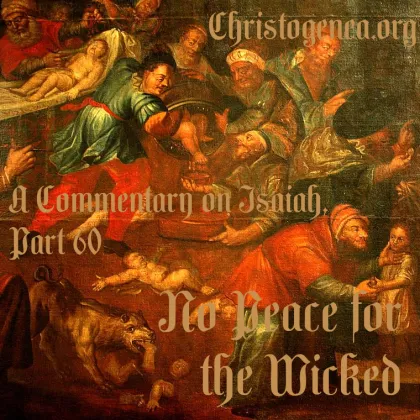
A Commentary on Isaiah, Part 60: No Peace for the Wicked

Isaiah 57:1-21

A Commentary on Isaiah, Part 60: No Peace for the Wicked

In our last discussion, where in Isaiah chapter 56 Yahweh had described Himself as “the Lord Yahweh which gathereth the outcasts of Israel”, we cannot imagine that Yahweh had intended to violate His covenants and promises which He had made to the patriarchs, Abraham, Isaac and Jacob, in order to gather to Israel any other people but “lost sheep” Israelites. So where verse 8 of that chapter continues and the Word of Yahweh says “Yet will I gather others to him, beside those that are gathered unto him”, we would make the assertion that here, it is the children of Israel in Assyrian captivity who are being addressed, yet other Israelites had long been scattered elsewhere throughout the οἰκουμένη, or the world of that time, and they would also be gathered to Israel.

Over the nine centuries prior to the Assyrian captivities, many Israelites had been departing from the main body of Israel, and settling colonies abroad, throughout the coasts of the Mediterranean Sea and the rivers and coasts of Europe. In relation to Isaiah chapters 23 and 24 we had discussed The Burden of Tyre, and how the words of the prophet help serve to elucidate the fact that the Phoenicians of the historical records were indeed Israelites. In that prophecy, Yahweh had promised not to lose sight of those Israelites who had fled from the Assyrians by sea. However Phoenicians had been colonizing the world of the Mediterranean Basin and points beyond long before the time of Isaiah, and even before Judah got involved, where Solomon had employed ships to join Hiram in his mercantile endeavors. One notable example of those early colonies is Thebes in Greece, which was recognized as a Phoenician city throughout the classical Greek writings. The people of Thebes were described as having been fair and blond, especially by the Tragic Poets. Another notable Phoenician settlement in the Greek world was ancient Miletus, and there were others in Thessaly.

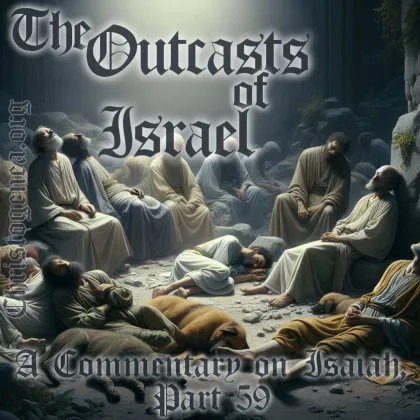
A Commentary on Isaiah, Part 59: The Outcasts of Israel

Isaiah 56:1-12

A Commentary on Isaiah, Part 59: The Outcasts of Israel

Since the description of the Suffering Servant in Isaiah chapter 53, the prophet has offered many Promises of Comfort to the children of Israel in captivity, and especially for the obedient among them. Among these promises, they had even been told that they would expand their dwelling space and “inherit the nations”, which we read in Isaiah 54:3:

3 For thou shalt break forth on the right hand and on the left; and thy seed shall inherit the [Nations], and make the desolate cities to be inhabited.

There should be no doubt that these words were intended for the children of Israel in captivity, and that they were meant for Israel exclusively, since we read in verses which follow that promise:

5 For thy Maker is thine husband; the LORD of hosts is his name; and thy Redeemer the Holy One of Israel; The God of the whole earth shall he be called. 6 For the LORD hath called thee as a woman forsaken and grieved in spirit, and a wife of youth, when thou wast refused, saith thy God. 7 For a small moment have I forsaken thee; but with great mercies will I gather thee. 8 In a little wrath I hid my face from thee for a moment; but with everlasting kindness will I have mercy on thee, saith the LORD thy Redeemer.

This promise is corroborated by a somewhat earlier promise given to the children of Israel in captivity, in Hosea chapter 2 where they were told:

19 And I will betroth thee unto me for ever; yea, I will betroth thee unto me in righteousness, and in judgment, and in lovingkindness, and in mercies. 20 I will even betroth thee unto me in faithfulness: and thou shalt know the LORD.

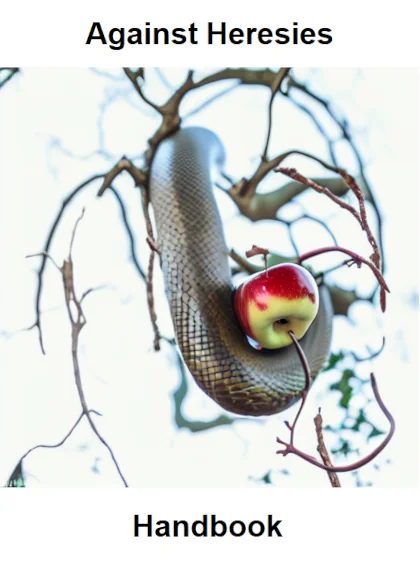
New Version July 5th! A Handbook Against Heresies for Identity Christians

A friend has created a Christian Identity: Handbook Against Heresies which seeks to compile and explain from Scripture a collection of basic Christian concepts which is meant to be a quick witness to help address and combat basic heresies and misunderstandings. This may also serve as a good primer for those wanting an overview of our general Christian Identity professions.
 

The Handbook was updated and a new copy posted July 5th, 2024. We expect this to happen periodically.

Download the PDF handbook here. There is also a clean version formatted for printing without any underlined cross-references and no highlighting. Another version without highlighting removes all background color from the text, but it has underlined cross-references. here you may also download the clean version, the version without highlighting, or now for a combined version which contains both highlighted and clean copies of the text.

Help Support Christogenea

These past few years, and the past few months especially, Christogenea has been cut off from most of its sources of funding. CashApp has cancelled us. We are currently searching for another new credit card processor as we have already been cancelled by cornerstone.cc, who has been rejecting payments for the past week. Cornerstone has not given us any explanation although we have requested one. We know the explanation already.  

If you appreciate our work, please remember that it is not "free" to produce or to keep freely available. Please help support Christogenea and keep us working!

Aside from 15 separate websites, a chat and 6 radio streams, Christogenea freely hosts over two dozen unrelated Christian Identity or Christian Nationalist websites, and incurs online expenses of over $1200 each month, not including the funding we need to produce our studies and other content

The Scorpion and the Frog, from Aesop's Fables

A scorpion and a frog meet on the bank of a stream and the scorpion asks the frog to carry him across on its back. The frog asks, "How do I know you won't sting me?" The scorpion says, "Because if I do, I will die too."

The frog is satisfied, and they set out, but in midstream, the scorpion stings the frog. The frog feels the onset of paralysis and starts to sink, knowing they both will drown, but has just enough time to gasp "Why?"

Replies the scorpion: "Its my nature..."

Never expect anyone to act contrary to their nature.

Addendum: The Wisdom of Solomon - An English Translation by William Finck


A completely new translation by William Finck of Christogenea.org, based on the text of the Rahlfs-Hanhart Septuaginta, but not necessarily following the punctuation of that edition. Download the PDF here. There is also a navigable chapter-by-chapter Greek-English Interlinear Version.

The Wisdom of Solomon is a profound and inspired work of literature, which, with all certainty, should have been included in the canonical Scriptures alongside the other works of Solomon, regardless of the fact that there is no extant Hebrew manuscript. The work is found in early lists of church canon, such as the Muratorian Canon, and it was included alongside the other Biblical books of wisdom in the Old Testament in the 4th century Codices Sinaiticus (א) and Vaticanus (B) and in the 5th century Codex Alexandrinus (A). While there have been contrary claims, for example at the Israeli website deadseascrolls.org, no supporting evidence has been presented, and therefore the work has evidently not been found among the Dead Sea Scrolls. However we must wonder if those examining the Scrolls would even recognize it, since there is no known Hebrew text against which to reference any possible fragments.

Passages from the Wisdom of Solomon were alluded to by Paul of Tarsus, and had obviously been an influence on him in his writings. For example, the “whole armor of God” analogy is very close to a description of the wrath of God found here in Wisdom chapter 5. In Romans chapter 8, Paul had used the term for creation in the same fashion as it was described in Wisdom chapter 19, in verse 6. Yet Wisdom also presages many of the illustrations which Yahshua Christ had employed in various of His parables in the Gospel, especially where Solomon spoke of races of men and their generations as trees and branches.

Of course, while we cannot imagine that Christ was inspired by Wisdom, His use of so many similar allegories in the same contexts certainly elucidates the fact that Solomon was inspired by Him. So in Wisdom we find rebukes of the lawless, the godless concept that “might is right”, the wandering of the impious into the corruption of their seed through miscegenation, and the fact that bad trees cannot produce good fruit, along with an exposition of some of the beginnings of idolatry. Finally, there is an analogy portraying the world of the wicked and of sin as Egypt and Sodom, much like the Revelation also attests, and the reordering of the creation of God in the organization of the children of Israel, which is how the history of the children of Israel had begun, and how Revelation also concludes. The Wisdom of Solomon is indeed a masterpiece of Christian theology, and a philosophical bridge between the Old and New Testaments which no true Christian should be without.

The Latin word GENTILIS in 1927 Junior Classic Dictionaries

Here we have several images from the Junior Classic Latin Dictionary. In his later papers, after he had found this definition, Clifton Emahiser cited this lexicon in relation to the meaning of the Latin word gentilis, which is "of the same clan or race", and how that true meaning of the word may affect one's view of Scripture, since with that meaning the truth of the nature of the covenants of God is revealed.

The word gentilis is the Latin word that Jerome had employed to represent the Greek word ἔθνος, or nation, in his Latin Vulgate, and that is the underlying word where the King James Version has gentile or gentiles in the New Testament. Jerome may have used any one of several other more general Latin words which may mean nation, but he purposely selected this more specific term. 
 

The word gentilis never meant "non-Jew" to any Roman!

Christian Identity: What Difference Does it Make?

Christian Identity: What Difference Does it Make?

It is no mistake that 2000 years ago, Christianity spread and was accepted by tribes of White Europeans as they encountered it. It is no mistake that for the last 1500 years Europe has been predominantly Christian. Christianity had spread not only to both Greece and Rome, but also to Britain and other points in Europe as early as the middle of the first century. Tribes in Gaul were converting to Christianity in the second century. By the third century, if not sooner, Germanic tribes of the Goths and Alans had accepted Christianity. All of this was long before the official acceptance of Christianity began with Constantine the Great, the Edict of Toleration and the Council of Nicaea.

To mock Christianity today is to mock a hundred generations of our ancestors. People who mock Christianity think they know something better about our past than their own ancestors, the people who actually lived in those times many centuries ago. The truth is that the people who mock Christianity know little-to-nothing about the world of the past and the circumstances under which their ancestors ultimately accepted Christianity.

There are many incongruities in the perception of the people who mock Christianity today. On one hand they claim that it is a “cuck” religion, and on the other they complain that their ancestors were forced into Christianity by Christians. So they admit that their own ancestors were weaker than the “cucks” they despise. On one hand they claim that Christianity is an effeminate religion, and a Jewish religion, but then they complain that their ancestors were forced into it by Christians. So they admit that their ancestors were weaker than effeminates and Jews. All the while, they proclaim the “might is right” mantra of their own neo-paganism, while professing that their weak ancestors, forced to subject to Christianity, were somehow treated unfairly! Those who mock Christianity are simply too stupid to realize all of these cognitive disconnects, and there are many more that we won’t get into here. We already presented them here a few years ago, in two podcasts titled White Nationalist Cognitive Dissonance.

Classics Corner

Here we will periodically feature one or more of our older program episodes. 

The alien hordes currently pouring into Europe, and also into America and other White nations, are fulfilling Biblical prophesies made many centuries ago. The proof is in a history which few now know, because Classical literature is irrelevant to modern churchmen, and the Bible is alien to classicists. Interpretations of archaeological discovery are seen through a Jewish worldview, and that worldview is also based on falsehoods. But when we come to love the truth of our God, we can no longer be blinded by the satanic Jews.


The Immigration Problem and Biblical Prophecy - 2011-11-05

Download podcast.

No Safe Haven: Stripped Bare and Naked - 2013-08-16

Download podcast.

The Camp of the Saints Revisited - 2015-10-07

Download podcast.