A Commentary on Isaiah, Part 59: The Outcasts of Israel
A Commentary on Isaiah, Part 59: The Outcasts of Israel
Since the description of the Suffering Servant in Isaiah chapter 53, the prophet has offered many Promises of Comfort to the children of Israel in captivity, and especially for the obedient among them. Among these promises, they had even been told that they would expand their dwelling space and “inherit the nations”, which we read in Isaiah 54:3:
3 For thou shalt break forth on the right hand and on the left; and thy seed shall inherit the [Nations], and make the desolate cities to be inhabited.
There should be no doubt that these words were intended for the children of Israel in captivity, and that they were meant for Israel exclusively, since we read in verses which follow that promise:
5 For thy Maker is thine husband; the LORD of hosts is his name; and thy Redeemer the Holy One of Israel; The God of the whole earth shall he be called. 6 For the LORD hath called thee as a woman forsaken and grieved in spirit, and a wife of youth, when thou wast refused, saith thy God. 7 For a small moment have I forsaken thee; but with great mercies will I gather thee. 8 In a little wrath I hid my face from thee for a moment; but with everlasting kindness will I have mercy on thee, saith the LORD thy Redeemer.
This promise is corroborated by a somewhat earlier promise given to the children of Israel in captivity, in Hosea chapter 2 where they were told:
19 And I will betroth thee unto me for ever; yea, I will betroth thee unto me in righteousness, and in judgment, and in lovingkindness, and in mercies. 20 I will even betroth thee unto me in faithfulness: and thou shalt know the LORD.
Then at the very end of Isaiah chapter 54, which continues to address the children of Israel exclusively, we see another promise of their preservation, at the expense of any others who would oppose them:
17 No weapon that is formed against thee shall prosper; and every tongue that shall rise against thee in judgment thou shalt condemn. This is the heritage of the servants of the LORD, and their righteousness is of me, saith the LORD.
In Isaiah chapter 55 these promises of comfort continue, but there we also faced the prospect that they were being made to Israel in obedience, and not to Israelites who had continued in rebellion. So for that, in verse 3 of the chapter we read:
3 Incline your ear, and come unto me: hear, and your soul shall live; and I will make an everlasting covenant with you, even the sure mercies of David.
Then a little further on:
6 Seek ye the LORD while he may be found, call ye upon him while he is near: 7 Let the wicked forsake his way, and the unrighteous man his thoughts: and let him return unto the LORD, and he will have mercy upon him; and to our God, for he will abundantly pardon.
This is the context of everything which we see here in Isaiah chapter 56, which is an appeal to those who would listen to keep the law and the Sabbaths, for which they would be rewarded even beyond sons and daughters. For such obedience, in Isaiah chapter 55 they were given further promises, which, as we hope to have already demonstrated, contain analogies that relate to people rather than to literal trees and bushes, where in the closing verses of that chapter they were told that as a result of obedience they would have spring up in their lands fir trees instead of thorns, and myrtles instead of briers. Now here, at the end of Isaiah chapter 56, we shall see how it is that the lands occupied by Israel in captivity are filled once again with thorns and briers.
So as we commence with Isaiah chapter 56, we must first say that this chapter probably contains the most abused passages of Isaiah, or perhaps, of all of the prophets, so far as the context of the words of this prophet is concerned, and the verses at the end of the chapter demonstrate the fact that Yahweh God had foreseen that abuse. The chapter break has not changed the subject of these promises. The subject is still the children of Israel in captivity, and Yahweh is still speaking to those of Israel who would hear His calls to “incline your ear, and come unto me: hear, and your soul shall live” and “seek ye the LORD while he may be found, call ye upon him while he is near” which are seen in chapter 55. So these words are for the children of Israel in captivity both explicitly and exclusively, and they are meant for no other parties. Where certain pejoratives are found in the opening verses of this chapter, those pejoratives must describe them, and individuals from among them who would hear those calls.
In other words, if Isaiah had supervised a construction crew, and if he said to his workers something such as “anyone who gets an injury we shall take to the hospital for treatment”, the scope of that last statement is limited to the workers on his crew. Someone who is injured down the road in a random parking lot, who had heard those words when he passed by earlier that day, could not run back to Isaiah and expect treatment at his expense. If the local firefighters’ union published a news bulletin concerning free healthcare for its members, a non-member could not expect to benefit from its healthcare plan, which is for firefighters. Perhaps the publication mentioned eunuchs. That doesn’t mean that any eunuch could benefit, but only eunuchs who had been members of the firefighters union.
Yet this is the childish way in which denominational Christians read these words, even when they are not eunuchs. They imagine that anyone who imagines for himself to have kept a sabbath may therefore also imagine himself to be the recipient of these promises here in Isaiah chapter 56. However they were not necessarily the parties to whom the promises had been made in the first place. In our examples, eunuchs who were not firefighters, and who did not belong to that particular union, could not expect to receive any healthcare benefits from that union. Yahweh made these promises to Israel, and never to any other people. So the Eunuchs, Dry Trees and strangers of Isaiah chapter 56 could only be Eunuchs, Dry Trees and strangers of the children of Israel. The children of Israel are the Strangers of this chapter, since Israel in captivity had been estranged from God in the time of punishment for their sins. Neither is it speaking of literal eunuchs, just as literal dry trees could not possibly even be cognizant of a Sabbath, and therefore it is also not speaking of literal strangers, who would have no cause to even know of a Sabbath.
Christianity truly is for the thinking man. Yahweh God created man with a mind that is capable of being conformed to Christ, and which is capable of representing the image of God Himself. There are over 37,000 words in the translation of Isaiah as it is found in the King James Version, and before we even attempt to make a doctrine out of a hundred and eighty four of those words (the text from verses 3 through 7 of this chapter), such as the denominational Christians do with eunuchs and dry trees, we ought to make certain that we are not interpreting them in a manner which conflicts with all the other words in Isaiah, or we are doing God Himself an injustice. However this is precisely the method which the denominational churches all employ not only here in Isaiah, but throughout the Scriptures.
Today, many people turn to these AI bots, or artificial intelligence programs, for answers to their questions. These AI bots are virtual nirvana for the average person, who is lazy and typically does not even care to make any effort to study the substance of what he is told to believe. Yet according to Oxford Languages, the word artificial primarily means “made or produced by human beings rather than occurring naturally, especially as a copy of something natural.” So artificial intelligence is made by men, but it is highly unlikely that those men are wiser than Solomon, who wrote, in Ecclesiastes chapter 2:
11 Then I looked on all the works that my hands had wrought, and on the labour that I had laboured to do: and, behold, all was vanity and vexation of spirit, and there was no profit under the sun.
Likewise, the Word of Yahweh spoke of the counsels of men in Isaiah chapter 49 and said:
29 Behold, they are all vanity; their works are nothing: their molten images are wind and confusion.
So AI bots are mere vanity, and when the surface is scratched, the intelligence part of the name is even more vain than the artificial part. But just for amusement, I had asked an AI bot, Gemini, which is incorporated into the Google search engine, what it is that the eunuch of Isaiah chapter 56 represented. I expected an answer similar to that of the denominational churches, and that certainly was the result which I obtained. When I publish the notes for this presentation I will include a screenshot of the entire result, but here I will repeat the four points which it offered as “key representations” of these eunuchs:
Key representations of the eunuch include:
Marginalized Outcasts: They represent individuals separated from the community due to physical, social, or religious constraints.
The Spiritual Over the Physical: As a "dry tree" (unable to have children), the eunuch symbolizes those who feel fruitless, yet through faith and adherence to the Sabbath, they gain a better, spiritual legacy than biological children.
Inclusion in the New Covenant: They represent the breaking down of barriers, foreshadowing the inclusion of Gentiles and outsiders, such as the Ethiopian eunuch in Acts 8.
- Faithful Obedience: The eunuch stands for anyone, regardless of their past or physical condition, who chooses to "hold fast to [God's] covenant".
Essentially, the eunuch is a powerful symbol of divine acceptance, overturning social stigma with spiritual belonging.
That is a completely Marxist view of the Scriptures, and of these prophecies here in Isaiah, as if they should be common to everyone. Each one of these so-called “key representations” completely ignores the broader context of the passage describing the eunuchs as it is presented here in Isaiah, and purposely sets it into a false context which had not developed until many centuries later, long after the time of Christ and His apostles. A partial exception is the first point, since eunuchs were marginalized outcasts, according to the law in Deuteronomy chapter 23 (23:1), but even that is not the context here, as we hope to elucidate in our commentary for the verse.
However the later three points are blatantly in error. The example of the eunuch does not mean that anyone can choose to adhere to the covenant, but only that anyone of the children of Israel may choose obedience, the obedience to which they had been called earlier in this discourse, in chapter 55, and the reference to a covenant here in Isaiah can only be a reference to the Sinai covenant, since there was no new covenant at this time yet people at this time were expected to take hold of the Sinai covenant, in which we find the law. The Sinai covenant includes the keeping of the law, it was only made with the biological children of Israel, and it is the only grounds for keeping the Sabbath, which is explicitly stated to have been for the children of Israel. Furthermore, where Gemini claims that the eunuch “symbolizes those who feel fruitless”, it is conjecturing something which is not found in the text itself, and today many proud Sodomites make themselves into literal eunuchs, and pretend to be satisfied with their self-mutilation.
As for the remaining “key representations”, the context of the promises to the eunuch and the stranger show that they were made for biological children, and the subjects of this particular prophecy are exclusively biological children. It would be a violation of Isaiah’s words to imagine that they could refer to anyone else. Even the strangers of Isaiah chapter 56 are Israelites, since these words are meant only for Israel, which is explicitly stated in several different ways in chapters 54 and 55. This may be corroborated in the words of Isaiah, and also in the words of other prophets.
For example, in the prophecy of Obadiah, Esau is chastised for how the Edomites had treated Israel when they had been taken off into captivity. The historical records show that the Edomites were subject allies of both the Assyrians and the Babylonians who had taken Israel and Judah into captivity. So there we read in part:
12 But thou shouldest not have looked on the day of thy brother in the day that he became a stranger; neither shouldest thou have rejoiced over the children of Judah in the day of their destruction; neither shouldest thou have spoken proudly in the day of distress.
Therefore, having gone into captivity, the biological children of Israel had become strangers, as they had been estranged by Yahweh their God, and as it is attested here in Obadiah, that Jacob “became a stranger”. Yet Isaiah and Obadiah, as well as the other prophets all have many messages and promises of hope, redemption, salvation and restoration for those same biological children of Israel. And on account of what Edom had done when Israel and Judah went into captivity, in a later passage Obadiah said:
18 And the house of Jacob shall be a fire, and the house of Joseph a flame, and the house of Esau for stubble, and they shall kindle in them, and devour them; and there shall not be any remaining of the house of Esau; for the LORD hath spoken it.
This is also a biological promise for the biological children of Israel which, when it is fulfilled, shall see the end of biological Edomites at the hand of the biological Israelites, although today, in the eyes of God, the children of Israel are Christians and the Edomites had become Jews.
Then, in the New Testament, and especially in Luke chapter 1, it is evident that Christ had come to uphold the promises made to the fathers, to Abraham, Isaac and Jacob. As Paul of Tarsus wrote in Romans chapter 4, those promises to the fathers are fulfilled “as it is written”, and reading those promises, they are all absolutely contrary to what this AI bot had claimed concerning the eunuchs here in Isaiah. While AI is artificial intelligence, it is only as intelligent as its creators allow it to be, and it is always designed to uphold the same narrative which the creators want to program into their prospective readers. So AI is no better than the evening television news, the daily tabloid, or selections at the local and woke library. Yahweh God had never promised Abraham anything about people of other races, except that he would remove from them their land, and all the positive promises of blessings for Abraham were made concerning his own seed, or biological descendants. Admitting any people of any other races into his promises, Abraham is being cursed, rather than blessed.
So we read towards the end of Isaiah chapter 65, in reference to the biological children of Israel:
22 They shall not build, and another inhabit; they shall not plant, and another eat: for as the days of a tree are the days of my people, and mine elect shall long enjoy the work of their hands. 23 They shall not labour in vain, nor bring forth for trouble; for they are the seed of the blessed of the LORD, and their offspring with them.
If others, meaning those who are not of Israel, can inhabit with them and eat with them, simply because they claim to be keeping the sabbath, then God is a liar. In truth, the AI bots and all the denominational churches are liars.
With this background, we shall now commence with Isaiah chapter 56:
1 Thus saith the LORD, Keep ye judgment, and do justice: for my salvation is near to come, and my righteousness to be revealed. 2 Blessed is the man that doeth this, and the son of man that layeth hold on it; that keepeth the sabbath from polluting it, and keepeth his hand from doing any evil.
As we have said, the context has not been broken since the beginning of this prophecy, which for our purposes here we may account as the opening verse of chapter 54, after the description of the Suffering Servant. Since then, the Word of Yahweh God has been addressing the children of Israel, and that is explicit in many places, in spite of the promise in those same chapters, that Israel would “inherit the nations”. This does not change the covenants. The AI bot, Gemini, is refuted by Paul of Tarsus in Galatians chapter 3 where he wrote that:
15 Brethren, I speak after the manner of men; Though it be but a man's covenant, yet if it be confirmed, no man disannulleth, or addeth thereto.
There Paul had spoken of the Sinai covenant, which had come four hundred and thirty years after the promises to Abraham, but the same principal may be applied to the New Covenant, which was explicitly promised to biological Israel, and which had been confirmed in Christ. Once confirmed, as Paul had said, then it cannot be changed, and in His Own words, Christ came only for the “lost sheep of the house of Israel” (Matthew 15:24).
The other races and nations could not “keepeth the sabbath from polluting it”, since they were never expected to keep it, it since was not given to them to keep. The Sabbath was given to the children of Israel exclusively, as we read in Exodus chapter 31:
15 Six days may work be done; but in the seventh is the sabbath of rest, holy to the LORD: whosoever doeth any work in the sabbath day, he shall surely be put to death. 16 Wherefore the children of Israel shall keep the sabbath, to observe the sabbath throughout their generations, for a perpetual covenant. 17 It is a sign between me and the children of Israel for ever: for in six days the LORD made heaven and earth, and on the seventh day he rested, and was refreshed.
The biological children of Israel were the only people for whom the Sabbath was prescribed, so the scope of these statements here in Isaiah must be limited to Israel, because nobody else had ever been given knowledge of the laws and sabbaths which only Israel had been required by God to keep.
Psalm 78: 5 For he established a testimony in Jacob, and appointed a law in Israel, which he commanded our fathers, that they should make them known to their children.
Psalm 105: 6 O ye seed of Abraham his servant, ye children of Jacob his chosen. 7 He is the LORD our God: his judgments are in all the earth. 8 He hath remembered his covenant for ever, the word which he commanded to a thousand generations. 9 Which covenant he made with Abraham, and his oath unto Isaac; 10 And confirmed the same unto Jacob for a law, and to Israel for an everlasting covenant.
Psalm 147: 19 He sheweth his word unto Jacob, his statutes and his judgments unto Israel. 20 He hath not dealt so with any nation: and as for his judgments, they have not known them. Praise ye the LORD.
The context of the 105th Psalm is early, and therefore it may be attributed to David, although there is apparently no indication in the text. But the 78th Psalm is attributed to Asaph, a prophet in the time of the Babylonian captivity, and the 147th Psalm is attributed to the prophets Haggai and Zechariah, who had their ministries at the beginning of the Second Temple period from around 520 BC. So at least two of these Psalms which profess that the law was only for the children of Israel, which included the law of the Sabbath, had lived over a hundred years after Isaiah had written these words.
So nobody but the biological children of Israel, as these citations of the Psalms attest, even could have sought to keep the Sabbaths and the Laws of God. These references to those keeping the Sabbaths in Isaiah chapter 56 must be references to estranged Israelites. The nation is put away for iniquity, yet here Yahweh calls to those of Israel who would listen to Him, and there is a promise that Yahweh would provide for the individuals of that nation who turned to obedience. So again, we shall cite the relevant passages from Isaiah chapter 55:
3 Incline your ear, and come unto me: hear, and your soul shall live; and I will make an everlasting covenant with you, even the sure mercies of David.… 6 Seek ye the LORD while he may be found, call ye upon him while he is near: 7 Let the wicked forsake his way, and the unrighteous man his thoughts: and let him return unto the LORD…
That is the context of the balance of chapter 55, which continues here in chapter 56 and later. The immediate context actually began in chapter 54, and continues without interruption at least through the end of chapter 60, although what follows that chapter is also closely related since the opening verse of chapter 61 begins another prophecy of the Gospel of Christ.
So what follows is a continued promise of hope for the biological children of Israel in captivity, who were the subjects of the words we had cited from chapter 55:
3 Neither let the son of the stranger, that hath joined himself to the LORD, speak, saying, The LORD hath utterly separated me from his people: neither let the eunuch say, Behold, I am a dry tree.
As we had seen in Obadiah, there is a reference to the day when Jacob “became a stranger”, which is a reference to the times when the various tribes of the biological children of Israel had been taken into captivity. The son of the stranger here represents the descendants of those same outcasts of Israel, who were estranged by Yahweh and therefore they became no different than strangers to Yahweh. So here they are being informed, that while the nation is cast out, the individuals of that nation who would keep His ways during the period of estrangement are promised an ultimate reward for their personal obedience. None of this can include non-Israelite peoples, because Yahweh had already separated and distinguished Israel from non-Israelite peoples a thousand years before this time, at Mount Sinai, and He only gave the law to them, and he only ever expected them to keep it. For example, in Deuteronomy chapter 7 we read:
6 For thou art an holy people unto the LORD thy God: the LORD thy God hath chosen thee to be a special people unto himself, above all people that are upon the face of the earth.
Here, those cast-off Israelites who chose to keep His ways are reassured that they will not be separated from being counted among His people. The only way they could say that “Yahweh hath utterly separated me from His people” is if they were His people in the first place, and therefore the allegorical eunuchs who may have said this could only have been of Israel!
Furthermore, the only way they could possibly “Keep ye judgment, and do justice” and “keepeth the sabbath from polluting it, and keepeth his hand from doing any evil”, as we read in verses 1 and 2, is to know the law and to live by it, and only the children of Israel had ever had the law in the first place. So none of this could possibly be referring to some random individual of some other race or nation who got some crazy inclination to suddenly attach himself to the god of Israel, a foreign nation. The children of Israel were estranged, and therefore here in Isaiah they were figurative strangers and figurative eunuchs. Their estrangement is expressed in Jeremiah chapter 14:
7 O LORD, though our iniquities testify against us, do thou it for thy name's sake: for our backslidings are many; we have sinned against thee. 8 O the hope of Israel, the saviour thereof in time of trouble, why shouldest thou be as a stranger in the land, and as a wayfaring man that turneth aside to tarry for a night? 9 Why shouldest thou be as a man astonied, as a mighty man that cannot save? yet thou, O LORD, art in the midst of us, and we are called by thy name; leave us not. 10 Thus saith the LORD unto this people, Thus have they loved to wander, they have not refrained their feet, therefore the LORD doth not accept them; he will now remember their iniquity, and visit their sins.
There the prophet is portrayed as having asked Yahweh God why He is acting as a stranger towards Israel, and he receives His answer, that on account of their sins, Yahweh “doth not accept them”, as they had been estranged.
The children of Israel were also accounted as figurative eunuchs in the time of their estrangement. This is evident because eunuchs were originally slaves who were castrated so that they could not bear children, protecting the bloodline of the ruling class which had owned the slaves. Having one’s testicles cut off is essentially the same as the cutting off of one’s seed, or descendants. So we read, in Hosea chapter 4:
6 My people are destroyed for lack of knowledge: because thou hast rejected knowledge, I will also reject thee, that thou shalt be no priest to me: seeing thou hast forgotten the law of thy God, I will also forget thy children.
If Yahweh forgets the children of Israel on account of the sins of Israel, then the men of Israel are no better than eunuchs, having no fruitful seed. Then from a feminine perspective, this is also what was meant in the opening verse at the beginning of this portion of Isaiah’s prophecy, in chapter 54:
1 Sing, O barren, thou that didst not bear; break forth into singing, and cry aloud, thou that didst not travail with child: for more are the children of the desolate than the children of the married wife, saith the LORD.
There, the collective body of the children of Israel in captivity are the “barren that did not bear”, and Israel in captivity is described as desolate, as opposed to the “married wife” or remnant granted mercy in Jerusalem, because Yahweh had forgotten her children, as Hosea was also addressing Israel when they were about to go into Assyrian captivity. The captive people of Israel had been described as having been desolate in this same manner even earlier in Isaiah, in chapter 49:
20 The children which thou shalt have, after thou hast lost the other, shall say again in thine ears, The place is too strait for me: give place to me that I may dwell. 21 Then shalt thou say in thine heart, Who hath begotten me these, seeing I have lost my children, and am desolate, a captive, and removing to and fro? and who hath brought up these? Behold, I was left alone; these, where had they been?
Later in Hosea, Ephraim, who in the prophecy of Hosea had represented the northern ten tribes of Israel, was once again promised to bear no fruit, which is to be a eunuch, and to be barren and bereft of children on account of their sins, in Hosea chapter 9:
11 As for Ephraim, their glory shall fly away like a bird, from the birth, and from the womb, and from the conception. 12 Though they bring up their children, yet will I bereave them, that there shall not be a man left: yea, woe also to them when I depart from them! 13 Ephraim, as I saw Tyrus, is planted in a pleasant place: but Ephraim shall bring forth his children to the murderer. 14 Give them, O LORD: what wilt thou give? give them a miscarrying womb and dry breasts. 15 All their wickedness is in Gilgal: for there I hated them: for the wickedness of their doings I will drive them out of mine house, I will love them no more: all their princes are revolters. 16 Ephraim is smitten, their root is dried up, they shall bear no fruit: yea, though they bring forth, yet will I slay even the beloved fruit of their womb. 17 My God will cast them away, because they did not hearken unto him: and they shall be wanderers among the nations.
Then where we read Hosea’s exclamation that “My God will cast them away”, it is apparent that some decades later, here in Isaiah, these are the “outcasts of Israel” mentioned later in this chapter. This is why Paul of Tarsus had called his Gospel and ministry the “word of reconciliation” and the “ministry of reconciliation”, in 2 Corinthians chapter 5. This is also why he told the Ephesians in chapter 2 of his epistle to them, as it is in the Christogenea New Testament:
19 So therefore you are no longer strangers and sojourners, but fellow-citizens of the saints and of the household of Yahweh, 20 being built upon the foundation of the ambassadors and the prophets, Yahshua Christ being the cornerstone Himself.
The estrangement ended with the reconciliation of the cross of Christ. For that same reason, Paul wrote in Hebrews chapter 2:
16 For verily he took not on him the nature of angels; but he took on him the seed of Abraham. 17 Wherefore in all things it behoved him to be made like unto his brethren, that he might be a merciful and faithful high priest in things pertaining to God, to make reconciliation for the sins of the people.
As Paul himself had also professed, in Romans chapter 9, his brethren are his “kinsmen according to the flesh”, Israelites as opposed to Edomites, and not according to something they may profess to believe. Paul wrote those words on behalf of his brethren which had not yet believed in Christ. Like the Romans and the Corinthians, it may be established that the Ephesians were also descendants of the ancient Israelites. So Paul wrote a little earlier in that same chapter of that epistle:
11 On which account you must remember that at one time you, the Nations in the flesh [the Nations promised to come of the fathers], who are the so-called ‘uncircumcised’ by the so-called ‘circumcised’ made by hand in the flesh, 12 because you had at that time been apart from Christ, having been alienated from the civic life of Israel, and strangers of the covenants of the promise, not having hope and in the Society without Yahweh; 13 but now you among the number of Yahshua Christ, who at one time being far away, have become near by the blood of the Christ.
There Paul described the reconciliation of the descendants of the ancient Israelites to God through Christ. As Paul had written in Romans, and Luke in the opening chapter of his Gospel, Christ had come to fulfill the promises made to the fathers, on account of which He has promised to save the children of Israel. So in that same light, we continue with Isaiah chapter 56:
4 For thus saith the LORD unto the eunuchs that keep my sabbaths, and choose the things that please me, and take hold of my covenant; 5 Even unto them will I give in mine house and within my walls a place and a name better than of sons and of daughters: I will give them an everlasting name, that shall not be cut off.
That phrase “take hold of” in verses 4 and 6, or “layeth hold on” in verse 2 here, does not mean that a stranger, who is not of Israel, can volunteer himself into a covenant which was made with Israel alone, a covenant which could not be changed, according to Paul of Tarsus in Galatians chapter 3. So I would assert that this word, which appears in each of these three verses, was purposely translated in this manner to support the false doctrines of the churches, which have historically accepted the heresy of so-called “replacement theology”, a doctrine which makes the Word of Yahweh God void by annulling the promises for which He had died to fulfill in Christ. The denominational churches trample on the blood of the covenant by making it common, which Paul had warned against in Hebrews chapter 10 (10:29).
Rather, the Hebrew word is חזק or chazaq (# 2388) and it primarily means to be or grow firm or strong or to strengthen. In Isaiah chapter 54, in verse 2, it is translated as strengthen in the phrase “strengthen thy stakes”. Interpreting this word in context, in verse 2 it should be read “and the son of man who is strengthened in it”, and in verses 4 and 6, “strengthened in my covenant”. In that manner, it is evident that those already in the covenant would be blessed if they strengthened themselves in it, and then these passages are in full agreement with the entire balance of the prophecy of Isaiah, as well as with Moses, the other prophets, Christ, and His apostles.
These eunuchs who consider themselves to be dry trees, trees which bear no fruit, are now described as strangers once again, where we would insist that the passage is a parallelism, a repeat of what we had read concerning the eunuchs, a literary device which is found throughout the Old Testament, and even in the writings of the New Testament:
6 Also the sons of the stranger, that join themselves to the LORD, to serve him, and to love the name of the LORD, to be his servants, every one that keepeth the sabbath from polluting it, and taketh hold of my covenant;
A stranger here is one who has been alienated from God, since the context can include only the children of Israel. The Hebrew word נכר or nekar (#5234) only refers to whether someone is recognized or not, as it is used of Joseph in Genesis chapter 42 (42:7), or as the closely related word נכרי or nekriy (#5237) is used of Rachel and Leah in Genesis chapter 31 (31:15), so there is no apparent ethnic or racial connotation in the use of the word. As we had read in Hosea chapter 4, “seeing thou hast forgotten the law of thy God, I will also forget thy children”, so those children became as these strangers in the eyes of God.
A eunuch cannot have children, and since Yahweh had forsaken the children of Israel, to Him they had become as if they were eunuchs. All of the Israelites of the captivity were sons and daughters of God. Yahweh said of Israel in Deuteronomy 14:1 that “Ye are the children of the LORD your God”. Here we see that if, in the captivity, any one of them remained in the agreement with Him to keep the Laws and the Sabbaths, which are found only in the Sinai covenant, that they being sons and daughters would be given a reward greater than other sons and daughters. These are the “children of God that were scattered abroad” where the apostle John had written, in regard to the fact that Christ had died on behalf of the nation, in chapter 11 of his Gospel, that He had died:
52 … not for that nation only, but that also he should gather together in one the children of God that were scattered abroad.
In ancient Palestine, the children of Israel had neglected Yahweh their God, and for that reason they went into captivity. In Jeremiah chapter 50, there is another promise of the New Covenant, which had been promised to the same people who were under the Old Covenant, as it fulfills the promises which Yahweh had made to the patriarchs. So there we read:
4 In those days, and in that time, saith the LORD, the children of Israel shall come, they and the children of Judah together, going and weeping: they shall go, and seek the LORD their God. 5 They shall ask the way to Zion with their faces thitherward, saying, Come, and let us join ourselves to the LORD in a perpetual covenant that shall not be forgotten. 6 My people hath been lost sheep: their shepherds have caused them to go astray, they have turned them away on the mountains: they have gone from mountain to hill, they have forgotten their restingplace.
Jeremiah wrote those words over a hundred years after this time in the ministry of Isaiah, but Hosea was an earlier contemporary of Isaiah. There are several other passages in Hosea which illustrate that Israel became as eunuchs and strangers to Yahweh when the nation was cast off, and therefore individual Israelites are allegorically referred to as eunuchs and strangers here in Isaiah 56. But each of these verses also promise reconciliation between Yahweh and those very same children of Israel. First, from Hosea chapter 1:
10 Yet the number of the children of Israel shall be as the sand of the sea, which cannot be measured nor numbered; and it shall come to pass, that in the place where it was said unto them, Ye are not my people, there it shall be said unto them, Ye are the sons of the living God.
The apostle Peter acknowledged the significance of this verse relative to the New Covenant which is in Christ, and therefore he wrote, in chapter 2 of his first epistle:
9 But ye are a chosen generation [or properly, race], a royal priesthood, an holy nation, a peculiar people; that ye should shew forth the praises of him who hath called you out of darkness into his marvellous light: 10 Which in time past were not a people, but are now the people of God: which had not obtained mercy, but now have obtained mercy.
For Peter to have written that, having made a direct and explicit reference to the prophesy concerning Israel in Hosea chapter 1, he was acknowledging that his readers were the “strangers and pilgrims”, as the King James Version had translated certain words in the very next verse of that passage, who were also the outcasts of Israel. Peter would not have written those things to any other people.
During the period of alienation from Yahweh, the children of Israel were not recognized as Jacob’s children, so the men of Israel who had been taken into captivity were no better than eunuchs. This is an allegory, and it is also promised that nevertheless one day it would be explained to those very same people that they are indeed His children.
Hosea 2:4-7: “4 And I will not have mercy upon her children; for they be the children of whoredoms. 5 For their mother hath played the harlot: she that conceived them hath done shamefully: for she said, I will go after my lovers, that give me my bread and my water, my wool and my flax, mine oil and my drink. 6 Therefore, behold, I will hedge up thy way with thorns, and make a wall, that she shall not find her paths. 7 And she shall follow after her lovers, but she shall not overtake them; and she shall seek them, but shall not find them: then shall she say, I will go and return to my first husband [Christ]; for then was it better with me than now.”
This is found here in Isaiah chapters 49 and 54, where Israel is described as barren and as having been bereaved of children, which is the feminine equivalent of a eunuch. That passage in Hosea is another prophesy of estrangement, and later reconciliation. Hosea chapter 3 also had a message of reconciliation:
4 For the children of Israel shall abide many days without a king, and without a prince, and without a sacrifice, and without an image, and without an ephod, and without teraphim [all the symbols of their national heritage]: 5 Afterward shall the children of Israel return, and seek the LORD their God, and David their king; and shall fear the LORD and his goodness in the latter days.
Again we see the promise of the reconciliation of Israel to God. And Paul explained that to be his ministry, in 2 Corinthians chapter 5 where he wrote:
18 But all things from Yahweh, who has reconciled us to Himself through Christ, and is giving the service of reconciliation to us. 19 How that Yahweh was within Christ reconciling the Society to Himself, not accounting their offenses to them, and placing in us the word of that reconciliation.
Paul knew the nations to which he had preached the Gospel, that they were the “lost sheep” of the House of Israel, and he knew that his message was one of reconciliation between Israel and God, as promised in the prophets and as he explained throughout his epistles. The children of Israel were as eunuchs to God, until the promised reconciliation in Christ, for which Daniel in chapter 9 of his prophecy concerning the coming of the Messiah stated the reason for His coming, in part, as “to make reconciliation for iniquity”.
These promises to the obedient of the children of Israel who strengthen themselves in the covenant, who “keep ye judgment, and do justice”, as they are beckoned to do in the opening verse of this chapter, are merely reassurances to Israelites who would choose obedience over rebellion, that their reward in the Kingdom of Heaven shall be greater than those rewards typically reserved for sons and daughters. So obedience to Yahweh as an outcast of Israel is of far greater value than the apathy which seems to be characteristic of most of the outcasts of Israel. Now there is a greater promise, ostensibly one that they would realize when the reconciliation is finally accomplished:
7 Even them will I bring to my holy mountain, and make them joyful in my house of prayer: their burnt offerings and their sacrifices shall be accepted upon mine altar; …
Here we shall stop before the final clause of this verse. As we have said, this passage is about Israelites in general, who are all considered to be strangers and eunuchs in the eyes of God during their period of captivity, but who choose obedience, as the people who are addressed here were exhorted to obedience in the chapter which had preceded this. But there is another prophecy, ostensibly a prophecy which is parallel to this passage, in Isaiah chapter 65 which summarizes the prophecy here in Isaiah chapters 55 and 56, with slightly different language:
9 And I will bring forth a seed out of Jacob, and out of Judah an inheritor of my mountains: and mine elect shall inherit it, and my servants shall dwell there. 10 And Sharon shall be a fold of flocks, and the valley of Achor a place for the herds to lie down in, for my people that have sought me. 11 But ye are they that forsake the LORD, that forget my holy mountain, that prepare a table for that troop, and that furnish the drink offering unto that number. 12 Therefore will I number you to the sword, and ye shall all bow down to the slaughter: because when I called, ye did not answer; when I spake, ye did not hear; but did evil before mine eyes, and did choose that wherein I delighted not.
Here we would assert that the mountains are the nations of Israel, most of which are still future to this time in the ministry of Isaiah, The inheritor is Christ, since Israel is described as His heritage, the elect are the collective body of the children of Israel, as Peter had described them while citing Hosea, and the Holy Mountain is Israel united in Christ, as Zion in Jerusalem had been used as an allegory in the time of David. This is found to a great degree in a prophecy found in Zechariah chapter 8:
3 Thus saith the LORD; I am returned unto Zion, and will dwell in the midst of Jerusalem: and Jerusalem shall be called a city of truth; and the mountain of the LORD of hosts the holy mountain.
It is also found in Daniel chapter 9:
19 O Lord, hear; O Lord, forgive; O Lord, hearken and do; defer not, for thine own sake, O my God: for thy city and thy people are called by thy name. 20 And whiles I was speaking, and praying, and confessing my sin and the sin of my people Israel, and presenting my supplication before the LORD my God for the holy mountain of my God.
It was not the pile of rocks and soil for which Daniel had prayed, but for the people of Israel he prayed. Now to finish verse 7:
… for mine house shall be called an house of prayer for all people.
This clause was quoted verbatim from the Septuagint in the Gospels of both Matthew (21:13) and Mark (11:17), although Matthew left off the words which read “for all people” here in Isaiah. In Luke chapter 19, Christ had alluded to this clause, but the context is different, where He said, in part, “My house is the house of prayer: but ye have made it a den of thieves”. There He had compounded this clause with a portion of Jeremiah chapter 7 (7:11) which by itself is very close to the meaning of what He had said in Luke.
In the Septuagint, the words which appear here as “for all people” is a form of the Greek word ἔθνος accompanied with a definite article, which we would prefer to translate as “for all the nations”, and interpret that as a reference to the many nations which would come of the children of Israel in fulfillment of the promises to Abraham, Isaac and Jacob. But the Hebrew word is עמים or amim, a plural form of עם or am (# 5971) which is a man, or commonly in the plural, people or tribes, or also nations, as it is defined in the Brown, Driver Briggs Hebrew lexicon. There they also state that “original meaning probably those united, connected, related” [1] and to that we would certainly agree here. In both Hebrew and Greek, the word is accompanied with a definite article, signifying a reference to certain nations or certain peoples, whom we would account as the nations or peoples into which the children of Israel had ultimately developed – again, in fulfillment of the promises to the fathers.
For this very same reason, we now read that Yahweh shall gather them:
8 The Lord GOD which gathereth the outcasts of Israel saith, Yet will I gather others to him, beside those that are gathered unto him.
The Septuagint has this verse to read, according to Brenton’s translation:
8 saith the Lord that gathers the dispersed of Israel; for I will gather to him a congregation.
However the reading in the Dead Sea Scrolls Bible agrees with the Masoretic Text. The surviving fragments of the Hexapla of Origen do not help in this regard, however it is noted in the fragments that rather than the verb which is translated as dispersed by Brenton, the editions of Aquila, Symmachus and Theodotion had all used a form of the verb ἐξωθέω, which means banished or expelled. [2]
The reference to the “outcasts of Israel” summarizes what had previously been said concerning the eunuchs and the strangers. In Christ, God intends to gather nobody but the lost sheep of Israel, who are the outcasts of Israel. It is this to which John had referred when he wrote that Christ had died so that He would “gather together in one the children of God that were scattered abroad.” As for these “others”, nobody else is ever promised this gathering to God, except the outcasts of Israel. The gathering of others to him, besides those which are gathered, is still inclusive only to Israelites, because Yahweh “gathers the outcasts of Israel”. Here these chapters had been addressed to the children of Israel in the Assyrian captivities. But even long before the Assyrian conquests of Palestine, the children of Israel had already come to colonize much of Europe by sea, as far away as the British Isles and the Scandinavian coasts. So Christ shall also gather them, as they are also lost sheep, Israelites gone astray in ancient times.
This is alluded to in Isaiah chapter 11, where we read another prophecy of this same gathering:
11 And it shall come to pass in that day, that the Lord shall set his hand again the second time to recover the remnant of his people, which shall be left, from Assyria, and from Egypt, and from Pathros, and from Cush, and from Elam, and from Shinar, and from Hamath, and from the islands of the sea. 12 And he shall set up an ensign for the nations, and shall assemble the outcasts of Israel, and gather together the dispersed of Judah from the four corners of the earth.
In the 147th Psalm, which we have already cited here, and also explained that it is attributed in the Septuagint to the prophets Haggai and Zechariah, in the opening verses of that Psalm we read:
1 Praise ye the LORD: for it is good to sing praises unto our God; for it is pleasant; and praise is comely. 2 The LORD doth build up Jerusalem: he gathereth together the outcasts of Israel. 3 He healeth the broken in heart, and bindeth up their wounds. 4 He telleth the number of the stars; he calleth them all by their names. 5 Great is our Lord, and of great power: his understanding is infinite.
In the prophecy of the two sticks, in Ezekiel chapter 37, the prophet was told to take two sticks, one for Ephraim, representing Israel, and one for Judah, and write those names upon them and join them together, and when the people would ask about them, Yahweh had instructed Ezekiel as to what he should tell them, and we read::
19 Say unto them, Thus saith the Lord GOD; Behold, I will take the stick of Joseph, which is in the hand of Ephraim, and the tribes of Israel his fellows, and will put them with him, even with the stick of Judah, and make them one stick, and they shall be one in mine hand. 20 And the sticks whereon thou writest shall be in thine hand before their eyes. 21 And say unto them, Thus saith the Lord GOD; Behold, I will take the children of Israel from among the heathen, whither they be gone, and will gather them on every side, and bring them into their own land: 22 And I will make them one nation in the land upon the mountains of Israel; and one king shall be king to them all: and they shall be no more two nations, neither shall they be divided into two kingdoms any more at all:
In every prophecy of the future gathering of the people, it is the people of Israel exclusively who are being gathered, and therefore we cannot interpret this passage of Isaiah in a manner which is contrary to any of the other promises concerning Israel, or which had been made to the fathers concerning the seed of Abraham through Jacob. The focus is on the gathering of dispersed Israel, and nobody else.
But now at the end of this chapter of Isaiah, there is a prophecy which seems to have foreseen how the promises in this chapter would be abused and misapplied to include other races. Without a doubt in our mind, this is being fulfilled throughout the White Christian nations in this very day, and it elucidates the fact that Yahweh God does indeed have full authority and control over the perceptions of men, the minds of men:
9 All ye beasts of the field, come to devour, yea, all ye beasts in the forest.
We would assert that the gathering of Israel is to A Place of Their Own, which is the land that they had been promised as early as the time of David and 2 Samuel chapter 7, which we had discussed at length earlier in this commentary, in relation to prophecies found in Isaiah chapter 49. We would also assert that this is the same land to which the woman with the twelve stars, representing nation and tribes of Israel, would flee as it is described in chapter 12 of the Revelation, where she would be nourished with the Gospel of Christ. However much later in the Revelation, when John returns to the wilderness to see the woman, in Revelation chapter 17, she is found in a very different condition, as she had joined herself to the beast, otherwise known as Mystery Babylon.
In Deuteronomy chapter 28, in the explanation of the consequences of disobedience, the children of Israel were told, in part:
25 The LORD shall cause thee to be smitten before thine enemies: thou shalt go out one way against them, and flee seven ways before them: and shalt be removed into all the kingdoms of the earth. 26 And thy carcase shall be meat unto all fowls of the air, and unto the beasts of the earth, and no man shall fray them away. 27 The LORD will smite thee with the botch of Egypt, and with the emerods, and with the scab, and with the itch, whereof thou canst not be healed. 28 The LORD shall smite thee with madness, and blindness, and astonishment of heart.
Then a little later, sexual promiscuity and fornication are also consequences of disobedience, where we read:
30 Thou shalt betroth a wife, and another man shall lie with her: thou shalt build an house, and thou shalt not dwell therein: thou shalt plant a vineyard, and shalt not gather the grapes thereof.… 32 Thy sons and thy daughters shall be given unto another people, and thine eyes shall look, and fail with longing for them all the day long: and there shall be no might in thine hand. 33 The fruit of thy land, and all thy labours, shall a nation which thou knowest not eat up; and thou shalt be only oppressed and crushed always.
So immediately preceding the promise of the New Covenant in Jeremiah chapter 31, there is a prophecy which is also quite similar to this one concerning beasts here in Isaiah:
27 Behold, the days come, saith the LORD, that I will sow the house of Israel and the house of Judah with the seed of man, and with the seed of beast. 28 And it shall come to pass, that like as I have watched over them, to pluck up, and to break down, and to throw down, and to destroy, and to afflict; so will I watch over them, to build, and to plant, saith the LORD. 29 In those days they shall say no more, The fathers have eaten a sour grape, and the children's teeth are set on edge. 30 But every one shall die for his own iniquity: every man that eateth the sour grape, his teeth shall be set on edge.
So this sowing of the house of Israel with these beasts is a punishment for sin, and it should be evident from Deuteronomy chapter 28 that the beasts are a metaphor for the aliens who would be found exploiting the children of Israel in that same punishment.
Yet we have also seen and discussed the blindness of Israel at length here in Isaiah, and especially in Isaiah chapter 6, where it is manifest that blindness is from God, so that His Word may be fulfilled without any interference from men. So men are made blind by God so that His punishment for their sins could be executed. Now with that foundation, we shall continue with Isaiah:
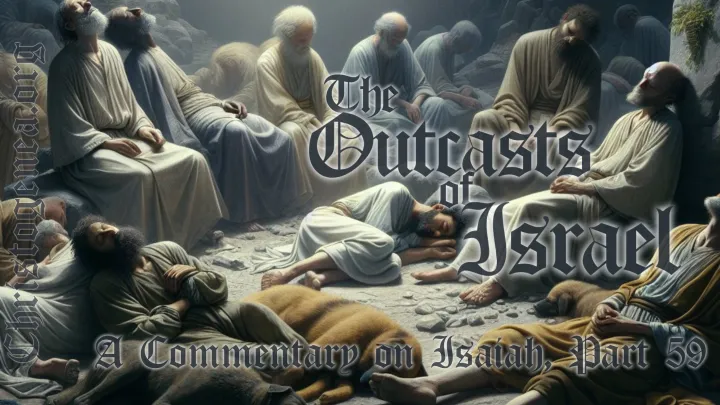
10 His watchmen are blind: they are all ignorant, they are all dumb dogs, they cannot bark; sleeping, lying down, loving to slumber. 11 Yea, they are greedy dogs which can never have enough, and they are shepherds that cannot understand: they all look to their own way, every one for his gain, from his quarter. 12 Come ye, say they, I will fetch wine, and we will fill ourselves with strong drink; and to morrow shall be as this day, and much more abundant.
The Septuagint is wanting verse 12 in its entirety, including the copy employed by Origen. However it is attested by at least two significant copies of Isaiah in the Dead Sea Scrolls, and according to the Hexapla, by Aquila, Symmachus and Theodotion as well as the Old Latin manuscripts which Origen had employed. [3]
The blind watchmen, which are the pastors and the political leaders of the people, are dumb dogs, because they have invited the beasts which are currently devouring all of the children of Israel in the lands which they inhabit today. The political leaders do it for power and for financial growth, which the pastors invite because they are greedy and seek to fill their bellies, claiming that everyone and anyone could choose to join himself to the Covenant of Christ as a eunuch or a stranger. The pastors think there is profit in their universalist teachings, when there is only destruction.
There are other hypocritical aspects of their profession concerning the law, as the same pastors claim that Jesus did away with the law, however Christ exhorted His disciples to keep His commandments, which are found in the law, and the blessings for the eunuch and the stranger here in Isaiah explicitly depend on their keeping of the law, something which today’s pastors neither do nor teach. They are dumb dogs indeed.
This concludes our commentary through Isaiah chapter 56, however what follows in chapter 57 is also directly related to the end of this chapter, so I am sure.
Footnotes
1 The Brown-Driver-Briggs Hebrew and English Lexicon, Hendrickson Publishers, 2021, p. 1033.
2 Origenis Hexaplorum, Fridericus Field, AA. M., Volume II, Clarendon Press, 1875, p. 540.
3 ibid., p. 541.