The Jews and Islam
The Jews and Islam
I imagine that this presentation should really be called an infocast, because for the most part I am only going to convey information from others, rather than my own first-hand research and conclusions. But then again, some things are beyond our reach, and that is all we can do in this case, which is to learn history through the eyes of others who can go places where we ourselves will never tread. So unfortunately, in order to attain first or even second-hand information concerning jewish history, one must employ jewish sources, and it seems that there was a complete dearth of medieval Western Christian scholars who even had access to penetrate jewish and islamic society in order to study their archives and develop a sense of their internal history. Political, social and linguistic isolation between the two worlds for many centuries had created an environment in which jews alone had a peculiar monopoly on any bridges between them. The few European scholars who did learn Hebrew or Arabic throughout the centuries, had done so strictly for theological reasons rather than for the investigation and writing of history.
In the past, both myself and Clifton Emahiser had cited Gibbon’s History of the Decline and Fall of the Roman Empire and Alzog’s Manual of Universal Church History in order to elucidate Muhammad’s jewish relations, however I am not going to repeat those here. Rather, here we are going to discuss much more extensive aspects of the relationship between jews and muslims, or really, some ancient sources which attest to the role of jews in the formulation of islam, and then how jews had facilitated its spread throughout the medieval world.
In western literature, a link between Muhammad, the creation of islam by jewry first appears in the late 8th or early 9th century writings of Theophanes the Confessor, a Byzantine aristocrat turned monk and chronicler, who had formerly served in the court of the emperor Leo IV the Khazar. In his chronicle for 630-631 AD we read the following:
In this year died Muhammad, the Saracens’ ruler and false prophet. He had previously chosen his relative Abu Bakr as his successor. As soon as rumor of him arrived, everyone became afraid.
When he first appeared, the Hebrews [sic jews] were misled and thought he was the Anointed One they expected, so that some of their leaders came to him, accepted his religion, and gave up of that of Moses, who had looked on God. Those who did this were ten in number, and they stayed with Muhammad until his death. But when they saw him eating of a camel they knew he was not the man they had thought. They were at a loss as to what to do; as they were afraid to give up his religion, they stayed at his side and taught him lawless behavior toward us Christians. [1]
Theophanes, who had apparently lived all of his life in Byzantium and its immediate surroundings, also portrayed Mohammad as having been an epilectic, and as a poor orphan and a grifter who convinced an elder noblewoman to marry him so he could gain control of her money and property. But Theophanes is not the only source of this story of the ten jewish leaders who joined themselves to Muhammad, an account which is often called the story of “The Ten Wise Jews”. So in another source which also cites this account of Theophanes, at the website answering-islam.org, we read the following:
The first Jewish account of this was written during the late 9th or early 10th century, and was preserved in manuscripts which are collectively referred to as the Cairo Genizah:
- This is the book of the story of Muhammad who dwelt in the sheep-pasturing place, which is called the New Mountain, and how he fared until he went up to San'a and to the Hijaz by reason of the monk who was in Balqin on a pillar that is called "the sign of the sun." And those Rabbis who had joined him, came and reminded him of his affair and fabricated for him a book. They inserted at the beginning of a chapter from his Qur'an their names and they inserted the words : "Thus did the wise men of Israel advise the wicked Alm [or 'illem - referring to Isaiah 56:10], making it hidden and distorted so that it would not be understood …. [2]
This last statement is debated today, and the explanation for it in this particular source is not very good. However it is explained in another jewish source, an academic paper on the jewish sages who joined Muhammad written by a jew named Reuven Firestone. He goes on to explain that the reference to Isaiah 56:10 in reference to Muhammad was not to assert his legitimacy, but rather, was a code to signal that he could not have been a true prophet. So we read, in part:
Ten Jewish elders “came to him and made for him the Qur’an.” The Hebrew term used here for Qur’an (ot hakalon) is also a code and is highly polemical. Four of the elders are named, and two of them, Ka`b al-A bar and Abdallah b. Salam, are significant characters in Muslim histories of Prophet Muhammad. According to Muslim tradition, both Jews converted to Islam and were entirely committed to their new religion. According to the Jewish stories, they were working undercover for their Jewish brethren.
Abdallah b. Salam is particularly important in the Muslim histories, for he takes the role of a learned rabbi who was expecting a prophet and found that Muhammad conformed to the signs he was seeking for a salvific figure. In the Jewish retelling, however, Abdallah and the others joined up with Muhammad only in order to prove that he was not a real prophet. This is an example of what Amos Funkenstein has called “counter-history.” It represents a retelling of a well-known account in a way that subverts its meaning. All these Jewish “Muslims” had Hebrew names that do not appear in Muslim sources. The Hebrew names are intended to show that they were actually Jews and continued to be so after their feigned conversions. Their role in writing the Qur’an for Muhammad completely undermines the premise for his prophetic authority. According to the story, the Qur’an is not a divinely revealed text but only a human invention, and a Jewish one at that. [3]
The author then goes on to argue that the names of the jewish sages of the qur’an and the discrediting of its prophet Muhammad are written in code in its opening chapter. So here he continues to refer to the account as it appears in the Cairo Genizah and he writes:
The brief segment ends with an explanation for the entire subterfuge: “All this was to save the people of God so that [Muhammad] would not harm them through his wanton deeds.” The conveyer of the story recognized that the ten Jewish elders engaged in morally condemnable acts. They disguised their identity and pretended they were loyal followers of Muhammad while actually undermining him. They tricked him into believing he was receiving revelation when they actually wrote the Qur’an themselves, and they disparaged both him and the Qur’an by writing insulting remarks about the prophet within it. However, given the gravity of the situation and the fear that the Jews under Muhammad’s rule would be destroyed, they had no choice but to engage in the subterfuge. Accordingly, the Jews had no intent merely to insult or to defame the religion of Islam or its prophet. The reason behind what would normally be inexcusable behavior according to Jewish law and tradition was one of community survival alone. [4]
These accounts from the Cairo Genizah are often dismissed as medieval jewish polemic. But the Geniza itself is described as:
a collection of some 400,000 Jewish manuscript fragments and Fatimid administrative documents that were kept in the genizah or storeroom of the Ben Ezra Synagogue in Fustat or Old Cairo, Egypt. These manuscripts span the entire period of Middle-Eastern, North African, and Andalusian Jewish history between the 6th and 19th centuries CE, and comprise the largest and most diverse collection of medieval manuscripts in the world. [5]
The Fatimid Caliphate was governed by a Shi’a muslim dynasty which had ruled Egypt, North Africa, and the Levant and Middle East for over 250 years in the 10th through the 12th centuries. Having these accounts preserved in their libraries, accounts which are quite unflattering to islam, seems to have been quite a risk, especially if they were not true, if they were mere polemic. Yet the fact that the parallel account is found in the older writings of Theophanes reveals that they must have had a much older source, and may well have been from the very time of Muhammad.
But the truth of a matter can often be realized once its results materialize. As Christ had said, a tree is known by its fruits, and the fruits of islam are the destruction of Christianity. Of course, we have also discussed this elsewhere in the perspective of Biblical prophecy, and how islam itself is a subject of prophecy, and a punishment upon sinners. However here our perspective is somewhat different, as we strive to show how islam is just another implement in the toolshed of the Devil, which is jewry.
So here we shall cite an article on the arrival of the Saracens in Visigothic Spain, from a wiki called Citizendium titled Sephardi Jews. First, in reference to pre-Christian Rome:
As citizens of the Roman Empire, the Jews of Hispania engaged in a variety of occupations, including agriculture. Until the adoption of Christianity, Jews had close relations with non-Jewish populations, and played an active role in the social and economic life of the province. The edicts of the Synod of Elvira, although early (and perhaps precedent-setting) examples of Christian Church-inspired anti-Semitism, provide evidence of Jews who were integrated enough into the greater community to cause alarm among some: of the Council's 80 canonic decisions, all which pertain to Jews served to maintain a separation between the two communities. It seems that by this time the presence of Jews was of greater concern to Catholic authorities than the presence of pagans; Canon 16, which prohibited marriage of Christians with Jews, was worded more strongly than canon 15, which prohibited marriage with pagans. Canon 78 threatens Christians who commit adultery with Jews with ostracism. Canon 48 forbade the blessing of Christian crops by Jews, and canon 50 forbade the sharing of meals by Christians and Jews….
The situation of the Jews changed after the conversion of the Visigothic royal family under Recared from Arianism to Catholicism in 587. In their desire to consolidate the realm under the new religion, the Visigoths adopted an aggressive policy towards the Jews. As the king and the church acted in a single interest, the Jews' situation deteriorated. Under successive Visigothic kings and under ecclesiastical authority, many orders of expulsion, forced conversion, isolation, enslavement, execution, and other punitive measures were made.
The Jews of Hispania had been alienated by Catholic rule since the time of the Muslim invasion. The Moors were welcomed as a liberating force. Wherever they went, the Muslims were greeted by Jews eager to aid them in administering the country. In many conquered towns the garrison was left in the hands of the Jews before the Muslims proceeded further north. Thus were initiated the two centuries of Muslim rule in the Iberian peninsula which became known as the "Golden Age" of Sephardi Jewry.
With the victory of Tariq ibn Ziyad in 711, the lives of the Sephardim changed dramatically. In spite of the stigma attached to being dhimmis (non-Muslim members of monotheistic faiths), the coming of the Moors was by-and-large welcomed by the Jews of Iberia.
Both Muslim and Christian sources tell us that Jews provided valuable aid to the invaders. Once captured, the defense of Cordoba was left in the hands of Jews, and Granada, Malaga, Seville, and Toledo were left to a mixed army of Jews and Moors. Although in some towns Jews may have been helpful to Muslim success, they were of limited impact overall.
Muslim rule placed restrictions upon the Jews as dhimmis. Nevertheless, life under Muslim rule was one of great opportunity and Jews flourished as had not under the Christian Visigoths. Many Jews emigrated to Iberia, seen as a land of tolerance and opportunity. Following initial Arab victories, and especially with the establishment of Umayyad rule by Abd al-Rahman I in 755, the native Jewish community was joined by Jews from Christian Europe, as well as from Arab lands, from Morocco to Babylon. Thus the Sephardim found themselves enriched culturally, intellectually, and religiously by the commingling of diverse Jewish traditions. [6]
So not only did jews welcome the invading muslims, but they also fought alongside them. However muslims did not invade Spain until 711 AD, and in 694 AD at the seventeenth Council of Toledo, the Visigoth king Egica levelled charges that Jews were conspiring to overthrow Christian kings in Spain, as they had elsewhere, and in all those places muslims were the armies which they had employed in that endeavor. In the records of that Council we read, in part:
[King Egica] Hence, highest reason pushes our glory to resist them [i.e., the Jews] with firm intention, since it has been said that in other parts of the world some have rebelled against their Christian princes, and so many have been put to death by Christian kings through the righteous judgment of God. But above all, because we have lately ascertained beyond doubt from some confessions, that these Jews have advised the other Jews in the regions beyond the sea to act in unison against the Christian people, so that, in expectation of the downfall of their age, they may corrupt the order of the Christian faith as well as likewise corrupting the order of the Christian faith. [sic !]
[Canon 8] (... ) And because it is known that the Jewish people have been defiled by sacrilege and stained by the brutal spilling of Christ’s blood, as well as by repeated perjury and, moreover, that their crimes are numerous, it is also necessary that they [the Jews] should weep over the fact that they have deserved such terrible punishments, who, through their additional offences, have not only attempted to dishevel the stability of the Church, but have endeavoured, with tyrannical lusts, to bring the fatherland and the entire people to ruin, to the effect that they worked towards the destruction of the Catholics, joyfully thinking that their time has now come. Therefore, this devious and astounding insolence must be punished with severe penalties, and in this way they should be duly condemned, so that what has been deviously concocted will be punished. [7]
So these records from the Council of Toledo are proven to have been true just 15 years later, when the Visigoths were overthrown by invading muslims with the cooperation of jews. The tree certainly is known from its fruit. In response to these charges, laws were passed to impose severe restrictions upon jews, and within a short time muslims appeared and delivered them from those laws, and the imposed dominance of al-Andalus over southern Spain ushered in a long era of prosperity for sephardic jews.
But was there even a koran in 694 AD? Or if there was, were the Saracens familiar with its teachings? This is disputable, and disputed in a book titled Hagarism, the making of the Islamic World, which also explores the ties between judaism and the creation of islam, where it states on page 3:
Virtually all accounts of the early development of Islam take it as axiomatic that it is possible to elicit at least the outlines of the process from the Islamic sources. It is however well-known that these sources are not demonstrably early. There is no hard evidence for the existence of the Koran in any form before the last decade of the seventh century, and the tradition which places this rather opaque revelation in its historical context is not attested before the middle of the eighth. The historicity of the Islamic tradition is thus to some degree problematic: while there are no cogent internal grounds for rejecting it, there are equally no cogent external grounds for accepting it. In the circumstances it is not unreasonable to proceed in the usual fashion by presenting a sensibly edited version of the tradition as historical fact. But equally, it makes some sense to regard the tradition as without determinate historical content, and to insist that what purport to be accounts of religious events in the seventh century are utilisable only for the study of religious ideas in the eighth. The Islamic sources provide plenty of scope for the implementation of these different approaches, but offer little that can be used in any decisive way to arbitrate between them. The only way out of the dilemma is thus to step outside the Islamic tradition altogether and start again.
If we choose to start again, we begin with the Doctrina lacobi, a Greek anti-Jewish tract spawned by the Heraclean persecution. It is cast in the form of a dialogue between Jews set in Carthage in the year 634; it was in all probability written in Palestine within a few years of that date. At one point in the argument reference is made to current events in Palestine in the form of a letter from a certain Abraham, a Palestinian Jew.
A false prophet has appeared among the Saracens … They say that the prophet has appeared coming with the Saracens, and is proclaiming the advent of the anointed one who is to come [tou erkbomenou Eleimmenou kat Khristou]. I, Abraham, went off to Sykamina and referred the matter to an old man very well-versed in the Scriptures. I asked him: ‘What is your view, master and teacher, of the prophet who has appeared among the Saracens?’ He replied, groaning mightily: ‘He is an impostor. Do the prophets come with sword and chariot? Truly these happenings today are works of disorder … But you go off, Master Abraham, and find out about the prophet who has appeared.’ So I, Abraham, made enquiries, and was told by those who had met him: ‘There is no truth to be found in the so-called prophet, only bloodshed; for he says he has the keys of paradise, which is incredible.’
There are several points of interest in this account. One is the doctrine of the keys. It is not of course Islamic, but there are some slight indications that it was a doctrine which the Islamic tradition had been at pains to repress: there is a group of traditions in which the keys of paradise are sublimated into harmless metaphor, and a Byzantine oath of abjuration of Islam mentions the belief that the Prophet was to hold the keys of paradise as part of the ‘secret’ doctrine of the Saracens. The point is not of great intrinsic interest, but it does suggest that we have in the Doctrina a stratum of belief older than the Islamic tradition itself. Of greater historical significance is the fact that the Prophet is represented as alive at the time of the conquest of Palestine. This testimony is of course irreconcilable with the Islamic account of the Prophet's career, but it finds independent confirmation in the historical traditions of the Jacobites, Nestorians and Samaritans; the doctrinal meaning of the discrepancy will be taken up later. But the really startling thing about the Doctrina is its report that the Prophet was preaching the advent of ‘the anointed one who is to come’. That is to say the core of the Prophet’s message, in the earliest testimony available to us outside the Islamic tradition, appears as Judaic messianism. The idea is hardly a familiar one, but again it is strikingly confirmed by independent evidence.
There is in the first place a Jewish apocalypse of the mid-eighth century, the ‘Secrets of Rabbi Simon ben Yohay', which preserves a messianic interpretation of the Arab conquest. Since the messiah belongs at the end of an apocalypse and not in the middle, this interpretation is likely to derive from an earlier apocalypse written soon after the events to which it refers. The relevant passage is as follows:
When he saw the kingdom of Ishmael that was coming, he began to say: ‘Was it not enough, what the wicked kingdom of Edom did to us [medieval jews considered the Roman empire to be Edom - WRF], but we must have the kingdom of Ishmael too?’ At once Metatron the prince of the countenance answered and said: ‘Do not fear, son of man, for the Holy One, blessed be He, only brings the kingdom of Ishmael in order to save you from this wickedness. He raises up over them a Prophet according to His will and will conquer the land for them and they will come and restore it in greatness, and there will be great terror between them and the sons of Esau.’ Rabbi Simon answered and said: ‘How do we know that they are our salvation?’ He answered: ‘Did not the Prophet Isaiah say thus: ‘And he saw a troop with a pair of horsemen, etc.’ Why did he put the troop of asses before the troop of camels, when he need only have said: ‘A troop of camels and a troop of asses’? But when he, the rider on the camel, goes forth the kingdom will arise through the rider on an ass. Again: ‘a troop of asses’, since he rides on an ass, shows that they are the salvation of Israel, like the salvation of the rider on an ass.’
In addition, the ‘Secrets’ contains some references to the Kenite of Num. 24:21 which are intelligible only as the residue of an alternative messianic interpretation of the conquest.
Now it is in no way surprising that a Jewish apocalypse of the time should present the invasion which terminated Roman rule in Palestine as a positive event in the eschatological drama, and it is as such that it appears in another such composition, the apocalyptic poem ‘On that day’. But the author of the passage quoted from the ‘Secrets’ does more than this: he presents the role of the Ishmaelites and their prophet as intrinsic to the messianic events themselves. This interpretation makes sense when set alongside the testimony of the Doctrina that the Prophet was in fact proclaiming the advent of the messiah, and at the same time provides independent confirmation of its authenticity. It may of course seem strange that Jews should accept the credentials of a presumably Arabian prophet as harbinger of the messiah; but there was good Judaic precedent for the performance of an Arab in this role.
The other direct confirmation of the messianism of the Doctrina is to be found fossilised in the Islamic tradition, and incidentally reveals to us the identity of the messiah himself: ‘Umar, the second caliph of the Islamic schema retains even there the messianic designation al-fārūq, the Redeemer. At the same time his entry into Jerusalem is an appropriate performance in this role, while the ‘Secrets’ would seem to have him engage in the equally messianic task of restoring the Temple. ‘Umar’s embarrassing by-name was not of course left unglossed in the Islamic tradition. When eventually the original Aramaic sense of the term had been successfully forgotten, it acquired a harmless Arabic etymology and was held to have been conferred by the Prophet himself. An earlier view attempted a historical rather than an etymological evasion: it was the people of the book who called ‘Umar the fārūq, and the appellation somehow slipped onto the tongues of the Muslims. Detailed historical accounts of the way in which an innocently curious ‘Umar was hailed in Syria as the fārūq are accordingly balanced by the attribution to him of acts which emphatically deny his role as a Judaic redeemer. It is ironic that the inevitable attribution of everything to the Prophet is in this instance probably right. For if there is contemporary evidence that the Prophet was preaching the coming of the messiah, it can hardly be fortuitous that the man who subsequently came bears even in the Islamic tradition a transparently messianic title.
We have so far confined our attention to the messianic aspect of the conquest of Palestine; but as might be expected, the sources provide indications of a wider intimacy in the relations of Arabs and Jews at the time. The warmth of the Jewish reaction to the Arab invasion attested by the Doctrina and exemplified by the ‘Secrets’ is far less in evidence in later Jewish attitudes. More significantly, it is entirely absent from those of contemporary Christians, whether Orthodox or heretical. At the same time the sources attest the translation of these philo-Arab sentiments into concrete political involvement: the Doctrina refers to ‘the Jews who mix with the Saracens’, while according to an early Armenian source the governor of Jerusalem in the aftermath of the conquest was a Jew.
This evidence of Judeo-Arab intimacy is complemented by indications of a marked hostility towards Christianity on the part of the invaders. The converted Jew of the Doctrina protests that he will not deny Christ, the son of God, even if the Jews and Saracens catch him and cut him to pieces. The Christian garrison of Gaza put the same determination into practice, and was martyred for it. A contemporary sermon includes among the misdeeds of the Saracens the burning of churches, the destruction of monasteries, the profanation of crosses, and horrific blasphemies against Christ and the church. A violent Saracen hatred of the cross is also attested in an early account of the arrival of the invaders on Mt Sinai. And the doctrinal corollary of all this finds neat expression when the Armenian source mentioned above has an early Ishmaelite ruler call upon the Byzantine emperor to renounce ‘that Jesus whom you call Christ and who could not even save himself from the Jews'. There is nothing here to bear out the Islamic picture of a movement which had already broken with the Jews before the conquest, and regarded Judaism and Christianity with the same combination of tolerance and reserve.
What the materials examined so far do not provide is a concrete picture of the way in which this Judeo-Arab involvement might have come about. For this we have to turn to the earliest connected account of the career of the Prophet, that given in an Armenian chronicle written in the 660s and ascribed to Bishop Sebeos. The story begins with the exodus of Jewish refugees from Edessa following its recovery by Heraclius from the Persians towards 628:
They set out into the desert and came to Arabia, among the children of Ishmael; they sought their help, and explained to them that they were kinsmen according to the Bible. Although they [the Ishmaelites] were ready to accept this close kinship, they [the Jews] nevertheless could not convince the mass of the people, because their cults were different. At this time there was an Ishmaelite called Mahmet, a merchant; he presented himself to them as though at God’s command, as a preacher, as the way of truth, and taught them to know the God of Abraham, for he was very well-informed, and very well-acquainted with the story of Moses. As the command came from on high, they all united under the authority of a single man, under a single law, and, abandoning vain cults, returned to the living God who had revealed Himself to their father Abraham. Mahmet forbade them to eat the flesh of any dead animal, to drink wine, to lie or to fornicate. He added: ‘God has promised this land to Abraham and his posterity after him forever; he acted according to His promise while he loved Israel. Now you, you are the sons of Abraham and God fulfills in you the promise made to Abraham and his posterity. Only love the God of Abraham, go and take possession of your country which God gave to your father Abraham, and none will be able to resist you in the struggle, for God is with you.’ Then they all gathered together from Havilah unto Shur and before Egypt [Gen. 25:18]; they came out of the desert of Pharan divided into twelve tribes according to the lineages of their patriarchs. They divided among their tribes the twelve thousand Israelites [Jews], a thousand per tribe, to guide them into the land of Israel. They set out, camp by camp, in the order of their patriarchs: Nebajoth, Kedar, Abdeel, Mibsam, Mishma, Dumah, Massa, Hadar, Tema, Jetur, Naphish and Kedemah [Gen. 25:13 - 15]. These are the tribes of Ishmael … All that remained of the peoples of the children of Israel came to join them, and they constituted a mighty army. Then they sent an embassy to the emperor of the Greeks, saying: ‘God has given this land as a heritage to our father Abraham and his posterity after him; we are the children of Abraham; you have held our country long enough; give it up peacefully, and we will not invade your territory; otherwise we will retake with interest what you have taken.’ [8]
After a conclusion which justly dismisses the historical accuracy of the account of the 7th century bishop Sebeos, the authors nevertheless justify and corroborate the attempt to link jews to the development of islam, where they wrote, in part:
… This need not however invalidate the picture which Sebeos gives of the structure of Jewish-Arab relations in in the period leading up to the conquest, and the authenticity of this account is in fact strikingly confirmed from a rather unexpected quarter. In contrast to the standard Islamic account of the relations between Muhammad and the Jewish tribes of Medina, the Jews appear in the document known as the ‘Constitution of Medina’ as forming one community (umma) with the believers despite the retention of their own religion, and are distributed nameless among a number of Arab tribes. Since this document is a patently anomalous and plausibly archaic element of the Islamic tradition, its agreement in these respects with the earliest narrative account of the origins of Islam is highly significant. Sebeos can therefore be accepted as providing the basic narrative framework within which the closeness of Judeo-Arab relations established earlier in this chapter belongs. [9]
As we have often asserted, jews certainly did have a role, a significant role, in the development of islam. When the koran was completed near the end of the 7th century AD, Palestine had already been conquered by muslims, and jews had evidently already conspired to have muslims invade Spain, all in their effort to destroy Christendom, an effort which continues to this very day. However before the 7th century I have never seen any evidence that common arabs had any clue concerning any relationship to the Biblical narrative. Rather, they were jinn-worshipping pagans and for the most part illiterate.
Any academic objections to the Jewish influence in the founding of islam in this light are merely lame attempts to defend both jews and the legitimacy of islam. Further evidence is plentiful. Another avenue of investigation which may be opened is the fact that many apocryphal jewish tales found in the Talmud are also found in the koran, but are not in Scripture or any other early Hebrew documents. These include a tale of a young Abraham smashing his father’s idols, of Cain having learned to bury the body of Abel from a raven, shooting stars that chase away devils, a claim that every living thing was brought forth from water, and of the role of angels in the creation of Adam, among other things.
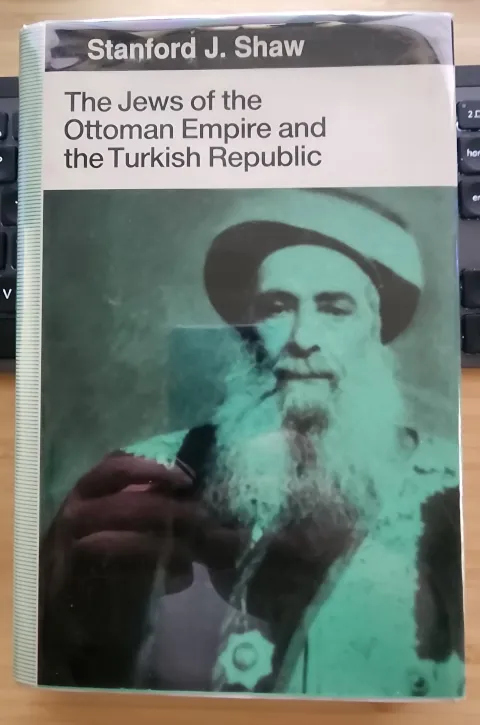 Here we have only scratched the surface, but perhaps we shall go into greater depth on the subject in future presentations. So although there is a lot more to say in reference to this history, now I am going to present a lengthy citation from a book titled The Jews of the Ottoman Empire and the Turkish Republic, written by a jewish academic named Stanford J. Shaw and published by New York University Press in 1991. [There will not be any footnotes in this section, because all citations are from pages 24 through 36 of that same source, and nothing is omitted.] On the inside front flap of the book’s cover we read the following, in part:
The Ottoman Turks provided the principal source of refuge and prosperity for Jews fleeing from persecution in Europe and Byzantium from the emergence of the Ottoman Empire in Southeastern Europe and the Middle East in the thirteenth century until the nineteenth century, when it also received thousands of Jews persecuted in Tzarist Russia, and the twentieth century, when it provided refuge for Jews fleeing from Russian pogroms and the Nazi holocaust.
Of course, there never was a “Nazi holocaust” except in the minds and the incessant propaganda of the jews themselves, who used it to manipulate the entire world in their favor. Yet it is also apparent that even in spite of the fact that the Ottoman’s lost their empire to the British at the end of World War I, in a situation that jews themselves both orchestrated and from which they benefitted greatly in the procurement of formerly Ottoman Palestine and the initiation of the so-called “jewish century”, the Ottomans continued to be of assistance to them in their cause against Christendom. However except to say that islam has always been one of the most significant instruments of jewry in their age-old desire to destroy Christendom, that is all beyond the scope of our purpose here.
On the inside rear cover flap we read something about Stanford Shaw:
Stanford J. Shaw is Professor of Turkish and Near Eastern History at the University of California in Los Angeles. He was previously Assistant and Associate Professor of Turkish Language and History at Harvard University and Director of its Near Eastern Summer programme. Professor Shaw pioneered the use of the Ottoman archives in Istanbul while writing numerous books and articles on Ottoman and Turkish history and society, including Between Old and New: The Ottoman Empire under Sultan Selim III and History of the Ottoman Empire and Modern Turkey.
While his acaemic credentials are well-established, Shaw is not without critics, as he is accused, probably justly, of downplaying the so-called Armenian genocide, and also sometimes of employing secondary sources rather than primary archives. However Shaw himself provided a forty-three page bibliography at the end of this book, organized in relevance to each of its chapters, and also many pages of footnotes and other appendices, so that this book is well documented.
Therefore, beginning from page 24 of the first and only chapter we shall cite here, and which is titled Ingathering of the Jews:
There had been thousands of Jews living in Byzantium following the exodus from the Holy Land, but in consequence of all this [aforementioned] persecution many were forcibly converted or massacred, and most of the remainder fled north of the Black Sea and the Russian Principality of Kiev. There they soon experienced more persecution in the eleventh century when the Ukraine was converted to Orthodox Christianity, leading most of them to move onward to more friendly territory, to the Jewish-Turkish Khazar Empire in the Caspian region and, as it was subsequently conquered by Muscovy, to Kafa and the Tatar Khanate of the Crimea in the thirteenth century. As a result by the time that the Ottomans conquered Anatolia during fourteenth and fifteenth centuries, hardly any Jews remained.
While we could not include the entire chapter in this presentation, the first 24 pages of the book are not entirely relevant to our purpose here this evening, except that we started with a glimpse of the claims of persecutions of jews made by the author, leading up to the final conquest of the Christian Byzantine empire under the muslim Ottomans, with which we shall now continue, as Shaw writes under the subtitle:
JEWISH ABSORPTION INTO THE EMERGING OTTOMAN EMPIRE
Byzantium, however, was breaking up, fortunately for the few Jews who remained under its dominion. As the Turkomans invaded Anatolia starting with their rout of the Byzantine army at the Battle of Manzikert (1071) and formed Turkoman principalities throughout the peninsula, and as the Seljuk Turks established a more settled state centered, first in defense of the Abbasid Empire of Baghdad, and later in Konya and central Anatolia starting in the twelfth century (the Seljuks of Rum, 1077-1246), Byzantine Jewry sprang rapidly to their assistance, welcoming the tolerance and prosperity which the rule of Islam was offering them once again, as it had done previously both in the Middle East and Spain, with thousands of Jews fleeing from Byzantine persecution to Seljuk protection even before the Ottoman state was born.
The Ottomans first established their principality in northeastern Anatolia about 1300 under the leadership of the founder of the dynasty, Osman (d. 1324?). Within a century, after taking over most of western Anatolia, they expanded through Southeastern Europe all the way to the Danube, conquering what are today Greece, Bulgaria, Rumania and Yugoslavia. For a time they bypassed Constantinople, which remained, though already depopulated and ravaged by the Latin Crusaders who occupied it early in the thirteenth century, isolated from the outside world, until it finally was conquered by Mehmed II the Conqueror in 1453. At the same time the Ottomans moved rapidly through Anatolia to the East, reaching the Tigris and Euphrates in the late fourteenth century. After a temporary check due to an invasion of Anatolia by the Tatar chief Tamerlane, they solidified their rule of eastern Anatolia by the end of the fifteenth century and then went on to conquer Syria and Egypt under the leadership of Selim I between 1512 and 1520. His successor, Süleyman the Magnificent (1520-66), called Kanuni, ‘the lawgiver’ by the Turks, completed the great Ottoman conquests in Europe, crossing the Danube and conquering Hungary in 1526. He then placed Vienna under siege in 1529, challenging the Habsburg Emperor, Charles V. In the East he conquered Iraq and much of the Caucasus in 1535, and then extended Ottoman rule across North Africa almost to the Atlantic before his reign came to an end in 1566.
These Ottoman conquests marked a very substantial change for the Jews of the Middle East and Europe. They meant instant liberation, not only from subjugation, persecution, and humiliation but often from actual slavery in Christian hands. As a result, Jews contributed significantly to the Ottoman conquests. The Jews of Bursa, Byzantine administrative center of northwestern Anatolia, actively helped Osman’s son Orhan (1324-59) capture the city in 1324. As a reward, to repopulate the city and develop its economy, he brought in Jewish artisans and money changers from Damascus and Byzantine Adrianople (Edirne) so that it could become the first Ottoman capital, with the ancient Etz ha-Haim synagogue marking the center of the Jewish quarter (Yahudi Mahallesi), established to assure their autonomy in religious and secular matters. In complete contrast to their situation under the Byzantines, Jews entering the Ottoman dominions were allowed to practice whatever profession they wished, to engage in trade and commerce without restriction, and to own landed property and buildings in town and country alike, in return paying a percentage of their revenues to the state as head tax in the traditional Islamic manner, though the Chief Rabbi, the Cantor, and other servants of the synagogues were exempted. At first all the Jews of Bursa were Romaniotes, or Greek-speaking Jews who had escaped from the Byzantines, but later they were joined by Ashkenazis from France and Germany as well as Sephardic Jews from Spain and Portugal, making Bursa into an early model of what was to follow of Jewish life in Salonica and Istanbul.
The Ottoman conquests of Gallipoli (1354) by Orhan’s son Süleyman Pasha, of Ankara (1360) in central Anatolia and of the Byzantine administrative capital of Southeastern Europe, Adrianople, in 1363 by Murad I, also were accomplished with support from the small and impoverished Jewish communities which had lived there under Byzantine persecution. Just as at Bursa, so also at Adrianople, now called Edirne, to restore it economically and make it into the capital of the Ottomans’ European possessions as quickly as possible, the Turkish conquerors repopulated it with large numbers of Jews resettled from the newly conquered lands in Bosnia and Serbia as well as with Ashkenazi refugees from Hungary, southern Germany, Italy, France, Poland and Russia, providing them with substantial tax and other concessions. This transformed Ottoman Edirne quite suddenly into the largest Jewish community in Europe at the time. Its Chief Rabbi (hahambast) was appointed to lead all the Jews of Southeastern Europe as the Ottoman conquests continued, and Edirne itself became a major center of Jewish religion and culture.
When the Ottoman sultan Mehmen II Fatih (The Conqueror) captured Constantinople and brought the Byzantine Empire finally to an inglorious end in 1453, his armies broke into the city through one of the Jewish quarters and with the assistance of the local Jewish population who, as at Bursa and Edirne, were overjoyed with the opportunity to throw off their Greek oppressors. So also at Buda and Pest in 1526, on the island of Rhodes in 1522, at Belgrade (1526), in Azerbaijan (1534), Iraq and Iran (1534-35, 1638). Yemen (1628) and elsewhere, Jews welcomed the conquering forces of Süleyman the Magnificent, and in each case they were rewarded with tax exemptions, concessions for trade and exploitation of minerals, repair or expansion of old synagogues, and even free houses and shops to meet the needs of the increasing Jewish populations.
Mehmed II's conquest of Constantinople was not followed by killing and destruction, as Greek nationalists have claimed to the present day in efforts to depict Turks as barbarians, but rather by an effort to rebuild and repopulate the city so that it could become the center of the great multinational empire he was trying to create, extending far beyond the Roman Empire and incorporating all the people of the world as he knew it under the dominion of his Turkish dynasty. Therefore though by Muslim tradition Constantinople should have been looted since it had forcefully resisted Muslim conquest, Mehmed prevented his soldiers from taking any more than nominal revenge during a single day so as to fulfill Islamic tradition in theory while in fact sparing it from destruction so that it could become his capital as soon as possible.
Mehmed II initially established the center of his government on the heights of Old Istanbul, south of the Byzantine Tauri Forum, at what came to be known as the Eski Saray (Old Palace), now the site of Istanbul University and the Süleymaniye mosque complex, but he subsequently created an entirely new palace that became known as the Topkapi Sarayi overlooking the Sea of Marmara and the Golden Horn. During the remaining three decades of his reign (1451-81), he built one hundred ninety new mosques in the city in addition to seventeen converted churches, twenty-four Muslim elementary schools (mektep) and colleges (medrese), thirty-two public baths (hamam), and twelve major commercial and industrial establishments (han) and markets (bazar) centered around the Grand Bazaar (bedestan), which rapidly became the nucleus of the Empire’s commercial activities. Old Istanbul was divided into twelve quarters (nahiye) each centered around a major Muslim mosque and related complexes of schools, hospitals and other charitable institutions supported by foundations (vakif) endowed with substantial portions of the conquered properties so as to support them in perpetuity. The quarters in turn were divided into sub-districts (mahalle) based on smaller mosques, churches and synagogues as well as the tombs and monasteries of the mystic orders.
But how to repopulate this city? It had already been despoiled and depopulated by the Latin crusaders at the start of the thirteenth century, and there were few people and little wealth left by the time the Ottomans arrived. No more than between thirty and fifty thousand people lived in squalor among large gardens and the ruins of what once had been a great metropolis. Mehmed II could not have an empire if his capital lacked people and economic activity. So in imitation of what had been done earlier at Bursa and Edirne he undertook strenuous efforts to repopulate and rebuild the city as quickly as possible. Initially, he tried to get those Christians who had fled during and immediately preceding the conquest to return, allowing them to reoccupy their houses and practice their trades and religion without hindrance if they arrived within a certain amount of time. He also settled one-fifth of his Christian prisoners and their families along the Golden Horn, providing them with free houses and tax exemptions in return for joining the effort to rebuild the city and beginning to practice their trades, thus allowing them to use their earnings to pay their ransoms. He initiated an effort at forced migration (stirgün) of different elements of the empire, Muslims, Jews and Christians alike, from all the conquered lands to constitute the population of the new Ottoman capital of Istanbul. Sometimes they were brought by force, sometimes by inducements such as free land and tax-free incomes if they developed shops, trades, and commerce. As a further inducement Mehmed II allowed the members of the major religious groups to govern themselves in their own religiously-based communities, or millets, first the Greeks, then the Armenians, and finally the Jews, meaning that they could live under their own leaders in their own way and follow their own religions and customs as they had in the past. This gave Mehmed II another great advantage in conquering and ruling his empire, namely the support of the religious leaders to whom he was giving secular as well as religious authority over their followers, an extent of power they never were able to achieve or exercise in states where they had to share it with temporal rulers. As a result of all these efforts, during the three decades following the Ottoman conquest, Istanbul’s population increased by 1478 to 16,326 households (hane), perhaps as many as 114,248 people, including 5,162 Christian and 1,647 Jewish households respectively, establishing proportions of fifty-eight percent Muslim, thirty-two percent Christian and ten percent Jewish which remained relatively unchanged even as the city’s population grew in later centuries.
But this still left the city relatively empty compared with its heyday half a millennium before at the height of Byzantine power. Mehmed could secure only so many people for his capitol from the conquered lands without depopulating them as well. And in any case he did not trust his new Christian subjects, since they remained strongly anti-Muslim as well as anti-Jewish and, still not reconciled to conquest and rule by Muslims and to the new freedoms given the Jews by the Sultan, were trying to stir Christian Europe to reconquer their lands from the Ottomans by new Crusades as soon as possible, continuing to do so well into the sixteenth century, though with little success.
While many Christian inhabitants of Constantinople had left the city before it was put under siege, and others had fled to Europe during and immediately after the conquest, the Jews, who welcomed the Turks, remained where they had lived in late Byzantine times, particularly on both sides of the Golden Horn and in what subsequently became Turkish Galata. It was therefore to Jews that Mehmed turned primarily to help revive trade, industry, and commerce in his capital. Not only did they offer the same sort of economic and financial skills which had attracted them to political and even religious leaders in Europe despite great religious prejudice, but they also had no liking for Christian Europe. They were in fact being driven out of Europe and were desperately seeking new homes where they could live and work and prosper. From the start, Mehmed assured the Jews remaining in the city that they would be allowed to practice their religion and occupations freely and without the hindrances to which they had been subjected by the Byzantines. In addition, just three days after the conquest, he sent messages to the Jews of Bursa and other places in Anatolia and to those living in Salonica and Edirne in Europe inviting them to come to Istanbul. As inducements he offered them free property in the northern areas of Balat (Tekfurdaği) and Hasköy as well as the Bahçekapi area where Jewish coppersmiths had lived since Byzantine times, adding exemptions from taxes on their incomes for substantial periods of time as well as permission to build synagogues as needed.
Mehmed Il retained the old Islamic prohibition against allowing Christians to build new churches, but placed Jews in a special category above Christian zimmis, enabling them to use legal formalities in order to evade this and other prohibitions imposed on Christians, in this case by allowing them to build synagogues on the foundations of existing houses. This arrangement was preserved throughout Ottoman history by means of orders (irade) issued by later sultans on the basis of this precedent, and it was applied as well to other traditional Islamic clothing and building restrictions imposed on Christians, which for Jews became in fact no more than requirements to secure official permits before such nominally forbidden acts were carried out. Mehmed II moreover placed the Jews in a position where they could dominate his Christian subjects financially and economically in order to make certain that the latter would not use their wealth to undermine the Empire, as they probably intended to do. As a result of these inducements, large numbers of Jews emigrated to Istanbul from Bursa and Edirne in particular.
Even more than the Jews living in the expanding Ottoman Empire itself, Mehmed from the start attempted to encourage the emigration of Jews from Europe. Just as the Jews of England, France, Germany, Spain, and even Poland and Lithuania were being subjected to increasing persecution, blood libels, massacres, and deportations, the Turkish rulers of the expanding Ottoman state actively encouraged them to come and live in the Ottoman Empire under the same conditions of tolerance and freedom which had favored the lives of Jews in the empires of the Umayyads of Damascus and Abbasids of Baghdad, and more recently in Muslim Spain.
Mehmed himself is said to have issued a proclamation to all Jews:
Who among you of all my people that is with me, may his God be with him, let him ascend to Istanbul the site of my imperial throne. Let him dwell in the best of the land, each beneath his vine and beneath his fig tree, with silver and with gold, with wealth and with cattle. Let him dwell in the land, trade in it, and take possession of it.
The sixteenth-century Jewish historian Elijah Capsali wrote at the time:
In the first year of the Sultan Mehmed, King of Turkey …, the Lord aroused the spirit of the king …, and his voice passed throughout his kingdom and also by proclamation saying: (from Ezra I, 1-3)
“This is the word of Mehmed King of Turkey, the Lord God of Heaven gave me a kingdom in the land and he commanded me to number his people the seed of Abraham his servant, the sons of Jacob his chosen ones, and to give them sustenance in the land and to provide a safe haven for them. (Based on verses in Ezra and Genesis) Let each one with his God come to Constantinople the seat of my kingdom and sit under his vine and under his fig tree with his gold and silver, property and cattle, settle in the land and trade and become part of it’ (from Genesis 34:10).
In Genesis 34:10 the Canaanite Hamor, the father of Shechem who had raped Dinah, was trying to convince Jacob and his sons to live and mingle in marriage with his own people. So these jews and muslims tell on themselves and exhibit their own evil even when they are citing Scripture.
The Jews gathered together from all the cities of Turkey both near and far, each man came from his home; and the community gathered in the thousands and ten thousands and God assisted them from heaven while the king gave them good properties and houses full of goods. The Jews dwelled there according to their families and they multiplied exceedingly (Exodus 1:7). From that day hence, from every place that the king conquered wherein there were Jews, he immediately forced them to emigrate (paraphrasing Isaiah 22:17), taking them from there and sending them to Istanbul the seat of his kingdom. And he bore them and carried them all the days of old (Isaiah 63:9).
Because the Jews feared the Lord, He gave them prosperity (based on Exodus 1:21), and in the place wherein formerly in the days of the Byzantine king there were only two or three congregations, the Jews multiplied and increased and became greater in number than forty congregations, and the land did not let them settle together because their property was so great (Genesis 13:6). The congregations of Constantinople were praiseworthy. Torah and wealth and honor increased among the congregations. In the congregations they blessed the Lord, the fountain of Israel (Psalms 68:27), the doer of great wonders. They opened their mouth in song to heaven and blessed the Lord, all the servants of the Lord who stand in the house of the Lord in the night seasons (Psalms 134:1).
The Ottoman rulers actively propagandized throughout Europe to attract Jewish emigrants to their newly expanding state. The most famous example of this effort was the letter sent in the name of the Ashkenazi Rabbi Isaac Tzarfati, who had come to the Ottoman dominions from Germany, apparently just before the conquest of Istanbul, became Chief Rabbi of the second Ottoman capital Edirne (Adrianople), and who some time afterwards wrote his co-religionists in Central Europe, in particular in Swabia, the Rhineland, Steuermark, Moravia, northern France, and Hungary, informing them of the advantages of the sultanate and of its liberal attitude toward Jews.
Several versions of Tzarfati’s letter have survived. The most famous expresses vividly the enthusiasm which he conveyed to the oppressed Jews of Central Europe:
My brothers and my masters, having prayed to God to grant you peace, I wish to relate to you the circumstances under which the young Rabbi Zalman and his companion Rabbi David Cohen came to me. They recounted to me all the ordeals, harsher than death, which our brothers, the sons of Israel who live in Germany, have undergone and still endure; the decisions taken against them, the martyrs, the expulsions, which take place every day and compel them to wander from country to country, from town to town, endlessly, without any place accepting them; for when these unfortunates arrive in a town of refuge hoping to find repose there, they do not find it, and they have so much misfortune that they say: the first town was the most welcoming and the second is more harsh than the first. It is “‘As if a man did flee from the lion and a bear met him; or went into the house and leaned his hand on the wall and a serpent bit him’ (Amos v 19); also ‘they shall not escape and their hope shall be as the giving up of the ghost” (Job xi 20) … Now a decree harsher than all the others has been enacted, and no Jew is permitted to embark, and they are lost in a country which has closed the sea routes to them; and they do not know where the wind of persecution will blow them, nor whither they can flee.
These are the circumstances which Rabbi Zalman and Rabbi David recounted to me. When they arrived here in Turkey, a land on which the wrath of God has not weighed heavily, when they saw the peace, the tranquility and the abundance which holds sway in these lands and when they saw that the distance between Turkey and Jerusalem is short, and may be traversed overland, they were overcome with great joy and they said: without any doubt if the Jews who live in Germany knew a tenth of the blessings which God has bestowed on His people of Israel in this land, neither snow nor rain, neither day nor night, would be of consequence until they had journeyed here.
They have asked me to write to the exiles, to the Jewish communities which reside in Germany, in the towns of Swabia, of the Rhineland, of Styria, of Moravia and of Hungary, to inform them how agreeable is this country …. When I realized that their desires were disinterested, I decided to acquiesce in their entreaties, for I too would like to give Israel the opportunity of acquiring its just deserts ….
Another version of Tzarfati’s appeal was even more emotional:
Your cries and sobs have reached us. We have been told of all the troubles and persecutions which you have to suffer in the German lands …. I hear the lamentation of my brethren …. The barbarous and cruel nation ruthlessly oppresses the faithful children of the chosen people …. The priests and prelates of Rome have risen. They wish to root out the memory of Jacob and erase the name of Israel. They always devise new persecutions. They wish to bring you to the stake …. Listen my brethren, to the counsel I will give you. I too was born in Germany and studied Torah with the German rabbis. I was driven out of my native country and came to the Turkish land, which is blessed by God and filled with all good things. Here I found rest and happiness; Turkey can also become for you the land of peace …. If you who live in Germany knew even a tenth of what God has blessed us with in this land, you would not consider any difficulties; you would set out to come to us …. Here in the land of the Turks we have nothing to complain of. We possess great fortunes; much gold and silver are in our hands. We are not oppressed with heavy taxes, and our commerce is free and unhindered. Rich are the fruits of the earth. Everything is cheap, and every one of us lives in peace and freedom. Here the Jew is not compelled to wear a yellow hat as a badge of shame, as is the case in Germany, where even wealth and great fortune are a curse for a Jew because he therewith arouses jealousy among the Christians and they devise all kinds of slander against him to rob him of his gold. Arise my brethren, gird up your loins, collect your forces, and come to us. Here you will be free of your enemies, here you will find rest ….
Rabbi Elija Capsali relates that Mehmed II’s successor, Sultan Bayezid II (1481-1512), who ruled at the time of the expulsion of the Jews from Spain, made even more urgent efforts to attract the Jews of Europe into his empire:
Sultan Bayezid, monarch of Turkey, heard of all the evil that the king of Spain inflicted on the Jews and he heard that they were seeking a refuge and resting place. He took pity on them, wrote letters, and sent emissaries to proclaim throughout his kingdom that none of his city governors be wicked enough to refuse entry to Jews or to expel them. Instead, they were to be given a gracious welcome, and anyone who did not behave in this manner would be put to death …. Thousands and tens of thousands of the deported Jews came to the land of the Turks and filled the land. Then they constructed righteous communities without number in Turkey and generously provided money to ransom captives, and so the children returned to their own country …
As a result of these and other such appeals, large numbers of Ashkenazi Jews who just then were being subjected to tortures, massacres, and expulsions from Bavaria and elsewhere in Central Europe, flooded into Mehmed’s newly-conquered provinces in southeastern Europe, settling at Sofia, Vidin, Plevna, Nicopolis, Salonica and Istanbul, establishing Ashkenazi synagogues and communities which subsequently received hundreds of Jewish refugees from persecution in Hungary and eastern Europe.
Bayezid II is said to have remarked during a conversation in his court: “you call Ferdinand a wise king, he who impoverishes his country and enriches our own…’ by expelling the Jews. Despite considerable religious conservatism of his own, Bayezid went on to decree that all Jews fleeing from Spain and Portugal should be admitted to his dominions without restriction, and with the same inducements that had been offered during the reign of his predecessor. Ottoman officials were ordered to do everything they could to facilitate the entry of Iberian Jews into Ottoman territory, and strict punishments were provided against all those who mistreated the immigrants or caused them any sort of damage.
Note that some of the tales of jewish persecution repeated by Shaw sound like the fantastic Holocaust(TM) narratives of post-War Germany. However since Shaw is criticized justly for downplaying the Armenian genocide, he may not have been above accentuating jewish tales of persecution, as he himself was also jewish.
So it was not just in 1492, but already starting with the Ottoman conquest of Bursa in northwestern Anatolia in 1324, and particularly after Mehmed II’s conquest of Constantinople in 1453, that Jews started flooding into the Ottoman Empire, Ashkenazi Jews from Germany, France, and Hungary, Italian Jews from Sicily, Otranto, and Calabria, Sephardic Jews from Spain and Portugal. And while most of them settled in the major Ottoman centers in Southeastern Europe where there were already flourishing communities of Ottoman Jews, such as Istanbul, Salonica and Edirne, others settled among their co-religionists in Anatolia as well as in the Arab provinces, at Cairo, Damascus, Beirut and Tripoli in particular, as well as in the Holy Land at Safed and Sidon more than at Jerusalem.
It is estimated that as many as 250,000 Jews came from the Iberian peninsula to the Ottoman Empire in the late fifteenth century, but the exact numbers will probably never be known. Jews at the time saw in the victorious Ottoman armies the punishing rod of God, his iron hand, predestined to carry through the righteous judgment of the Almighty against. the enemies of his people and to destroy what they called the ‘kingdom of Edom’, steeped in blood and sin. They declared the Ottoman leaders to be scions of the ‘righteous Cyrus’, the ‘anointed of God’, and firmly believed that at the head of the warlike Ottoman hosts the angel Gabriel himself strode with sword in hand to bring near the ‘end’ and prepare the way for the glorious Messiah.
Some of the new emigrants came directly by sea through the Mediterranean or overland from Central Europe. Some of them came indirectly, stopping off first across the Straits of Gibraltar in North Africa or going overland or by sea to Naples, Genoa or Venice in Italy or to the islands of the eastern Mediterranean and the Aegean, where they settled for a time before they were expelled and had to move on to the East. Some of them came in small boats with nothing but the clothes on their backs and had to be helped by the older Ottoman Jewish communities. Many of the wealthier Spanish and Portuguese Jews managed to survive in the West European dominions of the Spanish Habsburgs under Habsburg protection, in return for sizable gifts, before the Inquisition finally caught up with them and forced them onwards, though they still managed to bring a great deal of their wealth.
More Jews were included in the Empire by the Ottoman conquests during the sixteenth century. Selim I's (1512-20) conquest of the old Islamic provinces of the Middle East, Syria, Eretz Israel, and Egypt, brought with them the old-established Jewish communities of Jerusalem and Safed, Damascus and Antioch, Cairo and Alexandria, including many who had only recently fled from Spain and Portugal, often coming through Cyprus on their way to the East. Selim continued the policy begun by Sultan Mehmed II the Conqueror of deporting (sürgün) segments of the conquered population to Istanbul to assure the obedience and good behavior of those left behind. In order to strengthen the economy of the Ottoman capital at the same time, most of these were chosen from among the most experienced Jewish craftsmen and merchants of Cairo and Alexandria, who went most willingly to join their co-religionists in the capital of this new and rapidly expanding empire. Insofar as those left in Egypt were concerned, Selim continued the late Mamluk practice of appointing a leading Jewish merchant, Abraham Castro, as negid, to lead the Jewish community of Egypt, but starting late in the sixteenth century this office was eliminated, and Egypt’s Jews thereafter were led by Jewish representatives sent from Istanbul with the title of Çelebi, while Jewish bankers were appointed to direct Egypt’s mint as well as to act as chief money changers (Sarraf Başi) and bankers for the Ottoman governors. Egyptian Jewry prospered so much that, within a short time, a substantial proportion of the emigrants to the Ottoman Empire from North Africa, the Iberian Peninsula and Central Europe, found their way to Cairo and Alexandria rather than to Istanbul, Salonica, or elsewhere in Southeastern Europe or Anatolia. Kanuni Süleyman’s (1520-66) conquests of Serbia (1521) and Hungary (1526) rescued thousands of Jews who had been subjected to persecution under Habsburg influence, many of whom, at the invitation of the Sultan in his Ferman de los Alemanes, immediately migrated southward to Edirne and Istanbul in particular, greatly expanding their Ashkenazi populations. At the same time Jews both from Central Europe and from Spain migrated to Bosnia starting in the middle of the sixteenth century, settling first in its major cities Sarajevo (Bosna Saray) and Travnik, and later spreading into the smaller towns, Tuzla, Banja Luka, and Zenica as well as to Mostar, capital of Herzegovina. Süleyman’s subsequent conquest of Iraq and parts of the Caucasus added the ancient eastern Jewish colonies of Baghdad as well as many Jews who had fled from Byzantine persecution north of the Black Sea, only to be persecuted by the Shia Safavids who had conquered the eastern part of the province.
A ferman is an Ottoman royal decree, therefore Süleyman issued a “decree of the Germans”, apparently beckoning Jews in Austria. The reference to Shia Safavids is first, a reference to the Shia muslims, as opposed to the Ottomans who were Sunni muslims. The division is supposedly as old as islam itself. The division is said to have been mostly over the selection of leaders following the death of Muhammad. Continuing with Shaw:
Nor were the anti-Semitic persecutions in Christian Europe and the resulting flood of emigration into Ottoman territory ended by the exile from Spain in 1492. The acquisition of Apulia by the Papacy in 1537 led to a new wave of Jewish emigration into Ottoman territory from Italy, while anti-Semitic riots and legislation enacted by the Diet of Bohemia in 1542 caused more Jewish emigration from Central Europe, partly to Poland but much more to the Ottoman possessions. In 1555 Papal demands for substantial new taxes from the Jews in return for continued possession of their synagogues, subsequent orders concentrating them in newly-formed ghettos along the Tiber in Rome, forbidding them any exit during nights and on Sundays and Christian holidays and requiring them to wear distinctive clothing, stimulated similar anti-Semitic legislation in much of Italy. As a result, thousands more Jews sailed eastward through the Mediterranean to Ottoman territory during the remainder of the century.
So whether in the fourteenth century or the sixteenth, Jews rich and poor continued to come into the Ottoman dominions in large numbers from all over Christian Europe, settling in all parts of the sultans’ empire, in modern Hungary, Rumania, Bulgaria, Serbia, Greece, Egypt, and in Anatolia at Bursa, Gallipoli, Manisa, Izmir, Tokat, and Amasya. Some settled on the eastern Mediterranean islands of Cyprus, Patras and Corfu. But most frequently they settled in the places that became the centers of Jewish life in the Ottoman Empire, in the capital Istanbul, in eastern Thrace at Edirne, along the shores of the Aegean at Salonica, or Thessaloniki, and in the Holy Land, especially at Safed, in total numbers estimated anywhere from 100,000 to 250,000 people, compared to little more than 30,000 Jewish refugees in Poland and Lithuania at the end of the fifteenth century, and 75,000 in the mid-sixteenth. This made the Ottoman Jewish community not only the largest but also the most prosperous Jewish community in the world at the time, during the sixteenth and early seventeenth centuries, a period which constituted the Golden Age of Ottoman Jewry.
In the statement that there were 30,000 “Jewish refugees” in Poland and Lithuania at the end of the 15th century, and 75,000 of the same fifty years later, perhaps the author reflects his own bias, because with a population growth of 150% while at the same time jews were supposedly leaving for the Ottoman empire, perhaps they really could not have been persecuted to badly in those Christian countries.
That is a minor point, however here we have seen not only the cooperation of muslims and jews throughout the entire period of Ottoman conquests, but also the fact that jews had helped to facilitate that conquest in every major city where they had numbers sufficiently significant to do so. It is apparent that jews both invited the muslims, and assisted them in their advances. In recent history, this same process is fully apparent once again, as jews are a driving force behind muslim settlement in the nations of the Christian West, at the same time that they cry persecution in both Christian and muslim lands, while they are not really being persecuted at all.
Footnotes
1 The Chronicle of Theophanes, translated by Harry Turtledove, University of Pennsylvania Press, 1982, p. 34.
2 The Ten Wise Jews, https://www.answering-islam.org/Quran/Sources/tenwise.html, accessed November 13th, 2026.
3 The Legend of Jewish Sages Who Join Muhammad and Write the Qur’an, Reuven Firestone, CCAR Journal: The Reform Jewish Quarterly, Fall, 2017, pp. 104-107.
4 ibid.
5 Cairo Geniza, Wikipedia, https://en.wikipedia.org/wiki/Cairo_Geniza, accessed November 13th, 2026.
6 Sephardi Jews, Citizendium, https://en.citizendium.org/wiki/Sephardi_Jews, accessed November 13th, 2026.
7 694: The Accusation of Jewish Collaboration in the Records of the Seventeenth Council of Toledo, Daniel G. König, Transmediterranean History 1.2 (2019), https://doi.org/10.18148/tmh/2019.1.2.17, accessed November 13th, 2026.
8 Hagarism: The Making of the Islamic World, Patricia Crone and Michael Cook, Cambridge University Press, 1977, pp. 3-8
9 ibid.