A Commentary on Isaiah, Part 36: Pride and Humility
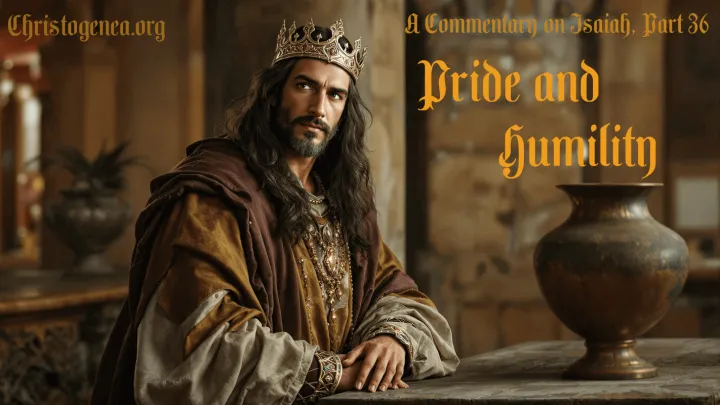
A Commentary on Isaiah, Part 36: Pride and Humility
As we proceed with our commentary on Isaiah, it is fitting to note that at this point there are only three chapters left to what we would consider the historical portion of Isaiah, which is that portion which pertains to the events of the prophet’s own time. From Isaiah chapter 41 and through to the end of Isaiah in chapter 66, the entire purpose of the prophet is to relate the will of God concerning the children of Israel in captivity, and their future preservation, along with their redemption and ultimate salvation in the coming of their Messiah, who is indeed revealed as the incarnation of Yahweh God Himself in the words of the prophet. But for now, the first two of these last three chapters describe events in the life of Hezekiah had apparently occurred both during and after the failed siege, and then chapter 40 contains a message of comfort for the remaining inhabitants of Judah in Jerusalem.
In our last commentary on Isaiah, where we had left off at the end of chapter 37, Yahweh had defended Jerusalem As Birds Flying, as He had promised in a prophecy found in Isaiah chapter 31, a promise which had been uttered no more than a few years earlier than the failed Assyrian siege. Now we are at Isaiah chapter 38, and Hezekiah is described as having been deathly ill “in those days”, which also seems to be a reference to the time of the Assyrian siege, and as the chapter progresses it becomes evident that this chapter actually contains an account which is parallel to chapter 37, that it describes events which had transpired at the same time as the events of the later portion of chapter 37. However while the people of Jerusalem had every reason for the celebration and praise of Yahweh their God, having been threatened by and delivered from the hand of the Assyrians, the narrative following the last verses of both 2 Kings chapter 19 and Isaiah chapter 37, where Sennacherib was described as returning to Assyria, only focuses on Hezekiah’s concurrent illness. There is nothing recorded of the mood in Jerusalem following the lifting of the siege and the withdrawal of Sennacherib, and nothing concerning the attitude of Hezekiah immediately after the delivery of Jerusalem from the hand of the Assyrians.
But in 2 Chronicles chapter 32 we see a record which seems contrary to what we might expect of a nation having been delivered from destruction by their God, as God had foretold to them through the prophet Isaiah. After the fate of Sennacherib is described in much the same manner as it had been here, we read in 2 Chronicles chapter 32: “22 Thus the LORD saved Hezekiah and the inhabitants of Jerusalem from the hand of Sennacherib the king of Assyria, and from the hand of all other, and guided them on every side. 23 And many brought gifts unto the LORD to Jerusalem, and presents to Hezekiah king of Judah: so that he was magnified in the sight of all nations from thenceforth. 24 In those days Hezekiah was sick to the death, and prayed unto the LORD: and he spake unto him, and he gave him a sign. 25 But Hezekiah rendered not again according to the benefit done unto him; for his heart was lifted up: therefore there was wrath upon him, and upon Judah and Jerusalem. 26 Notwithstanding Hezekiah humbled himself for the pride of his heart, both he and the inhabitants of Jerusalem, so that the wrath of the LORD came not upon them in the days of Hezekiah.”
That account informs us that after the failed siege of the Assyrians, Hezekiah had magnified himself rather than Yahweh his God, whom alone had been worthy of such magnification. So it portrays that as the reason why Hezekiah had become sick in the aftermath of the siege, where the author of 2 Chronicles chapter 32 explained that Hezekiah “humbled himself for the pride in his heart”, which was the pride he had for himself after the failed siege, as he portrays it, a pride which should have been reserved for Yahweh God. The author of 2 Chronicles next described the riches of Hezekiah, and the matter of the Babylonian ambassadors which is described here in Isaiah chapter 39. This, we shall see, is rather contrary to the sequence of events as it is explained here in Isaiah chapter 38. Furthermore, the account here in Isaiah is supported in 2 Kings chapter 20, where Hezekiah’s illness is described, and where Yahweh answers his prayer and says in part, “6 And I will add unto thy days fifteen years; and I will deliver thee and this city out of the hand of the king of Assyria; and I will defend this city for mine own sake, and for my servant David's sake.” So we see that according to both Isaiah and 2 Kings, this is indeed a parallel account of the events we had seen described in Isaiah chapter 37. Here we must note, that the books of Chronicles do seem to be a later compilation of what once might have been much longer and more detailed records. The proof of that is in the genealogies at the beginning of 1 Chronicles, which extend down to the second temple period for the people who had returned to Judah after they were released from the Babylonian captivity, but, or course, not for the tribes of the much earlier Assyrian captivity (i.e. 1 Chronicles 3:17-24).
In any event, Hezekiah must have been prone to succumbing to his own pride. But this is mostly evident from another aspect, which is found in the Assyrian records. While Isaiah had warned not to turn to Egypt for help, Hezekiah had indeed turned to Egypt for help, defying the words of the prophet. It is further evident in the matter of Padi, king of Ekron, that Hezekiah also made a league with at least some of the cities of the Philistines in the cause against the Assyrians. So, as we had discussed in our presentation of Isaiah chapter 37, only in the end was Hezekiah compelled to turn to Yahweh his God, when the Egyptians were defeated at Eltekah, and all of his other choices were apparently exhausted.
Now as we proceed with the historical portion of Isaiah, while these last three chapters may seem rather anticlimactic, some nevertheless interesting events are described, and they also contain a foreboding prophecy of one quite significant event in the subsequent history of Judah, which was the result of one of the final acts recorded in the life of Hezekiah. As a king, Hezekiah had often failed, however at the same time he was granted mercy, and in that mercy he had success, on each occasion where he had humbled himself and sought Yahweh his God. So Hezekiah should be viewed as a positive example and a model for Christians today, as we all often fail yet we should continue to seek God and His mercy in spite of our failures.
38:1 In those days was Hezekiah sick unto death. And Isaiah the prophet the son of Amoz came unto him, and said unto him, Thus saith the LORD, Set thine house in order: for thou shalt die, and not live.
Modern critics of this prophecy of Isaiah claim that because Hezekiah did not die immediately, but had instead ruled in Jerusalem for another fifteen years, that this is somehow a false prophecy. However that claim is an opportunistic lie. Throughout Scripture, the judgment of God is turned aside, or at least postponed, on account of His mercy, and especially as a result of the prayers and repentance of men, or even to give men space for prayers and repentance. First it must be noted here, that Isaiah had never told Hezekiah precisely when he would die, and if Hezekiah had made a choice to prioritize prayer and repentance in the course of getting his house in order, then Yahweh had left room for that circumstance, and had chosen to grant Hezekiah mercy, which is reflected as this chapter proceeds.
So this is not a false prophecy, because Hezekiah did not die immediately. Of course, all men eventually die, but Hezekiah lived, according to the records of Scripture, for exactly the number of additional years which Yahweh had granted him on account of his repentance as it is described here.
It has already been described from 2 Chronicles chapter 32, that Hezekiah was lifted up with pride, that he “rendered not again according to the benefit done unto him”, meaning that he did not give Yahweh the glory appropriate for the deliverance of Jerusalem, and that “26 Notwithstanding Hezekiah humbled himself for the pride of his heart, both he and the inhabitants of Jerusalem, so that the wrath of the LORD came not upon them in the days of Hezekiah.” But that is not how the chain of events is described here in Isaiah, or in 2 Kings. Rather here, Hezekiah may have had pride before the coming of the Assyrians to the walls of Jerusalem, and perhaps the preparations he made for the expected siege were also a reflection of that pride. But in Isaiah chapter 37, once he was given no other choice, once he realized that help would not be coming from Egypt, and was told that the Assyrians knew that he had sought help from Egypt, which is also reflected in their surviving inscriptions, only then had Hezekiah repented of his pride and turned to his God.
But the repentance of Hezekiah is evidently not the same repentance as that which is described here, and perhaps chapter 38 is actually describing something which had happened not long after the events of chapter 37 had begun, even during the siege itself, but before Sennacherib had departed for Assyria. This is the most plausible scenario, but nevertheless difficult to pinpoint precisely, since insufficient details are provided. However in any case, Hezekiah repents here, and as a result, Jerusalem would be delivered from the hands of the Assyrians, in the circumstances which had already been described in chapter 37.
While the acts of Hezekiah which had been recorded in Assyrian inscriptions seem to reflect his pride, where it is evident that he had sought to save Judah by his own means, apart from the Word of God, given the ultimatums by Rabshakeh at the wall of Jerusalem and the later pronouncement of the king of Assyria he certainly was humbled and repented, and therefore this illness may have struck him at the same time, or more plausibly, he must have been stricken ill shortly thereafter, during the ensuing siege. If Hezekiah was ill when the siege was lifted, there would have been no manner by which he could have taken credit for the Assyrian withdrawal for himself. So that is my hypothesis on the chronology of these events, but in any event, it seems that the record of the sequence of these events as it was later presented in 2 Chronicles chapter 32 is somewhat inaccurate.
Now Hezekiah is ill, and the words of Isaiah had even forebode his death:
2 Then Hezekiah turned his face toward the wall, and prayed unto the LORD, 3 And said, Remember now, O LORD, I beseech thee, how I have walked before thee in truth and with a perfect heart, and have done that which is good in thy sight. And Hezekiah wept sore.
The words translated as “perfect heart” are not necessarily a boast. The word for perfect is שלם or shalem (# 8003), which according to Strong’s Concordance is “complete (literally or figuratively); especially friendly”, which is rather odd since it is provided without elaboration. Gesenius has as his primary definition for the word “whole, perfect”, and then “sound, safe”, thirdly “completed, finished” and then finally, “cherishing peace and friendship” [1]. This last definition best fits the context here, that Hezekiah had a peaceful and friendly heart towards Yahweh his God. So rather than “in truth and with a perfect heart”, the Dead Sea Scrolls Bible translates the phrase to read “faithfully and wholeheartedly”. The truth of these words is supported in the historical Scriptures where we read in 2 Kings chapter 18 that as soon as Hezekiah ascended to the throne of his father, “3… he did that which was right in the sight of the LORD, according to all that David his father did.” That is also corroborated in 2 Chronicles chapter 29, where in both places it is described how Hezekiah had also torn down many of the idols in Judah and Jerusalem.
In those same chapters in 2 Kings and 2 Chronicles it is described that Hezekiah was 25 years old when he became king, and here in Isaiah chapter 36 we learn that these events had unfolded in the fourteenth year of his reign, so he is no older than thirty-eight or thirty-nine years of age here. Now once again, Hezekiah is described as having repented, and it is plausible that this repentance came shortly after the repentance of Isaiah chapter 37, and even during the time of the actual siege of Jerusalem. While it may be remotely possible that it had been earlier than the repentance of the previous chapter, in our opinion, that is far less likely since it was not mentioned at that time that Hezekiah had been ill. If he became ill during the siege, then everything here falls into place without straining the imagination, or the words of Isaiah himself and the order in which he had chosen to present these accounts. Isaiah would be the best witness to these events, since he is a contemporary and an eyewitness present when they had occurred.
Now, on account of Hezekiah’s repentance:
4 Then came the word of the LORD to Isaiah, saying, 5 Go, and say to Hezekiah, Thus saith the LORD, the God of David thy father, I have heard thy prayer, I have seen thy tears: behold, I will add unto thy days fifteen years. 6 And I will deliver thee and this city out of the hand of the king of Assyria: and I will defend this city.
At this point in the Dead Sea Scrolls Bible it is noted that the scroll known as 1QIsaiaha, a primary source for Isaiah in the scrolls, contains an interpolation adding the following words to the end of verse 6: “for my sake and my servant David’s sake.” The words appear in no other ancient source which we may access. We will discuss this scroll later, where it shall become further evident that it is not so authoritative a copy of Isaiah as the editors of The Dead Sea Scrolls Bible often seemed to imagine.
That final verse, where Yahweh promises once again to defend Jerusalem, informs us that the city must be under siege at the time when Hezekiah falls ill, and perhaps Sennacherib is already outside the gates making his preparations for the assault against the walls. So Hezekiah, who had ruled for twenty-nine years, but who had been besieged in his fourteenth year, may now be in his fifteenth year. If he had been in his fourteenth year, having ruled for only thirteen years at this point, the addition of fifteen years would only total twenty-eight, depending on the months of the events in question.
So with this the timing of this event is evident, that it is at least late in his fourteenth year or very early in his fifteenth. Hezekiah may not have done anything specific to have fallen ill at this time, but as we have seen earlier in his rule he had tended to be prideful, and now at the critical moment that the attempt on Jerusalem by the Assyrians was about to be disrupted in a rather miraculous manner and by Yahweh Himself, Hezekiah was reduced to a state of abject humility. It should have been his greatest moment as the king of Judah, seeing the lifting of the siege, a hundred and eighty-five thousand soldiers miraculously slain in one night, but instead, he was on his deathbed. Then once the proverbial smoke has cleared, the pride of Hezekiah shall cause him trouble once again, as it is described in chapter 39.
Now Hezekiah is given a sign of his assurance, which he had evidently requested, even if Isaiah did not record the request here. So after the promise of the additional fifteen years, we read in 2 Kings chapter 20: “7 And Isaiah said, Take a lump of figs. And they took and laid it on the boil, and he recovered. 8 And Hezekiah said unto Isaiah, What shall be the sign that the LORD will heal me, and that I shall go up into the house of the LORD the third day?” This will be mentioned at the end of this chapter. But where it continues in 2 Kings chapter 20, in verse 9, we see something very similar to what follows here:
7 And this shall be a sign unto thee from the LORD, that the LORD will do this thing that he hath spoken; 8 Behold, I will bring again the shadow of the degrees, which is gone down in the sun dial of Ahaz, ten degrees backward. So the sun returned ten degrees, by which degrees it was gone down.
On a sundial, since there are about 24 hours in a day, each hour is represented by 15 degrees on the dial, so ten degrees represents forty minutes. There are 1,440 minutes in a day (24 x 60) and therefore each degree represents 4 minutes (1,440 / 360 or 360 x 4). This sundial having been called the “dial of Ahaz”, it is evident that Ahaz had installed the dial in Jerusalem. But sundials are known to have existed in ancient Egypt from even before the time of the Exodus. Of course, they could only be used to reckon the time of day during the daylight hours, and different measurements were used to reckon the time of night, such as water clocks or burning candles.
It may simply be that Isaiah was purposely more concise here, where in 2 Kings chapter 20 there is a longer account of this event, where Isaiah is described as having given Hezekiah a choice concerning the movement of the sun which is reflected on the dial, where we read in part: “9 And Isaiah said, This sign shalt thou have of the LORD, that the LORD will do the thing that he hath spoken: shall the shadow go forward ten degrees, or go back ten degrees? 10 And Hezekiah answered, It is a light thing for the shadow to go down ten degrees: nay, but let the shadow return backward ten degrees. 11 And Isaiah the prophet cried unto the LORD: and he brought the shadow ten degrees backward, by which it had gone down in the dial of Ahaz.” At that point in 2 Kings, the account of Hezekiah’s illness ends and the narrative of the ambassadors from Babylon which we see here in Isaiah chapter 39 is presented. However here in this chapter Isaiah records the prayer of Hezekiah which followed the sign on the sun dial of Ahaz his father, and the prayer corroborates the things which Isaiah had neglected to mention at this point here, such as his offer of a choice in the direction of the dial which he made to Hezekiah.
The descriptions of this event have spawned some hare-brained theories. But first I must state, that I do not believe that this account supports arguments in favor of either the theoretic heliocentric or geocentric models of the so-called solar system, as we might know them. Whether the earth stood still, or whether the sun stood still during Joshua’s long day, which is recorded in Joshua chapter 10, is immaterial, because either way, within the limited perspective of man, it would have appeared as if it were the sun which was standing still. Likewise here, so that the shadow would move on the dial, whether the earth was moved, or the sun, it is immaterial because either way, it would have appeared as if the sun had moved from the earthly perspective of man. Think of a fly on the inside of an automobile window watching the trees go by, and never realizing that it was the automobile itself which was moving. For my part, I have no opinion of whether the solar system, or even the entire universe, revolves around our sun or around our earth, because that is also purely a matter of perspective, and from our earthly point of view we only think that we can answer it correctly.
However in relation to that, I had once read a book titled Joshua’s Long Day, written by a former American military officer named Charles Totten, who was a graduate of West Point, a university professor after his retirement from the military, and an adherent of the British Israel variety of Christian Identity, and also the author of at least several books related to that profession. He lived to be only 57 years old, and died in 1908. The book was carried in the catalogs produced by Destiny Publishers, which was Howard Rand’s publishing concern. In his book concerning Joshua’s long day, which is described in Joshua chapter 10, there is a section subtitled Shadowed on the Dial of Ahaz, in which we read, in part:
It is the firm conviction of the writer, fully borne out by certain conditions impressed upon the verification of these events as part of one grand entirety, that the actual duration of the stoppage of relative motion, in Joshua's day, was exactly 23/⅓rd hours, and that, to avoid calendric confusion, the High Priest, or official time-keeper naturally authorized the intercalation of a full day (24 hours) at the time of the Beth Horon occurrence: that, nevertheless, it was always thereafter a matter of the most careful record that this intercalation was 40 minutes in excess of the truth.
This knowledge must have descended to the days of Hezekiah and Isaiah, the latter of whom, probably fully informed thereon, made double purpose in his later and equally extraordinary request that this remaining part of the missing hour might be, then and there, made up, and the Calendar thus made absolutely correct.
To some this may sound convincing, but I am not persuaded by his arguments. While we have reasons to like Charles Totten, this aspect of his writing is sheer sophistry, because first, it did not matter to Isaiah which direction Hezekiah had chosen where Isaiah had asked him, as it is recorded in 2 Kings chapter 20, “shall the shadow go forward ten degrees, or go back ten degrees?” Furthermore, Isaiah could not have known the answer in advance. Then secondly, if Yahweh decided to make one day longer or shorter than all the others, what would it really matter to the high priest, if the next year began on the day of the Spring Equinox regardless of the time intervening? If the new year came a day early, the Sabbath might be shortened by a day, but the next year and the subsequent calendars would function as they would have been expected to function. In those days, there were really no clocks to reset. Man makes a calendar and measures time based on the movements of the heavenly bodies, but the heavenly bodies do not have to conform to the calendars of man. So the concept that the heavenly bodies must be “made absolutely correct” according to a calendar of men is quite arrogant, and reflects the same obnoxious sort of arrogance prevalent in today’s climate scams, that man somehow has control over nature and must correct it. Yahweh will humble the proud.
Now Isaiah presents a prayer, and evidently also a writing, issued by Hezekiah as he had repented and was healed of his disease:
9 The writing of Hezekiah king of Judah, when he had been sick, and was recovered of his sickness:
Now the words which follow, from verses 10 through 20, and even through verse 22, are represented as having come directly from Hezekiah himself:
10 I said in the cutting off of my days, I shall go to the gates of the grave: I am deprived of the residue of my years. 11 I said, I shall not see the LORD, even the LORD, in the land of the living: I shall behold man no more with the inhabitants of the world.
The word for grave here is שׁאול or Sheol (# 7585), which is more than just the grave, but the underworld abode of the dead. It is usually translated as Ἅιδης or Hades in Greek, as that was the name of the Greek idol whom they imagined had served as the overseer of the dead in their pagan religion. Among ancient Greeks, the place was originally called Τάρταρος, but the name of the idol eventually replaced that name in popular usage. In 1 Samuel chapter 28, the spirit of the prophet had emerged from Sheol even after his death, and prophesied to Saul foreseeing his own death, so Samuel had even prophesied out of Hades, and his words had been fulfilled. Hades is described in 1 Peter chapter 3 as the abode of the spirits of the dead, the prison in which they were kept, and as the place where Christ had preached the gospel even to those sinners of the race of Adam who had died in the flood of Noah.
Where Hezekiah had proclaimed “I shall not see the LORD, even the LORD, in the land of the living”, it is evident that the souls of the dead who had died before Christ had been alienated from God, but that men had a hope to commune with God as they lived. From the time of Christ, the Christian perspective has changed, since now the dead have been reconciled to God, and as Paul said, in 2 Corinthians chapter 5, “6 Therefore we are always confident, knowing that, whilst we are at home in the body, we are absent from the Lord: … 8 We are confident, I say, and willing rather to be absent from the body, and to be present with the Lord.”
The word translated as residue, which is יתר or yether (# 3499), would have more appropriately been translated as remainder. In verse 11, where Hezekiah had lamented that “I shall not see the LORD, even the LORD, in the land of the living”, he seems to have expressed a hope that only manifested itself in the Christian age, in the prospect of the return of Christ. So Job had expressed similarly, in Job chapter 19: “26 And though after my skin worms destroy this body, yet in my flesh shall I see God.”
12 Mine age [or time of life] is departed, and is removed from me as a shepherd's tent: I have cut off like a weaver my life [as a weaver would cut the thread from a loom]: he will cut me off with pining sickness: from day even to night wilt thou make an end of me. 13 I reckoned till morning, that, as a lion, so will he break all my bones: from day even to night wilt thou make an end of me. 14 Like a crane or a swallow, so did I chatter: I did mourn as a dove: mine eyes fail with looking upward: O LORD, I am oppressed; undertake for me. 15 What shall I say? he hath both spoken unto me, and himself hath done it: I shall go softly all my years in the bitterness of my soul. 16 O Lord, by these things men live, and in all these things is the life of my spirit: so wilt thou recover me, and make me to live.
In the Dead Sea Scrolls Bible, the last phrase of verse 16 is translated more accurately to read “Now you have restored my health and let me live.” The Septuagint, as Brenton has it, reads “and thou hast revived my breath; and I am comforted, and live.” Hezekiah is not expressing a hope that he may live, but making a statement of gratitude, that he was already granted his desire to live, in the words uttered by Isaiah. So up to this point, Hezekiah rather poetically describes the depression and lamentation caused by the knowledge of certain death, and glorifies God that He has now decided to let him live.
17 Behold, for peace I had great bitterness: but thou hast in love to my soul delivered it from the pit of corruption: for thou hast cast all my sins behind thy back.
Here the act of mercy in the continuance of life is described as a forgiving of sin, that since Hezekiah is allowed to live, his sins must also have been forgiven, and therefore this is also a confession that he had sinned, even if he did not explain how he sinned. This we also read in the 19th Psalm, where David professed not quite understanding at least some of his own errors, or sins: “8 The statutes of the LORD are right, rejoicing the heart: the commandment of the LORD is pure, enlightening the eyes. 9 The fear of the LORD is clean, enduring for ever: the judgments of the LORD are true and righteous altogether. 10 More to be desired are they than gold, yea, than much fine gold: sweeter also than honey and the honeycomb. 11 Moreover by them is thy servant warned: and in keeping of them there is great reward. 12 Who can understand his errors? cleanse thou me from secret faults. 13 Keep back thy servant also from presumptuous sins; let them not have dominion over me: then shall I be upright, and I shall be innocent from the great transgression. 14 Let the words of my mouth, and the meditation of my heart, be acceptable in thy sight, O LORD, my strength, and my redeemer.”
18 For the grave cannot praise thee, death can not celebrate thee: they that go down into the pit cannot hope for thy truth. 19 The living, the living, he shall praise thee, as I do this day: the father to the children shall make known thy truth.
As it is professed in the 115th Psalm, “17 The dead praise not the LORD, neither any that go down into silence. 18 But we will bless the LORD from this time forth and for evermore. Praise the LORD.” So now we read here in these words of Hezekiah:
20 The LORD was ready to save me: therefore we will sing my songs to the stringed instruments all the days of our life in the house of the LORD.
So Hezekiah wrote songs, and this certainly appears to be one of those songs, since it is evident that this is actually a work of poetry which is akin to many of the Psalms of David, who often wrote similarly in praise of Yahweh after he had been delivered from times of peril. Like other poems found in the historical books of Scripture, it merits a distinction along with the song of Debra, or even the apocryphal song of Manasseh. However the prose translation here detracts from its literary value.
Now the lump of figs is mentioned, as well as the question posited by Isaiah, both of which had been described in 2 Kings chapter 20 but not mentioned until this point here in this account, where Hezekiah still seems to be reflecting on what had happened and he ends his prayer.
But as we shall see, there is contention as to whether the next two verses belong to Hezekiah, however I am fully persuaded that they do. They celebrate what the corresponding account in 2 Kings chapter 20 had presented as historical fact, and they commemorate the healing of Hezekiah in the words which had belonged to the prophet. I would only have translated the opening words of verse 22 to read “Hezekiah had then said…” as it was a response to Isaiah’s promise of recovery.
21 For Isaiah had said, Let them take a lump of figs, and lay it for a plaister upon the boil, and he shall recover. 22 Hezekiah also had said, What is the sign that I shall go up to the house of the LORD?
These words are a poetic device employed by Hezekiah, commemorating the fact that the promise of recovery had been uttered by the prophet of God, and therefore explaining that Hezekiah had been healed by the Word of God. But as we have said, there is contention over these last two verses, but first we shall have a short digression.
While I had neglected to discuss it in our presentation of chapter 37, the editors of The Dead Sea Scrolls Bible assert that verses 5 through 7 of that chapter as they appear in 1QIsaiaha had been added by a later hand, because they had been written in a somewhat smaller script. This claim I must reject, since those verses are also attested in the Hexapla of Origen as having been present in his copies of the Hebrew, the Old Latin, the Septuagint, and in the translations of Aquila of Sinope, Symmachus and Theodotion. So they were clearly known throughout those five hundred years of witnesses, spanning over the same period of time during which the Dead Sea Scrolls had been preserved in jars in caves in the desert.
Likewise here, there is a note at this point in The Dead Sea Scrolls Bible pertaining to the same scroll, 1QIsaiaha, where we read:
The original scribe stopped after the opening words of verse 20; then a second scribe inserted additional text: a repetition of verse 19 and the beginning of 20, plus the rest of 20. Yet a third scribe added the two odd sentences in 21-22, which occur in 2 Kings 20, after verse 39. The resulting text (without the repetition) agrees with the text transmitted by the Masoretic Text and the Septuagint.
First, where they had written “in 2 Kings 20, after verse 39”, the citation is inaccurate, because while the statements do appear in that chapter, they are found at verses 7 and 8, and the chapter is only 21 verses long. However more importantly, verse 21 here has several words which vary with the corresponding passage in 2 Kings 20:7, so it is not a mere copy of that passage.
Isaiah 38:21: ויאמר ישׁעיהו ישׂאו דבלת תאנים וימרחו על־השׁחין ויחי׃
2 Kings 20:7: ויאמר ישׁעיהו קחו דבלת תאנים ויקחו וישׂימו על־השׁחין ויחי׃
Furthermore, the text of verse 22 here is much shorter than the text of 2 Kings 20:8, so they are not a mere copy. These passages are also present in the witnesses recorded in Origen’s Hexapla, so they were not necessarily the later addition of some scribe.
Isaiah 38:22: ויאמר חזקיהו מה אות כי אעלה בית יהוה׃ ס
2 Kings 20:8: ויאמר חזקיהו אל־ישׁעיהו מה אות כי־ירפא יהוה לי ועליתי ביום השׁלישׁי בית יהוה׃
So what this shows is that the original scribe of 1QIsaiaha was indeed corrected by later hands, even if they themselves had not been perfect, and therefore his omissions in Isaiah could not justly be claimed to have been interpolations where they appear in other manuscripts, some of which may well have been earlier than his own. So again we would assert that the copyist of 1QIsaiaha had not produced a document which is as authoritative as the editors of The Dead Sea Scrolls Bible would lead us to believe.
Furthermore, as we hope to have already explained, the text found in verses 21 and 22 here are indeed a fitting end to Hezekiah’s poetic description and profession of repentance and healing, as they explain the manner by which he had been healed.
As we continue with Isaiah chapter 39, perhaps we should note that the authors of 2 Chronicles chapter 32, where a parallel account is reported, only mentioned the occasion of the Babylonian ambassadors in passing, in a single verse, while here their interest is described as having been sparked by some news of Hezekiah’s recovery from illness. A corresponding account to that which Isaiah presents here is found in 2 Kings 20:12-19. So now we shall commence with Isaiah chapter 39, and the last historical event in the life of Hezekiah as it is recorded in Scripture, except for the brief descriptions of his death:
39:1 At that time Merodachbaladan, the son of Baladan, king of Babylon, sent letters and a present to Hezekiah: for he had heard that he had been sick, and was recovered.
The name Merodachbaladan accords with the names of the Babylonian god Marduk or Mardok, an idol worshipped by the Babylonians. And the name of Baal, which we shall describe shortly. A less likely reading found in 2 Kings chapter 20 certainly represents a scribal error, where it has Berodachbaladan instead. The name Baladan is evidently cognate to the Hebrew words ba’al and adon, and means “Baal is Lord”. Here it must be noted, that at this point in history the Babylonians had been striving for independence from the Assyrians, whose rule they had been under since the closing years of the reign of Tiglath-Pileser III, and it is plausible that they had been looking for allies in that endeavor here. So just some several years later, some time after the eighth campaign of Sennacherib, we read in an inscription the following:
In the same year with the opening (lit., flowing) of that canal which I dug, against Umman-menanu, king of Elam, and the king of Babylon, together with many kings of mountain and sea, who were their allies, in the plain of the city of Halule I drew up the battle line. At the command of Assur, the great lord, my lord, like a swift javelin I went into their midst and accomplished the defeat of their armies. Their hosts I shattered, I broke up their organization. The chieftains of the king of Elam, together with Nabu-shum-ishkun, son of Merodach-baladan, king of Babylonia, my hands took alive in that battle. [2]
It is plausible that the Babylonians had learned of the failed Assyrian siege and Hezekiah’s recovery, and for those things they must have flattered him, but in any event, now Hezekiah’s pride surfaces once again:
2 And Hezekiah was glad of them, and shewed them the house of his precious things, the silver, and the gold, and the spices, and the precious ointment, and all the house of his armour, and all that was found in his treasures: there was nothing in his house, nor in all his dominion, that Hezekiah shewed them not.
We do not know the identity of these men whom Merodachbaladan had sent, but they must have been trusted ambassadors, and of course, all ambassadors also function as spies, since they would report everything which they had seen and heard to those who had sent them. In the Assyrian inscription, we see that Merodachbaladan certainly was a historical figure, and his actions had real world consequences. But the Assyrians continued to prevail, so his own efforts were fruitless, and it would still be nearly 90 years before they gained their independence in the destruction of Assyria. The word of God concerning this visit must have come to Isaiah as soon as it had happened:
3 Then came Isaiah the prophet unto king Hezekiah, and said unto him, What said these men? and from whence came they unto thee? And Hezekiah said, They are come from a far country unto me, even from Babylon.
It is a sign of Hezekiah’s good character and integrity, that in spite of his rule and his pride, he seems to have been always honest and forthright with Isaiah, and therefore he certainly must have sincerely feared Yahweh his God. So where Isaiah continues:
4 Then said he, What have they seen in thine house? And Hezekiah answered, All that is in mine house have they seen: there is nothing among my treasures that I have not shewed them.
So this would, of course, be reported back to the kings of Babylon, and it probably remained in their collective memory, that Jerusalem was rich with treasure and a gem waiting to be taken for themselves. In what we would consider a commentary, in the account of Hezekiah’s life in 2 Chronicles chapter 32, we read: “31 Howbeit in the business of the ambassadors of the princes of Babylon, who sent unto him to enquire of the wonder that was done in the land, God left him, to try him, that he might know all that was in his heart.”
In any event, it is evident that Hezekiah’s pride has once again brought him into judgment before God, and therefore for what he had done, Hezekiah is now given a rather ominous portent:
5 Then said Isaiah to Hezekiah, Hear the word of the LORD of hosts: 6 Behold, the days come, that all that is in thine house, and that which thy fathers have laid up in store until this day, shall be carried to Babylon: nothing shall be left, saith the LORD. 7 And of thy sons that shall issue from thee, which thou shalt beget, shall they take away; and they shall be eunuchs in the palace of the king of Babylon.
Of course, this would be fulfilled about a hundred and ten or maybe a hundred and fifteen years later, as Nebuchadnezzar sacks Jerusalem, completely destroys the city and the temple, and even before that he had taken Jehoiachin, the king of Judah six generations after Hezekiah, into captivity along with his sons. While Zedekiah, the brother of Jehoiachin, was the last king of Judah, he was so wicked that his own sons were slain before his eyes, before his own eyes were put out and he was taken off to Babylon, according to 2 Kings chapter 25.
However the eventual destruction of Jerusalem had been prophesied from the very opening chapters of Isaiah, and in different ways on various occasions throughout these first thirty-nine chapters. Then, the rise to Babylon as an empire is also evident, in Isaiah chapters 13 and 14 and the burden of Babylon which had been uttered there by the prophet. So Hezekiah’s actions did not instigate the destruction of Jerusalem, but rather, it is evident that “God left him, to try him, that he might know all that was in his heart”, as we read in 2 Chronicles chapter 32.
However while Hezekiah was prideful before men, he always seemed to have been humble before God, and in the final verse of this chapter he responds to the warning of the prophet, in a manner which once again reflects that humility:
8 Then said Hezekiah to Isaiah, Good is the word of the LORD which thou hast spoken. He said moreover, For there shall be peace and truth in my days.
He was happy to have peace in his own days, but must have known that there was nothing which he could offer to do to change the future.
This concludes our commentary on Isaiah through chapter 39. When we return, chapter 40 offers comfort for Jerusalem, and from chapter 41 Isaiah becomes purely prophetic of Israel in captivity.
Footnotes
1 Gesenius’ Hebrew-Chaldee Lexicon to the Old Testament, translated by Samuel Prideaux Tregelles, Baker Books, 1979, p. 830.
2 Ancient Records of Assyria and Babylonia, Volume II: Historical Records of Assyria from Sargon to the End, Daniel David Luckenbill, Ph.D., University of Chicago Press, 1926, p. 151.