A Commentary on Isaiah, Part 57: The Heir of the World
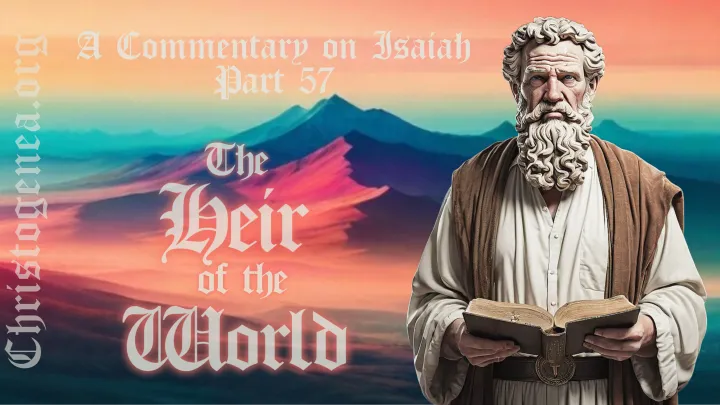
A Commentary on Isaiah, Part 57: The Heir of the World
From Genesis chapter 12 and the initial promises to Abraham, and throughout the Bible to the very end of the Book of Revelation, the entirety of Scripture may be summarized in one simple declaration: on account of the Word of God, the seed of Abraham through Jacob were given promises that they would ultimately inherit and inhabit the entire earth. There are more general promises to the entire race of Adam, and the Adamic man was created to be immortal, as the Scripture inform us, however these issues are peripheral to the more immediate promises made to this one man and his family, as we shall also see here in Isaiah chapter 54, and the the focal point of the apostles of Christ is the fulfillment of the promises to Abraham, Isaac and Jacob.
Here in Isaiah, as well as in the other books of the prophets, it is evident that these promises were never retracted or nullified, and they were never transferred to any other people. In their captivity, the children of Israel would become those many nations which had been promised to Abraham as well as in subsequent promises made to his wife Sarah, and to Isaac, Rebekah and Jacob. As Paul had written in Romans chapter 9, the children of Isaac through Jacob are counted as the seed of Abraham which is destined to inherit the promises. There Paul had repeated the promise to Abraham that “In Isaac shall thy seed be called” and then he attested that “the children of the promise are counted for the seed.” So the seed of the inheritance which is in Christ was determined in the promises to Abraham in Genesis, which Christ had come to fulfill.
The churches admit that the promises were fulfilled in Christ, but then they imagine that makes Christ the benefactor of those promises, that Christ is the seed and not the children of the promise as Paul had attested, or that Yahweh God had promised. This is a shell game that the churches play by which they imagine that they may replace the seed of Jacob with themselves, and extend the blessings of Abraham to anyone of any race who would join themselves to their church. But this is not what was taught by the prophets or the apostles. Christ is the mediator of a New Covenant that was promised exclusively to that same seed, the children of Israel. But Christ is not the sole benefactor or recipient of the promises and He won’t distribute them to anyone but to whom they were promised. Yahweh God had made a covenant and promises to Abraham. If Christ, being God incarnate, is the only seed of Abraham, why did God need Abraham in the first place? Or why did God make a covenant with Abraham to benefit only Himself? The churches have sought to nullify the Word of God with their nefarious innovations.
From Genesis chapter 12, in the first of the promises made to Abraham, we read, in part: “2 And I will make of thee a great nation, and I will bless thee, and make thy name great; and thou shalt be a blessing: 3 And I will bless them that bless thee, and curse him that curseth thee: and in thee shall all families of the earth be blessed.” The jews insist that this promise belongs exclusively to them, the churches interpret this promise as if it belongs exclusively to jews, and this represents one of the greatest examples of gaslighting in the history of man.
But in spite of how badly this verse is interpreted by jews and by the interpreters in the denominational churches, in Galatians chapter 3 Paul wrote concerning this very promise, and citing the translation of the Christogenea New Testament, he said:
6 Just as “Abraham had trusted Yahweh, and it was accounted to him for righteousness” 7 then you know that they from faith, they are sons of Abraham. 8 And the writing having foreseen that from faith Yahweh would deem the Nations righteous, announced to Abraham beforehand that “In you shall all the Nations be blessed.” 9 So those from faith are blessed along with the believing Abraham.
So regardless of whatever else one may think, according to Paul of Tarsus the promise of Genesis 12:3 belongs to Christians, and not to jews at all. If one is a Christian, then even on the surface, one should believe Paul, and not those who still deny the Christ. This alone demonstrates how badly the churches which pretend to be Christian are ignorant of Christian Scripture.
But there is a bigger question here, which is: What nations are meant by “all the nations”? There are people who insist that “all means all” but we would counter that words such as “all” or “every” always have a context. So in the King James Bible, the word which means nations which we have in verse 8 of that passage from Galatians chapter 3 is translated as heathens, as if the promises of God made to Abraham, Isaac and Jacob were actually intended for the children of their enemies rather than for their own children. Doing that, the church interpretations endeavor to rip the bread out of the hands of the children, and cast it all to the dogs, leaving nothing for the children themselves. But the promise was not made to jews, and it was not made to heathens, it was made to Abraham. Paul explained here in Galatians that the blessing would come to the nations, to certain nations, on account of the faith of Abraham, as it was Abraham who trusted – or had faith in – Yahweh.
In Romans chapter 4, Paul had defined the faith of Abraham, and since the faith of Abraham is what Abraham had believed, and not what the churches believe, we shall read some instrumental points in that definition:
13 Indeed, not through the law is the promise to Abraham or to his offspring, that he is to be the heir of the Society [or world], but through righteousness of faith…. 16 Therefore from of the faith, that in accordance with favor, then the promise is to be certain to all of the offspring, not to that of the law only, but also to that of the faith of Abraham, who is father of us all; 17 (just as it is written, ‘That a father of many nations I have made you,’) before Yahweh whom he trusted, who raises the dead to life, and calls things not existing as existing; 18 who contrary to expectation, in expectation believed, for which he would become a father of many nations according to the declaration, ‘Thus your offspring will be.’
In other words the declaration is that Abraham’s offspring would become many nations, not that many nations would become Abraham’s offspring, which is contrary to the declaration.
The surrounding nations had never blessed Abraham, and in fact, he or his sons had fought with them. Then some years later, his descendants were commanded to drive them all out, or slay them all, on account of their abominations. So none of them could be blessed for having blessed Abraham, and now they cannot bless him, since he is long departed. But if Abraham was promised to become a father of many nations, then it is those nations who can bless Abraham, by honoring their father and their God, and it is those nations whom Yahweh God shall bless in return. The commandment to honor one’s parents is the only commandment accompanied with a blessing, and this is why (Deuteronomy 5:16).
So we would assert that the nations which had descended from Abraham are the nations of Paul’s explanation of the promise in Galatians chapter 3, just as they are in Romans chapter 4, and that these nations which were promised to come from Abraham’s seed “as it is written”, as Paul had also said in Romans chapter 4, are the only nations can possibly bless Abraham because Abraham is blessed in the multitude of his seed, and not in the idle words or deeds of strangers. So going back to Galatians, Paul had also told his readers that “15 Brethren, (I speak as befits a man,) even a validated covenant of man no one sets aside, or makes additions to for himself. 16 Now to Abraham the promises have been spoken, and to his offspring.” That is not Christ by Himself, and Paul used the word heirs in the plural later in Galatians chapter 3, so Paul did not intend to state that Christ is the only heir. Nobody is going to steal Abraham’s blessing from Abraham’s seed, which is tantamount to cursing Abraham rather than blessing him.
Then where Paul said in Romans that “not through the law is the promise to Abraham or to his offspring, that he is to be the heir of the Society, but through righteousness of faith”, in Galatians chapter 3 he gave further explanation of what he had meant by that where he wrote “a covenant validated beforehand by Yahweh, the law which arrived after four hundred and thirty years does not invalidate.” So by that he means to explain that the failure of the children of Israel to keep the law does not invalidate the much earlier promises to Abraham. None of this would even be necessary to state if he had been speaking of heathens, or of those who did not descend from Abraham, because they were not the subjects of either the law or the promises. The nations of Genesis chapter 12 verse 3 are the nations which descend from Abraham and inherit the promises, and no others, as Paul also explained in his epistle to the Galatians.
So any other remarks in the verses which accompany those explanations cannot honestly be interpreted as having nullified or contradicted what Paul had said there, although that is what the jews and all the churches do. But the fact that Paul was speaking to actual descendants of Abraham through Jacob is manifest later in that same chapter, where he wrote “24 So the law has been our tutor for Christ, in order that from faith we would be deemed righteous.” Then in Galatians chapter 4 he repeated some of this in a different way where he wrote:
4 And when the fulfillment of the time had come, Yahweh had dispatched His Son, having been born of a woman, having been subject to law, 5 in order that He would redeem those subject to law, that we would recover the position of sons.
As we have long ago established elsewhere, the Galatians were indeed among the descendants of the ancient Israelites of the Assyrian captivities. But Paul himself has attested that here with these words. The reason for the differences which the Christogenea New Testament has with popular translations of these verses is not difficult to explain: it results from an honest interpretation of the Scriptures. The denominational churches take it for granted that their replacement theology is true, and then they interpret the Scriptures in any way that they can which conforms with their assumption. But the word ἔθνος is primarily a nation and not a heathen, even if in some limited contexts it may be translated as heathen. Then where we have recover in Galatians 4:5, the King James Version only has receive. The verb, ἀπολαμβάνω, has a stronger sense than receive, a meaning which λαμβάνω bears by itself, and it implies the receiving of something to which one is entitled, or to recover or regain something. [1]
Finally, where we have “the position of sons” in that same place, the Greek word is υἱοθεσία, and we have interpreted it literally. But even if we translate it as adoption, as it is in the King James Version, the same word appears in Romans chapter 9, where the King James Version also translated it as adoption, and we read:
3 For I could wish that myself were accursed from Christ for my brethren, my kinsmen according to the flesh: 4 Who are Israelites; to whom pertaineth the adoption, and the glory, and the covenants, and the giving of the law, and the service of God, and the promises; 5 Whose are the fathers, and of whom as concerning the flesh Christ came, who is over all, God blessed for ever. Amen.
So there we see a profession from Paul, in a letter which he had written over twenty-five years after the Passion of the Christ, that those who are Israelites are his kinsmen according to the flesh, not mere members of some synagogue or church, and that among other things related to the promises to Israel, the adoption also belongs to them. All of these interpretations which we offer are in firm agreement with the promises to Abraham, Isaac and Jacob “as it is written”, while the interpretations of the churches are all in conflict with those promises, and set them at naught. The churches, as well as the jews, are all guilty of attempting to steal the inheritance of Yahweh God Himself. But we should hope instead to never be found attempting to defraud God.
Here we have already cited Romans chapter 4, where in verse 13 Paul had mentioned “the promise to Abraham or to his offspring, that he is to be the heir of the Society”, and as we shall see, this chapter of Isaiah, along with some other passages of this prophet, must have been the inspiration for those words.
However where we have society in our translation of the passage from Romans, where the King James Version has world, that is because the Greek word is κόσμος, and κόσμος primarily means order, and good order, good behavior, decency. Then it is defined as the form or fashion of a thing, and speaking of states, order or government. So because of the overall meaning of the word, when applied to nations of men, it refers to their order or organization, we generally translate it as society. [2]
Therefore, speaking of the ultimate day of His wrath, in the last verse of Isaiah chapter 26 the word of Yahweh says:
21 For, behold, the LORD cometh out of his place to punish the inhabitants of the earth for their iniquity: the earth also shall disclose her blood, and shall no more cover her slain.
Then in the opening verses of Isaiah chapter 27, where the same context continues and the chapter division is once again unfortunate, we read:
1 In that day the LORD with his sore and great and strong sword shall punish leviathan the piercing serpent, even leviathan that crooked serpent; and he shall slay the dragon that is in the sea. 2 In that day sing ye unto her, A vineyard of red wine. 3 I the LORD do keep it; I will water it every moment: lest any hurt it, I will keep it night and day. 4 Fury is not in me: who would set the briers and thorns against me in battle? I would go through them, I would burn them together. 5 Or let him take hold of my strength, that he may make peace with me; and he shall make peace with me. 6 He shall cause them that come of Jacob to take root: Israel shall blossom and bud, and fill the face of the world with fruit.
As a digression, in our commentary for those passages in Isaiah, titled Triumph of the Righteous, we concluded that the serpent represents the race of the fallen angels or Nephilim who are still among the mass of the world’s people today, the mass of the world’s people being represented by the sea. Likewise, the briers and thorns are those people who had been accursed by God, and whom God had warned the ancient Israelites to destroy, lest they become “thorns in your sides” and “pricks in your eye”, or “all the land shall become briers and thorns” among other similar warnings seen in the books of Joshua and Judges.
The Hebrew word for world in that last verse we cited from Isaiah chapter 27 is תבל or tebel (# 8398). While Strong’s defines this as the earth and “by extension the globe”, but also “specifically a particular land”, Gesenius defines tebel as the “fertile and inhabited earth, the habitable globe, οἰκουμένη”, and in his second definition states that it only means “the whole earth” in appropriate contexts, and offers examples in references to the kingdoms of Babylon (Isaiah 13:11) and Israel (Isaiah 24:4). [3]
For our part, we might augment these definitions, to some degree, because it is apparent to us that tebel may also refer to the wider Mesopotamian society in those examples from Isaiah chapters 13 and 24. For example, in 1 Samuel chapter 2 where we read, in part: “8 … the pillars of the earth are the LORD'S, and he hath set the world upon them.” There the word for earth is ארץ or erets (# 776) which is primarily land, and therefore the tebel or world sitting upon the land would be the society. Yet where Gesenius equated tebel to the Greek word οἰκουμένη, which is the inhabitable earth or the dwelling space of man, that also may fit the context of these passages. In Luke chapter 2, the apostle tells us that Caesar made a decree that “all the world should be taxed” and there it is fully apparent that Caesar could only tax the Roman world, for which Luke used the word οἰκουμένη to describe.
In the context of the promises to Abraham in Genesis chapter 12, if he were to inherit the entire οἰκουμένη then that would refer to the dwelling place of the Adamic race as it was described in the table of nations in Genesis chapter 10. But Paul used the word κόσμος, which was seen by the Romans or Greeks as being the order or society of their οἰκουμένη, which is the region of earth which they inhabited. Of course, none of this inhibits a possibility that the οἰκουμένη could expand with time, and in the promises and blessings of Genesis that possibility certainly is expressed, for example in the promise that Jacob would “be fruitful and multiply; a nation and a company of nations shall be of thee, and kings shall come out of thy loins”, as he was told by God in Genesis chapter 35. Then later, in chapter 48, Jacob blesses Ephraim and Manasseh and says, in part, speaking of Manasseh first: “19 … he also shall become a people, and he also shall be great: but truly his younger brother shall be greater than he, and his seed shall become a multitude of nations.”
Even later, in Deuteronomy chapter 33, where Moses blessed the tribes of Israel he spoke in reference to Joseph and said:
17 His glory is like the firstling of his bullock, and his horns are like the horns of unicorns: with them he shall push the people together to the ends of the earth: and they are the ten thousands of Ephraim, and they are the thousands of Manasseh.
It is also evident, that since Jacob endowed upon the sons of Joseph the names of his fathers and himself in Genesis chapter 48 (48:16) and that Ephraim inherited the rights of the firstborn son of Jacob, that where it says “push the people” it refers to all of the future children of Israel, and not merely to the children of Joseph himself. So later, in the prophecy of Hosea, Ephraim is the name which Yahweh God had used to represent all of the tribes of Israel in the northern kingdom.
The world or society of the children of Israel is the only world which God has promised to preserve, ever since the promises to the fathers had been made. This is evident in chapter 18 of the Wisdom of Solomon, where Solomon portrayed himself as having prayed to God and he said, in part:
24 For upon the garment reaching to the feet was the whole Society [or world], and the glory of the fathers carved upon the four rows of stones, and Your majesty upon the diadem of his head.
With this it should be evident, that if the children of Israel were to become a great nation, a company of nations, and be pushed to the ends of the earth, that their οἰκουμένη certainly would have to expand beyond the borders of Palestine, and beyond the borders of the greater territory of Israel which was subjected to Israel in the time of David. But at the same time, Yahweh had always expected them to be a separate people, as He had commanded them from the beginning. So for example, we read in Leviticus chapter 20:
26 And ye shall be holy unto me: for I the LORD am holy, and have severed you from other people, that ye should be mine.
Then in Deuteronomy chapter 7:
6 For thou art an holy people unto the LORD thy God: the LORD thy God hath chosen thee to be a special people unto himself, above all people that are upon the face of the earth.
The Hebrew word for holy in those passages is קדושׁ or קדשׁ, qadoush or qadosh, and it means separate or apart. Sooner or later, the children of Israel shall have no choice but to keep that commandment along with all of the others found in the law.
As we have already discussed in relation to Isaiah chapter 49 and the promise of A Place of Their Own, much of that expansion of their οἰκουμένη would come to pass in the time of their captivity, although some of it had already occurred even as early as the time preceding the Exodus from Egypt, or the Judges and Kingdom periods where they had engaged in maritime trade and exploration. Now here in Isaiah chapter 54, we shall see further promises in reference to the expansion of the ancient people of Israel.
1 Sing, O barren, thou that didst not bear; break forth into singing, and cry aloud, thou that didst not travail with child: for more are the children of the desolate than the children of the married wife, saith the LORD.
In Galatians chapter 4 Paul had cited this passage after giving a lengthy allegory which had compared the people in Jerusalem who insisted on seeking their righteous through the law with Ishmael, who was born of a bondwoman, Hagar, as opposed to those who were being called to seek their righteousness from faith in Christ which are those who were born of Isaac, the son of a free woman, Sarah. To these Paul’s allegory had then likened the Sinai covenant as a covenant of bondage, to which men would be enslaved, and the promise in Christ as a covenant of liberty. Then, citing this very verse here in Isaiah, Paul wrote:
26 But the Jerusalem above is free, which is our mother. 27 For it is written, “Be gladdened, barren who is not bearing; break forth and shout, she who is not travailing; because many more are the children of the desolate than of she who has the husband.”
Saying that, Paul’s citation of this passage in Isaiah is not part of his allegory. In very next sentence in that epistle we read:
28 And we, brethren, down through Isaak, are children of promise.
Paul had already counted the Galatians as having been under the law and the covenants on several occasions earlier in chapters 3 and 4 of his epistle, so they must have been children of Isaac. However here in Isaiah, where the Word of Yahweh is addressing the children of Israel in captivity, the circumstances are different than those of Paul’s allegory, or his allegory would not have been an allegory. Here in Isaiah, the children of Israel who had only recently gone into captivity are the desolate, while the remnant of the children of Judah in Jerusalem remained as the married wife. The veracity of this later statement is fully evident in the wake of the failed Assyrian siege of Jerusalem and the resulting comfort proclaimed for the city, in Isaiah chapters 39 through 40, whereas ever since the opening verses of chapter 41 the prophet has addressed Israel in captivity.
The prophet Hosea was a contemporary of Isaiah, who had prophesied in Israel, and the fact that Israel in captivity had been considered desolate by Yahweh God is evident in Hosea chapter 4:
6 My people are destroyed for lack of knowledge: because thou hast rejected knowledge, I will also reject thee, that thou shalt be no priest to me: seeing thou hast forgotten the law of thy God, I will also forget thy children.
Then again, from Hosea chapter 9:
11 As for Ephraim, their glory shall fly away like a bird, from the birth, and from the womb, and from the conception. 12 Though they bring up their children, yet will I bereave them, that there shall not be a man left: yea, woe also to them when I depart from them!
We had seen this same expression earlier in Isaiah, in chapter 49, where the Word of Yahweh spoke to Israel and said:
20 The children which thou shalt have, after thou hast lost the other, shall say again in thine ears, The place is too strait for me: give place to me that I may dwell. 21 Then shalt thou say in thine heart, Who hath begotten me these, seeing I have lost my children, and am desolate, a captive, and removing to and fro? and who hath brought up these? Behold, I was left alone; these, where had they been? 22 Thus saith the Lord GOD, Behold, I will lift up mine hand to the [Nations], and set up my standard to the people: and they shall bring thy sons in their arms, and thy daughters shall be carried upon their shoulders. 23 And kings shall be thy nursing fathers, and their queens thy nursing mothers: they shall bow down to thee with their face toward the earth, and lick up the dust of thy feet; and thou shalt know that I am the LORD: for they shall not be ashamed that wait for me.
Ostensibly, these are the nations which Israel is told they would inherit here, by which Abraham would become the heir of the world.
The desolate are the children of Israel in captivity, the married wife continues to be the remnant of the kingdom of Judah in Jerusalem, at least until they go into Babylonian captivity, and now at least most of the children of Israel are in captivity, we see another reference to the expansion of their οἰκουμένη, or dwelling space:
2 Enlarge the place of thy tent, and let them stretch forth the curtains of thine habitations: spare not, lengthen thy cords, and strengthen thy stakes; 3 For thou shalt break forth on the right hand and on the left; and thy seed shall inherit the [Nations], and make the desolate cities to be inhabited.
We have already explained here in this commentary how groups such as the Romans and the Danaan Greeks were Israelites who had departed from Egypt by sea even before the time of the Exodus, and had settled in Europe and Anatolia. Likewise, it can be established that the Dorian Greeks had come to Greece from Palestine during the Judges period in Israel [4, 5]. Likewise, many other settlements both among the Greeks and elsewhere in Europe, such as in Miletus, Iberia, and even points beyond Iberia, were founded by the Phoenicians of Tyre, who were also of Israel [6].
Likewise, among the groups which had come out of the Assyrian captivities of Israel are the Kimmerians and Sakae, who were later called Scythians and then Galatae by the Greeks, that last name giving us the Galatians of Paul’s epistle, and also the Parthians. In turn, the Scythians spawned many divisions which had become known by other names, such as Massagetae, Goths, Huns, Saxons, and dozens of others. In the early centuries after the fall of Assyria many remained captive under the Babylonians and Persians, while others tarried in Central Asia and slowly migrated West, and still others had migrated in Europe at a very early time. So there were Scythians who were Sogdians and Bactrians, and for several centuries, at least, the Massagetae dwelt in the river valleys north of modern Afghanistan. The earliest of these tribes to enter Europe were called Kimmerians by the Greeks, as they became acquainted with them during the period when Assyria was still an empire, so it is evident that Kimmerian is derived from their Assyrian name, Khumri. Later waves of these tribes in Europe were known to the Greeks as Sakae, which is the name by which the Persians had called them. [7, 8]
Of course, I could not possibly establish all of the facts which support these assertions here, so I can only provide the references to my articles at Christogenea in which these facts are established here in my footnotes. However these things are also established by Paul of Tarsus in his epistles, where, for example, he had told the Romans that they had the truth of God and changed it into a lie, or that Abraham was their forefather, in Romans chapters 1 and 4. Then Paul had told the Corinthians, who were Dorian Greeks, that their ancestors had been baptized in the cloud and in the sea with Moses, which is a reference to the events of the Exodus, in 1 Corinthians chapter 10. Then Paul told the Galatians that they had been under the law, for which reason Christ had come to redeem them, so they also must have been of Israel, in Galatians chapters 3 and 4.
Having this information, and believing Paul of Tarsus, it is quite clear that just as the word of Yahweh has said here in Isaiah, traveling north away from the lands of their captivity the children of Israel certainly did break out on the right hand and on the left, having gone both east and west in search of new homes. During this period, and until after the fall of Rome, most of them lived a nomadic life, as we read in Hosea chapter 12:
8 And Ephraim said, Yet I am become rich, I have found me out substance: in all my labours they shall find none iniquity in me that were sin. 9 And I that am the LORD thy God from the land of Egypt will yet make thee to dwell in tabernacles, as in the days of the solemn feast.
The Hebrew word for tabernacle in that passage is אהל or ahel (# 168), which is primarily a tent and which denotes a transient or nomadic lifestyle. As late as the time of Christ, the Greek writer Strabo of Cappadocia remarked that they still lived in wagons or other temporary structures as nomads, even in Germany. So in Book 7, chapter 1 of his Geography he wrote in part:
It is a common characteristic of all the peoples in this part of the world that they migrate with ease, because of the meagerness of their livelihood and because they do not till the soil or even store up food, but live in small huts that are merely temporary structures; and they live for the most part off their flocks, as the Nomads do, so that, in imitation of the Nomads, they load their household belongings on their wagons and with their beasts turn whithersoever they think best. But other German tribes are still more indigent. [9]
There Strabo had spoken of the tribes whom the Romans had called Germans, but which had formerly been called Galatae by the Greeks, and Gauls by the Romans. In that same place, Strabo discusses the reason for the name change. But earlier, in chapter 4 of Book 4, Strabo wrote of the Galatae in Gaul, meaning those west of the river Rhine who had been conquered by Julius Caesar some decades earlier, and he said in part:
And on account of their trait of simplicity and straightforwardness they easily come together in great numbers, because they always share in the vexation of those of their neighbours whom they think wronged. At the present time they are all at peace, since they have been enslaved and are living in accordance with the commands of the Romans who captured them, but it is from the early times that I am taking this account of them, and also from the customs that hold fast to this day among the Germans. For these peoples are not only similar in respect to their nature and their governments, but they are also kinsmen to one another; and, further, they live in country that has a common boundary, since it is divided by the River Rhenus, and the most of its regions are similar (though Germany is more to the north), if the southern regions be judged with reference to the southern and also the northern with reference to the northern. But it is also on account of this trait that their migrations easily take place, for they move in droves, army and all, or rather they make off, households and all, whenever they are cast out by others stronger than themselves. [10]
There should be no doubt that the children of Israel were humbled for many centuries in the time of their captivity, and as we have seen prophesied in Hosea, they did live in tents or other temporary shelters throughout those centuries. But they still managed to multiply greatly in their indigence, just as they had also done as captives in Egypt, so there are many more of the children of the desolate than of she who has the Husband.
Now to address the clause in verse 3 which says “thy seed shall inherit the [Nations]”, it is this statement which must have contributed to Paul’s statement in Romans chapter 4 that Abraham was promised to be the heir of the world. But even earlier in Isaiah, in a promise of mercy upon Israel, and in the midst of prophecies of the fall of both Assyria and Babylon, in Isaiah chapter 14 we read:
1 For the LORD will have mercy on Jacob, and will yet choose Israel, and set them in their own land: and the strangers shall be joined with them, and they shall cleave to the house of Jacob. 2 And the people shall take them, and bring them to their place: and the house of Israel shall possess them in the land of the LORD for servants and handmaids: and they shall take them captives, whose captives they were; and they shall rule over their oppressors.
By the time of Christ, the Romans, who had descended from ancient Israel, had controlled the entire world of the Mediterranean Basin and the Middle East. The Scythian or Germanic tribes occupied much of Central Asia and northern Europe. The Phoenicians, who we would assert are the so-called proto-Kelts, occupied much of far Western Europe, Parthians ruled Persia and Mesopotamia, and Abraham had already become the heir of the world, or the ancient Adamic society, which is what the word must have meant to him at the time when the promises were uttered. All of those nations dominating the various portions of the inhabited world or οἰκουμένη were all descendants of Abraham, whether they were Scythians or Romans or Phoenicians or Parthians. In the history subsequent to the time of Christ and after the fall of Rome, the Germanic tribes and their Keltic and other kindred would dominate world history unto this day. However they did not truly come to dominate their world until they returned to Yahweh their God in Christ, for which we now read here in Isaiah chapter 54:
4 Fear not; for thou shalt not be ashamed: neither be thou confounded; for thou shalt not be put to shame: for thou shalt forget the shame of thy youth, and shalt not remember the reproach of thy widowhood any more.
The conversion of the Gauls, Iberians, Lombards and other tribes under Roman rule had occurred in the time from Constantine to Theodosius I, if it had not occurred sooner. In 380 AD Theodosius had made Christianity the official religion of the empire. Many of the Goths in the east were already Christians even before it was tolerated by Rome, although they followed the so-called Arian heresy form of Christianity.
Reading the history of Bede, it is evident that there were early Keltic churches in Britain, which had been sending missionaries to the Germanic tribes on the Continent as well as to their Anglo-Saxon neighbors, however in the late 6th century the missionaries sent to the Anglo-Saxons by the Romans seemed to be more successful at converting the Saxons of England to Christianity. Within two hundred years the various Anglo-Saxon kingdoms in Britain were unified under a very Christian King Alfred, who also instituted a law code which included the ten commandments and many other Biblical laws. Among other things, Alfred had also been determined to have the Bible translated into the English language for the common people.
About a century after the Anglo-Saxons had been converted to Christianity, the continental Saxons who remained in northwestern Germany had made war against the Franks for three decades, at the end of which they had been defeated by Charlemagne and forcibly converted to Christianity. Within a hundred and twenty years the Otto I became Duke of Saxony, King of East Franconia, in 961 King of Italy, and in 962, Holy Roman Emperor. Before he became king, in 929 he helped his father defeat the Wends, and was later seen as a savior of Christendom for his defeat of the Magyars in 955, ending their invasions of western Europe. Otto I unified Germany and Italy, however at the time Italy consisted only of Lombardy, Tuscany and Spoleto in the north.
While there were other medieval kings of Europe who also had great achievements, these two, along with the deeds of Charles Martel and his grandson Charlemagne, are preeminent in the formation of Christian Europe. Without them, perhaps there would have been no later Christian kings. Then, while Charlemagne and his successors bore the title of Emperor of the Romans, that form of the empire had lapsed in 924. So it seems that Otto I was a figure instrumental in the formation of modern Germany, the continuance of the Holy Roman Empire, and the maintaining of Christendom under the threat of both the Magyars and Slavs to the east. In the decades and centuries which ensued, the Magyars and Slavs would also be converted to Christ. The Magyars and the Poles were apparently both converted to Christianity with a decade of Otto’s death.
This is pertinent here, since Christ had referred to Himself as the Bridegroom, and now, even though the nation was already described as a wife divorced, Yahweh God declares that He is the Husband of Israel:
5 For thy Maker is thine husband; the LORD of hosts is his name; and thy Redeemer the Holy One of Israel; The God of the whole earth shall he be called. 6 For the LORD hath called thee as a woman forsaken and grieved in spirit, and a wife of youth, when thou wast refused, saith thy God. 7 For a small moment have I forsaken thee; but with great mercies will I gather thee.
In Isaiah chapter 50 we read:
1 Thus saith the LORD, Where is the bill of your mother's divorcement, whom I have put away? or which of my creditors is it to whom I have sold you? Behold, for your iniquities have ye sold yourselves, and for your transgressions is your mother put away.
Then in Hosea chapter 2:
1 Say ye unto your brethren, Ammi; and to your sisters, Ruhamah. 2 Plead with your mother, plead: for she is not my wife, neither am I her husband: let her therefore put away her whoredoms out of her sight, and her adulteries from between her breasts; 3 Lest I strip her naked, and set her as in the day that she was born, and make her as a wilderness, and set her like a dry land, and slay her with thirst. 4 And I will not have mercy upon her children; for they be the children of whoredoms.
So the children of Israel were put off by Yahweh their God, as a divorced wife is put out of the house of her husband, and they were sent off into captivity to suffer punishment for their sins. Later, the remnant of Judah is also divorced, which is described at length in Ezekiel chapter 23, and sent off into captivity in Babylon. Then in Jeremiah chapter 33, where Yahweh is portrayed as having spoken to His enemies, we read:
24 Considerest thou not what this people have spoken, saying, The two families which the LORD hath chosen, he hath even cast them off? thus they have despised my people, that they should be no more a nation before them.
However accompanying that statement is a message of hope, as Yahweh attested that He shall not cast them away completely, and the chapter ends where He said “26 … for I will cause their captivity to return, and have mercy on them.” Likewise, later in that same chapter of Hosea, there is a message of hope and ultimate reconciliation where we read:
19 And I will betroth thee unto me for ever; yea, I will betroth thee unto me in righteousness, and in judgment, and in lovingkindness, and in mercies. 20 I will even betroth thee unto me in faithfulness: and thou shalt know the LORD.
With this it should be apparent, that Christ had referred to Himself as the Bridegroom because it is His purpose to fulfill these promises, that He is the Husband of Israel, that He shall betroth the same children of Israel to Himself forever. In Matthew chapter 9, where the Pharisees had challenged Christ as to why His disciples did not fast, we read:
15 And Jesus said unto them, Can the children of the bridechamber mourn, as long as the bridegroom is with them? but the days will come, when the bridegroom shall be taken from them, and then shall they fast.
However even before that event, John the Baptist had declared that he was not the Christ, but that the Christ would come after him, and he said:
29 He that hath the bride is the bridegroom: but the friend of the bridegroom, which standeth and heareth him, rejoiceth greatly because of the bridegroom's voice: this my joy therefore is fulfilled.
These statements mean nothing if Yahshua Christ is not Yahweh God come to betroth His people Israel, as we read in the promise of Hosea, and if He is not the Husband of Israel as we read here in Isaiah. Thusly Isaiah continues and there is another promise of mercy:
8 In a little wrath I hid my face from thee for a moment; but with everlasting kindness will I have mercy on thee, saith the LORD thy Redeemer.
The usual Hebrew words for grace and kindness, which are חן or chen (2580) and חסד or chesed (2617) are quite close in spelling, and their respective roots are very similar in meaning. According to Strong’s Concordance, the root of chen is חנן or chenen (# 2603) which is “properly to bend or stoop in kindness to a superior” and for that reason it is favor, and the root of chesed, ignoring the rabbinical innovations, is spelled identically in Hebrew (# 2616) and means “properly perhaps to bow (the neck only in courtesy to an equal)” and therefore to be kind. For the first part of his definition Strong’s tells the reader to compare chenen.
We examined this, because the word chen, which is usually translated as grace in the King James Version, but almost as often as favor, appears in the prophets in reference to the children of Israel on only two occasions, in Jeremiah 31:2 and in Zechariah 12:10. The word chesed appears very often in the prophets in relation to Israel, but it is much more often translated as mercy than kindness, although there are other words which are also translated as mercy. While Strong did not include mercy in his definitions of chesed, the Septuagint translators also often translated the word with a Greek word that means mercy. So in Hebrew, these concepts of grace and kindness, as well as mercy, are all very closely related in these two words.
In spite of the few occasions of grace for Israel found in the prophets, the Greek word χάρις which is usually translated as grace in the King James Version appears nearly fifty times in the New Testament, and words meaning mercy, whether as a noun or as a verb, appear just over fifty times. In the prophets, Jeremiah chapter 31 is most relevant to this passage in Isaiah, where we read in reference to the captivity of Israel:
1 At the same time, saith the LORD, will I be the God of all the families of Israel, and they shall be my people. 2 Thus saith the LORD, The people which were left of the sword found grace in the wilderness; even Israel, when I went to cause him to rest.
Later in that same chapter, we find the explicit promise of a New Covenant for the houses of Judah and Israel. That wilderness is apparently the same wilderness we read of in Revelation chapter 12:
1 And there appeared a great wonder in heaven; a woman clothed with the sun, and the moon under her feet, and upon her head a crown of twelve stars: 2 And she being with child cried, travailing in birth, and pained to be delivered.
The woman with the twelve stars is apparently symbolic of the children of Israel, and the child is the Christ, where a description follows of a great red dragon which seeks to kill the child, a role fulfilled in history by Herod the Edomite king of Judaea. The dragon fails, and the child is caught up to His throne in Heaven, where we then read:
6 And the woman fled into the wilderness, where she hath a place prepared of God, that they should feed her there a thousand two hundred and threescore days.
This is the wilderness where the woman, the tribes of Israel, had found grace according to Jeremiah, and had received the Gospel over twelve hundred and sixty days, the Bread of Life by which she had been nourished. It took about that long, and even a little longer, before the last nations of Europe, the Baltic States, had finally converted to Christ.
In Christ, the children of Israel had inherited whatever was left of the other Adamic nations of Genesis chapter 10, today they are indistinguishable from other Europeans, and Abraham did indeed become the heir of the world, as the apostle Paul had also explained, when . Of course, there are tares among the wheat, but that is another topic entirely.
Here we shall pause our commentary on Isaiah chapter 54.
Footnotes
1 ἀπολαμβάνω, LSJ.gr, https://lsj.gr/wiki/ἀπολαμβάνω, accessed January 29th, 2026
2 κόσμος, https://lsj.gr/wiki/κόσμος, accessed January 30th, 2026
3 Gesenius’ Hebrew-Chaldee Lexicon to the Old Testament, translated by Samuel Prideaux Tregelles, Baker Books, 1979, p. 855.
4 Classical Records of Trojan-Roman-Judah, William Finck, Christogenea.org, accessed January 30th, 2026
5 Classical Records of the Dorian & Danaan Israelite-Greeks, William Finck, Christogenea.org, accessed January 30th, 2026
6 Classical & Biblical Records Identifying the Phoenicians, William Finck, Christogenea.org, accessed January 30th, 2026
7 Classical Records of the Origins of the Scythians, Parthians,& Related Tribes, William Finck, Christogenea.org, accessed January 30th, 2026
8 Classical Records and German Origins, William Finck, Christogenea.org, accessed January 30th, 2026
9 Geography, Strabo, Book 7, Chapter 1, paragraphs 3-4, Lacus Curtius, https://penelope.uchicago. edu/thayer/e/roman/texts/strabo/7a*.html, accessed January 30th, 2026
10 Geography, Strabo, Book 4, Chapter 4, paragraph 2, Lacus Curtius, https://penelope.uchicago.edu/ Thayer/E/Roman/Texts/Strabo/4D*.html#4.2, accessed January 30th, 2026