Highlights in Exodus: The Flight from Egypt
Highlights in Exodus: The Flight from Egypt
In our last presentation in Exodus, The Death of the Firstborn, we had of course discussed the last plague to come upon the Egyptians before the event of the exodus itself, which was the death of all the firstborn of the Egyptians, both of man and of beast, in a single night which was then commemorated each year by the children of Israel as the Passover, at the command of Yahweh their God. Making that presentation, we declined to discuss many of the details of the Passover feast itself, because we shall encounter it once again in the later portions of Exodus which begin to present the Law, the commandments and ordinances of Yahweh our God. So even here, where the Passover feast is described in Exodus chapter 13, we shall defer speaking of the details until we reach Exodus chapter 34, and then we hope to make a more detailed commentary, comparing the descriptions in these earlier chapters. Here we instead focused upon the death of the firstborn of Egypt, and the one significant indication in Egyptian archaeology which supports the Exodus narrative. Now, after a brief discussion of that and some of the subsequent history of Egypt, we shall focus on the actual flight from Egypt without the distraction of the details of the Passover law.
Throughout their history, the pharaohs of the Egyptians were inclined to erase memory of people and events which they found uncomplimentary or uncomfortable. This practice is called damnatio memoriae by archaeologists and historians, which is the damnation of memory, and there is a notable example of it at this very time in ancient Egypt, where this same pharaoh of the Exodus, Thutmose III, is known to have ordered the erasure of the memory of Hatshepsut, his queen regent for over twenty years early in his life. So her name and her images were chiseled from walls and other inscriptions, her statues were smashed, and her obelisks were concealed behind walls. Evidence for this has been discovered by various archaeologists since the nineteenth century, and especially where Hatshepsut’s mortuary temple was excavated, since they found it filled with fragments of her smashed statues [1]. They have also found evidence that this happened late in the reign of Thutmose III, years after the date of the Exodus, so that he could assure the unchallenged ascension of his second son, Amenhotep II, to the throne [2]. So if Thutmose III eradicated the memory of his step-mother and fellow-ruler of Egypt, Hatshepsut, for political reasons, why wouldn’t he also seek to eradicate the memory of the presence of Israel in Egypt, since it had ended in the disaster of the plagues suffered by all Egyptians?
However when his eldest son had died, Amenemhat, whom he hoped would succeed him, he could not state the cause of death without remembering the reproach upon Egypt, and therefore it would remain unexplained, as it is not mentioned in the ancient monuments. Yet he had been remembered by the title of “Overseer of the Cattle”, which, as we had said, was appropriate for a crown prince if Amenemhat had been assigned the governorship over Israel, and they had originally been overseers of the cattle of the pharaohs, which is apparent in Genesis chapter 47. But the title had also persisted through the administrations of subsequent pharaohs of the Egyptian New Kingdom period [3]. So we would assert that this is indeed a significant indication of the night of the death of the firstborn in Egyptian archaeology which supports the Exodus narrative.
However as we have explained earlier, the inscriptions of the later pharaohs of Egypt where they had mentioned Israel as the “Shasu of Yahweh”, and the Amarna tablets written by the kings of Canaan which plead for help against the invading Apiru or Hebrews, also help serve to establish the historicity of the Exodus narrative. In fact, all of these together make it quite difficult to deny the Exodus narrative and at the same time maintain any semblance of intellectual honesty. Only the Exodus narrative properly explains the inscriptions and correspondence of the Egyptians in this period, as well as the apparent decline of Egyptian power in the Near East, which was at its height in the time of Thutmose III, while in generations subsequent to Thutmose III the Egyptians gradually lost influence and power in the region.
Before the time of Akhenaton, by which the Israelites had become a much more serious threat to the cities of Canaan which were loyal to Egypt, the successor of Thutmose III, his second son Amenhotep II, led a military campaign to Syria, where he was compelled to make peace with the Mitanni Kingdom, and where they were also challenged by the Hittites to the west. During most of his rule, which is generally dated from 1425 to 1401 BC, Israel had wandered in the desert. His own son and successor, Thutmose IV, ruled for ten years about which little is known. He apparently suppressed a minor uprising in Nubia, and in one stele he is declared the “Conqueror of Syria”, a title which seems to have been a gross overstatement, since he was at peace with the Mitanni and evidently he even partook of a diplomatic marriage with a Mittani princess. It was the Mitanni who dominated Syria during this time.
After Thutmose IV, his successor Amenhotep III ruled for 38 years, from 1391 to 1353 BC, and had apparently had only one military campaign, in Kush. After him, Akhenaten ruled Egypt for 18 years, and he had also failed to intervene in any of the affairs of Canaan or Syria. During his rule, from about 1345 BC the Hittites had made war against the Mittani, and gained much territory and influence in Syria and the northern Levant, where kings formerly loyal to Egypt had switched their alliance to the Hittites. Then the Amarna tablets also give accounts of the invading Apiru, or Hebrews, who had conquered the cities of Canaan. In the aftermath of the war with the Hittites, Mittani was eventually reduced to a province of the rising Assyrian empire, and Canaan was lost to Israel. In the 10th century BC, David would take control of the Levant as far north as the Orontes River for Israel, but that position was contended for by the Assyrians throughout the 9th and 8th centuries BC. With this, it should be apparent that while Egypt was able to project some power into Canaan through the time of the pharaoh Merneptah, they were never again as powerful as they had been before the Exodus had taken place.
It is often remarked that the books of Joshua and Judges are silent on Egypt, even though in Egyptian inscriptions there is evidence of projections of Egyptian power in Canaan during those years. Pharaoh Seti I, who ruled for 20 years from about 1290 BC, marched on Canaan and received tribute from several cities, notably Bethshan (1 Samuel 31:10, 12; 2 Samuel 21:12) and Yanoam, which seems to be a reference to the Biblical city Janoah (2 Kings 15:29). A stele found at Bethshan commemorates this event, which also attests to his battles with the Apiru, or Hebrews [4]. Later, his successor, Ramesses II, who ruled Egypt around 1279 to 1213 BC, would fight the Hittites at the battle of Kadesh in 1274 BC, along with campaigns in other places in Canaan and Syria. This pharaoh also erected a stele at Bethshan, or Beth Shean [5]. The pharaoh Merneptah was his son and successor.
However while Judges appears not to mention the presence of these pharaohs in Canaan, upon a relatively new examination of Scripture in the Book of Judges, there does seem to be credible evidence in favor of the mention of the presence of these pharaohs in Canaan. In an August, 2025 article found at the Armstrong Institute of Biblical Archaeology and titled The Book of Judges Fails to Mention an Egyptian Presence in Canaan—Or Does It?, there is an assertion concerning Judges chapter 5, verse 2, where in the King James Version we read: “Praise ye the LORD for the avenging of Israel, when the people willingly offered themselves.” Concerning that verse, the article first notes that the words “for the avenging” are not in the Hebrew text, which is not quite true. In reality, it is only a poor translation of a word in the Hebrew text. Then the article compares various other translations of the first few words of that verse from Hebrew into English, such as “when leaders lead” in the New King James Version, or “for freeing freemen” in Young’s Literal Translation. Referring to those first few words, the article states:
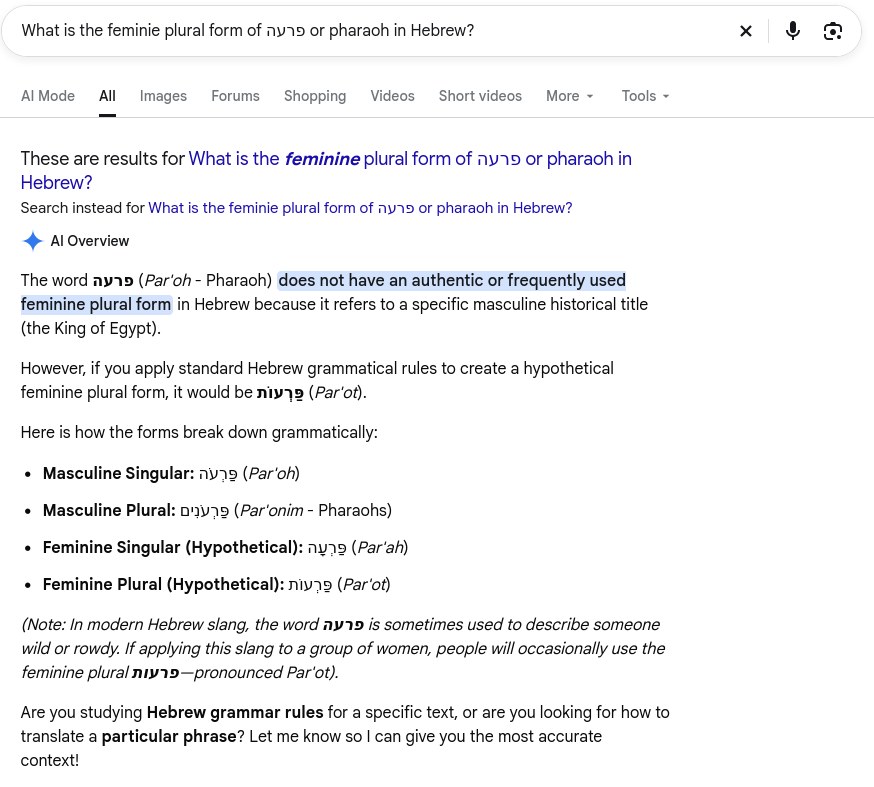
At the core of this problem are two words in Hebrew (that are in fact a play on one another, given their core consonants): בפרע פרעות [bi phara pharaoth]. For Hebrew readers, the second word, פרעות [pharaoth], is particularly striking because it happens to be precisely the plural of the Hebrew word pharaoh (פרעה).
In this phrase, apparently the assertion is not quite correct, because it is oversimplified, that פרעות or pharaoth is a precise plural of the Hebrew word פרעה or pharaoh, which is generally said to be פרעונים. However that form, or any plural for pharaoh, does not appear in Scripture. This we shall revisit later, but here we shall state that פרעות or pharaoth certainly may be interpreted as a feminine plural of the Hebrew word for pharaoh, where פרעונים or pharaonim is a masculine plural.
Then the author of the Armstrong Institute article makes an admission revealing his source for this assertion:
When I first stumbled upon this (doing a Bible word-search for the Hebrew word “pharaoh”), I was stunned. Only more so when I discovered a 2008 article on this very subject written by the late Dr. Robert D. Miller II, titled “When Pharaohs Ruled: On the Translation of Judges 5:2.”
Then the author cites Dr. Robert Miller, where we read:
“The first two words of the Song of Deborah have posed great difficulties for translators since antiquity,” he wrote. “After a review of the various proposals, this essay proposes a translation that solves the quandary of apparent Israelite ignorance of Egyptian domination of Palestine in the Late Bronze and Early Iron Ages.”
It is then explained that Miller had pointed out that these first two words are the opening of the Song of Deborah, where the citation of the author continues:
He highlighted these two opening words of the song, בפרע פרעות [bi phara pharaoth], as the “colophon or ‘byline’ of the song.” Miller reviewed the various attempts in both early and later sources to translate this passage, pointing out various improbabilities and impossibilities in such attempts. In spite of all such attempts at translation, “[t]he meaning of these words is actually quite clear. The second word is obviously the plural of ‘pharaoh’ ….”
Miller explained the construct of the word. Further, given the initial word—פרע [phara] (the first letter ב [b or bet] is a prefix [with, by, etc.])—is related, it is clear that there is word-play going on here. He continued:
The Hebrew writers wished to coin a phrase: “When the Pharaohs pharaohed.” Namely, they wanted to coin a verb that would cover the action done by a pharaoh and express the combination as a cognate accusative. Compare Numbers 11:4 [“lusters lusting”]; Isaiah 35:2 [“blossoms blossoming”]; Psalm 14:5 [“fearful fearing”], where the accusative noun is likewise anarthrous …. This would best be rendered in English as “When Pharaohs ruled.” …
[This] fits the function of the superscription better than any of the other proposals; it actually provides a date formula that situates the events of the song. [7]
With this we have to agree. Those first two words, בפרע פרעות, certainly are the same, except for the use of prefixes and suffixes. The word pharaoh in Scripture is commonly spelled פרעה [p-r-a-h or pe-resh-ayin-he], and this certainly does seem to be a play on words. In the Greek of the Septuagint, however, there is early confusion evident, because there are so many differences between the Greek of the Codex Alexandrinus compared to that of the Codex Vaticanus in the book of Judges, that the Rahlfs-Hanhart edition of the Greek Septuagint presents them both separately, on split pages.
So we read the opening words of the verse in the Codex Vaticanus where it has ἀπεκαλύφθη ἀποκάλυμμα ἐν Ισραηλ, which we would translate as “A revelation was revealed in Israel”, but in the Codex Alexandrinus we read ἐν τῷ ἄρξασθαι ἀρχηγοὺς ἐν Ισραηλ, which we would translate as “at the time when rulers ruled in Israel”. Yet Israel had no rulers in the Judges period, as Yahweh their God was their king, so the reference to rulers here must be a reference to foreign rulers. In the Hexapla of Origen, both of these readings are provided and are attributed to differentiating manuscripts of the Septuagint, at a time over two hundred years before the Codex Alexandrinus is esteemed to be dated. Origen also provides readings of another phrase from Aquila of Sinope and Theodotian which is later in the verse, but there is no indication of what they had written at the beginning of the verse. We will only mention that Aquila’s reading in that later portion of the verse supports the Codex Vaticanus, and Theodotion’s supports the Alexandrinus. However, that circumstance alone does not assure that their full readings of the verse agreed with the corresponding versions of the Septuagint for these opening words of the verse [6].
So we have obtained an electronic copy of Robert Miller’s original paper, titled When Pharaohs Ruled: On the Translation of Judges 5:2, and in support of the grammar concerning the feminine form of the noun for pharaoh, he wrote in part:
The opening words of the song are found at the start of Judg. 5:2. They are bipĕrōaʽ pĕrāʽôt [the phrase we transliterated above as bi phara pharaoth]. The first word is Qal infinitive construct [a verb], and the second is a feminine plural noun. As will be shown below, there have been many different translations given for these words. But first, it should be noted that they clearly form the colophon or ‘byline’ of the song. Whatever the song’s relationship with the events in the narrative of Judges 4 (and I do not consider it a given that the song does relate to them), the temporal setting of the song is given in the superscription bipĕrōaʽ pĕrāʽôt. [8]
In his paper, Miller mentioned other scholars who had worked on this problem, so the debate over the translation of these words is not peculiar to him alone. But as we shall see, we do not agree with a footnote which Miller had made here at this point in his paper which reads:
It is not my contention that the Song has anything to do with Egypt or an Egyptian presence in Canaan; the reference to Egypt is merely a date formula. [9]
Since pharaohs had ruled in Egypt for many centuries before and after the Song of Deborah, this reference would be useless as a mere date formula, but the pharaohs only ruled in Canaan, or portions of Canaan, for a relatively short period of time, and this century leading up to the time of Deborah was the later half of that period, which began in the time of Ahmose I, after the expulsion of the Hyksos from Egypt.
So here we must offer the opinion that concerning the meaning of the Hebrew phrase, Robert Miller and the later author of the Armstrong Institute article which we have cited here are correct, and the reading of the opening verse of the Song of Deborah to read “when the pharaohs pharaohed”, or “when the pharaohs ruled”, where the wordplay is lost, is very plausibly a reference to this very time of Seti I, Ramesses II and Merneptah. Furthermore, Jabin king of Canaan, for whom Sisera had led an army, very well may have been a vassal of these Egyptian pharaohs. Now we shall discuss the date formula, as Miller recognized some of this, but he did not bring it to a full and proper conclusion.
It is stated in Scripture that Moses led Israel for forty years, until his death around 1410 BC, and then Joshua judged Israel for 30 years. From the time of the death of Joshua circa 1380 BC, there are 8 years of the rule Chushan-rishathaim, 40 years of rest under the judge Othniel, 18 years of Moabite oppression and 80 years of rest during the time of Ehud, whereafter some time around 1234 BC, Israel was delivered into the hands of Jabin king of Canaan, in Judges chapter 4. So Jabin oppressed Israel for 20 years, which brings us to 1214 BC, near the end of the rule of the pharaoh Ramesses II who died in 1213 BC. So while the chronology may not be perfect, on account of the text itself, we are clearly within a reasonable time frame for the Song of Deborah to have mentioned these pharaohs in connection with this event of the deliverance of Israel from the hands of the king of Canaan. If Jabin was defeated in 1214 BC, perhaps the invasion of Canaan by Merneptah a few years later was a response to the defeat of Jabin.
So shortly after this period, the pharaoh Merneptah, the son and successor of Ramesses II, invaded Canaan once again and left the Merneptah Stele, which was discovered in Thebes, as a monument to this feat. The stele also attests to the presence of Israel in the land of Canaan, and it is both the earliest mention of Israel by that name, and the only mention of Israel by that name in ancient Egypt, as the earlier pharaohs had referred to Israel only as the “Shasu of Yahweh”. That campaign is generally dated to the fifth year of his reign or 1210 to 1208 BC, which is well within our chronology for the defeat of Jabin and Sisera around 1214 BC, and the subsequent writing of the Song of Deborah. After the rule of Merneptah had ended, the 19th Dynasty pharaohs suffered a period of conspiracies and short reigns by competing successors, two of which were his own sons, where the dynasty itself ended four pharaohs and 15 years after the death of Merneptah.
With that, we shall now return to the time of Moses and the flight from Egypt. Where we had left off in our last presentation, The Death of the Firstborn, the children of Israel had prepared for their flight, and from Exodus chapter 12 we read:
33 And the Egyptians were urgent upon the people, that they might send them out of the land in haste; for they said, We be all dead men. 34 And the people took their dough before it was leavened, their kneadingtroughs being bound up in their clothes upon their shoulders. 35 And the children of Israel did according to the word of Moses; and they borrowed of the Egyptians jewels of silver, and jewels of gold, and raiment: 36 And the LORD gave the people favour in the sight of the Egyptians, so that they lent unto them such things as they required. And they spoiled the Egyptians.
Here it must be noted, that the children of Israel had departed from Egypt urgently, in haste. This is also why they were told to eat that first Passover meal with their loins girded, their staffs in hand, and their shoes on their feet, standing, in Exodus chapter 12 (12:11), and that seems to have been a premonition of the haste in which they would have to take flight. So this must be taken into consideration during the entire time of their flight, to the point where the army of the Egyptians was destroyed in the waters of the Red Sea, and all danger was past. There are Biblical commentators who suggest that Israel had tarried for days or longer at their campsites, or that they had travelled hundreds of miles to cross the sea, however none of that it true. If it were true, it would contradict the need for such haste as is described here in the text. So we shall assert that the entire flight from Egypt had taken only a few days.
37 And the children of Israel journeyed from Rameses to Succoth, about six hundred thousand on foot that were men, beside children. 38 And a mixed multitude went up also with them; and flocks, and herds, even very much cattle.
In ancient times, it is said that Roman troops had been trained to march about 21 of our modern miles in a day, although the times vary depending on circumstances and conditions. In standard marches, the Roman armies covered 15 to 20 miles in a day, but in rough terrain as little as 5 miles, or on forced marches perhaps as many as 25 miles. But these are distances for trained Roman soldiers.
While at least most of the children of Israel may have been in a generally fit physical condition, having worked at forced labor in servitude for many years, they nevertheless had both young children and the elderly men and women in their company. They also had livestock with them, as we read here in this passage. Later, in chapter 7 of the Book of Numbers, we learn that they also had wagons, where we read that after the tabernacle in the wilderness was built:
2 That the princes of Israel, heads of the house of their fathers, who were the princes of the tribes, and were over them that were numbered, offered: 3 And they brought their offering before the LORD, six covered wagons, and twelve oxen; a wagon for two of the princes, and for each one an ox: and they brought them before the tabernacle. 4 And the LORD spake unto Moses, saying, 5 Take it of them, that they may be to do the service of the tabernacle of the congregation; and thou shalt give them unto the Levites, to every man according to his service. 6 And Moses took the wagons and the oxen, and gave them unto the Levites. 7 Two wagons and four oxen he gave unto the sons of Gershon, according to their service: 8 And four wagons and eight oxen he gave unto the sons of Merari, according unto their service, under the hand of Ithamar the son of Aaron the priest. 9 But unto the sons of Kohath he gave none: because the service of the sanctuary belonging unto them was that they should bear upon their shoulders.
So those wagons must have also been with Israel as they departed from Egypt, since at that time they had not yet suffered the forty years in the wilderness. But since oxen were pulling the wagons, and oxen walk very slowly compared to horses, perhaps only two miles an hour, even in haste it is difficult to perceive that the Israelites in their flight could have covered more than twenty miles a day, so during our discussion of their flight, we shall imagine this to have been the limitation for their daily travels.
The number of six hundred thousand Israelites does not represent the entire population. When Moses numbered the children of Israel on the plain of Moab some years after this event of the Exodus, the total of men at least 20 years of age was slightly more than six hundred thousand. So counting women and children, the number of Israelites was at least double that number, and possibly as many as triple. To many, this seems incredible, however in the Word of God, in Exodus chapter 1, we read:
7 And the children of Israel were fruitful, and increased abundantly, and multiplied, and waxed exceeding mighty; and the land was filled with them.
This process seems to have begun even before Joseph had died. Discussing this same subject in relation to our commentary on Paul’s epistle to the Galatians in 2015, we created a spreadsheet detailing the possibility of population growth over as many as twelve generations. Beginning with 30 couples, which is plausible for the number of people that Jacob had brought to Egypt, if each adult man and woman are married, and if each couple produces an average of seven children during their reproductive lifetime, then in the eighth generation a population may indeed grow to as many as one and a half million people. Since there were 215 years that Israel had been in Egypt, that would be approximately eight 25-year generations, and this figure is not at all fantastic, even in spite of the efforts of the pharaohs to reduce the population of Israel in the later decades of the period.
As for the mixed multitude mentioned here, it is apparent that many Egyptians followed the children of Israel out of Egypt. But it is unlikely, at this point in Egyptian history, that there were many people of any other races, although it cannot be entirely ruled out that there may have been some residual Canaanites or people of other tribes in the Delta region who also may have followed along. Here we must take into account the conditions during the plagues of Egypt, and realize that even many native Egyptians would have wanted an escape at this point.
This is the first time in Scripture that we see the Hebrew word ערב translated as mixed and used to describe people. Brown, Driver, Briggs in their Hebrew lexicon primarily define this word to mean “mixture, mixed company;— [a] heterogeneous body attached to a people” and secondarily, “woof (as mixed, interwoven, with warp)” [10], where warp and woof refer to two different sets of threads used to make woven fabric. There it should be apparent that this term can describe single mixed-race individuals as well as a plurality of people of different races. Apparently, the mixed multitude who remained with Israel would have died off in the wilderness, if they had not conformed, or perhaps could not conform, to the piety expected of them here in the later chapters where the Law is recorded.
Now, after a comment explaining that the children of Israel had no leaven, and had prepared no food for their journey, there is a chronological reference:
40 Now the sojourning of the children of Israel, who dwelt in Egypt, was four hundred and thirty years. 41 And it came to pass at the end of the four hundred and thirty years, even the selfsame day it came to pass, that all the hosts of the LORD went out from the land of Egypt.
The way in which numbers of years are accounted in Scripture is not always as we in our own modern culture may expect them today. As we have pointed out in our Genesis commentary, and especially in part 60, which is titled A Post-Genesis Chronology, this number is actually inclusive of all the time from the call of Abraham to the event of the Exodus, half of which was consumed by the lives of Abraham, Isaac and Jacob in Canaan, and the other half which began when Jacob had brought his family down to Egypt. So the children of Israel actually spent only about 215 years of the 430 in Egypt, and only a portion of that in a state of servitude, which began after the death of Joseph. By our chronology, Joseph died about a hundred and forty five years before the Exodus event. This is the way that Paul of Tarsus had reckoned the same period, where he wrote in Galatians chapter 3:
17 And this I say, that the covenant, that was confirmed before of God in Christ, the law, which was four hundred and thirty years after, cannot disannul, that it should make the promise of none effect.
Then, concerning the night of the death of the firstborn of Egypt, which coincided with the Passover and the flight from Egypt the very next morning, we read:
42 It is a night to be much observed unto the LORD for bringing them out from the land of Egypt: this is that night of the LORD to be observed of all the children of Israel in their generations.
We shall see that this is later codified in the Law, in several places, but here in Exodus chapter 34. But this is an ordinance, and not a commandment, as we shall see next:
43 And the LORD said unto Moses and Aaron, This is the ordinance of the passover: There shall no stranger eat thereof: 44 But every man's servant that is bought for money, when thou hast circumcised him, then shall he eat thereof. 45 A foreigner and an hired servant shall not eat thereof.
Later, in the law, there are conditions for certain strangers, namely Syrians and Egyptians, that they could be incorporated into the body of the children of Israel if they fulfill certain conditions (Deuteronomy 23:7-8). However these conditions for the eating of the Passover remain concerning other strangers or hired servants, as they have no such privilege in the Law, and no expectation of being incorporated into the body of Israel according to the Law.
The word translated as ordinance here and in verses 17 and 24 of this chapter, for example where we read in verse 17 that the Passover and feast of Unleavened Bread “shall ye observe this day in your generations by an ordinance for ever”, is חקת or chuqah (Strong’s # 2708). But the word for law here is the Hebrew word תורה or תרה, which is torah (# 8451), the word generally used to describe the Law. So here there is a distinction between types of law, which we shall be aware of through our discussions of the Law from Exodus through Deuteronomy. To at least a great extent, this distinction seems to have been upheld in the King James translation. There is one exception, in Genesis chapter 47 (47:26) where a term closely related to chuqah, which is חק or choq (# 2706) is translated as law but would have been better translated as statute or ordinance.
Now this is all we shall say concerning the details of the keeping of the Passover and the date on which it was celebrated until we reach Exodus chapter 34, so we shall now commence with Exodus chapter 13, but we shall only discuss the verses relevant to the flight from Egypt:
17 And it came to pass, when Pharaoh had let the people go, that God led them not through the way of the land of the Philistines, although that was near; for God said, Lest peradventure the people repent when they see war, and they return to Egypt: 18 But God led the people about, through the way of the wilderness of the Red sea: and the children of Israel went up harnessed out of the land of Egypt.
The children of Israel we described as having lived in the land of Rameses as early as Genesis chapter 47. Once they were put into servitude by the Egyptians, they were commanded to build cities, one of which was called Raamses. This may have been the site of the later city Pi-Ramesses, but it was certainly in the same vicinity. Pi-Ramesses was built, or rebuilt, by the pharaoh Ramesses II as his new capital, in the mid 13th century BC, at least a hundred years after the Exodus. In the time of Joseph, Rameses and Goshen are used synonymously. The ancient site of Pi-Ramesses is about 62 miles northeast of old Cairo, and 42 miles southwest of the modern Port Said, a large port on the Mediterranean near the egress of the Suez Canal. The coasts of the Mediterranean east and northeast of Port Said would have been populated with the Philistines of Gaza, who were already known as a warlike people, and who would certainly have seen so many Israelites advancing on their territory as a threat worthy of war. But the Philistine cities were on the coast, as they were primarily a maritime people, and the “wilderness of the Red Sea” is not as far to the south of the coast as one may be led to believe. From Port Said to the northernmost tip of the Gulf of Suez, which is part of the Red Sea, is about 90 miles.
Now there is a peripheral comment:
19 And Moses took the bones of Joseph with him: for he had straitly sworn the children of Israel, saying, God will surely visit you; and ye shall carry up my bones away hence with you.
At the end of his life, in the last portion of the Book of Genesis, we read in chapter 50:
24 And Joseph said unto his brethren, I die: and God will surely visit you, and bring you out of this land unto the land which he sware to Abraham, to Isaac, and to Jacob. 25 And Joseph took an oath of the children of Israel, saying, God will surely visit you, and ye shall carry up my bones from hence. 26 So Joseph died, being an hundred and ten years old: and they embalmed him, and he was put in a coffin in Egypt.
For us, this reflects the folly of all those who imagine that they may find Joseph’s tomb in Egypt. Upon the death of Joseph, his own people would have seen to him, rather than the Egyptians, and the capital of Egypt had been moved to Thebes from the Delta area, where it remained for many years. As the crow flies, ancient Thebes is over 300 miles south of old Cairo, and 360 miles south of Rameses. So Joseph’s bones were certainly kept with his own people in Rameses, and he should not be sought among the tombs of the ancient pharaohs and their officers.
Later, we read in Joshua chapter 24:
31 And Israel served the LORD all the days of Joshua, and all the days of the elders that overlived Joshua, and which had known all the works of the LORD, that he had done for Israel. 32 And the bones of Joseph, which the children of Israel brought up out of Egypt, buried they in Shechem, in a parcel of ground which Jacob bought of the sons of Hamor the father of Shechem for an hundred pieces of silver: and it became the inheritance of the children of Joseph.
Now it seems that it could not have been more than a single day and night that the children of Israel had departed for Succoth and encamped, as they were in haste to leave Egypt, and now Moses continues with their flight:
20 And they took their journey from Succoth, and encamped in Etham, in the edge of the wilderness. 21 And the LORD went before them by day in a pillar of a cloud, to lead them the way; and by night in a pillar of fire, to give them light; to go by day and night: 22 He took not away the pillar of the cloud by day, nor the pillar of fire by night, from before the people.
Here it is apparent that they would have left Succoth in the second morning of their journey. But the locations of Succoth and Etham are not known today. So we only know what we are told here, and in Numbers chapter 33 (33:6), that Etham was “in the edge of the wilderness” of Egypt. In these chapters of Exodus, the words desert and wilderness are often from the same Hebrew word, מדבר or midbar (Strong’s # 4057). Either way, the Delta area was much more fertile and more populated than the surrounding wilderness, and if the Israelites had travelled north or directly east in their flight from Egypt, they would have passed closely to the land of the Philistines, which we read here that they had purposely avoided. So they must have went to the south, and by today’s maps, the wilderness outside the Delta is at least 30 miles from Rameses, depending on how directly south a route they had taken. However 30 miles, or no more than 40 miles, is consistent with the distance which they could expect to make in two days.
In reference to the pillar of cloud and the pillar of fire, which were certainly one and the same pillar, here we see the presence of Yahweh God represented by physical phenomena, just as had been apparent to Moses in the burning of the bush in the land of Midian. Later, the presence of God would be made manifest in the rock in the desert. But ultimately, it is made manifest once and for all in the person of Yahshua Christ.
Moving on to Exodus chapter 14:
1 And the LORD spake unto Moses, saying, 2 Speak unto the children of Israel, that they turn and encamp before Pihahiroth, between Migdol and the sea, over against Baalzephon: before it shall ye encamp by the sea. 3 For Pharaoh will say of the children of Israel, They are entangled in the land, the wilderness hath shut them in. 4 And I will harden Pharaoh's heart, that he shall follow after them; and I will be honoured upon Pharaoh, and upon all his host; that the Egyptians may know that I am the LORD. And they did so.
This seems to indicate that the children of Israel did indeed travel south leaving Rameses, and were on the edge of the wilderness near to or approaching the vicinity of Cairo. To turn towards the sea, which in this case would be the Gulf of Suez, they would have to turn east and make a southeasterly course. The locations of Pihahiroth, Migdol and Baalzephon are not known today. It is not even assured that the Egyptians had used those names for the places in Egypt which the Hebrew references. Of these, only Migdol is mentioned outside of the description of the flight of the Exodus. However the Migdol of Jeremiah chapters 44 and 46, where the name is found elsewhere, even if it is also in Egypt is not necessarily the same Migdol as the Migdol of this account, eight hundred years later, since Migdol simply means tower and seems to be a common name for military fortresses or lookout towers.
But if the children of Israel had crossed the Gulf of Suez on its northwest shore, near the modern Red Sea town of Adabiya, that would be about 75 miles from Rameses, or if they crossed further south on the same shore, near the modern town of Ain Sokhna, that would be just over 80 miles. Either location could be reached, but only if they traveled a more difficult pace of about 25 miles per day.
Here we would assert, that because the children of Israel had travelled in haste to leave Egypt, they did not tarry at any one of these three stopping points, at Succoth, Etham or Pihahiroth. However depending on the location of Pihahiroth, it is possible that while Yahweh told Moses to leave Etham and go there, that it took a second day to get there, so the Israelites may have had a fourth day to reach Pihahiroth, or it may be that Pihahiroth was a little further down the coast, and they needed a fourth day. In any event, the flight from Rameses to the sea could not have taken longer than three days, or perhaps four.
Here we allow for this in our estimation, because the children of Israel had a head start of full two days on the Egyptians, one to travel from Rameses to Succoth, and a second to travel to Etham. If the Egyptian chariots embarked from a camp in the Delta area, their chariots could travel up to 30 miles in a typical day, but they would need at least a day, and more likely two days, to find and catch up to Israel. The following account seems to have transpired while Israel was on the way to Etham, but perhaps not until the next day when they were in the process of travelling to Pihahiroth:
5 And it was told the king of Egypt that the people fled: and the heart of Pharaoh and of his servants was turned against the people, and they said, Why have we done this, that we have let Israel go from serving us? 6 And he made ready his chariot, and took his people with him: 7 And he took six hundred chosen chariots, and all the chariots of Egypt, and captains over every one of them. 8 And the LORD hardened the heart of Pharaoh king of Egypt, and he pursued after the children of Israel: and the children of Israel went out with an high hand. 9 But the Egyptians pursued after them, all the horses and chariots of Pharaoh, and his horsemen, and his army, and overtook them encamping by the sea, beside Pihahiroth, before Baalzephon.
The name Baalzephon is compounded from Baal, the title of the Canaanite and Babylonian deity, and a word which means north, so it is Lord of the North. It is not clear what Baalzephon is here, as it could be a mountain or hill, of a place established by the Hyksos who had previously ruled Lower Egypt and the area of the Nile Delta. But there is one more variable which we have not yet mentioned: at least some modern archaeologists have posited the assertion that the Gulf of Suez had once extended much further north than it does today, to include the Great Bitter Lake which is found on the modern Suez Canal which connects the Gulf to the Mediterranean Sea since it was built in the 19th century. Others also include Timsah Lake to the north of the Great Bitter Lake, so that the Gulf of Suez may have extended as many as 45 miles further north than it does today. If this is the case, we would have to reconsider the possible points of crossing, but in the end it really does not matter all that much as the outcome would be the same, as we shall see later in our discussion, when after their crossing, the children of Israel are found in the Wilderness of Shur.
Continuing with the pursuit of the Egyptians:
10 And when Pharaoh drew nigh, the children of Israel lifted up their eyes, and, behold, the Egyptians marched after them; and they were sore afraid: and the children of Israel cried out unto the LORD. 11 And they said unto Moses, Because there were no graves in Egypt, hast thou taken us away to die in the wilderness? wherefore hast thou dealt thus with us, to carry us forth out of Egypt? 12 Is not this the word that we did tell thee in Egypt, saying, Let us alone, that we may serve the Egyptians? For it had been better for us to serve the Egyptians, than that we should die in the wilderness.
Seeing the hardness of the hearts of most people today, it probably should not startle us, that the Israelites who had left Egypt had witnessed all the plagues of Egypt and the miracles and power of Yahweh firsthand, and still doubt that He would deliver them from Egypt. Yet even after departing through the midst of the sea, they shall remain just as stubborn when they get to the other side. Of course, they have remained that stubborn all throughout history. The people always seem to seek instant gratification, rather than await the salvation of Yahweh their God, regardless of how often they have heard of or even witnessed His salvation in the past.
13 And Moses said unto the people, Fear ye not, stand still, and see the salvation of the LORD, which he will shew to you to day: for the Egyptians whom ye have seen to day, ye shall see them again no more for ever. 14 The LORD shall fight for you, and ye shall hold your peace.
This seemed to be a reasonable appeal to the people by Moses, yet the answer Moses received could not have been what he had expected:
15 And the LORD said unto Moses, Wherefore criest thou unto me? speak unto the children of Israel, that they go forward: 16 But lift thou up thy rod, and stretch out thine hand over the sea, and divide it: and the children of Israel shall go on dry ground through the midst of the sea. 17 And I, behold, I will harden the hearts of the Egyptians, and they shall follow them: and I will get me honour upon Pharaoh, and upon all his host, upon his chariots, and upon his horsemen. 18 And the Egyptians shall know that I am the LORD, when I have gotten me honour upon Pharaoh, upon his chariots, and upon his horsemen.
Whether the parting of the Red Sea had some underlying cause found in some natural phenomenon is really not relevant, by any means it was miraculous. While there are several lessons which may be drawn from this event, we shall not be able to conceive of them all in this one presentation. So we shall say this: that when faced with challenges, if we truly have faith and want to overcome them, we should confront them head on, as Moses was told to do here, rather than attempt to avoid them, and in Yahweh our God we have hope to prevail. There are many historical accounts of men in the past who did that very thing, and did prevail.
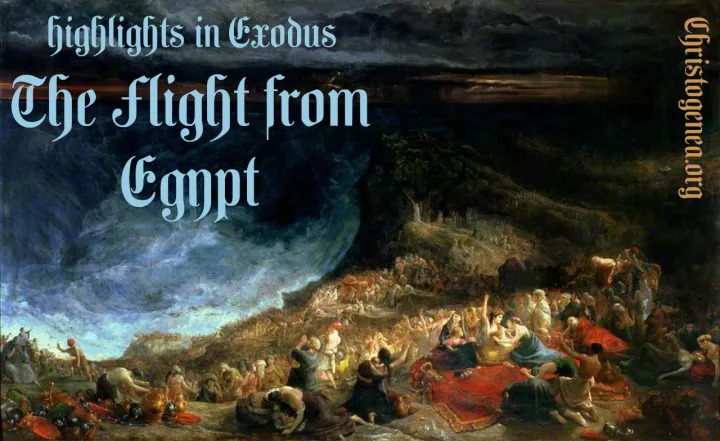
19 And the angel of God, which went before the camp of Israel, removed and went behind them; and the pillar of the cloud went from before their face, and stood behind them: 20 And it came between the camp of the Egyptians and the camp of Israel; and it was a cloud and darkness to them, but it gave light by night to these: so that the one came not near the other all the night. 21 And Moses stretched out his hand over the sea; and the LORD caused the sea to go back by a strong east wind all that night, and made the sea dry land, and the waters were divided. 22 And the children of Israel went into the midst of the sea upon the dry ground: and the waters were a wall unto them on their right hand, and on their left. 23 And the Egyptians pursued, and went in after them to the midst of the sea, even all Pharaoh's horses, his chariots, and his horsemen.
Just as the Egyptians suffered the plague of darkness in Exodus chapter 10, while the children of Israel had light, so it is here, that even in the midst of the sea the Egyptians were hampered by the darkness and could not pursue the successfully, but the children of Israel once again had light, even though it seems that much of the crossing transpired in the nighttime hours. If the crossing occurred on the coast that we had first mentioned, in the event that the geography of the Gulf of Suez did not differ drastically from what it is today, then the length of the crossing was somewhere around 8 or 9 and as many as 20 miles. So it may have been a full day’s journey just to cross through the sea, which is consistent with what follows:
24 And it came to pass, that in the morning watch the LORD looked unto the host of the Egyptians through the pillar of fire and of the cloud, and troubled the host of the Egyptians, 25 And took off their chariot wheels, that they drave them heavily: so that the Egyptians said, Let us flee from the face of Israel; for the LORD fighteth for them against the Egyptians.
The morning watch is the last watch of the night, a watch being about a fourth of the duration of the night, so we see tht the Red Sea crossing certainly did take all night for the children of Israel to accomplish. We do not know how far the Egyptians could have gotten into the sea in darkness, but going down a river even on the darkest of nights, one may follow the stars above to ensure that he is on the right path, since the stars are obscured when one ventures too close to the treeline. So we can imagine that passing through the sea with walls of water on each side is not much different, and apparently they were able to make some progress even though they were hindered by the darkness. What happens next does indicate that they journeyed far enough into the sea so as to have no hope of escaping their fate:
26 And the LORD said unto Moses, Stretch out thine hand over the sea, that the waters may come again upon the Egyptians, upon their chariots, and upon their horsemen. 27 And Moses stretched forth his hand over the sea, and the sea returned to his strength when the morning appeared; and the Egyptians fled against it; and the LORD overthrew the Egyptians in the midst of the sea. 28 And the waters returned, and covered the chariots, and the horsemen, and all the host of Pharaoh that came into the sea after them; there remained not so much as one of them. 29 But the children of Israel walked upon dry land in the midst of the sea; and the waters were a wall unto them on their right hand, and on their left. 30 Thus the LORD saved Israel that day out of the hand of the Egyptians; and Israel saw the Egyptians dead upon the sea shore. 31 And Israel saw that great work which the LORD did upon the Egyptians: and the people feared the LORD, and believed the LORD, and his servant Moses.
Here it is not mentioned that the pharaoh himself had died in the sea, and this pharaoh, Thutmose III, certainly did not die since he ruled Egypt for about another 25 years, until 1425 BC. So in the end, it is apparent that he sent his troops into the sea, but he himself observed their fate from the shore, at least so far as he could see. Evidently, he would have kept at least some of his close officers and troops with him, but the bulk of them drowned. Therefore, in the end, the pharaoh of Egypt was basically a coward, not having ventured into the sea with his troops.
Yahweh willing, we shall continue our discussion of Exodus in the near future.
Footnotes
1 Unearthing Hatshepsut, Egypt's Most Powerful Female Pharaoh, Pac Pobric, The Metropolitan Museum of Art, https://www.metmuseum.org/perspectives/hatshepsut-female-pharaoh-egypt, accessed November 5th, 2026.
2 Hatshepsut Found; Thutmose I Lost, Mark Rose, Archaeology, https://archive.archaeology.org/ online/features/hatshepsut/, accessed November 5th, 2026.
3 Overseer of cattle, Wikipedia, https://en.wikipedia.org/wiki/Overseer_of_cattle, accessed November 5th, 2026.
4 Seti I, Wikipedia, https://en.wikipedia.org/wiki/Seti_I, accessed November 5th, 2026.
5 Beit She'an, Wikipedia, https://en.wikipedia.org/wiki/Beit_She'an, accessed November 5th, 2026.
6 Origenis Hexaplorum, Fridericus Field, AA. M., Volume I, Clarendon Press, 1875, p. 410-411.
7 The Book of Judges Fails to Mention an Egyptian Presence in Canaan—Or Does It?, Christopher Eames, Armstrong Institute of Biblical Archaeology, https://armstronginstitute.org/1245-the-book-of-judges-fails-to-mention-an-egyptian-presence-in-canaan-or-does-it, accessed November 5th, 2026.
8 When Pharaohs Ruled: On the Translation of Judges 5:2, Robert D. Miller II, Mount St. Mary’s Seminary Journal of Theological Studies, NS, Vol. 59, Pt 2, October 2008, p. 651.
9 ibid.
10 The Brown-Driver-Briggs Hebrew and English Lexicon, Hendrickson Publishers, 2021, p. 786.