Gaymangate with Elijah Hansen

Gaymangate with Elijah Hansen
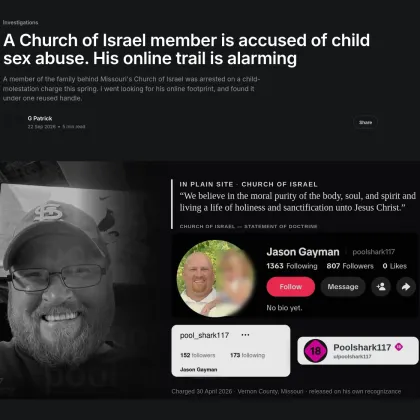
Here we are going to discuss a very uncomfortable subject, but I feel as if since I know about the subject, that I have an obligation to bring it into the open, so that our friends may also know. From what I gather, most old-time Identity Christians already despise me for upsetting quite a few of their apple carts, and view me as a trouble-maker, so why stop there?

In Scripture, when a soul sins, and a witness does not testify to the sin when he is called to do so, then he also bears the iniquity of the sinner. This is found in a rather poorly translated passage, in Leviticus chapter 5. As Christ had said in Luke chapter 12:

1 In the mean time, when there were gathered together an innumerable multitude of people, insomuch that they trode one upon another, he began to say unto his disciples first of all, Beware ye of the leaven of the Pharisees, which is hypocrisy. 2 For there is nothing covered, that shall not be revealed; neither hid, that shall not be known. 3 Therefore whatsoever ye have spoken in darkness shall be heard in the light; and that which ye have spoken in the ear in closets shall be proclaimed upon the housetops. 4 And I say unto you my friends, Be not afraid of them that kill the body, and after that have no more that they can do. 5 But I will forewarn you whom ye shall fear: Fear him, which after he hath killed hath power to cast into hell; yea, I say unto you, Fear him.

Thomas Sewell Hears about White Christianity

We thought this was a quite constructive conversation with Thomas Sewell, the former leader of Australia's now-proscribed National Socialist Network, a persecuted political organization in Australia. We appreciated Thomas' inquisitiveness and candor. But of course, like all of these encounters we have experienced with others, the discussions go in many different directions as answered questions only raise more questions. 

The Jews and Islam

The Jews and Islam

I imagine that this presentation should really be called an infocast, because for the most part I am only going to convey information from others, rather than my own first-hand research and conclusions. But then again, some things are beyond our reach, and that is all we can do in this case, which is to learn history through the eyes of others who can go places where we ourselves will never tread. So unfortunately, in order to attain first or even second-hand information concerning jewish history, one must employ jewish sources, and it seems that there was a complete dearth of medieval Western Christian scholars who even had access to penetrate jewish and islamic society in order to study their archives and develop a sense of their internal history. Political, social and linguistic isolation between the two worlds for many centuries had created an environment in which jews alone had a peculiar monopoly on any bridges between them. The few European scholars who did learn Hebrew or Arabic throughout the centuries, had done so strictly for theological reasons rather than for the investigation and writing of history.

In the past, both myself and Clifton Emahiser had cited Gibbon’s History of the Decline and Fall of the Roman Empire and Alzog’s Manual of Universal Church History in order to elucidate Muhammad’s jewish relations, however I am not going to repeat those here. Rather, here we are going to discuss much more extensive aspects of the relationship between jews and muslims, or really, some ancient sources which attest to the role of jews in the formulation of islam, and then how jews had facilitated its spread throughout the medieval world.

Highlights in Exodus: The Flight from Egypt

Exodus 12:37 - 14:31

Highlights in Exodus: The Flight from Egypt

In our last presentation in Exodus, The Death of the Firstborn, we had of course discussed the last plague to come upon the Egyptians before the event of the exodus itself, which was the death of all the firstborn of the Egyptians, both of man and of beast, in a single night which was then commemorated each year by the children of Israel as the Passover, at the command of Yahweh their God. Making that presentation, we declined to discuss many of the details of the Passover feast itself, because we shall encounter it once again in the later portions of Exodus which begin to present the Law, the commandments and ordinances of Yahweh our God. So even here, where the Passover feast is described in Exodus chapter 13, we shall defer speaking of the details until we reach Exodus chapter 34, and then we hope to make a more detailed commentary, comparing the descriptions in these earlier chapters. Here we instead focused upon the death of the firstborn of Egypt, and the one significant indication in Egyptian archaeology which supports the Exodus narrative. Now, after a brief discussion of that and some of the subsequent history of Egypt, we shall focus on the actual flight from Egypt without the distraction of the details of the Passover law.

Throughout their history, the pharaohs of the Egyptians were inclined to erase memory of people and events which they found uncomplimentary or uncomfortable. This practice is called damnatio memoriae by archaeologists and historians, which is the damnation of memory, and there is a notable example of it at this very time in ancient Egypt, where this same pharaoh of the Exodus, Thutmose III, is known to have ordered the erasure of the memory of Hatshepsut, his queen regent for over twenty years early in his life. So her name and her images were chiseled from walls and other inscriptions, her statues were smashed, and her obelisks were concealed behind walls. Evidence for this has been discovered by various archaeologists since the nineteenth century, and especially where Hatshepsut’s mortuary temple was excavated, since they found it filled with fragments of her smashed statues [1]. They have also found evidence that this happened late in the reign of Thutmose III, years after the date of the Exodus, so that he could assure the unchallenged ascension of his second son, Amenhotep II, to the throne [2]. So if Thutmose III eradicated the memory of his step-mother and fellow-ruler of Egypt, Hatshepsut, for political reasons, why wouldn’t he also seek to eradicate the memory of the presence of Israel in Egypt, since it had ended in the disaster of the plagues suffered by all Egyptians?

The X Faction, Round 2

Another conversation with our Identity Christian friends on X.com ... thanks to all who participated! The following topics are found in the discussion:

  • So-called Christian Nationalists and what they really believe.
  • What it is to be persecuted by the world. No Christian has immunity, even people of the greatest faith are going to face trials. Drugs and poor rural America.
  • Age-old corruption of Christianity by jews and the Church.
  • Learning CI Scripture is made clear, once one is willing to shed the baggage of judeo Christians.
  • Community trust impossible in an atheist, pagan or secular world.
  • Race-mixing neo-Nazis in contrast with Adolf Hitler, who would despise at least most of them as degenerates.
  • Where are we in the Revelation and other prophecy?
  • The meaning of the mark of the the beast.
  • Christian Zionism and jewish Zionism in Malachi chapter 1
  • Prayer and pretense, the “holy” things jews do are all in pretense.
  • AI, along with many other new technologies, are always used for base purposes.
  • The need for tech skills among Identity Christians, capacity of AI to help with tech.
  • CQRadio (the “Christian Question”) and the characters on X.com who are supposedly “White Nationalists” but spend much of their time and energy continually harassing Identity Christians.

And more…

Highlights in Exodus: The Death of the Firstborn

Exodus 11:1 - 12:36

Highlights in Exodus: The Death of the Firstborn

Here, after a hiatus of about six weeks, we return to our discussions of Highlights in Exodus, from where we had left off with The Plagues of Egypt. However when we discussed the plagues which the Egyptians had suffered at the hands of an angry God, on account of the insolence of their king, we had stopped short of the final plague, which is the night of the death of all of the firstborn of Egypt which had also marked the first Christian Passover. This description of the first Passover is purposeful, and will lead us to begin with a long digression:

Yes, we would assert that the first Passover was Christian, and also that every proper Passover is Christian. The people of the Old Testament were Christians, since they were looking forward to their salvation. That salvation only comes at the hand of Yahweh God Himself, and He chose to effect it through Yahshua Christ, which is evident throughout the words of the prophets. Properly, true Christians today are their descendants, as only the seed of Abraham through Jacob had been given the promises of salvation, and now they have the Gospel of Salvation, even if they continue to await its ultimate fulfillment at the marriage supper of the Lamb.

What Scripture Teaches About The “Unclean”, a Review of a paper by Clifton Emahiser

What Scripture Teaches About The “Unclean”, a Review of a paper by Clifton Emahiser

I want to apologize for not having a podcast last week, but we had a hurricane to prepare for, and it really did not let us down. It actually hit us about two hours before the podcast would have been scheduled, and lasted until almost the time the podcast might have ended. On Thursday the 8th it was projected to hit the Alabama state line near Pensacola, about 75 miles west of us, and throughout that day and the next the projected path kept moving closer to our location in Florida. So preparing for a hurricane became the priority over writing a podcast. But rather than landing in the next State, when it did come ashore the hurricane hit the next county. So we endured tropical storm force winds for probably more than a few hours, and hurricane force winds for at least an hour or two Friday evening. Quite a few structures in our village were destroyed, almost all of them by fallen oaks. This assured me that I made the right decision a few years ago, to start removing trees from our own property, which is difficult to do because giant oaks are indeed beautiful trees to live under. None of the remaining trees on our own property fell, although the storm convinced me that I should remove one more before the next hurricane season, if I can. I had tried to compromise and removed nearly half of it two years ago.

While I am not superstitious, in 2018 Melissa and I took a road trip in September where we spent most of our time in Tennessee, and returned in the early days of October only to be confronted with Hurricane Michael on October 10th, an event by which we lost the home where we had lived. So now, eight years later, on the way home from Pennsylvania we spent nearly a week in Tennessee and returned in the early days of October, and having a hurricane coming on October 9th evoked some memories which we really don’t want to relive. While we were directly in the path of Michael this hurricane struck not quite 40 miles west of us, several people lost homes in our village and many others lost other structures, such as pole barns or boat docks. Similar damage was suffered even many miles east of us. Praise Christ, that the only damage we suffered was a storm door which came off of its hinges, as the latch had failed, and we were able to catch it and bar it during the storm, so that I could repair, which I did yesterday.

European Fellowship Forum, October 2026

  • Natural plants, herbs, and pharmaceuticals, where to draw the line.
  • Roundup, glysophate, and poisons introduced.
  • GMO and “gene edited” foods, “gene edited” tomatoes now being sold in Britain.
  • Bread and circuses.
  • Nicotine for therapeutic purposes.
  • News agencies and 20th century history, practically all information out of Europe came through Reuters, and even today, just a small number of new agencies.
  • Soviet propaganda which became Holocaust “history”, including the lack of snow in Auschwitz liberation photographs.
  • Some discussion concerning the development of Holocaust propaganda in the West.
  • Pop culture and the isolation of adult children.
  • The prevalence of AI and data centers, and the depravity which is trending in AI produced content. New tech always seems to get caught up in a race to the bottom, to be used for the most depraved purposes.
  • Democracy and the illusion that the opinions of most people matter. Judeo-Christians and the Pharisees, teaching for doctrines the commandments of men.
  • Is Russia the superpower it is perceived to be? The struggle in Ukraine, etc. Donbas and Euromaidan, Azov Battalion, etc. Is there really a war in Ukraine? Not our opinion, but it is expressed by some.
  • Orthodox idolatry, icons, and the connection to the Islamic invasions, as well as the failure to repent as warned in Revelation chapter 9, a prophecy of those invasions.
  • Symbols such as the cross, swastika or Confederate battle flag: icons or symbols of expression?
  • Why is there pagan philosophy in traditional Christian Churches?
  • Crusades and wars against the Ottomans.
  • The difficulty of coming out of Babylon and being self-sufficient.
  • Addiction – a spiritual or a mere l problem?
  • Problems at Dan Gayman’s Church of Israel in Schell City, Missouri.

And more!

William Finck with Critical Review on Republic Broadcasting

This evening Etta Volk and William Finck discussed various figures who are supposed to be "White nationalists" or "Pro-White" but who are actually subversives acting against the interests of White Europeans. This was a necessary distraction, which came to the foreground of discussions in certain social media circles after our recent Mark Collett interview.

Then we spoke of the Revelation, and tried to put it in a general perspective, but the time ran short, and Etta has gracefully offered to have me back in the near future. 

Highlights in Exodus: The Plagues of Egypt

Exodus 7:13 - 10:29

Highlights in Exodus: The Plagues of Egypt

In our last segment of Highlights in Exodus, The Confrontation, Moses had finally accepted his commission from Yahweh, and returning to Egypt he met with Aaron along the way. With that meeting, it is important to observe the fact that they had met at Sinai, the “mountain of God”, and by that we know that the Mount Sinai of the Exodus was in the northern part of the Sinai peninsula, and could not have been far from the common route that was customarily traveled between Midian and Egypt. We know this because Moses had embarked on a routine journey with his family to return to Egypt, where no precautions had made it necessary to use any alternate routes, and the common route would have been the most comfortable, as there had been at least one inn where he had stopped in along the way. Likewise, Aaron was sent by Yahweh to meet Moses on his way, so Aaron also must have taken the common route and traveled until he encountered him coming in the opposite direction. With this simple understanding of this chapter, all of the insane theories about the location of Sinai having been in the extremely mountainous southern part of the peninsula are entirely discredited.

Now we shall discuss the plagues of Egypt, but first we shall have a presentation of a section of the Wisdom of Solomon. This is because many Bible commentators have for a long time connected these plagues of Egypt to the idols of ancient Egypt, and often attest that Yahweh God is mocking the idols of the Egyptians by having natural phenomena related to their own idols turn against them. Those connections are highly creditable, and to a great extent I agree, but far too often those commentators do not reveal the original source of that assessment, which is the Wisdom of Solomon. In his Wisdom, Solomon made that exact association, as the greater scope of the work compared the fate of the impious, for which Egypt was an example, with the fate of the pious, for which the children of Israel were his example.

Highlights in Exodus: The Confrontation

Exodus 4:1 - 7:13

Highlights in Exodus: The Confrontation

In Exodus chapter 3, Moses had received his appointment from the “angel” in the burning bush. Notice that while the apparition of burning in the bush was called “the angel of Yahweh” in verse 2 of the chapter, Yahweh Himself is characterized as having done all of the speaking. This should broaden our concept of the use of the word angel. The corresponding Hebrew and Greek words simply mean messenger. While an angel may be a man, and it may be a supernatural entity or being, it may also be anything which Yahweh God wants to utilize in order to send a message to men. So the burning in the bush was an angel, insofar as it was a physical apparition by which Yahweh had gotten the attention of Moses, so that He may speak to him. Since Yahweh God Himself is invisible to men, basically any physical apparition representing His presence is an angel, such as the pillars of smoke and fire which shall be manifest later in this Exodus account. This changes with the advent of Yahshua Christ, whom Paul of Tarsus had described as the image of the person of Yahweh in the opening verses of his epistle to the Hebrews.

With that event at the burning bush, we also learned from the ensuing dialogue why it is that Moses had called Him Yahweh, since when he asked God what He should be called, he was told, in verse 14 of that chapter, that “I AM THAT I AM: and he said, Thus shalt thou say unto the children of Israel, I AM hath sent me unto you.” Here we explained that the phrase which translates as “I AM” is אהוה or ahavah, which is the Hebrew word הוה or havah (# 1961), a verb which means to be, prefixed with the letter א or aleph, so that it becomes a first person verb meaning I am. So Moses, from his own perspective, understood the Name given by God to mean He is, and in proper Hebrew grammar the aleph is replaced with a י or iota, by which the verb is converted to the third person and the spelling is יהוה, which may be pronounced Yahweh or perhaps Yahavah. While we shall never really know how the verbs were enunciated in ancient Hebrew, the oldest testimony is that of Flavius Josephus, who had said in Book 5 (5:235) of his Wars of the Judaeans that the Name of God “consists of four vowels”. Since Josephus was writing in Greek, he must have meant four Greek vowels, and we can pronounce the name Yahweh with four Greek vowels, but that does not work for Yahavah.

It’ll Be More Blessed to Be “Left Behind”! A Review of a Paper by Clifton Emahiser

It’ll Be More Blessed to Be “Left Behind”! A Review of a Paper by Clifton Emahiser

The past few weeks have been difficult, and I had been compelled to miss a few podcasts, which I really hate having to do. Aside from some health issues I have had to address, for which I should be limiting the time I spend sitting at my desk, on the afternoon of Wednesday July 29th the computer I had used every day for the last eight and a half years needed to be rebooted, and it never came back on. Once I get the time, I am sure I can fix it, but in the meantime it was a lot quicker to replace.

Then on Wednesday August 7th, not long after 5:00 PM, the main Christogenea website suddenly went offline. The server was the victim of a purposeful hacking, and while a couple of things are going to remain unexplained, an exploit had been published for some of the software used by the server, and that exploit allowed a hacker a way into the system. The hacking was perpetrated through a sophisticated set of scripts, and while the target might have been random, which is less likely, to get past the firewall the hackers must have significant internet resources. But it is easier to move on and rebuild than to sit around and cry about what had been done, so by Friday afternoon Christogenea was back up and running on a new and better server. Doing that, I also took many additional precautions with the hope of making another hacking attempt even far less likely.

So this week I have decided to offer some lighter fare, and present and critique a paper by Clifton Emahiser, the title of which is a stab at a popular book series which had been published for a decade beginning in the late 1990’s, and generally titled Left Behind. The book series capitalized on the evangelical belief in a so-called rapture, a heresy which was evidently developed by John Darby, and later popularized by the Scofield Reference Bible, as well as books such as the Left Behind series. So here in the American South we often see these corny rapture bumper stickers, stating things such as “Warning in Case of Rapture This Car Will Be Unmanned” or “Your Choice: Rapture Ready or Left Behind”, among a hundred other childish and pretentious sentences.

Highlights in Exodus: The Appointment

Readings from Exodus chapter 3 and the True Meaning of the Name of Yahweh

Highlights in Exodus: The Appointment

In our last presentation in Exodus, titled The Life, and Wife, of Moses, we had also taken some time discussing the Tel el Amarna tablets, which contain a cache of correspondence from the various rulers of the city-states of Canaan, most of them written to the Egyptian Pharaoh Akhenaton. This was expedient to do, since in our first presentation, The Exodus In Controversy and History, we discussed inscriptions left behind by his immediate predecessor, Amenhotep III, which mentioned a people whom he had described as the “nomads of Yahweh”, and as having been in the land of Canaan in his time.

We have dated the Exodus event to about 1450 BC. Amenhotep III ruled Egypt from about 1391 to 1353 BC, and Akhenaten from about 1353 to 1336 BC, according to the general chronologies which sometimes differ by a few years. So after forty years of wandering in the desert of Sinai, the children of Israel, the only group who could possibly have been called the “nomads of Yahweh”, are in Canaan, which is consistent with the Biblical account of the book of Joshua. Then some time later the rulers of the various cities in Canaan are appealing to help from Egypt to ward off the invading hapiru, or habiru, a group which academic scholars are resistant to identifying as Hebrews, in spite of the consistency of the reports in the Amarna tablets with the events recorded in the books of Joshua and the early chapters of Judges.

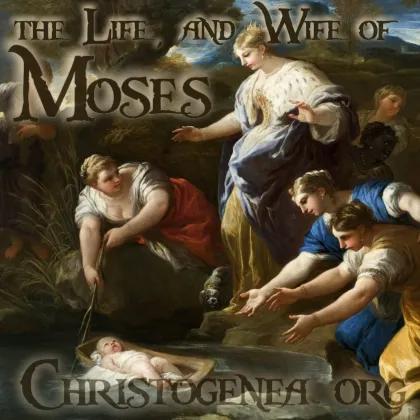
Highlights in Exodus: The Life, and Wife, of Moses

Readings from Exodus chapter 2

Highlights in Exodus: The Life, and Wife, of Moses

In our last discussion of Exodus, titled The Exodus In Controversy and History, we illustrated how the children of Israel in their nomadic post-Exodus period were described as the “Shasu of Yahweh”, which is to say, “Nomads of Yahweh”, by pharaoh Amenhotep III in inscriptions which had been made some time around 1390 BC. This correlates very well with our general estimations of the time of the event of the Exodus from 1450 BC. After over forty years of wandering in the Sinai desert, an event which the Egyptians must have spied out somewhat regularly, even if the children of Israel had gone north to the plains of Moab, and began to invade Canaan at that time, Amenhotep III must have known of their presence wandering in the wilderness, and recorded it as he had known it. This, beyond all doubt, proves the general veracity of the Exodus account.

The memory among the nobility of the Name Yahweh, a Name with which Moses had confronted the pharaoh in subsequent chapters of Exodus, also serves to corroborate the Exodus account of the plagues of Egypt and the ultimate release of Israel. So those events must have been sufficiently notable that the house of the pharaoh remember the Name of Yahweh.

Now here I am going to take an opportunity to take this proof of the historicity of the Exodus account a step further in Egyptian archaeology. While there is much academic debate as to whether the habiru or hapiru of the Tel el Amarna tablets are the Hebrews of Scripture, I would certainly insist that they are. But academic scholars point to the apparent use of the similar Akkadian word hapiru to describe groups of outlaws, brigands or robbers, or also marginalized outsiders or refugees. With this I disagree.

My first contention is this: a marginalized ethnic group taken to living outside of the fringes of society may naturally be perceived in such a manner, and the Hebrews, whether in Egypt or in Padanaram, do seem to have been marginalized and disenfranchised, having had no distinct land of their own. Then we should consider colloquialisms. For example, in Medieval Europe the word Slav, describing the people of Eastern Europe, became synonymous with slave in English, as the Vikings regularly traded Slavs as slaves in the West, whereby we have our word slave. In America today, if someone, even a friend, burdens you with undue requests, you may look at him and say something like “What am I, your nigger?” Of course, you are not making a statement that you are black, but blacks had been slaves for several hundred years, and they are the most recent slaves in our historical experience, so blacks are still associated with slavery in parts of our vernacular. The Israelites having escaped Egypt may easily have been seen in that same manner.