Highlights in Exodus: The Death of the Firstborn
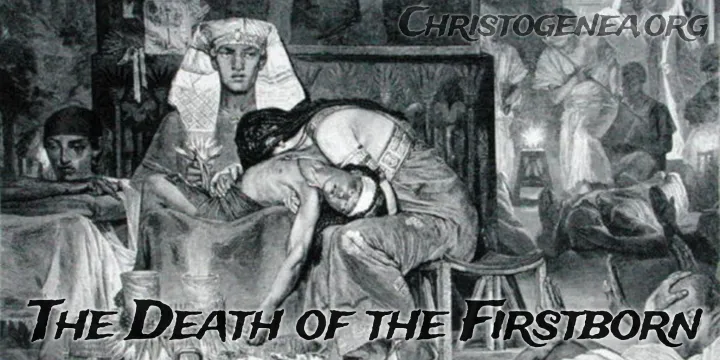
Highlights in Exodus: The Death of the Firstborn
Here, after a hiatus of about six weeks, we return to our discussions of Highlights in Exodus, from where we had left off with The Plagues of Egypt. However when we discussed the plagues which the Egyptians had suffered at the hands of an angry God, on account of the insolence of their king, we had stopped short of the final plague, which is the night of the death of all of the firstborn of Egypt which had also marked the first Christian Passover. This description of the first Passover is purposeful, and will lead us to begin with a long digression:
Yes, we would assert that the first Passover was Christian, and also that every proper Passover is Christian. The people of the Old Testament were Christians, since they were looking forward to their salvation. That salvation only comes at the hand of Yahweh God Himself, and He chose to effect it through Yahshua Christ, which is evident throughout the words of the prophets. Properly, true Christians today are their descendants, as only the seed of Abraham through Jacob had been given the promises of salvation, and now they have the Gospel of Salvation, even if they continue to await its ultimate fulfillment at the marriage supper of the Lamb.
Paul of Tarsus had made an interesting analogy when he spoke of those who carried the faith in Hebrews chapter 11, speaking in reference to Abraham:
9 By faith he sojourned in the land of promise, as in a strange country, dwelling in tabernacles with Isaac and Jacob, the heirs with him of the same promise: 10 For he looked for a city which hath foundations, whose builder and maker is God.
Then a little further on in that chapter, speaking of all of the patriarchs from Abel through Jacob, he said:
13 These all died in faith, not having received the promises, but having seen them afar off, and were persuaded of them, and embraced them, and confessed that they were strangers and pilgrims on the earth. 14 For they that say such things declare plainly that they seek a country. 15 And truly, if they had been mindful of that country from whence they came out, they might have had opportunity to have returned. 16 But now they desire a better country, that is, an heavenly: wherefore God is not ashamed to be called their God: for he hath prepared for them a city.
As Paul had written in Ephesians chapter 4 (4:5), there is only one Lord and one faith, so therefore the faith of Christians must be the same as the faith of those patriarchs, and of all Israel after them, so long as they were faithful. The New Testament is not a different faith than that of the Old Testament. The apostle Jude had commented on this where he wrote:
3 Beloved, when I gave all diligence to write unto you of the common salvation, it was needful for me to write unto you, and exhort you that ye should earnestly contend for the faith which was once delivered unto the saints.
There Jude had referenced the faith which had been delivered unto the saints of the Old Testament, and he immediately turned to events in Genesis to explain the nature of those who would attempt to corrupt that faith. Then he mentioned the event of the Exodus, in which it becomes clear that Jude was writing of a faith shared in common from the patriarchs down to the Christians of his own time. Likewise, in Romans chapter 4, Paul had explained that it is the faith of Abraham which Christians should share:
13 For the promise, that he should be the heir of the world, was not to Abraham, or to his seed, through the law, but through the righteousness of faith. 14 For if they which are of the law be heirs, faith is made void, and the promise made of none effect: 15 Because the law worketh wrath: for where no law is, there is no transgression. 16 Therefore it is of faith, that it might be by grace; to the end the promise might be sure to all the seed; not to that only which is of the law, but to that also which is of the faith of Abraham; who is the father of us all; 17 (As it is written, I have made thee a father of many nations,) before him whom he believed, even God, who quickeneth the dead, and calleth those things which be not as though they were. 18 Who against hope believed in hope, that he might become the father of many nations, according to that which was spoken, So shall thy seed be.
In Romans chapter 15, Paul wrote:
8 Now I say that Jesus Christ was a minister of the circumcision for the truth of God, to confirm the promises made unto the fathers.
The very basis of Christianity is the promises to the fathers which Christ had come to fulfill, and in that sense, looking forward to salvation, the patriarchs of our race were indeed all Christians. As Paul had explained there in Romans, the promises were fulfilled “as it is written” in Genesis, and “according to that which was spoken” to Abraham, and therefore there can be no substitute for Abraham’s seed. Later, in Romans chapter 9 (9:8), Paul had attested once again that “… the children of the promise are counted for the seed”, referring to the promises made to Isaac, and then contrasting the fates of Jacob and Esau. So the children of Jacob are the seed of the promise, and transferring the meaning of “seed” to Christ alone, in wayward interpretations of Galatians chapter 3, the denominational churches force Paul into conflict with himself, as they lie about the meanings of his words. Yet even there, Paul said “heirs” and not “heir” in relation to the promises. They also attempt to nullify the purpose of Christ for their own purposes. These are the very men of whom Jude had warned.
The City of God of which Paul had spoken in Hebrews chapter 11 was described long after Paul’s own passing, in Revelation chapter 21:
1 And I saw a new heaven and a new earth: for the first heaven and the first earth were passed away; and there was no more sea. 2 And I John saw the holy city, new Jerusalem, coming down from God out of heaven, prepared as a bride adorned for her husband…
A study of Revelation chapter 21 reveals that the City of God is actually an allegory for the children of Israel themselves, as Christians, since it is built on the foundation of the apostles of Christ, and has the names of the twelve tribes of Israel upon its twelve gates. Then, in Hebrews chapter 12, Paul further spoke of the City of God, where his words are a premonition of that chapter of the Revelation, and he sought to encourage his Hebrew brethren to consider the Gospel of Christ:
22 But ye are come unto mount Sion, and unto the city of the living God, the heavenly Jerusalem, and to an innumerable company of angels, 23 To the general assembly and church of the firstborn, which are written in heaven, and to God the Judge of all, and to the spirits of just men made perfect, 24 And to Jesus the mediator of the new covenant, and to the blood of sprinkling, that speaketh better things than that of Abel.
There Paul’s words also explain the sense of the word Jerusalem as it is often used by the prophets, that it had often referred not to the earthly physical city in Palestine, but to a city, or government, of God which He had implicitly promised to the fathers, a city which they could not find in Palestine.
While Christ is the Anointed One, the Messiah of Israel, the recognition of the children of Israel as the anointed of Yahweh God is first found explicitly in the 105th Psalm, a Psalm of David which also appears in the narrative of 1 Chronicles chapter 16. So from the Psalm we read in part:
9 Which covenant he made with Abraham, and his oath unto Isaac; 10 And confirmed the same unto Jacob for a law, and to Israel for an everlasting covenant: 11 Saying, Unto thee will I give the land of Canaan, the lot of your inheritance: 12 When they were but a few men in number; yea, very few, and strangers in it. 13 When they went from one nation to another, from one kingdom to another people; 14 He suffered no man to do them wrong: yea, he reproved kings for their sakes; 15 Saying, Touch not mine anointed, and do my prophets no harm.
Where we see David attest that “for their sakes” God had said “touch not mine anointed”, he himself having been anointed as king of Israel, does not use the term here of himself, but of the collective of all of Israel. Saying that, David was referring to the earlier time of the occupation of Canaan by the Israelites, who had been anointed at Sinai when they agreed to keep the Law of Yahweh presented to them there. Thus we read in chapter 14 of Deuteronomy:
14:2 For thou art an holy people unto the LORD thy God, and the LORD hath chosen thee to be a peculiar people unto himself, above all the nations that are upon the earth.
Then again in chapter 26:
17 Thou hast avouched the LORD this day to be thy God, and to walk in his ways, and to keep his statutes, and his commandments, and his judgments, and to hearken unto his voice: 18 And the LORD hath avouched thee this day to be his peculiar people, as he hath promised thee, and that thou shouldest keep all his commandments; 19 And to make thee high above all nations which he hath made, in praise, and in name, and in honour; and that thou mayest be an holy people unto the LORD thy God, as he hath spoken.
As the Gospel of Christ is recorded by the various apostles, Yahshua Christ Himself had not anointed anyone during the course of His ministry, except perhaps for the eyes of a blind man so he would be healed, which is found in John chapter 9. Yet in 2 Corinthians chapter 1 Paul had written, speaking of Christ:
20 For all the promises of God in him are yea, and in him Amen, unto the glory of God by us. 21 Now he which stablisheth us with you in Christ, and hath anointed us, is God;
Note that Paul did not say that all of the promises of God are for Christ, but rather, that they are in Christ, meaning that all of the promises made for the children of Israel shall be fulfilled in Christ. Of course, Christ is the Anointed One, the Messiah of Israel. But that does not mean that Israel collectively had not also been anointed for a special purpose by God. So the apostle John spoke to his readers of this same thing where he wrote, in 1 John chapter 2:
27 But the anointing which ye have received of him abideth in you, and ye need not that any man teach you: but as the same anointing teacheth you of all things, and is truth, and is no lie, and even as it hath taught you, ye shall abide in him. 28 And now, little children, abide in him; that, when he shall appear, we may have confidence, and not be ashamed before him at his coming. 29 If ye know that he is righteous, ye know that every one that doeth righteousness is born of him.
Later in the chapter John repeated the concept, but in another manner:
18 Little children, it is the last time: and as ye have heard that antichrist shall come, even now are there many antichrists; whereby we know that it is the last time. 19 They went out from us, but they were not of us; for if they had been of us, they would no doubt have continued with us: but they went out, that they might be made manifest that they were not all of us. 20 But ye have an unction from the Holy One, and ye know all things.
The word unction was used to translate the Greek word χρῖσμα, which is an anointing, as a noun. The word Christ is from χριστός, an adjective meaning anointed. So one having an anointing is anointed, for some particular purpose.
Elsewhere John had explained that antichrists are those who deny Christ, as Christ Himself had told His adversaries, as it is recorded in John chapter 10:
26 But ye believe not, because ye are not of my sheep, as I said unto you. 27 My sheep hear my voice, and I know them, and they follow me: 28 And I give unto them eternal life; and they shall never perish, neither shall any man pluck them out of my hand.
So it is on this basis that we consider the Israelites of the Old Testament, as well as their patriarchs, to have been Christians, as it is they who had originally received this anointing, it is they who were first of the faith of Abraham, which is that Abraham had believed that his offspring would become many nations “as it is written”, and they too had looked forward to the salvation of God which had been announced and which will be realized in Christ. That is the basis upon which Europeans had turned to Christ, as it is also written: “My sheep hear my voice, and I know them, and they follow me” and that is where the apostles had gone to find those sheep.
The denominational churches, and especially the Roman Catholic Church, taking the Gospel to other, alien nations and races, have sought to defraud Christ of His inheritance.
So when we discuss later chapters of the Exodus, and especially the Law as it was given to Israel, we shall once again hope to demonstrate that the commandments of the Law are also the commandments which Christ requires Christians to keep, if they are to have fellowship with Him, and with that we shall see that the practice of the faith is essentially the same under both covenants, except for necessary circumstantial changes found in sacrifices, other rituals, and the national symbols of a temporal kingdom which no longer exists, which was the Old Testament kingdom of Israel. Today’s Christians have a new kingdom, but it will not be whole until the return of their King.
Now we shall proceed with Exodus chapter 11, and discuss the night of the death of all the firstborn of Egypt. But first we shall make the remark that from the beginning, Yahweh God had planned on redeeming Israel from sin, and He also foreknew just how He would accomplish that: through the death of His Own firstborn Son, Yahshua Christ. So Christ is declared to be the Lamb of God, as He was baptized by John at Bethabara (the house of the ford, a crossing place of the Jordan, Judges 7:24) in the River Jordan, and in the Revelation He is called “the Lamb slain from the foundation of the world” (13:8).
This was necessary, because once Israel had collectively sinned to the point of being liable to death under the Law, Yahweh God had to redeem them in a manner which was in accordance with the Law, as Paul had explained in Romans chapter 7, that the Husband of Israel had to die in order to free the Wife, Israel from the law of the Husband, but being God, He could take up his own life again. As Paul also explained in Romans chapter 8, the Law condemns the flesh, but it does not condemn the Spirit:
7 Because the carnal mind is enmity against God: for it is not subject to the law of God, neither indeed can be. 8 So then they that are in the flesh cannot please God. 9 But ye are not in the flesh, but in the Spirit, if so be that the Spirit of God dwell in you. Now if any man have not the Spirit of Christ, he is none of his. 10 And if Christ be in you, the body is dead because of sin; but the Spirit is life because of righteousness. 11 But if the Spirit of him that raised up Jesus from the dead dwell in you, he that raised up Christ from the dead shall also quicken your mortal bodies by his Spirit that dwelleth in you.
In Romans chapter 8 (8:29) Paul of Tarsus described Christ as “the firstborn among many brethren”, and in Colossians chapter 1 (1:15, 18) as both the “firstborn of all creation” and the “firstborn from the dead”. Then in Hebrews chapter 12 (12:23) Paul referred to the Christian church as the “church of the firstborn”, referring once again to Christ. While it may be disputed, that Christ is firstborn, having been born as a man over five thousand years after Adam, the birth of Christ and the presence of Yahweh God within His Creation certainly is manifested in Genesis. This is found where the very first spoken words of the Creation had been uttered by God in Genesis chapter 1:
3 And God said, Let there be light: and there was light.
That light which represents the first spoken words of Creation had never been seen by men. Men may only see the light created later in Genesis chapter 1, where God had made the sun, moon and stars, or man may see the artificial lights which men have since learned to make on their own, such as the light of fire, or electric lights. But the first light of Genesis chapter 1 was finally seen in the manifestation of Christ, where the apostle John had written, speaking of Christ, in the opening verses of his Gospel:
3 All things were made by him; and without him was not any thing made that was made. 4 In him was life; and the life was the light of men. 5 And the light shineth in darkness; and the darkness comprehended it not. 6 There was a man sent from God, whose name was John. 7 The same came for a witness, to bear witness of the Light, that all men through him might believe. 8 He was not that Light, but was sent to bear witness of that Light. 9 That was the true Light, which lighteth every man that cometh into the world. 10 He was in the world, and the world was made by him, and the world knew him not.
Then later in the Gospel of John, in chapter 8, Christ is recorded as having spoken in reference to Himself as we read:
12 Then spake Jesus again unto them, saying, I am the light of the world: he that followeth me shall not walk in darkness, but shall have the light of life.
Therefore we would assert that the unseen light of Genesis chapter 1 was an announcement of the presence of God within His Creation, and that presence took its visible form in the manifestation of Christ at His coming over five thousand years later. Here in Exodus, His presence was represented by other physical phenomena, such as the pillars of smoke and fire, or later, by the rock in the desert.
So on account of their own sins, Yahweh had redeemed Israel in preparation for a New Covenant by the slaying of His Own firstborn Son. But here, in contrast, Yahweh shall redeem Israel from their state of slavery in Egypt at the cost of the slaying all of the firstborn sons of the Egyptians, on account of their sins against Israel. Speaking of the sixth plague of Egypt, which was the three days of darkness with which we had left off in our last presentation in Exodus, Solomon had done well to write the following in his Wisdom in chapter 18, referring to Egypt:
4 Indeed the others, worthy to be deprived of light and imprisoned in darkness, having imprisoned Your sons confined, by whom the uncorrupt light of the law was about to be given unto the age, 5 and them being determined to slay the infants of the holy ones, then for one child being exposed and saved [Moses] for a reproach You have taken away and a multitude of their children then with like passion You destroyed in violent water, 6 that night being made known beforehand to our fathers in order that knowing with certainty, having faith in the oaths they would rejoice.
So now, commencing with Exodus chapter 11 and the last plague upon Egypt before the children of Israel had finally been able to depart, we read of some of the preparation for their departure:
1 And the LORD said unto Moses, Yet will I bring one plague more upon Pharaoh, and upon Egypt; afterwards he will let you go hence: when he shall let you go, he shall surely thrust you out hence altogether.
Preceding the plagues upon Egypt, Moses had been warned by Yahweh that the pharaoh would not let them go. This is found in the dialogue attributed to Yahweh in several of the first six plagues, however it was also warned from the very beginning, before the start of the plagues, where we read in Exodus chapter 7:
1 And the LORD said unto Moses, See, I have made thee a god to Pharaoh: and Aaron thy brother shall be thy prophet. 2 Thou shalt speak all that I command thee: and Aaron thy brother shall speak unto Pharaoh, that he send the children of Israel out of his land. 3 And I will harden Pharaoh's heart, and multiply my signs and my wonders in the land of Egypt. 4 But Pharaoh shall not hearken unto you, that I may lay my hand upon Egypt, and bring forth mine armies, and my people the children of Israel, out of the land of Egypt by great judgments.
So from the beginning Yahweh had explained that Egypt would suffer greatly before they would relent, and now Yahweh assures Moses that the pharaoh still would not relent. This is repeated in the final verse of this chapter, where we read that Yahweh Himself would not let the pharaoh relent. But even if the pharaoh himself had changed his mind later, and pursued Israel, that had also been foreknown and predetermined by God. So we continue with the preparations:
2 Speak now in the ears of the people, and let every man borrow of his neighbour, and every woman of her neighbour, jewels of silver, and jewels of gold. 3 And the LORD gave the people favour in the sight of the Egyptians. Moreover the man Moses was very great in the land of Egypt, in the sight of Pharaoh's servants, and in the sight of the people.
As Yahweh had told Moses earlier, in Exodus chapter 7, before the episode where the rods were turned into serpents, and the series of plagues upon Egypt had begun, “1 … See, I have made thee a god to Pharaoh: and Aaron thy brother shall be thy prophet…” here where we read that “Moses was very great in the land of Egypt, in the sight of Pharaoh's servants, and in the sight of the people”, we see the fulfillment of those words in Exodus chapter 7, and it is apparent that even the common people of the Egyptians, and the members of the court of pharaoh, who are “pharaoh’s servants”, would all honor Moses in spite of obstinance of the pharaoh their king.
This account was written in a manner in which we do not have to read it all twice, and now Moses evidently relates the Word of Yahweh to the pharaoh, although it is apparent that the words which are recorded as having been made to Moses in the foregoing verses did not include everything which Moses had been instructed to speak:
4 And Moses said, Thus saith the LORD, About midnight will I go out into the midst of Egypt: 5 And all the firstborn in the land of Egypt shall die, from the firstborn of Pharaoh that sitteth upon his throne, even unto the firstborn of the maidservant that is behind the mill; and all the firstborn of beasts. 6 And there shall be a great cry throughout all the land of Egypt, such as there was none like it, nor shall be like it any more. 7 But against any of the children of Israel shall not a dog move his tongue, against man or beast: that ye may know how that the LORD doth put a difference between the Egyptians and Israel. 8 And all these thy servants shall come down unto me, and bow down themselves unto me, saying, Get thee out, and all the people that follow thee: and after that I will go out. And he went out from Pharaoh in a great anger.
Where we read “from the firstborn of Pharaoh that sitteth upon his throne, even unto the firstborn of the maidservant that is behind the mill”, the reference to the woman is not really personal, but only serves as an example, that all of the firstborn of Egypt regardless of class or status, from the greatest to the least, would die in this plague.
With all of the plagues and destruction which had already come upon the Egyptians, a people for whom Moses must have had some degree of sympathy, where he “went out from pharaoh in a great anger” he certainly could not be blamed, as the pride and obstinance of the pharaoh is the cause for which his people had been suffering these plagues.
Now for the conclusion of Exodus chapter 11:
9 And the LORD said unto Moses, Pharaoh shall not hearken unto you; that my wonders may be multiplied in the land of Egypt. 10 And Moses and Aaron did all these wonders before Pharaoh: and the LORD hardened Pharaoh's heart, so that he would not let the children of Israel go out of his land.
As we shall see in Exodus chapter 12, in his own moment of grief, upon the loss of his own firstborn son, the pharaoh did yield to Moses and tell him to take his people and go. But his having relented was only temporary, and after a short time he sent his army to pursue Israel, which is described in Exodus chapter 14, whereby his army was destroyed by God Himself. So by these circumstances, the wonders of Yahweh certainly had been multiplied in the land of Egypt.
Now, as we commence with Exodus chapter 12, we shall not discuss in detail all of the aspects of the first Passover, as many of them shall be repeated later in the Law, however we do hope to discuss the points relevant to the significance of the Passover.
1 And the LORD spake unto Moses and Aaron in the land of Egypt, saying, 2 This month shall be unto you the beginning of months: it shall be the first month of the year to you.
Here there must be a divergence, since the Israelite Passover was historically always a Spring festival, but the ancient Egyptian New Year was reckoned with the rising of Sirius in mid-July, as it is on our calendar, and the appearance of Sirius presaged the annual flooding of the Nile River which typically lasted from late July to October.
Apparently, since the date of the appearance of Sirius drifted throughout the course of many years, the Egyptian calendar of twelve months also drifted, and was not entirely stable in its coordination with the agricultural season. But in ancient Mesopotamian calendars, and later in Assyria and Babylon, the New Year was tied to the vernal equinox. In ancient Ur, the city near the Euphrates River from which Abraham had been called, the ancient Sumerians had employed a calendar which tied the New Year to the Vernal or Spring Equinox [1], and we would assert that on account of the fact that the feasts of the Israelites had been reliant on the various harvests, this first month of the year must also have begun in coordination with the Spring Equinox.
So the Passover would begin with the selection of a lamb on the tenth day of the first month. To this day, arguments arise because we are not explicitly informed by Scripture as to whether the full moon was also a factor in determining the beginning of the month, as it had been in at least some of the ancient Mesopotamia calendars, as it was in Babylon, and also in the modern Jewish and Roman Catholic calendars which follow the Babylonian calendar in that aspect, although they deviate somewhat from one another. We would assert, that the moon could not be a factor in marking the beginning of the year, if the calendar were to stay consistently coordinated to the growing season, in spite of the fact that the children of Israel had celebrated the new moons.
3 Speak ye unto all the congregation of Israel, saying, In the tenth day of this month they shall take to them every man a lamb, according to the house of their fathers, a lamb for an house: 4 And if the household be too little for the lamb, let him and his neighbour next unto his house take it according to the number of the souls; every man according to his eating shall make your count for the lamb.
Sheep and Goats were both described by the Hebrew word צאן or tsan (# 6629), which referred to small cattle. However a young sheep or goat is described by the Hebrew word שׂה or sheh (# 7716). While we really cannot know the method by which the Hebrews had distinguished lambs from sheep, according to conventional agricultural sources, today a lamb is typically weaned by the time it is two to three months old, and weighs as much as forty to fifty pounds. But a lamb is not considered a sheep until it is about a year old, or when grows its first permanent incisor teeth, which can happen anywhere from nine to eighteen months. In any case, a fifty pound live lamb could yield twenty pounds of meat when slaughtered, and that certainly would be too much for a small household, especially since here on the Passover, the children of Israel are commanded to burn all of the excess (Exodus 12:10).
5 Your lamb shall be without blemish, a male of the first year: ye shall take it out from the sheep, or from the goats: 6 And ye shall keep it up until the fourteenth day of the same month: and the whole assembly of the congregation of Israel shall kill it in the evening.
So the Passover lambs were most certainly weaned, but not quite a year old, as we also see in modern practice. A typical leg of lamb sold in modern supermarkets weighs up to eight pounds, a rack of lamb, which is the rib portion, up to three pounds, and a shoulder over six pounds. Doubling those amounts for a whole lamb, those portions alone would weigh nearly forty pounds. While that includes some bone, by that measure alone it is evident that a typical lamb easily yields at least twenty pounds of meat, so it must be slaughtered at or beyond the age in which it is weaned. At one full year, lambs today are typically between one hundred and thirty to two hundred pounds, and would yield much more meat.
With the ministry of Christ, it becomes apparent that the Passover lamb was itself a prophetic type for the role of the Messiah, Yahshua Christ, in the salvation of Israel from their sins. Here in Exodus, it is a significant symbol in the salvation of Israel from their state of slavery in Egypt. Perhaps Paul of Tarsus had this in mind when he explained the relationship of man to sin, in Romans chapter 6, where, because it properly translates a word that means slave, we shall cite the New American Standard Bible:
16 Do you not know that when you present yourselves to someone as slaves for obedience, you are slaves of the one whom you obey, either of sin resulting in death, or of obedience resulting in righteousness? 17 But thanks be to God that though you were slaves of sin, you became obedient from the heart to that form of teaching to which you were committed, 18 and having been freed from sin, you became slaves of righteousness. 19 I am speaking in human terms because of the weakness of your flesh. For just as you presented your members as slaves to impurity and to lawlessness, resulting in further lawlessness, so now present your members as slaves to righteousness, resulting in sanctification. 20 For when you were slaves of sin, you were free in regard to righteousness. 21 Therefore what benefit were you then deriving from the things of which you are now ashamed? For the outcome of those things is death. 22 But now having been freed from sin and enslaved to God, you derive your benefit, resulting in sanctification, and the outcome, eternal life. 23 For the wages of sin is death, but the free gift of God is eternal life in Christ Jesus our Lord.
As we may read in the opening verse of Isaiah chapter 50, Yahweh had told the children of Israel: “Behold, for your iniquities have ye sold yourselves, and for your transgressions is your mother put away.” Later in Romans Paul admitted this, where he had said in chapter 7 of his epistle: “14 For we know that the law is spiritual: but I am carnal, sold under sin.” So at their first redemption, from Egypt, Israel had been slaves to the Egyptians, but in their final redemption, Yahshua Christ has freed them from the slavery under sin, into which they had sold themselves, if only they would cease from sin. For this, in Isaiah chapter 52 where Yahweh addresses the children of Israel we read: “3 For thus saith the LORD, Ye have sold yourselves for nought; and ye shall be redeemed without money.”
Returning to the Passover instructions:
7 And they shall take of the blood, and strike it on the two side posts and on the upper door post of the houses, wherein they shall eat it.
As we shall see, this marked the homes of those in whom the firstborn would be preserved alive. It also seems to be a prophetic type relating to Christ, as He is the Lamb of God, and as he had said in Matthew chapter 26:
28 For this is my blood of the new testament, which is shed for many for the remission of sins.
Referring to this very first Passover, Paul had written in reference to Moses in chapter 11 of his epistle to the Hebrews, where we read:
28 Through faith he kept the passover, and the sprinkling of blood, lest he that destroyed the firstborn should touch them.
Then, among other places where Paul had also made an illustration of redemption through blood, he wrote in Ephesians chapter 1, referring to Christ:
7 In whom we have redemption through his blood, the forgiveness of sins, according to the riches of his grace;
Even later, in the opening chapter of the Revelation, we read:
4 John to the seven churches which are in Asia: Grace be unto you, and peace, from him which is, and which was, and which is to come; and from the seven Spirits which are before his throne; 5 And from Jesus Christ, who is the faithful witness, and the first begotten of the dead, and the prince of the kings of the earth. Unto him that loved us, and washed us from our sins in his own blood, 6 And hath made us kings and priests unto God and his Father; to him be glory and dominion for ever and ever. Amen.
That, in turn, is the fulfillment of a promise which Yahweh had made to the children of Israel in Exodus chapter 19:
6 And ye shall be unto me a kingdom of priests, and an holy nation. These are the words which thou shalt speak unto the children of Israel.
The apostle Peter, writing to certain Christians in Anatolia, had told them this same thing in chapter 2 of his first epistle:
9 But ye are a chosen generation [properly race], a royal priesthood, an holy nation, a peculiar people; that ye should shew forth the praises of him who hath called you out of darkness into his marvellous light:
Here in Exodus chapter 12, in verses 8 through 11, the children of Israel are told how they should eat the Passover lamb: by roasting it in fire, with anything remaining to be burned by fire by the following morning, and with their loins girded and their shoes on their feet, even holding their staffs. So evidently, they would be ready to depart Egypt as soon as the morning broke, before which they would eat the Passover lamb in haste.
Then in verses 12 through 14 we read:
12 For I will pass through the land of Egypt this night, and will smite all the firstborn in the land of Egypt, both man and beast; and against all the gods of Egypt I will execute judgment: I am the LORD. 13 And the blood shall be to you for a token upon the houses where ye are: and when I see the blood, I will pass over you, and the plague shall not be upon you to destroy you, when I smite the land of Egypt. 14 And this day shall be unto you for a memorial; and ye shall keep it a feast to the LORD throughout your generations; ye shall keep it a feast by an ordinance for ever.
So each subsequent annual Passover should be celebrated as a memorial of the deliverance by which Yahweh God had delivered the children of Israel out of the slavery of Egypt. But as Christ had indicated at the final Passover which He had celebrated with His disciples, just hours before His crucifixion, the bread and wine had signified His body and blood. So it is evident that on that account, Paul of Tarsus had described a new significance for the celebration of Passover, in 1 Corinthians chapter 5, where he was also making reference to their conduct in relation to a particular sinner found among them:
7 Purge out therefore the old leaven, that ye may be a new lump, as ye are unleavened. For even Christ our passover is sacrificed for us: 8 Therefore let us keep the feast, not with old leaven, neither with the leaven of malice and wickedness; but with the unleavened bread of sincerity and truth.
So the Old Testament saints celebrated Passover as a memorial of their redemption from Egypt, and while Christians should not forget that today, they have an overarching reason to celebrate Passover, a feast which Paul of Tarsus advised them to keep, in memory of their redemption in Christ.
Where we read that Yahweh had also judged “all the gods of Egypt”, that reveals the truth of what we had discussed in relation to the plagues of Egypt, as it was attested in the Wisdom of Solomon, that the Egyptians were punished by the things which they had worshipped, so that each of the plagues had also symbolized the failure of Egypt’s gods to save the Egyptians.
In verses 15 through 18 the feasts of Passover and Unleavened Bread, and the commandments not to work during those feasts, are first described and imposed. There it is evident also, that the first day of Unleavened Bread is the day of Passover itself, and once morning broke, that is also the day that Israel began their departure from Egypt. In verse 19, is the first time it is seen that strangers among the children of Israel must also abstain from leaven during the feast of Unleavened Bread. Such commands are not necessarily to the credit of strangers, but rather, so that the strangers do not tempt the children of Israel to break these ordinances. Verse 20 ends the instructions given to Moses concerning this feast, and from verse 21 Moses conveys them to the children of Israel, telling them to paint the door frames of their houses, which are the lintels and the doorposts, with the blood of the sacrificed lambs:
21 Then Moses called for all the elders of Israel, and said unto them, Draw out and take you a lamb according to your families, and kill the passover. 22 And ye shall take a bunch of hyssop, and dip it in the blood that is in the bason, and strike the lintel and the two side posts with the blood that is in the bason; and none of you shall go out at the door of his house until the morning. 23 For the LORD will pass through to smite the Egyptians; and when he seeth the blood upon the lintel, and on the two side posts, the LORD will pass over the door, and will not suffer the destroyer to come in unto your houses to smite you. 24 And ye shall observe this thing for an ordinance to thee and to thy sons for ever.
The word translated as ordinance here shall be discussed towards the end of this chapter. However it is not evident, that Moses actually wanted the children of Israel to paint with blood the door frames of their houses forever, as the act is not mentioned again in reference to the people or the celebration of Passover after this first Passover. However in Exodus chapter 49 there is a parallel, where the priests are commanded in the law, to paint the posts of the house and the gates of the tabernacle with the blood of the annual and monthly sacrifices for sin, as well as on the Passover.
Next there is another commandment to keep the Passover feast annually:
25 And it shall come to pass, when ye be come to the land which the LORD will give you, according as he hath promised, that ye shall keep this service. 26 And it shall come to pass, when your children shall say unto you, What mean ye by this service? 27 That ye shall say, It is the sacrifice of the LORD'S passover, who passed over the houses of the children of Israel in Egypt, when he smote the Egyptians, and delivered our houses. And the people bowed the head and worshipped. 28 And the children of Israel went away, and did as the LORD had commanded Moses and Aaron, so did they.
Now as the children of Israel were busy preparing and eating their Passover meal, there is the death of the firstborn of Egypt:
29 And it came to pass, that at midnight the LORD smote all the firstborn in the land of Egypt, from the firstborn of Pharaoh that sat on his throne unto the firstborn of the captive that was in the dungeon; and all the firstborn of cattle.
Here it may be fitting to cite the Wisdom of Solomon once again, and his contrasting of the fates of the Israelites and the Egyptians on this fateful night. Therefore, proceeding from where we had left off in outrprevious citation of the Wisdom of Solomon, in Wisdom chapter 18, Solomon described the night of the death of the firstborn of Egypt, saying in part:
7 By Your people is anticipated both the salvation of the righteous and the destruction of the enemies. 8 For in that which You punish those opposed, You distinguish us having been called. 9 For secretly the righteous children of good men sacrificed, and in harmony dispensed the divine law for the saints to partake equally of the same things of both good and of danger while already singing the praises of the fathers.
This first part described Israel, and now Solomon describes what had befallen the Egyptians at that same time:
10 But in response there sounded the discordant cry of the enemies, and it carried a pitiable sound of the singing of dirges for children. 11 Then servant and master being punished together with like penalty also the commoner suffered the same things with the king. 12 So they all with one accord, in one expression of death, had innumerable corpses, then neither were those living enough for which to bury the dead – since in one moment the most honored of their race were destroyed.
As we shall see, pharaoh himself was not unscathed on this night, as Yahweh had attested earlier in this chapter that the firstborn of pharaoh would also be slain:
30 And Pharaoh rose up in the night, he, and all his servants, and all the Egyptians; and there was a great cry in Egypt; for there was not a house where there was not one dead. 31 And he called for Moses and Aaron by night, and said, Rise up, and get you forth from among my people, both ye and the children of Israel; and go, serve the LORD, as ye have said. 32 Also take your flocks and your herds, as ye have said, and be gone; and bless me also.
So pharaoh relented in his own distress, but as we had seen that the Egyptians had esteemed Moses, they had suffered much, and were probably ecstatic at the thought that his burdens would be lifted from them:
33 And the Egyptians were urgent upon the people, that they might send them out of the land in haste; for they said, We be all dead men. 34 And the people took their dough before it was leavened, their kneadingtroughs being bound up in their clothes upon their shoulders. 35 And the children of Israel did according to the word of Moses; and they borrowed of the Egyptians jewels of silver, and jewels of gold, and raiment: 36 And the LORD gave the people favour in the sight of the Egyptians, so that they lent unto them such things as they required. And they spoiled the Egyptians.
Those who survived the death of the first born are portrayed here as having been afraid that they too would die if Moses and the Israelites continued to remain in their land. As we had said, in Exodus chapter 14 pharaoh had changed his mind, and sent his army in pursuit of Israel. This pharaoh, whom we assert must have been Thutmose III, ruled Egypt for at least twenty-five years after the event of the Exodus, and therefore we see that he did not accompany his army in that pursuit, or he also would have died in the Red Sea.
As we have discussed at length earlier in these presentations of Exodus, and also in our Genesis commentary, we generally date the event of the Exodus to 1450 BC. But that date is more of a general guide to our chronology rather than a certain fact, as it could be off by five years, or even a couple more, without upsetting our estimations. As we have also discussed in several places, even the academic chronologies of ancient Egypt vary greatly in their estimations.
The name rendered as Amenemhat in English was the name of eight pharaohs and at least one prince from the earlier 12th and 13th Dynasties of ancient Egypt, a time which was several hundred years before Moses. But concerning this later Amenemhat, in part 56 of our Genesis commentary, presented here in May of 2024 and titled Subjects of the State, we wrote the following:
Later, in the time of the 18th Dynasty pharaoh Thutmose III, who was the pharaoh of the Exodus, Amenemhat, his first-born son and heir to his throne, had died under seemingly unknown circumstances. The year of his death is usually given by archaeologists as 1455 BC. Of this circumstance, it would certainly be our assertion that Amenemhat had died on the night of the killing of all of the first-born of Egypt which is described in Exodus chapter 12: “29 And it came to pass, that at midnight the LORD smote all the firstborn in the land of Egypt, from the firstborn of Pharaoh that sat on his throne unto the firstborn of the captive that was in the dungeon; and all the firstborn of cattle.”
So the second son of Thutmose III, who is known as Amenhotep II, became the pharaoh around 1425 BC, when his father died after having ruled for about fifty-four years, the first twenty of which were as a co-regent to his half-sister the pharaoh Hatshepsut. A plaque commemorating his deceased son Amenemhat has been found in an ancient temple located in Karnak, where he is mentioned on an inscription dated to the 24th year of his rule. In part, we read of this inscription that “He was appointed as Overseer of cattle – quite an unusual title for a prince – in that year.” [2]
This is conjectural, however it is plausible that if the Israelites in Goshen had once been “rulers of the cattle”, that in their later state of slavery, as Goshen had continued to be used as pastureland, that this title may have been assumed by whatever official of the Egyptian government was appointed to rule over Israel in slavery. Since the Israelites in slavery were assigned important chores, such as the building of “treasure cities” for the Egyptians [Exodus 1:11], it is even further plausible that an official of Amenemhat’s stature had been appointed to supervise them. That would explain why Amenemhat was described in the inscription as having had such an unusual title, having been a prince. It is typical that princes are assigned administrative duties, and also military duties, in their father’s kingdom, gaining the experience they would need to later rule themselves. Otherwise, the circumstances and the titles may forever remain unexplained.
We had also mentioned this event of the death of Amenemhat even earlier, in part 30 of our commentary on the Wisdom of Solomon, presented here in April of 2021 and titled Requiem for the Wicked, where we said:
As a digression, it is interesting that the Pharaoh instructed Joseph to take some of his more ambitious brethren and “make them rulers over my cattle”. The Pharaoh of the Exodus was Thutmose III, and his eldest son Amenemhat did not succeed him, as he died prior to his father. Of course, we believe that he died on the night of the death of the firstborn of Egypt, and there is no record of why he died in the tombs of the kings. However the Egyptian records do state that he was “Overseer of the Cattle”, and it is noted that the title for a prince is unusual. However if he was given that title to replace men of the children of Israel who held it prior, then from that aspect it may be better understood.
While the Egyptian archaeologists attest that such a title for a prince, as “overseer of the cattle”, is unusual, as we have seen here in the Exodus, the children of Israel in captivity had become a quite numerous people, and the Egyptians sought to reduce their numbers, lest they be overtaken by them, for which reason the pharaoh had commanded the exposure of their firstborn sons, in Exodus chapter 1 where we read:
8 Now there arose up a new king over Egypt, which knew not Joseph. 9 And he said unto his people, Behold, the people of the children of Israel are more and mightier than we: 10 Come on, let us deal wisely with them; lest they multiply, and it come to pass, that, when there falleth out any war, they join also unto our enemies, and fight against us, and so get them up out of the land.
So with the children of Israel having become so great in number that they were considered a threat, and because they had served as the shepherds of Egypt, it is not unusual that a crown prince would be appointed over them, and it is fully evident in this account in Exodus that Israel in slavery must have been quite important to the economy of the Egyptians, that the pharaoh would see his people suffer to such an extent, and still refuse to let them go, regardless of his great pride and his insolence.
Now from verse 37 of Exodus chapter 12, we see the beginning of the description of the flight of Israel, which we shall discuss in the next portion of our Highlights in Exodus. So for now, we shall pause here, and, Yahweh willing, continue from this point in the near future.
Footnotes
1 About the Calendar, Temple of Sumer, https://templeofsumer.org/?page_id=116, accessed October 23rd, 2026
2 Amenemhat (son of Thutmose III), Wikipedia, https://en.wikipedia.org/wiki/Amenemhat_(son_of_Thutmose_III), accessed May 10th, 2024.