Highlights in Exodus: The Confrontation
Highlights in Exodus: The Confrontation
In Exodus chapter 3, Moses had received his appointment from the “angel” in the burning bush. Notice that while the apparition of burning in the bush was called “the angel of Yahweh” in verse 2 of the chapter, Yahweh Himself is characterized as having done all of the speaking. This should broaden our concept of the use of the word angel. The corresponding Hebrew and Greek words simply mean messenger. While an angel may be a man, and it may be a supernatural entity or being, it may also be anything which Yahweh God wants to utilize in order to send a message to men. So the burning in the bush was an angel, insofar as it was a physical apparition by which Yahweh had gotten the attention of Moses, so that He may speak to him. Since Yahweh God Himself is invisible to men, basically any physical apparition representing His presence is an angel, such as the pillars of smoke and fire which shall be manifest later in this Exodus account. This changes with the advent of Yahshua Christ, whom Paul of Tarsus had described as the image of the person of Yahweh in the opening verses of his epistle to the Hebrews.
With that event at the burning bush, we also learned from the ensuing dialogue why it is that Moses had called Him Yahweh, since when he asked God what He should be called, he was told, in verse 14 of that chapter, that “I AM THAT I AM: and he said, Thus shalt thou say unto the children of Israel, I AM hath sent me unto you.” Here we explained that the phrase which translates as “I AM” is אהוה or ahavah, which is the Hebrew word הוה or havah (# 1961), a verb which means to be, prefixed with the letter א or aleph, so that it becomes a first person verb meaning I am. So Moses, from his own perspective, understood the Name given by God to mean He is, and in proper Hebrew grammar the aleph is replaced with a י or iota, by which the verb is converted to the third person and the spelling is יהוה, which may be pronounced Yahweh or perhaps Yahavah. While we shall never really know how the verbs were enunciated in ancient Hebrew, the oldest testimony is that of Flavius Josephus, who had said in Book 5 (5:235) of his Wars of the Judaeans that the Name of God “consists of four vowels”. Since Josephus was writing in Greek, he must have meant four Greek vowels, and we can pronounce the name Yahweh with four Greek vowels, but that does not work for Yahavah.
So Yahweh God does not truly have a name, as humans perceive that men and entities have names. Rather, He only called Himself I am, and had evidently wanted His people Israel to acknowledge that when they called upon Him, proclaiming that He is. Among other places in Scripture, this is also evident in a Messianic prophecy in Isaiah chapter 52:
6 Therefore my people shall know my name: therefore they shall know in that day that I am he that doth speak: behold, it is I. 7 How beautiful upon the mountains are the feet of him that bringeth good tidings, that publisheth peace; that bringeth good tidings of good, that publisheth salvation; that saith unto Zion, Thy God reigneth!
Later, in John chapter 8, Christ declared to His adversaries that He was the fulfillment of this prophecy, where we read:
28 Then said Jesus unto them, When ye have lifted up the Son of man, then shall ye know that I am he, and that I do nothing of myself; but as my Father hath taught me, I speak these things. 29 And he that sent me is with me: the Father hath not left me alone; for I do always those things that please him.
In the phrase “I am he” in verse 28, the pronoun he is added, and the Christogenea New Testament has the passage to read:
28 Then Yahshua said that “When you raise up the Son of Man, then you shall know that I am, and I do nothing by Myself, but just as the Father has taught Me, these things I say. 29 And He who has sent Me is with Me, He has not left Me alone, because I always do the things which please Him!”
Yahweh had declared may times in Isaiah that I am, or that He is, and especially in the final 26 chapters, relating to the many promises of salvation for Israel. So it is natural that Christ would later make the same declaration concerning Himself, informing us that He is the Savior of the promises and prophecies of Isaiah. So in Isaiah chapter 44 we read:
6 Thus saith the LORD the King of Israel, and his redeemer the LORD of hosts; I am the first, and I am the last; and beside me there is no God.
Then in the words of Christ in reference to Himself, in Revelation chapter 22:
13 I am Alpha and Omega, the beginning and the end, the first and the last.
So once again, Christ is Yahweh, Christ is the image of the person of God, who spoke that of Himself in both places.
Now, moving on from where we had left off in Exodus chapter 3, Yahweh had given Moses his appointment, but also warned that the king of Egypt would not let the people go casually, so that Yahweh would have to smite Egypt before the people could go. Moses seems to have accepted the appointment, but as chapter 4 opens he expresses many reservations and concerns, and he even ventures to beg for a replacement.
In the opening verses of Exodus chapter 4, Moses had doubted that the people would believe him, but Yahweh gave him a sign, changing his staff into a serpent, as an indication that He would make the people believe Moses. Later, the Egyptian magicians are portrayed as having been able to perform a similar miracle, something which is beyond our current understanding, however Yahweh also prevailed in their eyes, employing the staff of Aaron. Doing that, Yahweh also demonstrated to Moses that He could make a man a leper, and restore him again, something which later happened to Miriam, Moses’ own sister. Then Yahweh showed Moses that He can turn water to blood. Having observed these things as a demonstration at this early time, it is apparent that the experience may have comforted and strengthened Moses when he saw them on a much larger scale in the events which followed.
But Moses also doubted himself, as we read in Exodus chapter 4 verse 10:
10 And Moses said unto the LORD, O my Lord, I am not eloquent, neither heretofore, nor since thou hast spoken unto thy servant: but I am slow of speech, and of a slow tongue.
Moses, a man educated in the house of a king, was not necessarily eloquent, as education alone does not endow a man with speaking ability. We can observe in politics today that many educated men do not necessarily speak well, and many empty suits can talk their way into high offices, men who are evidently of the class of the brambles of the parable of the trees of the forest. So once again Yahweh reassured Moses, however Moses kindled the wrath of God where he continued to doubt and said, according to the King James Version:
13 … O my Lord, send, I pray thee, by the hand of him whom thou wilt send.
This translation seems to obscure the plain meaning of the passage, and it is interpreted in the Septuagint to read:
13 And Moses said, I pray thee, Lord, appoint another able person whom thou shalt send.
Only about a third of the Book of Exodus survived in the Dead Sea Scrolls, and this section of chapter 4 is not in that number. The fragments in Field’s edition of Origen’s Hexapla attest to only two words of the Hebrew of this verse, and the way in which they were read in other translations. But the meaning expressed in the Septuagint is also the meaning interpreted from Hebrew in the New American Standard Bible, although that edition adds words in order to fill in the sense of what is being said. Here Moses had exhorted Yahweh to choose some other man for this mission, and the exhortation is depicted as having provoked the wrath of God:
14 And the anger of the LORD was kindled against Moses, and he said, Is not Aaron the Levite thy brother? I know that he can speak well. And also, behold, he cometh forth to meet thee: and when he seeth thee, he will be glad in his heart. 15 And thou shalt speak unto him, and put words in his mouth: and I will be with thy mouth, and with his mouth, and will teach you what ye shall do. 16 And he shall be thy spokesman unto the people: and he shall be, even he shall be to thee instead of a mouth, and thou shalt be to him instead of God. 17 And thou shalt take this rod in thine hand, wherewith thou shalt do signs.
As we had discussed in reference to the earlier chapters of Exodus, Miriam seems to have been the oldest child, as she was apparently the sister of Moses who as a young girl was able to speak to the daughter of pharaoh when Moses was discovered in the basket of reeds, and Aaron was three years older than Moses, so he was evidently born before the orders for the Hebrews to expose their male children were harshly enforced, or possibly even before they had been issued. So the dialog here also indicates that Moses had indeed known something about his natural family in Egypt, in spite of his having been raised in the house of the pharaoh.
So Moses is compelled to relent and accept his appointment, even if he seemed so reluctant that Yahweh had become angry with him. Then we read:
18 And Moses went and returned to Jethro his father in law, and said unto him, Let me go, I pray thee, and return unto my brethren which are in Egypt, and see whether they be yet alive. And Jethro said to Moses, Go in peace. 19 And the LORD said unto Moses in Midian, Go, return into Egypt: for all the men are dead which sought thy life.
At the end of our recent Genesis commentary we had appended A Post-Genesis Chronology, and we had probably also discussed the chronology of Exodus elsewhere, so we shall only summarize it here. According to our Genesis chronology, Moses was born approximately 1530 BC. This is deducted from his age in the event of the Exodus, where we read in Exodus chapter 7:
7 And Moses was fourscore years old, and Aaron fourscore and three years old, when they spake unto Pharaoh.
In that same chronology we set an approximate date for the Exodus of 1450 BC, which we deduced in part by counting the lives and birth years of the patriarchs down through Abraham, the age of Abraham at his calling by Yahweh, and then from the statement of Paul of Tarsus, who stated in chapter 3 of his epistle to the Galatians that it was four hundred and thirty years from the call of Abraham to the giving of the law at Sinai. It is evident in our Genesis chronology that all of these dates agree with other witnesses, such as the time of the lives of Isaac and Jacob down to when Jacob had gone to Egypt. This is also fairly consistent with the statement of Paul in Acts chapter 13, that it was four hundred and fifty years that Israel had been ruled by judges, up to the time of Samuel the prophet. So once we get into the historical period, from that time we see that our chronology is approximately consistent with ancient history, including that of Egypt and Assyria, even if there are small differences at various times. For example, we had explained in our Genesis and Isaiah commentaries that there is a ten-year problem reconciling the histories of Israel and Assyria which is naggingly persistent throughout the entire period of Assyrian intervention in Israel and Judah.
But with all that being said, Moses was forty years old when he fled from Egypt. Having been born around 1530 BC, according to our chronology, the pharaoh from whom he had fled was most likely Thutmose II, who, by the common Egyptian chronology, is said to have ruled Egypt from 1493 to 1479 BC. This Thutmose was succeeded by his wife Hatshepsut, who was both queen and regent for his succesor Thutmose III, as he was too young to directly replace his father when he had died. During his early life, Hatshepsut consolidated her power, and Thutmose III, although he was a son by another of his father’s wives, had evidently remained more or less subordinate to her until her death in 1458 BC. But the rule of Thutmose III is generally counted as having been concurrent, from 1479 to 1425 BC, and with that it is quite certain that he was the pharaoh of the Exodus account. In several passages of his treatise Against Apion, Flavius Josephus, following the early Egyptian writer Manetho, attested that Thutmose was the pharaoh of the Exodus, but he does not state which Thutmose.
So where Yahweh had told Moses here in Exodus chapter 4 that “all the men are dead which sought thy life”, this Thutmose III would have had little or no connection to the reign of his father at the time of the flight of Moses, as his age is estimated to have been as young as two years when his father had died, although his date of birth is uncertain and he may have been a little older. Even Hatshepsut, who is estimated to have been born as early as 1505 BC, or as late as 1495 BC, was very young as Moses fled Egypt. So at most, she could have been 14 or 15 years old at the flight of Moses, or as young as 4 or 5 years old. However it is possible that she had been familiar with Moses as a young girl, since she was the half-sister of her husband Thutmose II. They were each the children of Thutmose I, and they had different mothers. The chronology of the 18th Dynasty pharaohs before the time of Thutmose I has difficulties, but his paternal grandfather Ahmose I seems to be the best candidate for pharaoh at the time of the birth of Moses. He had at least three daughters and four sons. So circumstantially, not only is it evident in that statement that the men who sought the life of Moses were all dead, but the rulers at the time of his return to Egypt forty years after his flight would have been too young to have even remembered him. At most, the name of Moses may have been a distant and dim memory, if he was not altogether forgotten.
So a reluctant Moses, who was already off on a bad footing with the God whom he would serve for the rest of his life, is portrayed as packing up his wife Zipporah and the two sons whom he had with her, and setting out for Egypt. Along the way, Moses begins to receive instruction, and the instructions must have been beyond what we read here:
21 And the LORD said unto Moses, When thou goest to return into Egypt, see that thou do all those wonders before Pharaoh, which I have put in thine hand: but I will harden his heart, that he shall not let the people go. 22 And thou shalt say unto Pharaoh, Thus saith the LORD, Israel is my son, even my firstborn: 23 And I say unto thee, Let my son go, that he may serve me: and if thou refuse to let him go, behold, I will slay thy son, even thy firstborn.
So the event of the killing of the firstborn of the Egyptians is the first of the plagues that Yahweh had planned upon Egypt, even if it was not first in order when the plagues were actually inflicted. But now there is an episode of personal drama in the life of Moses:
24 And it came to pass by the way in the inn, that the LORD met him, and sought to kill him. 25 Then Zipporah took a sharp stone, and cut off the foreskin of her son, and cast it at his feet, and said, Surely a bloody husband art thou to me. 26 So he let him go: then she said, A bloody husband thou art, because of the circumcision.
This passage raises several questions, but it certainly seems to be an authentic part of the text. So first, according to The Dead Sea Scrolls Study Bible by Abegg, Flint and Ulrich, while most of the chapter from verses 9 through 26 are completely wanting, sufficient fragments of the text of verses 26 and 27 had survived to understand that these verses did appear in the manuscripts of the scrolls. So while this account of Moses and the circumcision of his son by his wife Zipporah seems out of place here, it is attested to some degree manuscripts of the Dead Sea Scrolls. They are also attested in Hebrew and Old Latin, as well as the Septuagint and the other later Greek translations, in Origen’s Hexapla.
Circumcision was practiced in ancient Egypt, especially by the upper classes of the Egyptians, but only as a matter of custom and not as a matter of law. There is archaeological evidence of the practice there which dates to as early as the 6th Dynasty and the 23rd century BC. But was circumcision being practiced among the Israelites at this time? In Exodus chapter 12, it is stated that strangers must be circumcised in order to eat the Passover, and it states that “no uncircumcised person shall eat thereof.” but there is not an explicit record of a mass circumcision at this time.
So we would be led to believe that the Israelites had maintained the practice of circumcision in Egypt, except for a statement in the book of Joshua. So whether they maintained circumcision in Egypt, or whether there was a mass circumcision before the first Passover which is not recorded, some time later, in the forty years of wandering in the wilderness, the practiced evidently ceased, and once those years were completed, we read in Joshua chapter 5:
2 At that time the LORD said unto Joshua, Make thee sharp knives, and circumcise again the children of Israel the second time. 3 And Joshua made him sharp knives, and circumcised the children of Israel at the hill of the foreskins. 4 And this is the cause why Joshua did circumcise: All the people that came out of Egypt, that were males, even all the men of war, died in the wilderness by the way, after they came out of Egypt. 5 Now all the people that came out were circumcised: but all the people that were born in the wilderness by the way as they came forth out of Egypt, them they had not circumcised.
So where it says “the second time” that implies that there was a mass circumcision before the first Passover, even if Moses did not record one. So we cannot be entirely certain of the motive for circumcision here in Exodus chapter 5. But it seems that Yahweh may have commanded it of Moses in order to have Moses rectify his own house before he entered Egypt. So we may ask, were Moses and Zipporah bickering, because Moses wanted to circumcise his son before taking him to Egypt? If so, why weren’t both sons mentioned as having been circumcised? Did Yahweh have an issue with Moses because the sons were not circumcised, if at least many of the Israelites in captivity in Egypt may not have been circumcised? Perhaps it would not matter whether the Israelites themselves had been circumcised, because Moses was to be their leader, and therefore he should have also been a role model for them, so it is evident that he was compelled to have his sons circumcised as model for the children of Israel. But the concise nature of this account leaves open these questions, and probably others.
In any event, Zipporah evidently circumcised her son in response to the trial suffered by Moses, and on account of that she had enmity towards him, so it seems that he had insisted on the circumcision, and it seems that circumcision must have been an issue between them before that point. In the Septuagint, it is the “angel of the Lord” whom Moses encountered at the inn, but the later Greek translations of Aquila of Sinope, Symmachus and Theodotian all agree with the Masoretic Text. So Zipporah, having been a Midianite, seems hostile to the concept of circumcision, and by that we know that the practice was alien to the children of Midian. Abraham had circumcised both Ishmael and Isaac, in Genesis chapter 17, but there is no record of his having circumcised his later sons with Keturah.
What is more evident, however, is that here Moses has been appointed to lead the household of Yahweh out of Egypt. But if Moses cannot assert his authority over his own private household, then how does he qualify to rule the house of Israel? Therefore it becomes apparent that he suffer this trial so that he may learn to step up and assert his patriarchal authority when it is necessary, so that he would not falter and vacillate to a headstrong woman who would attempt to supplant his authority, as it is evident that Zipporah had defied him here.
Paul of Tarsus had written of this necessity in 1 Timothy chapter 3:
2 A bishop then must be blameless, the husband of one wife, vigilant, sober, of good behaviour, given to hospitality, apt to teach; 3 Not given to wine, no striker, not greedy of filthy lucre; but patient, not a brawler, not covetous; 4 One that ruleth well his own house, having his children in subjection with all gravity; 5 (For if a man know not how to rule his own house, how shall he take care of the church of God?)
Therefore Moses had to be compelled to rule his own house, so that he would be prepared to rule over the house of God. In the opening verses of Hebrews chapter 3, Paul of Tarsus wrote concerning Moses and his relationship with the household of Yahweh:
1 Wherefore, holy brethren, partakers of the heavenly calling, consider the Apostle and High Priest of our profession, Christ Jesus; 2 Who was faithful to him that appointed him, as also Moses was faithful in all his house. 3 For this man [Christ] was counted worthy of more glory than Moses, inasmuch as he who hath builded the house [Christ] hath more honour than the house [of which Moses was a part]. 4 For every house is builded by some man; but he that built all things is God. 5 And Moses verily was faithful in all his house, as a servant, for a testimony of those things which were to be spoken after; 6 But Christ as a son over his own house; whose house are we, if we hold fast the confidence and the rejoicing of the hope firm unto the end.
Of course, Yahweh God knows each turn of future events long before they transpire, so what is described next did not necessarily happen subsequent to what has already been described. So we shall read the closing verses of Exodus chapter 4:
27 And the LORD said to Aaron, Go into the wilderness to meet Moses. And he went, and met him in the mount of God, and kissed him. 28 And Moses told Aaron all the words of the LORD who had sent him, and all the signs which he had commanded him. 29 And Moses and Aaron went and gathered together all the elders of the children of Israel: 30 And Aaron spake all the words which the LORD had spoken unto Moses, and did the signs in the sight of the people. 31 And the people believed: and when they heard that the LORD had visited the children of Israel, and that he had looked upon their affliction, then they bowed their heads and worshipped.
As Yahweh had promised Moses, the crooked paths were made straight, so that the people believed him. Yet Aaron must have been a respected elder among the Israelites of the captivity, although he was the eldest of the male line descended from Levi’s second son, Kohath. The people would have been familiar with Aaron, while Moses was but a stranger to them. As for the “mountain of God”, the label may indeed have been used anachronistically here, since Moses had most likely written this account some time, perhaps even some years, after these events had taken place.
Wherever the children of Israel had crossed the Red Sea, they had done so only a short time after their departure from Goshen. They departed on the day of the Passover, in Exodus chapter 12, and they encamped in Succoth (12:37). But there is no record of any intervening days, nor is there any record of events that must have spanned more than a day, and the last verse in chapter 12 informs us that it was still the day in which they had departed. As chapter 13 opens, it is still the same day, and some commandments are given concerning the Passover and the firstborn of beasts. However no further time seems to have passed before we read at the end of chapter 13 that the children of Israel departed from Succoth and camped at Eltham, at “the edge of the wilderness”. Then, with no records of any activity at Eltham, as Exodus chapter 14 opens Moses is told:
2 Speak unto the children of Israel, that they turn and encamp before Pihahiroth, between Migdol and the sea, over against Baalzephon: before it shall ye encamp by the sea.
So it is very likely that the children of Israel encamped in Succoth the first night, Eltham the second, and Pihahiroth on the third night after departing from Pi-Rameses, and in the manner in which the account is written, there is no reason to believe it had been any longer. So it seems highly likely that the Exodus crossing of the Red Sea had occurred on the fourth day.
In the ancient world, traveling on foot with a large contingent of people, it is highly unlikely that they could have covered more than twenty five miles a day, and that distance would be difficult, but they were departing in hurried circumstances. From the ancient site of Pi-Rameses there is a resort town on the Red Sea which is called Ain Sokhna, and that is about 80 miles distant by air, so with some travel on the fourth day of their journey, that is probably close to the furthest point south at which the children of Israel could have crossed the Red Sea, in the northern portion of the Gulf of Suez. Crossing at that point, there is full agreement with the geography of Sinai where they had emerged from the sea, as we read in Exodus chapter 15:
22 So Moses brought Israel from the Red sea, and they went out into the wilderness of Shur; and they went three days in the wilderness, and found no water.
The wilderness of Shur, by all accounts, is the strip of desert adjacent to ancient Egypt north of the Gulf of Suez, and that is consistent with the six passages in which it is mentioned in Scripture. The children of Israel did not begin to grow weary from their travels and their time in the desert until after they had crossed the Red Sea, and they finally reached Sinai about a month after the first Passover, which was the day they departed from Egypt. However there they had tarried in several places, and that does not mean that Sinai was not relatively close to begin with. While we hope to discuss all of this in greater detail when we reach the appropriate chapters of Exodus, we intend hope to show here that the Exodus crossing could not have occurred at any point in the southern part of the Sinai peninsula. In our opinion, the best candidate for identification with Sinai is a mountainous cluster which lies between four modern Egyptian towns, Bi’r Hammah, Bi’r al Jifjafah, Bi’r ath Thamadah, and Bi’r Hasanah. Each of these towns is named for a particular well or spring.
This site would be just slightly more than a hundred miles east of Pi-Rameses, so that Aaron may make the journey to meet Moses in about four days, or faster if he had access to a chariot, which is not unreasonable. But in any event, this advance meeting with Moses helps to establish the fact that the “mountain of God”, which is a label for Mount Sinai, must have been somewhere along the route which was commonly traveled between the land of Midian and the conventional entrances into Egypt. Moses was traveling to Egypt casually, with his family, and had no reason at all to venture into the mountains of south Sinai. Even to this day, the southern portion of the Sinai peninsula is very sparsely inhabited, with only a handful of small towns even on its coasts, and hardly anything in its mountainous and hostile interior.
Now we shall move on to Exodus chapter 5, and it seems that almost immediately after arriving in Egypt, Moses has his first confrontation with the pharaoh:
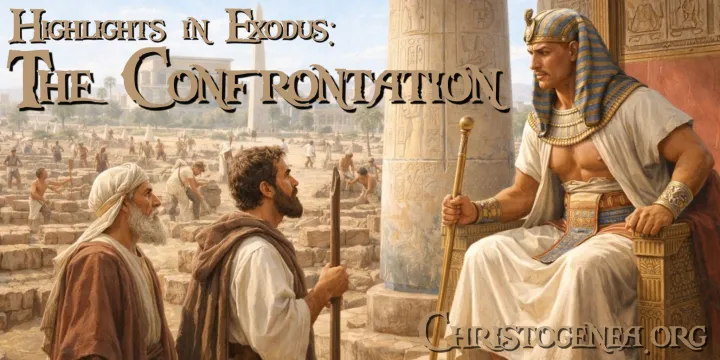
1 And afterward Moses and Aaron went in, and told Pharaoh, Thus saith the LORD God of Israel, Let my people go, that they may hold a feast unto me in the wilderness. 2 And Pharaoh said, Who is the LORD, that I should obey his voice to let Israel go? I know not the LORD, neither will I let Israel go. 3 And they said, The God of the Hebrews hath met with us: let us go, we pray thee, three days' journey into the desert, and sacrifice unto the LORD our God; lest he fall upon us with pestilence, or with the sword. 4 And the king of Egypt said unto them, Wherefore do ye, Moses and Aaron, let the people from their works? get you unto your burdens.
In the treaties of this ancient world, the kings of nations often invoked the names of the gods of the surrounding nations. This is especially evident in the treaties of the Hittites and Egyptians, or the Hittites and Amorites, which had been made around this very same time in history. The names of the gods of the nations would be invoked so that those who would violate the treaties would be punished accordingly. But in response to Moses’ having invoked the Name of Yahweh, this pharaoh said “Who is the Yahweh, that I should obey his voice to let Israel go?” If the name of Yahweh had been associated with any god in Canaan or Syria at this time, this pharaoh would have known that, because he ruled over a great portion of the lands of Canaan and Syria. So the customs and circumstances of the time help serve to destroy the contentions of the critics who claim that the Name of Yahweh is older than the time of Moses. This pharaoh was highly educated in all of the customs of the surrounding nations, and his response makes it evident that he had never heard the name before this time.
While we do not know much about the personal disposition of this pharaoh, Thutmose III, he seems here to be a very harsh ruler, especially over his slaves. But this Thutmose had apparently had every reason to have been a very proud man. Typical of characterizations of his reign is the Wikipedia entry for him, which states in part that he is “sometimes called Thutmose the Great”, ostensibly by modern historians, at least, and that “He is regarded as one of the greatest warriors, military commanders, and military strategists of his time; as Egypt's preeminent warrior pharaoh and conqueror; and as a dominant figure in the New Kingdom period.” It is said that he led from 17 to 20 military campaigns and was undefeated, and that he innovated, for example forming an Egyptian navy which is the first known State navy in the ancient world. This year being 1450 BC, he had already ruled Egypt for 29 years, including the period of co-regency which he had alongside Hatshepsut, and much of his time in those younger years was evidently spent in the field commanding his armies.
Therefore, rather than giving the people any rest from their labors, he makes it much harder for them to complete their assignments:
5 And Pharaoh said, Behold, the people of the land now are many, and ye make them rest from their burdens. 6 And Pharaoh commanded the same day the taskmasters of the people, and their officers, saying, 7 Ye shall no more give the people straw to make brick, as heretofore: let them go and gather straw for themselves. 8 And the tale [or tally] of the bricks, which they did make heretofore, ye shall lay upon them; ye shall not diminish ought thereof: for they be idle; therefore they cry, saying, Let us go and sacrifice to our God. 9 Let there more work be laid upon the men, that they may labour therein; and let them not regard vain words.
In the subsequent verses, the Egyptian taskmasters bring this message to the children of Israel, and when they cannot fulfill the demands, they beat the Israelites whom they had appointed over their brethren to supervise their work. So on that account, these supervisors go to Moses and Aaron, and in the last two verses of chapter 5 we read:
20 And they met Moses and Aaron, who stood in the way, as they came forth from Pharaoh: 21 And they said unto them, The LORD look upon you, and judge; because ye have made our savour to be abhorred in the eyes of Pharaoh, and in the eyes of his servants, to put a sword in their hand to slay us. 22 And Moses returned unto the LORD, and said, Lord, wherefore hast thou so evil entreated this people? why is it that thou hast sent me? 23 For since I came to Pharaoh to speak in thy name, he hath done evil to this people; neither hast thou delivered thy people at all.
There is an old adage, that the night is always darkest before the dawn, and in many circumstances it is absolutely true, this being one of them. But just like modern Christians, who are enslaved by modern pharaohs in this current world tyranny which the Scripture refers to as Mystery Babylon, the ancient Israelites in Egypt were comfortable in their state of oppression, so they could not tolerate any further adversity even if it would lead to their release from bondage. Later, in the wilderness, they had even lamented and expressed a desire to return to bondage in Egypt, rather than face the hardships they suffered there. Now as we proceed with Exodus chapter 6, Moses has an answer from Yahweh regarding this situation caused by their first confrontation with pharaoh:
1 Then the LORD said unto Moses, Now shalt thou see what I will do to Pharaoh: for with a strong hand shall he let them go, and with a strong hand shall he drive them out of his land. 2 And God spake unto Moses, and said unto him, I am the LORD: 3 And I appeared unto Abraham, unto Isaac, and unto Jacob, by the name of God Almighty, but by my name JEHOVAH [Yahweh] was I not known to them. 4 And I have also established my covenant with them, to give them the land of Canaan, the land of their pilgrimage, wherein they were strangers.
Here Yahweh is invoking the covenants which He made with the fathers as an assurance to Moses, that He would also do what He has promised to do here. Where we see the name Jehovah, this is an Anglicized version of the alternate transliteration which we had offered for יהוה or Yahweh, which may be pronounced Yehovah. We stopped short of explaining that since there is an alternate form of the spelling of the verb meaning to be, which is either היה or הוה, then using that spelling Yehovah is a legitimate transliteration of the Name of Yahweh. This we said in our discussion of Exodus chapter 3, referring to the Brown, Driver, Briggs definition of the verb:
At the beginning of their definition, they explain that היה or hayah is a parallel form of הוה or hawah.
The Hebrew letter ו may be a waw or a vav, a ‘w’ or a ‘v’. So if to be can be spelled as הוה, which is havah or hawah, then He is may be spelled as יהוה, and that may be transliterated as Yahweh, but also as Yehowah or perhaps Yehovah, and this is the origin of the name Jehovah. This is the real source of the alternate spelling of the Name of Yahweh, as Jehovah.
In Genesis chapter 15, Yahweh had promised to give to Abraham all the land of Canaan, so that promise is repeated here, that it would be fulfilled in Israel once they depart from Egypt. Continuing with Exodus chapter 6:
5 And I have also heard the groaning of the children of Israel, whom the Egyptians keep in bondage; and I have remembered my covenant. 6 Wherefore say unto the children of Israel, I am the LORD, and I will bring you out from under the burdens of the Egyptians, and I will rid you out of their bondage, and I will redeem you with a stretched out arm, and with great judgments: 7 And I will take you to me for a people, and I will be to you a God: and ye shall know that I am the LORD your God, which bringeth you out from under the burdens of the Egyptians. 8 And I will bring you in unto the land, concerning the which I did swear to give it to Abraham, to Isaac, and to Jacob; and I will give it you for an heritage: I am the LORD.
These are great promises considering their current state of bondage, but the children of Israel seem to have been angry, that they were moved from their comfort level and might have to suffer somewhat while these things are brought to fruition:
9 And Moses spake so unto the children of Israel: but they hearkened not unto Moses for anguish of spirit, and for cruel bondage.
People today seem to be no different, as they would give up every liberty they have for a pint of beer and football. But Moses once again becomes recalcitrant, and expresses doubt:
10 And the LORD spake unto Moses, saying, 11 Go in, speak unto Pharaoh king of Egypt, that he let the children of Israel go out of his land. 12 And Moses spake before the LORD, saying, Behold, the children of Israel have not hearkened unto me; how then shall Pharaoh hear me, who am of uncircumcised lips?
The objections which Moses had seem to have been ignored:
13 And the LORD spake unto Moses and unto Aaron, and gave them a charge unto the children of Israel, and unto Pharaoh king of Egypt, to bring the children of Israel out of the land of Egypt.
At this point there is a reckoning of the principal families of Israel, but it only mentions three tribes, the three eldest of the sons of Jacob, which are Reuben, Simeon and Levi. Then most of the Israelites who are listed cannot be alive at this point in history, because only one generation of the sons of Reuben and Simeon are mentioned, but two generations of the sons of Levi through his sons Gershon and Merari. None of these can be alive at this point. Then through his son Kohath, at least three generations are listed for each of his sons, with the exception of Amram, where a fourth is listed, being Moses and Aaron, and a fifth in the children of Aaron, but the sons of Moses are not listed. So the purpose of this listing is obscure, because it seems odd to mention the sons of Reuben and Simeon, who were basically left nothing for an inheritance when their father Jacob had blessed his sons, but not to mention the other nine sons and their tribes. The real purpose seems to be to list the genealogy of Levi, down to the sons of Aaron who would have the priesthood, but they do not have the priesthood yet at this point, and the entire list seems out of place. While the text of the Dead Sea Scrolls here is fragmentary, it does support the general reading of the Masoretic Text.
Now some things from earlier in this chapter are repeated in the closing verses, which we shall read for illustration:
26 These are that Aaron and Moses, to whom the LORD said, Bring out the children of Israel from the land of Egypt according to their armies. 27 These are they which spake to Pharaoh king of Egypt, to bring out the children of Israel from Egypt: these are that Moses and Aaron. 28 And it came to pass on the day when the LORD spake unto Moses in the land of Egypt, 29 That the LORD spake unto Moses, saying, I am the LORD: speak thou unto Pharaoh king of Egypt all that I say unto thee. 30 And Moses said before the LORD, Behold, I am of uncircumcised lips, and how shall Pharaoh hearken unto me?
As chapter 7 opens, Moses is answered, but his protest is once again ignored without reprimand. The confrontation heightens as they confront the pharaoh once again, and we shall read the opening verses of the chapter:
7:1 And the LORD said unto Moses, See, I have made thee a god to Pharaoh: and Aaron thy brother shall be thy prophet. 2 Thou shalt speak all that I command thee: and Aaron thy brother shall speak unto Pharaoh, that he send the children of Israel out of his land. 3 And I will harden Pharaoh's heart, and multiply my signs and my wonders in the land of Egypt. 4 But Pharaoh shall not hearken unto you, that I may lay my hand upon Egypt, and bring forth mine armies, and my people the children of Israel, out of the land of Egypt by great judgments.
Moses had been warned in Exodus chapter 4, before the first confrontation with pharaoh, that the pharaoh would not let the people go, where we read:
21 And the LORD said unto Moses, When thou goest to return into Egypt, see that thou do all those wonders before Pharaoh, which I have put in thine hand: but I will harden his heart, that he shall not let the people go.
Yet Moses still became discouraged when he confronted pharaoh and pharaoh did not listen. Instead, Moses should have become encouraged, because the outcome was precisely what he had been told it would be. But eventually, as we proceed through the plagues of Egypt, it seems that Moses finally does cease from being discouraged. For now, we shall continue through the second confrontation with the pharaoh:
5 And the Egyptians shall know that I am the LORD, when I stretch forth mine hand upon Egypt, and bring out the children of Israel from among them. 6 And Moses and Aaron did as the LORD commanded them, so did they.
For some unknown reason, Moses takes this opportunity to relate the ages of himself and Aaron, before proceeding by describing further instructions from Yahweh:
7 And Moses was fourscore years old, and Aaron fourscore and three years old, when they spake unto Pharaoh. 8 And the LORD spake unto Moses and unto Aaron, saying, 9 When Pharaoh shall speak unto you, saying, Shew a miracle for you: then thou shalt say unto Aaron, Take thy rod, and cast it before Pharaoh, and it shall become a serpent.
Moses was 80 years old, but in those days men were still living somewhat longer lifespans than they have historically. For example, according to Exodus chapter 6, verses 18 through 20, Kohath the grandfather of Moses had lived for 133 years, and Amram his father lived even longer, for 137 years.
Now there is a second short confrontation with the pharaoh:
10 And Moses and Aaron went in unto Pharaoh, and they did so as the LORD had commanded: and Aaron cast down his rod before Pharaoh, and before his servants, and it became a serpent. 11 Then Pharaoh also called the wise men and the sorcerers: now the magicians of Egypt, they also did in like manner with their enchantments. 12 For they cast down every man his rod, and they became serpents: but Aaron's rod swallowed up their rods. 13 And he hardened Pharaoh's heart, that he hearkened not unto them; as the LORD had said.
As we shall see when we discuss the plagues of Egypt, Yahweh had punished the Egyptians with their own devices. This is described in reference to Egypt in the Wisdom of Solomon, and we shall elucidate that here, in reference to the plagues which had come upon Egypt as we proceed with this portion of Exodus. There we shall see that Yahweh punishes Egypt with their own devices. The serpent had a significant role in the cultural life of Egypt. First, there was a religious myth that the serpent of the night sky, Apophis, would attack the sun bark, or boat, of Ra as it passed to the underworld, or the time of sunset, and it was repelled and defeated by the god Seth. Secondly, the serpent was a symbol of royalty in Egypt, and the pharaohs wore a serpent affixed to their headdress to symbolize their authority.
So with that, it is also evident that the trick of turning a staff into a serpent must have been previously practiced by the Egyptian magicians, for which reason Yahweh had chosen to make an exhibition of it here. In the later plagues, the magicians themselves confess to the pharaoh that he should concede to the God of Moses, but the pharaoh continues to be hardened in heart and does not even listen to his own magicians. All of this is purposed towards a glorious destruction of Egypt, and at that point we hope to return soon, when we can continue our Highlights in Exodus.