Highlights in Exodus: The Life, and Wife, of Moses
Highlights in Exodus: The Life, and Wife, of Moses
In our last discussion of Exodus, titled The Exodus In Controversy and History, we illustrated how the children of Israel in their nomadic post-Exodus period were described as the “Shasu of Yahweh”, which is to say, “Nomads of Yahweh”, by pharaoh Amenhotep III in inscriptions which had been made some time around 1390 BC. This correlates very well with our general estimations of the time of the event of the Exodus from 1450 BC. After over forty years of wandering in the Sinai desert, an event which the Egyptians must have spied out somewhat regularly, even if the children of Israel had gone north to the plains of Moab, and began to invade Canaan at that time, Amenhotep III must have known of their presence wandering in the wilderness, and recorded it as he had known it. This, beyond all doubt, proves the general veracity of the Exodus account.
The memory among the nobility of the Name Yahweh, a Name with which Moses had confronted the pharaoh in subsequent chapters of Exodus, also serves to corroborate the Exodus account of the plagues of Egypt and the ultimate release of Israel. So those events must have been sufficiently notable that the house of the pharaoh remember the Name of Yahweh.
Now here I am going to take an opportunity to take this proof of the historicity of the Exodus account a step further in Egyptian archaeology. While there is much academic debate as to whether the habiru or hapiru of the Tel el Amarna tablets are the Hebrews of Scripture, I would certainly insist that they are. But academic scholars point to the apparent use of the similar Akkadian word hapiru to describe groups of outlaws, brigands or robbers, or also marginalized outsiders or refugees. With this I disagree.
My first contention is this: a marginalized ethnic group taken to living outside of the fringes of society may naturally be perceived in such a manner, and the Hebrews, whether in Egypt or in Padanaram, do seem to have been marginalized and disenfranchised, having had no distinct land of their own. Then we should consider colloquialisms. For example, in Medieval Europe the word Slav, describing the people of Eastern Europe, became synonymous with slave in English, as the Vikings regularly traded Slavs as slaves in the West, whereby we have our word slave. In America today, if someone, even a friend, burdens you with undue requests, you may look at him and say something like “What am I, your nigger?” Of course, you are not making a statement that you are black, but blacks had been slaves for several hundred years, and they are the most recent slaves in our historical experience, so blacks are still associated with slavery in parts of our vernacular. The Israelites having escaped Egypt may easily have been seen in that same manner.
Finally, there is no record of anyone else attacking the cities of Canaan in the 14th century BC except the Israelites, and the timing of the writing of the Amarna tablets, which contain pleas of help from Egypt in the face of the invading Habiru, is within the time frame of the time of Joshua and the early Judges period, the same time that the main portion of the conquest of Canaan by Israel had taken place. In our Genesis Chronology, we affixed the death of Moses to 1410 BC. Joshua, his successor, ruled for thirty years, until 1380 BC. Then a king of Mesopotamia oppressed Israel for eight years, and there were forty years of rest. There are no details from this forty year period provided in Scripture, however these years overlap the end of the rule of Amenhotep III and the entire time of the rule of the pharaoh Akhenaten. At least most of the Amarna tablets are esteemed to date to the rule of Akhenaten, but some are dated to the time of Amenhotep his predecessor, and some to the time of Tutankhamen his successor. At the start of the rule of Akhenaten, the Levant as far north as Ugarit had been controlled by Egypt.
So here we shall offer a few of the Amarna letters. They were originally written in Akkadian cuneiform, as Akkadian was the lingua franca, the language of trade and diplomacy at the time. This leads me to a brief digression. The earliest discoveries of the Hebrew alphabet are called “proto-Canaanite” by today’s academic scholars, who are all fools. The earliest known example is dated to the late 13th century BC, in an inscription known as the Mount Ebal Curse Tablet. It was reportedly found on Mount Ebal, which is believed to be the ancient Ebal where, as it is described in Deuteronomy chapter 27, half of the tribes of the children of Israel stood to proclaim the curses of disobedience in the Law. The other six tribes stood on Mount Gerizim to proclaim the blessings of obedience to the Law. This curse tablet is said to contain a curse, but the results of its examination are highly controversial and are still under academic contention.
So if we discard the Mount Ebal Curse Tablet, which we may have to do one day, there is the 12th century BC Izbet Sarta Abecedary, a clay ostracon discovered in 1976 which contains a copy of the early proto-Hebrew alphabet. It may have been a child’s exercise in learning to write. All other examples of the old Hebrew alphabet are from the 10th century BC and later. The Amarna Tablets were all written in cuneiform script, and there is no evidence of the existence of the Hebrew alphabet in Canaan before the taking of Canaan by the Israelites. So it is just as ridiculous to consider the Hebrew alphabet to have been “proto-Canaanite” as it would be to consider the modern alphabet used by Americans in North America to have been “proto-Cherokee” or “proto-Iroquois” or something else just as ridiculously similar.
For the sake of those who may read this presentation, in the line numbers of the Amarna tablets, the preceding ‘o’ is the obverse or front side of the tablet, and the preceding ‘r’ the reverse or back side.
From EA 246, an Amarna tablet written to Akhenaten from Biridiya, a king of Megiddo, we read:
(o 001) Spea[k to the ki]ng, [my] lo[rd and] my Sun god, a message from Biridiya, your loyal servant. I fall at the feet of the king, my lord and my Sun god, seven times and seven times.
(o 008) I have obeyed the instru[ctions] of the king […]
(r 01') […] and [...].
(r 02') Now, you all ar[e ... …].
(r 05') The king, [my] lord, should know. Now, the two son[s] of Labʾaya are gi[vi]ng their silver to habiru and to Sut[eans in] order for (them) to wage [war] against me. [The ki]ng [should care] for [his land]. [1]
Of course, the Suteans were not mentioned in the Bible, but perhaps this only reflects a suspicion on the part of Biridiya, or a mistaken identity. The Suteans were apparently a semi-nomadic people who lived on the east bank of the Euphrates, in a region called Suhum in Mesopotamia, which is above both Akkad and Babylon but southwest of both Nineveh and Assur, and also in an area called Jebel Bishri, which is on the bank opposite Suhum in eastern Syria. This is nearly four hundred miles east-northeast of Megiddo. The fault in not rendering habiru as an actual ethnonym here is this: Sutaean is an ethnonym, but while they were also apparently just marginalized semi-nomadic robbers and brigands, then why are they even mentioned separately, if the word habiru describes all such people? With all certainty, I would translate habiru, or hapiru as it sometimes appears, as Hebrews in these documents.
In any event, another king also mentioned the Habiru along with Suteans, where we read in EA 318 the following:
(o 001) Dagan-taka[la], your servant, speaks to the great king, [my] lord, the Sun god from the heavens. I fall at the two feet of the great king, my lord, seven times and seven times.
(o 008) Rescue me from my strong enemies (lit. the enemies of my strength), from the control of habiru, bandits, and Suteans. Rescue me, O great king, my lord.
(r 016) Look, I sent a message about my enemies, so you, O great king, my lord, should rescue me so that I can depart for the great king, my lord. [2]
It may be evident, that as the Israelites had swarmed over the Jordan River from the East, that the Canaanites of Jericho and other cities may have identified them with the Sutaeans and imagined that they had come from points further east, rather than having come from the Sinai wilderness.
From another of the Amarna Tablets, EA 254, this time from Ancient Near Eastern Texts Relating to the Old Testament. The Canaanite Lab'ayu was the ruler of Shechem.
To the king, my lord and my Sun-god: Thus Lab'ayu, thy servant, and the dirt on which thou dost tread. At the feet of the king, my lord, (5) and my Sun-god, seven times and seven times I fall.
I have heard the words which the king wrote to me, and who am I that the king should lose his land (10) because of me? Behold, I am a faithful servant of the king, and I have not rebelled and I have not sinned, and I do not withhold my tribute, and I do not refuse (15) the requests of my commissioner. Now they wickedly slander me, but let the king, my lord, not impute rebellion to me!
Further, (20) my crime is namely that I entered Gezer and said publicly: (25) "Shall the king take my property, and not likewise the property of Milkilu ?" I know the deeds which Milkilu has done against me.
(30) Further, the king wrote concerning my son. I did not know that my son associates with the ‘Apiru (36), and I have verily delivered him into the hand of Addaya. [3]
This Addaya was most likely an Egyptian official monitoring the interests of Egypt in Canaan. Now we shall read from another Amarna letter, one of several which had originally been published in various volumes of the Revue d'Assyriologie et d'archéologie orientale and reproduced in Ancient Near Eastern Texts Relating to the Old Testament, and identified by the letters RA followed by a volume and page numbers. So this is from RA xix, p. 106:
To the king, my lord, my Sun-god, my pantheon, say: Thus Shuwardata, thy servant, servant of the king (5) and the dirt (under) his two feet, the ground (on) which thou dost tread! At the feet of the king, my lord, the Sun-god from heaven, seven times, seven times I fall, both (10) prone and supine.
Let the king, my lord, learn that the chief of the Apiru has risen (in arms) against the lands which the god of the king, my lord, gave me; (16) but I have smitten him. Also let the king, my lord, know that all my brethren have abandoned me, and (20) it is I and 'Abdu-Heba (who) fight against the chief of the ‘Apiru. And Zurata, prince of Accho, and Indaruta, prince of Achshaph, it was they (who) hastened (25) with fifty chariots—for I had been robbed (by the ‘Apiru)—to my help; but behold, they are fighting against me, so let it be agreeable to the king, my lord, and (30) let him send Yanhamu, and let us make war in earnest, and let the lands of the king, my lord, be restored to their (former) limits! [4]
This Shuwardata is esteemed to have been the king of either Gath or Hebron by academic scholars who only seem to be guessing, but Hebron is more credible. Here, because some of these Amarna Letters are quite lengthy, we shall present only excerpts from several more, where the invading Habiru are mentioned. From a portion of the first paragraph of EA 286, written by Abdu-Heba, a Canaanite who was the ruler of Jerusalem. He imagines that he may have been thought to have betrayed the Egyptians, when in fact he was under siege, so the question where we shall begin is rhetorical:
Why should I commit (15) transgression against the king, my lord? As long as the king, my lord, lives, I will say to the commissioner of the king, my lord, "Why do ye favor the ‘Apiru and oppose the governors?"—And thus (21) I am blamed in the presence of the king, my lord. Because it is said, "Lost are the lands of the king, my lord," thus am I blamed to the king, my lord! (25) But let the king, my lord, know that (when) the king had established a garrison, Yanhamu took it all away, [and . . . ] the troops! (30) [of archers( ? ) . . . ] the land of Egypt [ . . . ] O king, my lord, there are no garrison troops (here)! [So] let the king take care of his land! [5]
Yanhamu also seems to have been an Egyptian official. From further on in the same letter:
Let the king turn his attention to the archers, and let the king, my lord, send out (55) troops of archers, (for) the king has no lands (left)! The ‘Apiru plunder all the lands of the king. If there are archers (here) in this year, the lands of the king, my lord, will remain (intact); but if there are no archers (here) (60) the lands of the king, my lord, will be lost! [6]
From EA 288, also from Abdu-Heba:
The land of the king is lost; in its entirety (25) it is taken from me; there is war against me, as far as the lands of Seir (and) as far as Gath-carmel! All the governors are at peace, but there is war against me. I have become like an ‘Apiru (30) and do not see the two eyes of the king, my lord, for there is war against me. I have become like a ship in the midst of the sea! The arm of the mighty king (35) conquers the land of Naharaim and the land of Cush, but now the ‘Apiru capture the cities of the king. There is not a single governor (remaining) (40) to the king, my lord—all have perished! Behold! Turbazu has been slain in the (very) gate of Sile, (yet) the king holds his peace. Behold Zimreda, the townsmen of Lachish have smitten him, slaves who had become ‘Apiru. (45) Yaptih-Hadad has been slain [in] the (very) gate of Sile, (yet) the king holds his peace. [Wherefore] does not [the king] call them to account? [So] let the king take care of his land; [and l]et the king decide, and let the king send (50) archers to his land! [But] if there are no archers (here) this year, all the lands of the king, my lord, will be lost. [7]
From EA 289, which is also from Abdu-Heba:
Behold this land belongs to the king, or why like the town of Gaza is it loyal to the king? Behold the land of the town of Gath-carmel, it belongs to Tagu, and the men of Gath (20) have a garrison in Beth-Shan. Or shall we do like Lab'ayu, who gave the land of Shechem to the ‘Apiru? [8]
From EA 290, which is from Abdu-Heba once again:
[To] the king, my lord, say: Thus ['Abdu]-Heba, thy servant At the two feet of the [king,] my lord, seven times and seven times I fall (5) Behold the deed which Milkilu and Shuwardata did to the land of the king, my lord! They rushed troops of Gezer, troops of Gath (10) and troops of Keilah; they took the land of Rubutu; the land of the king went over to the ‘Apiru people. [9]
Finally, in the closing passage of a letter written from one “Yapahu, the prince of Gezer”, we read in EA 298:
To the king, my lord, my pantheon, my Sun-god, the Sun-god of heaven. Thus Yapahu, the prince of (5) Gezer, the dirt (under) thy two feet, the groom of thy horse. At the two feet of the king, my lord (10) the Sun-god of heaven, seven times and seven times I fall, both prone and supine; and everything (15) which the king, my lord, commands me I hear very attentively. A servant of the king am I, and the dirt of thy two feet. (20) Let the king my lord know that my youngest brother is estranged from me, and has entered (25) Muhhazu, and has given his two hands to the chief of the ‘Apiru. And now the [land of . . . ]anna is hostile to me. (30) Have concern for thy land! Let my lord write to his commissioner concerning this deed. [10]
These seem to be at least most, if not all, of the Amarna letters which mention the ‘Apiru, and while these were included in the collection of Ancient Near Eastern Texts Relating to the Old Testament because the editors believed that they were important to the Biblical narrative, even they doubted the identification of the ‘Apiru as Hebrews, when the 3rd edition of the work went to print in 1967. So we read in a footnote the following, which is made in reference to RA xxxi, pp. 125-136:
This letter, from the beginning of Akh-en-Aton's reign, is an extraordinarily illuminating illustration of the situation in Palestine at that time. Just who this redoubtable ‘Apiru chieftain was we do not learn, since the proud feudal princes disdained even to mention names of the semi-nomadic ‘Apiru. However, he was sufficiently dangerous to unite the arch-foes, 'Abdu-Heba and Shuwardata, and to induce them to offer fifty chariots (a very considerable offer for Palestinian chieftains) to the princes of Accho and Achshaph (for whom see notes 3 and 6) in the Plain of Acre, far to the north. One suspects that Milkilu of Gezer and Lab'ayu of Shechem, who are not mentioned at all, were—either or both—involved with the ‘Apiru. [11]
Of course, Joshua would have been dead for nearly thirty years before the rule of Akhenaten had begun in Egypt. So the ruler of the Hebrews may have been one of the subsequent judges mentioned in the Book of Judges, or at diverse times he may have even more likely been a local ruler, a captain over the hundreds or thousands as we see the children of Israel had been organized under Moses. The Book of Judges portrays each of the tribes as having been responsible for their own lands, and for that reason, where they failed to drive out Canaanites, the tribes which failed are mentioned explicitly. But this is a digression, and now that we have read that footnote, we shall read the inscription to which it pertains, since quite interestingly, while Akhenaten was not sending archers merely to try to defend his subject states in Palestine, he was sending at least some archers, in order to gratify his own unseemly lusts. Therefore, from RA (Revue d'Assyriologie…) xxxi, pp. 125-136 we read where Akhenaten had written:
To Milkilu, prince of Gezer. Thus the king. Now I have sent thee this tablet to say to thee: Behold, (5) I am sending to thee Hanya, the commissioner of the archers, together with goods, in order to procure fine concubines (i.e.) weaving women: silver, gold, (linen) garments, (10) turquoise, all (sorts of) precious stones, chairs of ebony, as well as every good thing, totalling 160 deben. Total: 40 concubines: the price of each concubine is 40 (shekels) of silver. (15) So send very fine concubines in whom there is no blemish. (19) And let the king, thy lord, say to thee, "This is good. To thee life has been decreed." And mayest thou know that (25) the king is well, like the Sun-god. His troops, his chariots, his horses are very well. Behold, the god Amon has placed the upper land, (30) the lower land, the rising of the sun, and the setting of the sun under the two feet of the king. [12]
Apparently, Akhenaten was much more interested in procuring items of luxury and women for his harem, lots of women without blemish, than he was about the Empire and maintaining its subject states. History presents Akhenaten as a religious reformer, for which reason he did not protect or seek to expand his empire beyond the borders of Egypt. He did, at one point, send troops to put down a rebellion in Nubia, but that event is the only act of war on his historical record. Otherwise, while he did deviate from the traditional religion of the Egyptians, he was really just a pervert looking for women from his subject States, so he was the Bill Clinton or Donald Trump of his time.
This discussion of the ‘Apiru, or Hapiru, actually better belongs in the company of a commentary on Joshua, or even better, in the Judges period. However I have included it here, to show that soon after Amenhotep III had described the “Nomads of Yahweh” in the land of Canaan, the princes and kings of the cities of Canaan begin to write to Egypt of the distress which they suffered at the hands of the invading Hebrews. While the Amarna Tablets portray a different perspective of the invasion than what we see in the Scripture, the authors of Scripture who observed the execution of the invasion would of course know much better their identity and their motives than the Canaanites who were their victims. If anyone disputes the identification of these events with the Biblical Hebrews, or Israelites, then they are only looking for excuses by which they may set aside the Biblical narrative, and their reward awaits them in the Lake of Fire prepared for the devil and his angels.
According to our Genesis Chronology, as Exodus chapter 2 opens, the year is somewhere around 1531 BC, and Moses was born in 1530. If pharaoh Apepi, or Apophis, is the pharaoh who knew not Joseph, which is something that we are persuaded of at this time, then Israel had been in bondage in Egypt for perhaps as long as sixty years. Apophis is said to have ruled Lower Egypt for thirty-five or even as long as forty years, the longest duration of the known 15th Dynasty pharaohs. His successor, Khamudi, was the final king of the dynasty and is said to have ruled for eleven or twelve years. However it was probably not that long that Israel had been enslaved under the rule of Apophis, since it was evidently at least some time into the duration of his rule before he had put Israel in bondage. Following Khamudi, the Hyksos were expelled from Lower Egypt, and that is also said to have occurred in or about 1530 BC, roughly the same year when Moses was born. So now we shall read from Exodus chapter 2:
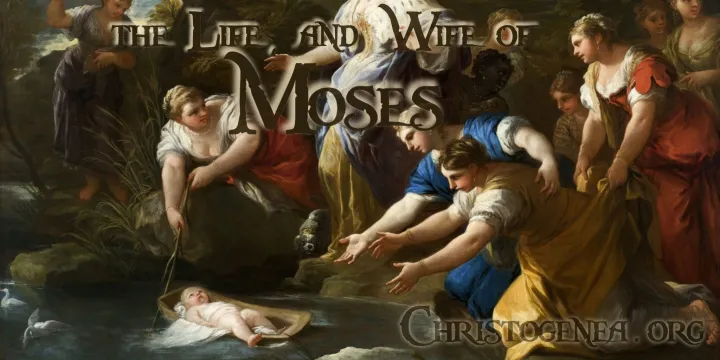
1 And there went a man of the house of Levi, and took to wife a daughter of Levi. 2 And the woman conceived, and bare a son: and when she saw him that he was a goodly child, she hid him three months. 3 And when she could not longer hide him, she took for him an ark of bulrushes, and daubed it with slime and with pitch, and put the child therein; and she laid it in the flags by the river's brink. 4 And his sister stood afar off, to wit what would be done to him.
Aaron, the brother of Moses, was several years older than Moses. This we read in Exodus chapter 7:
7 And Moses was fourscore years old, and Aaron fourscore and three years old, when they spake unto Pharaoh.
Ostensibly, Aaron was born either before the pharaoh demanded that the Hebrews expose their young males, or possibly in the early times of that demand, when the midwives were in revolt. However nowhere are we told the age of Miriam, and if this sister of Moses was Miriam, since only three children are even mentioned in the genealogy of Amram their father, then she must have been the oldest child, able to stand on her own and watch what became of her brother by herself. As the passage continues, she is also mature enough to lead a conversation with the daughter of pharaoh, and give her advice on a Hebrew nursemaid, who of course would happen to be her own mother. Therefore commencing with Exodus chapter 2:
5 And the daughter of Pharaoh came down to wash herself at the river; and her maidens walked along by the river's side; and when she saw the ark among the flags, she sent her maid to fetch it. 6 And when she had opened it, she saw the child: and, behold, the babe wept. And she had compassion on him, and said, This is one of the Hebrews' children. 7 Then said his sister to Pharaoh's daughter, Shall I go and call to thee a nurse of the Hebrew women, that she may nurse the child for thee? 8 And Pharaoh's daughter said to her, Go. And the maid went and called the child's mother. 9 And Pharaoh's daughter said unto her, Take this child away, and nurse it for me, and I will give thee thy wages. And the woman took the child, and nursed it. 10 And the child grew, and she brought him unto Pharaoh's daughter, and he became her son. And she called his name Moses: and she said, Because I drew him out of the water.
For reason that this princess “called his name Moses”, I have insisted that the pharaoh of this time must have been Ahmose I, and since he is credited with having driven the Hyksos out of Lower Egypt by 1530 BC, then he was the pharaoh of Lower Egypt at this time. Perhaps it is he, and not the Hyksos pharaohs, who had commanded the newborn Hebrew males to be exposed, where the Hyksos pharaohs had only enslaved Israel. So Aaron may have been born just before the victory of the 18th Dynasty pharaoh Ahmose I, and it is Ahmose I who demanded that the Hebrew males be exposed, an event which affected Moses but not his elder brother Aaron. Perhaps he wanted the Hebrew girls to survive, if he was anything like the later pharaoh Akhenaten.
This princess is evidently from the house of Ahmose I, and his father, the last king of the 17th Dynasty, was named Khamose. The Dynasty later produced four pharaohs named Thutmose, and other family members who were frequently also subordinate administrators, or even women, had born similar names. Sometimes academic scholars spell the names Khamosis, Ahmosis, Thutmosis or Tuthmosis. So we see a trend, and we can only understand that regardless of what moses or mosis may mean in Egyptian, this princess named the child with her family name because she is the one who took him out of the river.
The truth is, that the Egyptian root word ms, which is transliterated as mose or mosis, or in this case, Moses, means born of, so that Thutmose means born of Thoth, and in yet another variation of spelling, Ramesses means born of Ra. Moses does not mean to draw water, and denominational churches have wrong meanings for many Hebrew names, especially for those of Moses and Esau.
The Bible is silent concerning the youth of Moses, or the state of the Israelites during the time of his youth. However from the account which follows, it is certain that he was raised as a prince in the house of Pharaoh. Such a man would have been highly educated in his youth, as lesser sons in the household of a king were educated for diplomatic office, or for the military, or for general administrative functions. So they would need to learn the languages of Egypt’s allies and enemies, as well as history and other things which are useful to a ruler or administrator within a mighty empire. So Moses must have been exposed to a great deal of whatever was known of the past, long before he wrote his Genesis account.
Then of course, there is the inspiration of God, but I am convinced that Yahweh God ensures that men are educated in the course of their lives for the role that He intends them to fulfill. David was already an expert with a sling when he killed Goliath, although God certainly gets the credit for his having killed him, as God made certain David was prepared, and that David was in place to kill him. Likewise, Paul was educated in the Classics as well as in Hebrew learning, and for that reason he was fit to bring the Gospel to the nations. So it is that Moses also had an education which prepared him for the tasks of his later life. He could never have attained such an education and the learning which he later exhibited, as a mere slave in Egypt.
Moving on with Exodus chapter 2, Moses is suddenly an adult:
11 And it came to pass in those days, when Moses was grown, that he went out unto his brethren, and looked on their burdens: and he spied an Egyptian smiting an Hebrew, one of his brethren. 12 And he looked this way and that way, and when he saw that there was no man, he slew the Egyptian, and hid him in the sand. 13 And when he went out the second day, behold, two men of the Hebrews strove together: and he said to him that did the wrong, Wherefore smitest thou thy fellow? 14 And he said, Who made thee a prince and a judge over us? intendest thou to kill me, as thou killedst the Egyptian? And Moses feared, and said, Surely this thing is known.
Here my commentary shall be adapted from my June, 2013 commentary on the relevant passages in Acts chapter 7, where the martyr Stephen, in the confession of the faith which he had given before he was stoned to death by the Judaeans, had spoken of this same event from the life of Moses.
Moses was raised in the household of the Pharaoh, and must have had all of the privileges of a member of the royal family. Yet he risked his enjoyment of these worldly luxuries for the benefit of defending a lowly man, because that lowly man was one of his own tribesmen. For this, Moses had been selected by Yahweh as the man who would lead His people out of Egypt. Ostensibly, this is the point that Stephen is making, and which he had hoped that his own contemporaries would learn from by example: That Moses, regardless of his high station, acted contrary to his own interests and stood against the institutions of his own time in favor of those of his own race, and Moses was therefore employed by Yahweh God as His instrument of their redemption from Egypt. In that manner, Moses was a type for Christ. Likewise, Christ was rejected by many of His Own kinsmen, men who would not risk their stations to stand for what was right (John 12:42), and He was therefore slain. But it was He who Moses and the prophets foretold would come, and it was He, and no longer Moses, who [is] now the instrument of Israel's redemption.
Paul, in Hebrews chapter 11, says of Moses in part: “23 By faith Moses, being born was hid three months by his fathers because they saw the handsome child, and did not fear the ordinance of the king. 24 By faith Moses, becoming full-grown, refused to be called a son of the daughter of Pharaoh, 25 rather preferring to be mistreated with the people of Yahweh than to have the temporary rewards of error, 26 having esteemed the reproach of the Anointed [a reference to Israel in Egypt, not to Christ] greater riches than the treasures of Egypt, since he had regard for the reward. 27 By faith he left Egypt, not fearing the temper of the king, since seeing the invisible he persevered.” One aspect of the life of Moses that is not related in the Book of Exodus, is that he must have been a well-educated man, having been raised as the son of a princess, and certainly educated for a role in the administration of the kingdom.
The Egyptian whom Moses killed was almost certainly another Adamic White man. While Egypt had imported some black aliens, which they used as slaves, and while there is evidence that certain of the Pharaohs also had Nubian concubines and there was frequent intercourse with the Nubians at this time, Egypt was still both originally and primarily a White nation up until the Nubian invasions of a much later period had occurred and had changed its nature permanently [i.e. Isaiah 43:3]. Yet even though the Egyptian was White, Moses was not ever labeled as a murderer, except by those who despised him. However if Moses had not defended his brother, then he may have been considered a murderer [by Yahweh God], for the apostle John says in his first epistle that “whosoever hateth his brother is a murderer” (1 John 3:15). Sadly, many Israelites still do not understand this, and instead they accept the doctrines and laws of men.
In Acts chapter 7, Stephen is recorded as having commented on this incident and saying:
25 And he expected the brethren to understand that Yahweh through his hand gives deliverance to them, but they did not understand.
For that, I had said the following:
In this day Identity Christians wonder when our own people, who are locked in the paradigms of this world, will awaken to the fact that they are once again in bondage, and that their own attitudes concerning race and righteousness have been taught to them by the very ones who hold them in that bondage: the international jews. The concept of political correctness which holds sway over their minds is an invention of the jewish masters who rule over them, that they may retain that rule without difficulty. Here we see that an Israelite in bondage would despise another Israelite who delivered him, rather than be grateful for any relief he was granted from his oppressor. Our people are little different today.
Next, Stephen had described what we have just read here in Exodus, and cited verse 14 of Exodus chapter 2, so we shall read a little further on in Acts chapter 7:
26 Then the next day he appeared to those who were fighting and he reconciled them in peace saying ‘Men! You are brothers! For what reason do you do wrong to one another?’ 27 But he doing wrong to he near to him rejected him saying ‘Who appointed you ruler and judge over us? 28 Do you not desire to kill me in the manner that you killed the Egyptian yesterday?’
As the King James translates Acts 7:27, we read:
27 But he that did his neighbour wrong thrust him away, saying, Who made thee a ruler and a judge over us?
As it is today, it was then also, that the righteousness of the children of Israel was after the reckoning of man rather than of God, and this man was more concerned even for his dead oppressor than he was for the men of his own race [whom he would evidently beat with impunity]. According to Stephen, Moses [must have been] already somehow cognizant of his mission to free his people Israel. However [with] the people rejecting him, Moses would flee Egypt, and it would be another forty years before he fulfilled his mission. Our people have much the same attitude today, where because the churches teach them lies, when they are informed of their sins they respond, “Who appointed you ruler and judge over us?”
The most common Greek word translated as neighbor in the King James Version [New Testament] is the adverb πλησίον (4139), the neuter form of πλησίος, which literally means near or close to. Liddell & Scott state in reference to this word that “the word πλησίος itself is a derivative of another adverb, πέλας, which also means “near, hard by, close...”, and either of these three words used with the definite Article as a Substantive means one who is near, or, as the King James Version has it, a neighbor. But by themselves these words do not readily distinguish between nearness in relationship or in geographical proximity.
Because of the way that the English word neighbor is perceived in modern times, [whee it is] understood only in the geographical sense, I have refrained from using that word in my translations[, because it is simply not a good translation]. However the corresponding Hebrew word from which these were often translated in the Septuagint certainly does bear a distinction, and so does the context of scripture on occasions where the word πλησίον is found.
First, in secular Greek there are other words used by authors contemporary to the New Testament period, and which also appear in the New Testament, which are often translated as neighbor. These are γείτων (1069), which is explicitly “one of the same land, a neighbour” (Liddell & Scott) and is found at Luke 14:12; 15:6, 9; and John 9:8, and περίοικος (4040) which is “dwelling round...οἱ περίοικοι neighbours...” (ibid.), and which is found only at Luke 1:58. Both of these words have an explicitly geographical meaning.
So in the commandment in Leviticus chapter 19, which Christ Himself had called the second greatest commandment, we read:
18 Thou shalt not avenge, nor bear any grudge against the children of thy people, but thou shalt love thy neighbour as thyself: I am the LORD.
There, in the Septuagint, the phrase τὸν πλησίον was translated from a Hebrew word into Greek to express the meaning of the Hebrew word which is translated as neighbor in the King James Version of that verse. The Hebrew word is רע or reya (#7453) and it can mean friend, companion or intimate, in relation to people. To that, the Brown, Driver, Briggs Hebrew lexicon adds “in [a] weaker sense, fellow, fellow-citizen, even another person, with whom one stands in reciprocal relations”. [13] However looking at other words spelled similarly and within proximity of reya, included among them are a verb which means to tend a flock, or as a noun, a shepherd, which is ra’ah (# 7462), other nouns describing male and female companions, which are re’eh and re’ah (#’s 7463 and 7464), along with several others. So from that it is evident that one’s neighbor should be someone of the same flock. That is how the word is also defined in that Law in Leviticus, where neighbor corresponds to “the children of they people”. Where πλησίον appears in the New Testament, it is not ever speaking geographically, or one of those other relevant Greek terms which carry such a meaning explicitly would have been used. But πλησίον denotes a nearness in relationship, not in geographically.
Somehow Moses had naturally understood this. Although he was raised as an Egyptian, and the Egyptian soldier whom he had killed was his fellow and his subordinate, he nevertheless understood that the Hebrew slaves were his neighbors, and not the Egyptian. They were near to Moses, and not the Egyptian, regardless of where they slept. But the Israelites whom he sought to protect did not display that same understanding. So we must interpret this event which Exodus provides here, and upon which Stephen had expounded, to be exemplary of the reasons as to why Yahweh had chosen Moses to fulfill the role which he would have in history. Moses truly loved and sought to care for his own people, even at his own disadvantage.
15 Now when Pharaoh heard this thing, he sought to slay Moses. But Moses fled from the face of Pharaoh, and dwelt in the land of Midian: and he sat down by a well.
As we have already said, in Exodus chapter 7 Moses is eighty years old when he returned to Egypt and stood before pharaoh. But we only know that Moses fled Egypt at the age of forty from the account of Stephen in Acts chapter 7, where we read:
23 And when he was full forty years old, it came into his heart to visit his brethren the children of Israel.
So whether that is merely from tradition, or from some now-lost Scripture, we may never know. But it is apparent that the life of Moses was split into three forty-year periods in that manner. From birth to age forty where he was raised and educated as an Egyptian, from ages forty to eighty where he was working in the land of Midian as a shepherd, and from eighty to a hundred and twenty, when he led Israel out of Egypt and spent the last four decades of his life dealing with them in the wilderness. The Israelites were stiff-necked here in Exodus chapter 2, and they were still stiff-necked when Moses died. But they are just as stiff-necked to this very day.
Now Moses enters the land of Midian:
16 Now the priest of Midian had seven daughters: and they came and drew water, and filled the troughs to water their father's flock. 17 And the shepherds came and drove them away: but Moses stood up and helped them, and watered their flock. 18 And when they came to Reuel their father, he said, How is it that ye are come so soon to day? 19 And they said, An Egyptian delivered us out of the hand of the shepherds, and also drew water enough for us, and watered the flock. 20 And he said unto his daughters, And where is he? why is it that ye have left the man? call him, that he may eat bread. 21 And Moses was content to dwell with the man: and he gave Moses Zipporah his daughter.
There is much contention over this Zipporah, since she is called a Cushite, where the King James Version has Ethiopian, in Numbers chapter 12. But for making such a charge, Aaron and Miriam had suffered, and Miriam was even stricken with leprosy for a time, something which the entire congregation must have witnessed, and for which she had to be put out of the camp so long as she was infected, according to the Law. Therefore, on account of that punishment, which was from Yahweh God Himself, the charge must have been patently false, and it certainly was false. Anyone who repeats the lie of Aaron and Miriam today should also be stricken with leprosy, as Moses is continually slandered in all of the denominational churches.
So for this, I am going to offer some redacted comments from a Topical Discussion podcast where I had last addressed this issue in October of 2023:
Here we shall discuss the true identity of the wife of Moses. A common perception in the mainstream churches is that Moses had married a negress, and it seems like those who repeat it actually want to believe it. They even often ridicule those who attempt to correct their error. This is because in one verse in the Book of Numbers it says that his wife was an “Ethiopian”. But this entire view is based upon a childish ignorance of Scripture and history, simply because there is a land called Ethiopia today, over thirty-five hundred years later, which is inhabited by negroes. The verse is found at Numbers 12:1: “And Miriam and Aaron spake against Moses because of the Ethiopian woman whom he had married: for he had married an Ethiopian woman.” For that they were punished by Yahweh, so they must have been wrong. The word Ethiopian there is from כשית or cushith, (# 3571), a feminine form of the word for Cush, which is a Cushite, and in this case, a female.
Yet without getting into the history of Ethiopia in Africa, which is wholly unnecessary in this context, here we will state that it is clear through the lens of the New Testament, esteeming the words of Stephen in Acts chapter 7, that these early Christians, who were indeed Hebrews, understood that Moses' wife came from the regions east of the land of Canaan, where the “land of Madian”, which is the Old Testament land of Midian, had been located. So in Acts 7:29 Stephen is recorded as having said: “Then fled Moses at this saying, and was a stranger in the land of Madian, where he begat two sons.”
Genesis chapter 25 explains the origin of this Midian: “1 Then again Abraham took a wife, and her name was Keturah. 2 And she bare him Zimran, and Jokshan, and Medan, and Midian, and Ishbak, and Shuah. 3 And Jokshan begat Sheba, and Dedan. And the sons of Dedan were Asshurim, and Letushim, and Leummim. 4 And the sons of Midian; Ephah, and Epher, and Hanoch, and Abida, and Eldaah. All these were the children of Keturah. 5 And Abraham gave all that he had unto Isaac. 6 But unto the sons of the concubines, which Abraham had, Abraham gave gifts, and sent them away from Isaac his son, while he yet lived, eastward, unto the east country.”
Midian was therefore a son of Abraham, and lived in the country east of where Abraham had dwelt in Hebron. The traditional location of Midian in Scripture is in what was later called Arabia, and that is the land to which Moses had fled, east of Hebron, and east of the Dead Sea. There were many tribes of Cushites and Shemites in that region, and although there were also some Canaanites, Midian did not necessarily intermarry with them at the time of Moses. Rather, he must have known what things his father Abraham would have said about them. So Moses actually married a cousin, perhaps only five or six generations removed from Jacob and Isaac.
Abraham lived to be a hundred and seventy five years old. Sarah evidently did not die until Abraham was a hundred and thirty seven years old, since Abraham was ten years older than Sarah (Genesis 17:17), and Sarah was a hundred and twenty seven years old when she died (Genesis 23:1). So these sons born of Keturah were all still under forty years old when their father sent them off to the east.
Exodus chapter 2 tells us precisely where it was to which Moses had fled, and where he obtained his wife, less than four hundred years after Abraham sent his son Midian off to “the east country”. It is clear from all subsequent Old Testament Scripture as well as from Acts chapter 7 and Numbers chapter 10, that Zipporah was a Midianite, from the land of Midian which was to the east of Palestine, as Abraham sent his sons to the east. We also see in Genesis chapter 37 that it was Midianites who had rescued Joseph from the pit and sold him into slavery, whereby he ended up in Egypt. So Midianites were traversing the land later known as Samaria, as that is where Joseph had been thrown into a pit, in Dothan. By this account it may be evident that Midianites commonly traversed the land of Canaan.
In Numbers chapter 10, the name Reuel is spelled Raguel in the King James Version, as it is throughout the Septuagint, and we read: “29 And Moses said unto Hobab, the son of Raguel the Midianite, Moses' father in law, We are journeying unto the place of which the LORD said, I will give it you: come thou with us, and we will do thee good: for the LORD hath spoken good concerning Israel.” Here in Numbers 10:29 Raguel, or Reuel as the name appears in Exodus 2:18, is perceived to be a pious man. In Numbers 3:1 Moses' father-in-law is called “the priest of Midian”, and the Midianites were children of Abraham through the concubine, Keturah. Since Moses is only five generations from Abraham, as it is recorded in 1 Chronicles chapter 6, it is likely that Raguel is only 4 generations removed from Abraham, since Isaac was already at least 37 years of age (Genesis 24), and probably even older, when Midian was born to Keturah (Genesis 25). Isaac was 37 when Sarah had died, because she died at the age of 127 years and had Isaac at the age of 90.
It is very clear, throughout the entire Biblical narrative from Genesis through the books of Judges, Kings and Chronicles, that the land of Midian was to the east of Palestine, and not very far from it, because the children of Israel had recorded their interactions with Midianites in those very regions all throughout those Scriptures. We cannot simply assume, however, that the statement in Numbers 12:1, calling Zipporah an Ethiopian, is wrong in every sense of the word. Nor can we assume that it necessarily contradicts all of these other Scriptures. Rather, we must be able to explain from a historical perspective just how she may have been considered an Ethiopian, or in Hebrew, a Cushite while all of those other Scriptures that explain that she was a Midianite are certainly also valid.
As we have explained at length, with many historical citations, in part 15 of our Genesis commentary, titled The Hamites, in the earliest Greek writings there are two lands called Ethiopia. One was to the far south of Egypt, and while it was mentioned by them, it was scarcely known to the most ancient Greeks. Another was the “Ethiopia of the east”, as Herodotus had called it, and it was east of Syria and the Euphrates river. The Ethiopia of the south, below Egypt, was called Cush by the Hebrews, and in the early Scriptures the Hebrew name Cush first appears in Genesis chapter 2, relating to the four rivers which sprang from the original location of the Garden of Eden. There, in Genesis 2:13, the Gihon river is said to “compasseth the whole land of Ethiopia.” Now while the identity of all four of those rivers is contested today, two others are identifiable: the Hiddekel which is believed to be the Tigris since it “goeth toward the east of Assyria”, and the Euphrates which the Hebrews called the Perath in Genesis chapter 2 and throughout Scripture. The fourth river is apparently a riverbed, now dried up, known as the Kuwait River which crossed Arabia and emptied in the same area as the other three rivers. This must have been the River Pison, which Genesis chapter 2 (2:11) explains had compassed “the whole land of Havilah”. And from other So there we also see descendants of Cush in Arabia.
Therefore it is fully evident In Genesis chapter 2 that the Hebrews had also identified a land which they called Cush in the east, as the Greeks referred to an Ethiopia in the east, and it only makes sense that the origins of such a Cush must be the empire of Nimrod in Mesopotamia, since he was the son of Cush (Genesis 10:8). The empire of Nimrod was the early stage of the Akkadian empire, and its borders stretched across Arabia to the land of Canaan. Therefore, the land of Midian at the time of Moses would also have been a part of that land of Cush, and Moses' wife Zipporah could be called a Cushite, or Ethiopian, by geography, as well as a Midianite, which was the name of her tribe. She was certainly not a negress, since she was also a descendant of Abraham.
Among the descendants of Cush who had settled in various parts of what had later become known as Arabia, there are Seba, Havilah, Sabtah, Raamah, and Sabteca, and then the sons of Raamah, Sheba and Dedan. Seba looks and sounds like Sheba, but there is a greater difference in the Hebrew spelling than there is in just the sound. Many of these places are identifiable in Arabia to this very day. Sheba was a well-known nation in the far southern portion of Arabia. Raamah is mentioned in company with Sheba in Ezekiel chapter 27. Dedan is mentioned frequently in the books of Jeremiah and Ezekiel, and is in Arabia. Seba is coupled with Sheba in the 72nd Psalm, and later in Isaiah chapter 43 where Ethiopia and Egypt are also included in a foreboding oracle. From ancient Sheba, it is only about 15 miles by sea across the mouth of the Red Sea where it meets the Persian Gulf, to cross to Ethiopia in Africa. It is manifestly clear that the Cush in Africa was a settlement of people from the lands of Cush in Arabia. But Moses found his wife in Arabia, which was in his time populated with the Adamic tribes of the sons of Cush.
At the end of Exodus chapter 2, we are informed that Moses had a son with the wife Zipporah, named Gershom. This is the same name as one of Moses’s distant uncles, Gershom the son of Levi, who was the brother of Moses’s great grandfather Kohath. There is barely another mention of this Gershom, son of Moses, in Scripture. In Exodus chapter 18, we see that Moses’ father-in-law, called Jethro at that time, had taken his wife Zipporah, along with Gershom and another son born to Moses, named Eliezer, back to the land of Midian, and at some point later took them again to meet with Moses in the wilderness near Sinai. But after that chapter it seems that they are not mentioned again, so they must have returned with Jethro to Midian when he departed.
But now, with Moses in Midian and rather recently married to Zipporah, we read:
23 And it came to pass in process of time, that the king of Egypt died: and the children of Israel sighed by reason of the bondage, and they cried, and their cry came up unto God by reason of the bondage. 24 And God heard their groaning, and God remembered his covenant with Abraham, with Isaac, and with Jacob.25 And God looked upon the children of Israel, and God had respect unto them.
We do not know the year, or the pharaoh, to which this passage refers. Since Moses was forty when he fled Egypt, and he was born circa 1530 BC, counting forty years from the most likely pharaoh for his flight from Egypt is Thutmose II, who is said to have ruled Egypt from 1493 to 1479 BC. He was succeeded by Thutmose III, who ruled Egypt for over fifty years, from 1479 to 1425 BC. During the first portion of his rule, for about twenty-two years, his half-sister Hatshepsut was his co-regent. So this time portrayed here in the final passages of Exodus chapter 2 can be no later than 1479 BC. It is not likely to have been in 1493, when Thutmose I died, because at that time Moses had not even yet fled to Egypt.
This concludes our commentary on Exodus chapter 2.
Footnotes
1 EA 246, Open Richly Annotated Cuneiform Corpus, https://oracc.museum.upenn.edu/aemw/amarna/ P271095?srch=s.atNkjE, accessed July 16th, 2026.
2 EA 318, Open Richly Annotated Cuneiform Corpus, https://oracc.museum.upenn.edu/aemw/amarna/ P270959?srch=s.pht4Wj, accessed July 16th, 2026.
3 Ancient Near Eastern Texts Relating to the Old Testament, 3rd edition, James Pritchard, editor, 1969, Harvard University Press, p486.
4 ibid., p. 487.
5 ibid.
6 ibid., p. 488.
7 ibid., pp. 488-489.
8 ibid., p. 489.
9 ibid., p. 489.
10 ibid., p. 490.
11 ibid., p. 487.
12 ibid., p. 487.
13 Gesenius’ Hebrew-Chaldee Lexicon to the Old Testament, translated by Samuel Prideaux Tregelles, Baker Books, 1979, pp. 945-946.