The Protocols of Satan, Part 4: Secret Societies and the Source of the Protocols

Christogenea Saturdays, September 5th, 2015 - The Protocols of Satan, Part 4: Secret Societies and the Source of the Protocols

A few years ago I had participated in a series of programs with Sword Brethren that consisted of discussions based on Nesta Webster's book World Revolution. They could probably be greatly improved upon, as they were rather informal. We stopped with Syndicalism and chapter 9, I believe. Chapter 10 concerns primarily the Revolution of 1917, and instead we went on to present the British whitepaper on the Bolshevik Revolution known as Russia No. 1, never getting back to Nesta Webster.

Here we are not going to present the entire chapter, as our area of interest at the moment is confined to the Protocols of the so-called “Learned Elders of Zion”. Therefore it is our intention to present what Nesta Webster has to offer us in that regard. But we must also say a few things about the author herself. Nesta Webster, being very well read in the areas relevant to our study, had meticulously researched in several languages all of the primary sources that she could locate for her subject, and she offers copious citations. Often, and especially in this field of study, primary sources are impossible to obtain, so she resorted to what she believed were the most reliable and authentic secondary sources. However she was very altruistic, she was very reserved in her conclusions, and she seems not to have recognized the Jew as a truly alien character who is forever opposed to Christian society as a matter of his nature. However for us that is a benefit, because she cannot be accused of having motives which were merely based on hatred of any race or religion.

The Epistles of Paul - Galatians Part 7: The Family of the Faith

Galatians 5:19 – Galatians 6:18

The Epistles of Paul - Galatians Part 7: The Family of the Faith

The concept of antinomianism has meant different things to different theologians. However to accuse Paul of Tarsus of being an antinomian in the sense of one who would set aside or negate or diminish the Laws of God, or to have derived a doctrine which includes those things and claim for it the authority of Paul of Tarsus, is to be a liar. In both Galatians and Romans, and also in his epistle to the Hebrews, Paul has explained how and why the “works of the law”, which are the ordinances such as the sacrificial rituals and ceremonies conducted by the priests, are done away with in Christ. However in all of these epistles Paul also fully demonstrates that the moral laws of Yahweh which are found in the commandments of the law are to be upheld in Christ. Apparently, all of the theological confusion in regard to antinomianism as opposed to the equally wrong concept of salvation by works has resulted because Christians have failed to perceive between the “works of the law” and the commandments which even Christ has admonished them to keep.

In Galatians chapter 5, Paul had said in verse 18 that “if you are led by the Spirit, you are under no law.” The denominational sects often use that phrase by itself to give approbation to whatever it is that they may desire. But Paul had already said earlier in verse 13 that the freedom in which Christians are called is “not that freedom for occasion in the flesh”, and insisted in verse 14 that “all the law is fulfilled in one statement, to wit: 'You shall love him near to you as yourself.'” With that, we must discern that Paul had indeed remained concerned with the keeping of the commandments of the law.

Invading Britain: Then and Now, It Always Comes Down to Treachery! Part 3

William Finck's program notes follow (other resources are linked below):

A HISTORY OF THE MONEY CHANGERS, by Andrew Hitchcock

1558 Queen Elizabeth I succeeds Queen Mary I, her half sister, to the throne in England. During her reign, Queen Elizabeth I decided that in order to wrest control of the money supply she would have to issue her own gold and silver coins. She did this through the public treasury and successfully took control of the money supply from the money changers.

1609 The money changers in the Netherlands establish the first central bank in history, in Amsterdam.

1642 Oliver Cromwell is financed by the money changers for the purposes of fomenting a revolution in England, and allowing them to take control of the money system again. After much bloodshed, Cromwell finally purges the parliament, overthrows King Charles I and puts him to death in 1649.

The money changers immediately consolidate their power and for the next few decades plunge Great Britain into a costly series of wars. They also take over a square mile of property in the center of London which becomes known as the City of London.

1688 The money changers in England following a series of squabbles with the Stuart Kings, Charles II (1660 - 1685) and James II (1685 - 1688), conspire with their far more successful money changing counterparts in the Netherlands, who had already set up a central bank there.

They decide to finance an invasion by William of Orange of Netherlands who they sound out and establish will be more favorable to them. The invasion is successful and William of Orange ascends to the throne in England as King William III in 1689.

The Protocols of Satan, Part 3: Bergmeister and the Verdict at Berne

Christogenea Saturdays, August 29th, 2015 - The Protocols of Satan, Part 3: Bergmeister and the Verdict at Berne 

Here we shall conclude our presentation of the booklet, The World Jewish Conspiracy, written by Dr. Karl Bergmeister and published in 1938, which defended the authenticity of the Protocols against some of the evidence presented at the Berne trial of 1934-1935, where a lawsuit had been tried against certain Swiss politicians because they had used the Protocols as propaganda in their campaigns. While it is accepted that Bergmeister could not prove the actual origin of the Protocols, and that the actual origin of the work in the form in which we know it may never be determined, he did indeed prove that the early attempts by Jews to discredit them as fabrications, or “forgeries”, were themselves based upon lies.

Before beginning, I am going to take a short digression to discuss the word forgery. I often hear the argument concerning the Protocols, that since a forgery is a copy of an original, the Jews prove that the Protocols are authentic by calling them a forgery. This might be funny, and it might even convince the simple-minded, but it should not be repeated because it is simply not true. If you examine not only the modern dictionaries, but also the original definitions for the word forgery in the first English dictionaries by Samuel Johnson and Noah Webster, you will see that the definition of the word is much broader. More precisely, a forgery is a document produced and ascribed to someone other than the person who produced it. So from a Jewish perspective, where the Protocols are disclaimed, the word forgery is appropriate. However we know better than to believe the Jews, and although certainly not all Jews are responsible for the Protocols, the Protocols do indeed represent the desires of world Jewry for the subversion of Christendom. And while all Jews are certainly not acting consciously to effect those desires, Jews do indeed act naturally towards their accomplishment. So many Jews may be able to plausibly deny the Protocols, but that does not mean that they are fraudulent.

The Epistles of Paul - Galatians Part 6: Liberty in Christ

Galatians 5:1-21

The Epistles of Paul - Galatians Part 6: Liberty in Christ

For most of the first four chapters of this epistle to the Galatians, Paul has been explaining that the works of the law, which were the required rituals and ceremonial ordinances, are done away with in Christ. At the same time, Paul has explained the circumstances of the fulfillment in Christ of the Abrahamic covenant and the promises to Abraham, Isaac and Jacob and to their seed after them, after the same manner which Yahweh God had made those promises in the Old Testament. Because the children of Israel shall not any longer be judged by the law, but instead have mercy in Christ, and because they are no longer bound to the rituals and ceremonies of the law, they have liberty in Christ, which Paul is about to explain here in Galatians chapter 5. But liberty in Christ is not liberty from morality or from the commandments of Yahweh God. Rather it is the freedom to love and have mercy for one another, and to receive of the same, to a much greater extent than the letter of the Hebrew law allowed, as Paul shall also explain here in this chapter of Galatians.

It should be clear from Scripture as well as from experience that a man cannot be found righteous by the law, because all men sin and fall short of the glory of God. That is why those promises to Abraham are so important to the New Covenant, because the New Covenant, as Paul has explained here, is the fulfillment of the promises to Abraham which must be kept by Yahweh God in spite of the dissolution of the Old Covenant due to Israel's failure to keep the law of God. In this manner Paul is attempting to put the covenants in perspective. But before Christians can do the same, it must be understood that both covenants, the Old and the New, were made with the same genetic people according to the Word of God in the promises which He had made to Abraham. Neither covenant circumvents nor supersedes the promises to Abraham, which were passed down through Isaac and Jacob and to the seed of their loins after them. So the New Covenant is not at all predicated on the Old Covenant. Rather, the New Covenant is predicated on the Abrahamic covenants. Wherever it says “forever” in the Old Covenant, that “forever” depends upon whether the children of Israel would keep the law. But wherever it says “forever” in the original promises to Abraham, that “forever” only depends upon Yahweh. Man fails, but Yahweh God cannot fail.

The Protocols of Satan, Part 2: A Count, a Princess, and a Hoax as a Lifestyle

Christogenea Saturdays, August 22nd, 2015 - The Protocols of Satan, Part 2: A Count, a Princess, and a Hoax as a Lifestyle

Here we will continue our presentation of The Protocols of Satan, which to a large extent will consist of the second part of our presentation of the booklet, The World Jewish Conspiracy, written by Dr. Karl Bergmeister and published in 1938.

While only history itself, and the actions of so many Jews throughout the last two hundred years of history, can certainly establish the credibility of the so-called “Protocols of the Learned Elders of Zion” as representing the definite plans of World Jewry in the destruction of the Christian nations, we are presenting this booklet as the central part of our objective to demonstrate that the Jewish attempts to label the Protocols as a forgery were in fact fraudulent themselves.

Our source booklet is subtitled “The Protocols of the Elders of Zion before the Court in Berne”, and it was written to show the abuse and miscarriage of justice which resulted as certain nationalist-leaning politicians were using the Protocols against the Jews in elections in Switzerland, and then in 1933 the so-called “Federation of Jewish Communities of Switzerland” and the “Berne Jewish Community” had brought a lawsuit against those politicians in Berne. Obtaining favorable results in what was basically a mockery of a trial, Jews throughout the West, and especially in Britain, France and the United States, then began to even more fervently use the fraudulent evidence produced at Berne to discredit the Protocols as an “antisemitic” forgery. They continued to do this, and they do it to this day, in spite of the fact that the trial is discredited and that its results were overturned, although because the results were overturned for rather innocuous reasons, the treachery of the original trial proceedings was never fully elucidated in the public records.

The Epistles of Paul - Galatians Part 5: Sons of the Promise

Galatians 4:1-31

The Epistles of Paul - Galatians Part 5: Sons of the Promise

Perhaps after his epistle to the Romans, Paul's epistles to the Galatians is a paramount exhibition of the practical conception of covenant theology. But this is only apparent when the individual sentences of the epistle are read and interpreted in their own context, rather than being isolated and their interpretations perverted as the commentators of the denominational sects are accustomed to doing.

In Galatians chapters 1 and 2 Paul addressed the fallacy that one's righteousness could be obtained through the works of the law, by clinging to ordinances in ceremonies and rituals, which certainly is contrary to Scripture since the Scripture itself professes that no living man can be justified in the sight of Yahweh God: for all men are sinners and fall short of the glory of God. From Romans chapter 9 it is evident that there were Edomites in Judaea who claimed to be of Israel and who were seeking their righteousness by the law, but there were also many Israelites remaining in Judaea who were persuaded by them, which we can tell from Acts chapter 21, and it is these Judaizers whom Paul is addressing here in the bigger picture which he began to explain in those same opening chapters of Galatians. Then in Galatians chapter 3 Paul explained that in spite of the law, righteousness is inferred by God through the promises to Abraham, but that those promises to Abraham were not passed on to all of Abraham's descendants. Rather they were passed on only to those which had been anointed by God, which are the children of Israel. The children of Jacob-Israel are the anointed seed out of all of Abraham's seeds, or the various races which could claim descent from Abraham, and therefore the children of Israel are the exclusive heirs of the covenant, in spite of whether the Edomites or Ishmaelites would keep the law.

Invading Britain: Then and Now, It Always Comes Down to Treachery! Part 2

William Finck's program notes follow:

When the Jews were banished by Edward I, usury was banished along with them. I found the following excellent summary in a book of the Parliamentary debates of New Zealand for the year 1901, where there was a debate over the permittance of pawn shops:

The Anglo-Saxon laws against usury were also very severe. Edward the Confessor outlawed usurers and confiscated their property; and [300 years later] Edward the First took such stringent steps to put an end to what was considered a great evil that he hanged 280 Jews and banished another fifteen thousand in one year - in fact, the opposition of the Catholic and also the Reformed Church with regard to this matter was so strong that it was considered un-Christian to take interest for money lent; and the consequence was that a liberal interpretation was put upon the Mosaic law to which I have referred, and the business fell principally into the hands of the Jews. It was held that, while a Jew might not take interest from another Jew, he was at liberty to get all he could from a stranger. Well, the fifteen thousand Jews were banished in one year, and no Jews were allowed to return to England until the time of Cromwell. That shows the view taken in England at that time in regard to the practice. It was left to Henry the Eighth to be the first to legalise usury in England, and he fixed the rate at 10 per cent. But his son, Edward the Sixth, a few years afterwards, repealed it: he did not believe in it; but when Elizabeth, the virgin Queen, came to the throne, she revived the statute of her father. James the First reduced the rate of interest to 8 per cent., Cromwell to 6, and Anne to 5; and since then usury has continued to exist and flourish.

The Protocols of Satan, Part 1: Dr. Karl Bergmeister and The World Jewish Conspiracy

Christogenea Saturdays, August 15th, 2015 - The Protocols of Satan, Part 1: Dr. Karl Bergmeister and The World Jewish Conspiracy

We are going to begin a long and multifaceted series which we are going to call the “Protocols of Satan”, and this is Part 1. The Protocols, so far as we know, have never been presented from our Christian Identity worldview, and we hope to make a thorough presentation in that manner here. However first we are going to have to establish the credibility of the Protocols, because they certainly were not some pro-Aryan conspiracy against Jews, as they are often claimed to be. Rather, they fully reflect the course of a long-running Jewish conspiracy against Aryans, against Christendom, which has with all certainty been carried out against our European races since the Emancipation of the Jews at the time of Napoleon, and even earlier than that. Henry Ford recognized this, and published The International Jew in book form and as a series in his paper, The Dearborn Independent, throughout the early 1920's.

However another book by Sergei Alexander Nilus, The Protocols and World Revolution, was translated into English and supposedly, as some sources refute the account, edited by Boris Brasol and published in Boston in 1920 by Maynard, Small & Co. The Nilus book, from its second Russian edition published in 1905, contained a copy of the Protocols, and they were apparently the first version available in English. Boris Brasol is a story in himself. He was a Russian lawyer who prosecuted a blood libel case against Jews in 1912. He was an officer in the Tsar's army during the first great war, and was fortunate to have been sent on a mission to the United States, where he was during the Jewish takeover of Russia in October 1917, and where remained thereafter, remaining a writer for several decades and writing several books against Soviet socialism.

The Epistles of Paul - Galatians Part 4: Heirs of the Covenant

Galatians 3:17-29

The Epistles of Paul - Galatians Part 4: Heirs of the Covenant

The typical denominational Christian understanding of Galatians 3:16 is not only absolutely contrary to the original intent of its author, Paul of Tarsus, but it is also absolutely contrary to all of the promises of Scripture. It goes so far as to endeavor to make void all of the promises of Scripture which we see that Yahweh had made to Abraham and to the children of Israel exclusively, in spite of Paul's actual words confirming them, but especially in spite of the words of Yahweh God Himself. It is an outright theft and a grave deception to imagine that the “seed” of Galatians 3:16 is the single individual, Jesus Christ. Those who insist on saying this must not be able to understand just how or why Yahweh would keep His promises to a particular race, they cannot even properly identify that race, and therefore they seek to twist the Word of God. Here we shall see that in the balance of Paul's statements, it is clear that Yahshua (Jesus) Christ is the Mediator of the New Covenant, and not its lone beneficiary, since Paul also attests that the intended beneficiary of the promises to Abraham are a plural entity, and not a singular individual, and Paul himself connects these promises to Abraham to the promises of a New Covenant.

In spite of the traditional explanations of the denominational sects, it is quite clear that here in Galatians chapter 3 Paul is explaining that the promises of Yahweh God fulfilled in Christ are indeed going to be kept according to what Yahweh had already promised to Abraham as it is recorded in Genesis, which ensured Abraham that his seed would become many nations and as the stars of heaven, and that they would inherit the world as well as inheriting his blessing. This is what Abraham believed, so this belief alone is the “faith of Abraham”. Paul also said, in Galatians 3:15, that the covenant could not be amended or added to. There is no man capable of adding to or amending the promises of God. There is no changing the nature or definition of Abraham's seed, and there is no adding to the promises of a New Covenant as they are found in Jeremiah or Ezekiel. Paul once again reinforces this statement in Galatians 3:17.

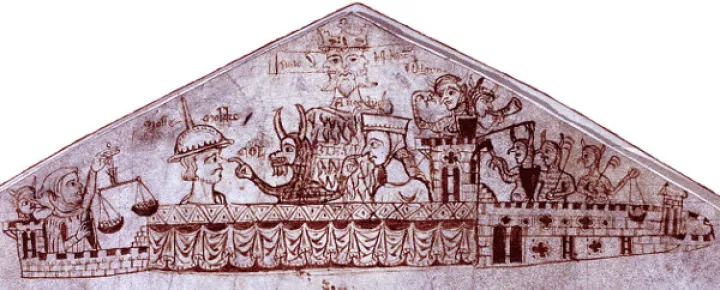
Edict of Expulsion of the Jews from England in 1290

An illustration from an English tax roll, an Exchequer Roll, from the year 1233 AD.The devils are Jews, and the Jew was the source of revenue and taxes for the King.

This program is based on the article found at Heretical Press titled The Edict of Expulsion of 1290. Many of the original Medieval sources cited by Arnold Leese and Geoffrey Smith in that article are available freely online.

These include the Chancery Rolls and other documents of the English kings, which are available in facsimile format online and are indexed in several places, including the Medieval English Genealogy website and Medieval Genealogy Resources at Google.

The Epistles of Paul - Galatians Part 3: The Seed of Seeds

Galatians 3:1-16

The Epistles of Paul - Galatians Part 3: The Seed of Seeds

In order to understand what Paul has written in Galatians chapter 3, one must have the same Scriptural world view which Paul of Tarsus had, understanding ancient history and the ethnic constitution of Judaea in the manner which Paul had understood those things. But because they rarely actually study ancient history, that worldview is far out of reach for most denominational Christians. Even their academics prove this every time they speak of how Flavius Josephus wrote of Jesus, but they never speak of how Flavius Josephus described the conversion of all of the Edomites to Judaism. If they would study that, they may realize that the Jews of today are actually Edomites and not Israel at all, something which is absolutely true. Understanding that history would turn their whole world upside-down. But even that is only one crucial aspect required in order to understand this third chapter of this epistle.

In our presentation of Galatians chapter 1, we established the identity of these Galatians as the tribes of the Germanic Galatae who had settled in Anatolia in the 3rd century BC. We asserted that they in turn had descended from Israelites of the Assyrian captivity, and to help prove those assertions there is a much more detailed demonstration in our German Origins series which we have also recently presented here. In discussing that chapter we also showed how Paul often referred to the children of Israel collectively as the anointed, using the same term which he used to describe Christ. Understanding all of these things is also crucial to understanding Paul's words here in Galatians chapter 3.

Invading Britain: Then and Now, It Always Comes Down to Treachery! Part 1

No matter the invasion, the conquered or the conqueror, it has always been the treachery of the native kings, nobles or chieftains by which Britain was overrun by foreigners, whether they were Romans or Saxons or Normans. The same thing is true of the non-White hordes who are overrunning Britain today.

True Christian Communion

Christogenea Saturdays, August 1st, 2015: True Christian Communion

Earlier this summer, on our recent five-week trip, we were invited to give an opinion of Christian Communion at a Wednesday Bible Study. Some members of a certain church which is dear to us had a long-standing division over the practice of communion as it is traditionally conducted in denominational churches, and whether it should be continued, and how it should be continued, in a true Christian church. I spent nearly an hour giving my opinion on the matter, and this presentation will be based on the outline notes which I had made for that reason.

We all (and when I say we I mean Identity Christians) have backgrounds in one denomination or another, one mainstream belief system or another which, upon discovering our Christian Identity, we now understand to have been based on false paradigms when compared to Scripture and history. But we also all have some degree of what I can really only describe as baggage. While after we have come to the Truth we usually realize that we must cast away much of what we upheld in our former walk, there are almost always some things which we maintain to which we have some emotional tie, things which made us feel good, and which we want to hold onto. Sometimes we simply take it for granted that we are supposed to be doing those things, which are supported by vague understandings of certain Scriptures, and so we insist that we keep doing them. But these are often traditions of men, or even Old Testament rituals that we have not let go of, and which are obscure to us because of the translations which have been made by the professional priests and because of the language and even the cultural barriers between us and the original texts. The truth is, that if we have baggage, then we have not come to the Truth with a clean slate. Often we fail to clean the slate out of our own ignorance, and often we fail to clean the slate out of our own desires to maintain our traditions simply because there are things which we like and we have always done them, so we insist on continuing them. Tonight we are going to take issue with some of the modern “traditions of men”, in comparison with scripture.

The Epistles of Paul - Galatians Part 2: The Works of the Law

Galatians 2:1-21

The Epistles of Paul - Galatians Part 2: The Works of the Law

In Galatians chapter 1 Paul had begun to establish his credentials and his authority as a preacher of the Gospel of Christ. Here he shall continue to do this, and he did it because, as we shall see here in this chapter, he is addressing the Judaizers who had obviously infiltrated among the Galatians in order to bind them to the circumcision and other rituals of the Old Testament law. Ostensibly, these Judaizers had credentials of their own, and therefore Paul, writing in opposition to them, was compelled to present the evidence of his own legitimacy.

At Galatians 1:18 Paul spoke of his time in Jerusalem as described at Acts 9:26, where he had said “Then after three years I went up to Jerusalem to relate an account to Kephas, and remained with him fifteen days”. Here Paul is talking about his visit to Jerusalem in Acts Chapter 15, then he continues in Galatians chapter 2 and says:

1 Then after fourteen years I had again gone up to Jerusalem with Barnabas, taking Titos along also; 2 and I had gone up after a revelation, and laid upon them the good message which I proclaim among the Nations, but privately to those of repute, lest in any way I strive, or have strived, in vain.

Martin Luther in Life and Death, Part 8: Politics and Religion Must Mix

Martin Luther, in Life and Death, Part 8: Politics and Religion Must Mix

Studying Medieval European history is like untying a bundle of knots, and you have to untie one before you can get to the next. But then every so often you get one that can't be undone, so you are forced to cut the rope because there are some knots that can never be untied. The Protestant Reformation was not only religious, but it was also political. We can discuss all of the religious principals, but it is absolutely naive to think that the princes of Germany joined the Reformation because of those principles alone. Rather, politics is much more responsible for the success of the Reformation than religion. We can understand a lot of the politics, but because the sinister forces that had driven some of the players were successful at remaining in the shadows, there are always going to be some things which we cannot truly understand.

A backdrop to Luther's Reformation were the Italian Wars which spanned over 60 years and most of Luther's life. Involved at diverse times were the French, the Spanish, the Austrians, the Germans, the Popes, the Republic of Venice, and even the English and the Scots. These wars began as disputes over Naples and Milan, resulted in several invasions of Italy, and continued as struggles for control between the royal houses all over Europe. They were marked by alliances, counter-alliances, and betrayals no different than those which we have seen in the World Wars of the twentieth century. In the meantime the Austrians and the Venetians were fighting the Turks on other fronts. At one point in the wars, the French, who under Charles VIII had originally sought to use Naples as a base for the war against the Turks, had under Francis I been so treacherous as to ally themselves with the Turks, and allowed the Ottomans to use Toulon as a winter port for the alien fleets. As a result, over thirty thousand Muslims had occupied the city for about eight months, as Christians kidnapped from the coasts were being sold as slaves in its streets.

The Epistles of Paul - Galatians Part 1: The Gospel to the Germanic Galatae

Galatians 1:1-24

The Epistles of Paul - Galatians Part 1: The Gospel to the Germanic Galatae

Here we shall present Paul's epistle to the Galatians, and before doing so we must establish the identity of the Galatians whom Paul was writing to. The name Galatia at the time of Paul's ministry referred to either one of two things. First, the word referred to the kingdom of the Galatae which was established in Anatolia in the 3rd century BC, or secondly it may have referred to the Roman province of Galatia, which incorporated the ancient kingdoms of Lycaonia, Phrygia and Galatia. Considering only the use of the term Galatia in reference to the Roman province, there have long been academic debates disputing whether Paul had written to the “northern Galatians” of the province, which refers to the somewhat Hellenized Galatae of the ancient kingdom, or to the “southern Galatians” which more numerously included the Greeks and Hellenized Lycaonians of the larger cities. But the so-called scholars who debate on these terms do not even seem to realize that Luke did not use the term Galatia in reference to the Roman province, but only as it was originally used, in reference to the ancient kingdom, and that was only the northern part of the Roman province.

In his accounts in Acts, in chapters 13 through 16, Luke specifically mentions the cities Derbe, Lystra and Iconium several times each, and many commentators imagine that it was the Christians in these cities who were the recipients of Paul's epistle to the Galatians, because these cities were all in the southern portion of the Roman province of Galatia. But Derbe, Lystra and Iconium were cities of the ancient kingdom of Lycaonia, which the Romans had later incorporated into the province of Galatia, and in Acts 14:6 Lystra and Derbe are called “cities of Lycaonia”, and then in Acts 14:11 we see a reference to the “speech of Lycaonia”, and the ancient Lycaonians were properly neither Greeks nor Galatians, although they had been Hellenized to a great degree. Then later, in Acts 16:6, Luke mentioned “Phrygia and the region of Galatia” as being separate places, and the ancient kingdom of Phrygia, like Lycaonia, had also been incorporated into the Roman province of Galatia. Then in Acts 18:23 Luke once again describes Paul as having traveled through “the country of Galatia and Phrygia” where he had strengthened “all the disciples”. So we see that in Luke's writing, Phrygia and Galatia are clearly distinguished from one another and also from the cities of Derbe, Iconium and Lystra mentioned in verses 1 and 2 [of Acts 16], which were in Lycaonia.

Early Two-Seedline - Christogenea Europe, July 19th, 2015

The introduction for this program employed information found at Clifton Emahiser's website here: Early Celtic Church Taught Physical Seduction Of Eve!! and here: Early Church Era On Two Seedline

Two-Seedline Christian Identity teachings are found in some of the earliest writings of the Church Fathers. But it is the greatest of Biblical Truths and therefore the most oppressed and persecuted. Ultimately, the attitudes of the Alexandrian universalists prevailed because they were the most useul for both the Jews and the Roman Imperialists.

The following are William Finck's notes for the program:

A brief discussion of the universalist poison of Clement, Origen and Eusebius

Clement of Alexandria misused the phrase “brood of vipers” in Book 1 Chapter 11 of The Instructor (Paedagogus) and in Book 4 chapter 16 of The Stromata. Then in his Exhortation to the Heathen, Chapter 1, ascertained that one could go from being of the “brood of vipers” to being a man of God by accepting Christ:

Again, therefore, some venomous and false hypocrites, who plotted against righteousness, He once called “a brood of vipers.” But if one of those serpents even is willing to repent, and follows the Word, he becomes a man of God.

The universalist position of Scripture was expressed by Clement of Alexandria, and after him it was continued by his student Origen, another Alexandrian, and then by Eusebius. By the time of Eusebius, it seems to be the only position he could imagine, although he neglected to mention at least some of his own theological opponents, such as Methodius of Olympus.

The Prophecy of Zephaniah

The Prophecy of Zephaniah

If the editors of the King James Version of the Bible sought to order the minor prophets chronologically, then Zephaniah is probably just a little out of place, as it seems that the book should have preceded Habakkuk in order. This is because Habakkuk had made no mention of Nineveh as a world power while in Zephaniah chapter 2 we read an oracle against Nineveh, where it says: “13 And he will stretch out his hand against the north, and destroy Assyria; and will make Nineveh a desolation, and dry like a wilderness.” This indicates that Assyria is about to be judged by Yahweh and therefore Zephaniah wrote his prophecy before 612 BC, which is the generally accepted year of Nineveh's destruction. Zephaniah himself tells us that he prophesied during the reign of the good king Josiah, who likely ruled Judah from about 640 BC down to about 609 BC.

We had argued while presenting the prophecy of Habakkuk that he had probably prophesied after the fall of Nineveh, since he never mentions the city or the Assyrians, and even then after the death of Josiah and before the coming of the Babylonians to Judah, which was between 608 and 601 BC. Therefore Zephaniah is probably the next-to-last of the prophets of the Kingdom of Judah whose writings have survived to us, while Habakkuk is probably the last of the Old Kingdom prophets whom we know.

Most of the Book of Zephaniah was also preserved in the Dead Sea Scrolls, and we may examine readings from that source and from the Septuagint where they may improve our understanding of the words of the prophet.