Positive Christianity in the Third Reich, Part 3
Here we continue our presentation of Positive Christianity in the Third Reich by Professor D. Cajus Fabricius

Here we continue our presentation of Positive Christianity in the Third Reich by Professor D. Cajus Fabricius
Christogenea Saturdays, June 6th, 2015 - Esther: Fraud or Fable? Part 3
In the first part of our presentation refuting the canonical status of the Book of Esther, we showed that historically, the Esther narrative does not fit into the rule of any of the kings of Persia, from the earliest of them all the way down to the last of them, for the entire 200-year span of the Persian empire. We also presented textual evidence of the rejection of Esther by the writers of the Dead Sea Scrolls and the sect of Judaeans at Qumran. Additionally, we showed that the supposed events portrayed in Esther are impossible in light of the records of Ezra, Nehemiah, Daniel, and the minor prophets of the second temple period, which are Haggai, Zechariah and Malachi.
Then in the second part of our presentation of the arguments against the veracity of the Book of Esther, we began following Bertrand Comparet's sermon against the book. Doing this, along with Comparet we pointed out several inconsistencies in the story itself, as well as several historically ridiculous situations which the book expects us to accept. Among the inconsistencies is the fact, recorded by both the prophet Daniel and by the Greek historian Herodotus, that the Kings of Persia were forbidden to change any laws or decrees which had been made before-time. Yet in the Esther story, even though the story itself also informs us of this Persian custom, the king is seen making such changes which are impossible because of the custom. Among the historically ridiculous situations, we saw that the king had issued a lengthy proclamation that all of the Jews throughout the empire would be put to death, on a specific date eleven months from the date that the proclamation was made. Yet there was no Exodus, and no uprising. Among the inconsistencies we pointed out, the story purports that only two months later the King of Persia had apparently forgotten that he made such an important proclamation.
Here we continue our presentation of Positive Christianity in the Third Reich by Professor D. Cajus Fabricius
We apologize to our listeners for the technical difficulties that caused this program to be interrupted and abbreviated. The short program is just over 50 minutes long.
Mike Delaney of Prothink.org and Trutube.tv discusses the Real White Nationalism found in Christian Identity as supposed to the hollow ideals and corrupted Jewish morality of so-called secular White nationalists.
Here we shall present Positive Christianity in the Third Reich by Professor D. Cajus Fabricius
Here are only some of William Finck's program notes:
Identity Christians should accept anyone who is apparently White, identifies as White, and who accepts the Gospel of Christ as being White. But it takes a greater-than-average knowledge of history and Scripture to accept Christian Identity, so we cannot expect all Whites who first hear it to do so, and some will never do so. Therefore. Identity Christians should accept as White anyone who, not having an Identity Christian understanding of Scripture, is apparently White and identifies as White so long as they do not openly oppose our message.
Because these lines can be so complicated in today's world with all of its various competing philosophies, then for the purpose of the problems which we are trying to address here we should define our expectations from our fellow Whites, whether they profess to be Christian or not, in the simplest terms possible.
Esther: Fraud or Fable? Part 2
In Part 1 of Esther: Fraud or Fable? this past Saturday we hope to have established as fact that the Esther narrative does not fit into the histories of any of the kings of Persia, especially taking into consideration the circumstances of Ezra and Nehemiah and some of the internal circumstances of the Esther story, such as the chronology which the book itself provides. We had walked through each of the Kings of Persia, from Cyaxares all the way down to Darius III, the last Persian king, and illustrated the problems which materialize with identifying any one of them as the King of Esther.
We also spoke at length about the Dead Sea Scrolls, and the fact that not only is any portion of Esther entirely missing from those scrolls, but in addition, the Feast of Purim is not mentioned in any of the extensive calendrical writings found among the scrolls. Now, as we have often discussed before at Christogenea, the Dead Sea Scrolls can with certainty be dated to the time of Roman rule over Judaea and while Jerusalem was still intact, to the 130-year period between 65 BC and 65 AD. So the sect which created those scrolls obviously did not have the Esther story among their holy scriptures.
The Epistles of Paul - 2 Corinthians Part 12: Christian Transcendentalism
Since the middle of 2 Corinthians chapter 10 Paul has been defending himself and his ministry against those in Corinth who were also attempting to undermine and corrupt the Christian assemblies there. Therefore he found it necessary to discuss some of the trials and challenges which he had faced in the conduct of his ministry. He considered his having to do that as boasting, even if he is simply found to be reiterating plain facts. This too should stand as an example to Christians as to what constitutes boasting.
As Paul began defending himself, he laid forth another sound principle: that the Word of God is the measure which Christians must use in order to estimate the value of those who are administering the Gospel of Christ. Therefore, if one comes to you preaching a Gospel other than the Gospel of Christ, or who claims to have some sort of esoteric knowledge which is not consistent with the Word of God, that person must be rejected as a false apostle, a treacherous worker, and is perhaps even a minister of Satan.
The Book of Esther, Fraud, or Fable? Part 1
“Oh no”, some would say, “now he's attacking the Bible!” Well, whose Bible is that? And what is the Bible? The books which we call the Bible were compiled into a single volume by men, and originally many of them were argued over at great length. Of the 66 books (they are not all “books”, but we will call them “books” for our purposes here) in the King James Version of the Bible, 65 certainly belong there. However the original King James Version of the Bible contained 80 books. The Geneva Bibles which were published in the 16th century and which were the Bibles of the first American protestants also contained 80 books. Someone before us must have attacked the Bible 14 times, because 14 books are already missing! Those 14 books are sometimes published separately and are called the “Apocrypha”. Reportedly, Martin Luther was the first to have published a Bible with these 14 books placed under that special designation, and the Geneva and King James Bibles followed his lead. The typical Catholic Bibles have 72 books, because they retain 6 books from the Apocrypha as well as the 66 found in the King James Version.
But other ancient scriptures exist which are not in the Bible, and were quoted by the apostles as scripture, yet they are not found in the Apocrypha. For a clear example of this, there is Jude 14, where the apostle quotes Enoch. The passage is famous, where it says “14 And Enoch, seventh from Adam, prophesied to these saying 'Behold, the Prince has come with ten thousands of His saints 15 to execute judgment against all and to convict every soul for all of their impious deeds which they committed impiously and for all of the harsh things which the impious wrongdoers have spoken against Him!'” But no such prophecy from Enoch is found in the Old Testament as we have it today. So there are books which the apostles themselves esteemed as Holy Scripture, which never made it into our Bibles at all.
The Epistles of Paul - 2 Corinthians Part 11: Ministers of Satan
From the early portion of 2 Corinthians chapter 10, from verse 7, Paul of Tarsus has been discussing those men in Corinth who had been causing disturbances within the Christian assembly, boasting and inflating themselves during the troubles that the Corinthians had in relation to the fornicator whom Paul discussed in 1 Corinthians chapter 5. Doing so, Paul had told the Corinthians that they “must look at things according to appearance”, asserting that even if his adversaries were of Christ, he was also of Christ, and that the fruits of his ministry according to the standards of the Word of God are the proof of its legitimacy, while those in Corinth who were opposed to him were only exalting themselves according to their own standards. One aspect of the standards of which he speaks and which he expected his readers to notice is the edification of the Body of Christ which had come by his ministry, where he suggests that his adversaries sought the destruction of that same body. He also asserted that his ministry edified and magnified the Body of Christ through knowledge of the Gospel, while his adversaries took to “boasting in others' troubles” whereby they magnified themselves.
In the opening verses of 2 Corinthians chapter 11, Paul of Tarsus had asked that the Corinthians abide with him in a little foolishness. It shall become evident later in the chapter that Paul had considered that foolishness to be his having to boast in the fleshly aspects of his own ministry, including both how he had conducted himself in Corinth, and the trials which he had suffered in order to perform his ministry, in contrast with those who were opposing him.
The notes for both parts 1 and 2 of this presentation have been developed into an article for the Saxon Messenger, with the same title: White Nationalist Cognitive Dissonance
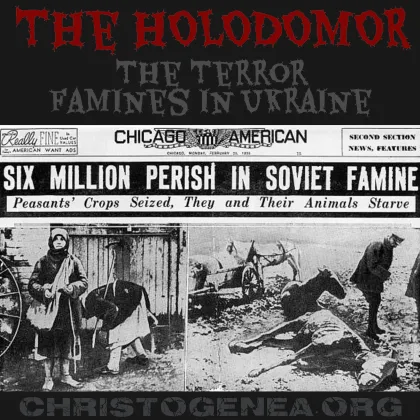
Tonight we are going to discuss what has come to be called the Holodomor, a word which refers to the Terror Famine in the Ukraine and the genocide against Ukrainians and Germans in Ukraine which was conducted by the Bolsheviks over 12 years in the 1920's and 30's. While this topic is becoming discussed more and more in certain circles, it has not yet managed to pervade the public consciousness, which is a testament of the degree Jewish control over the media where their own claims concerning a holocaust are fervently repeated each and every day. So we do this with the purpose of lending our voice to the ever-growing choir. For this discussion, we are going to use as our primary source an article which ran in the Barnes Review in July of 1996. We will, however, include other materials and we also have plenty of our own comments.
We have only a couple of small disclaimers, however, and that is that the author seems to concede a Jewish holocaust perpetrated by Germany, however that is not truly the case. Also, he offers some quotes from some Jewish sources, as if that gives legitimacy to his assertions. That is fine, but we hope that White Europeans realize that we do not need Jews to learn about Jewish treachery. It seems that self-hating Jews are all too popular in certain White Nationalist circles, and it leads to the mistaken belief that there may actually be some good devils, which is certainly not the case.
 The Other Holocaust— The Terror Famine In Ukraine
by Peter J. Lorden
[This article was first published in the July, 1996 edition of The Barnes Review.]
People talk about “the holocaust” as if there had been only one this century, and that one unique in human history. But what of the one inflicted by Josef “Stalin” Djugashvili on Ukraine?
Although Ukraine’s holocaust by famine resulted in the deaths of many more people than were ever attributed to Adolf Hitler in the “official” holocaust, and although it happened only a few years earlier, few now living have any perception of it. That’s understandable, as only one “holocaust” is taught in our schools and constantly featured in the media.
Could this be because those media are heavily influenced by people who have much to gain by promoting one while drawing a blackout curtain across the other? Is it merely by accident that obsessive promotion of the one would be diminished by extensive disclosure of the horrors and dimensions of the other?
The Epistles of Paul - 2 Corinthians Part 10: Judging by Appearances
We have already summarized the theme of the earlier chapters of Paul's second epistle to the Corinthians, but we shall do so once more here. Over the first five chapters of this epistle, Paul had expounded at length upon the affliction and the encouragement which the children of Israel have in the Gospel of Reconciliation to Yahweh their God, and Yahweh's plan of mercy for Israel in that reconciliation. Then in 2 Corinthians chapter 6 Paul illustrated the responsibility which the children of Israel have as recipients of that Gospel and of that mercy, which requires those who are turning to Christ to separate themselves from all of the sinners and from all of the unclean of the other races, and then Yahweh their God shall receive them and dwell with them. Then in 2 Corinthians chapter 7 Paul had turned to express his gratitude that the Corinthians, being grieved, had chosen to repent from the problems which Paul had addressed in his first epistle to them, and the joy which Titus had transmitted to him on account of their repentance and their abiding in Christ. In the eighth and ninth chapters of this epistle, Paul had turned to discuss the collections he had been taking on behalf of the poor of the saints in Jerusalem. However this is also a part of the Christian obligation which Paul had begun to discuss in chapter 6 of this epistle.
Therefore we can determine that outside of a few short digressions, Paul's purpose so far in this epistle has been to present two great themes in a series of smaller discussions. While sometimes the themes are interwoven one with the other, the first theme dominates the context of the first part of the epistle, and likewise for the second theme. The first theme is the Gospel of Reconciliation and the mercy of God for the children of Israel. The second theme is the obligation of the children of Israel upon accepting that offer of reconciliation to God, which is through Yahshua Christ. The first theme dominated the first five chapters, and the second through verse 6 of this tenth chapter, where Paul had attested that the children of Israel would have a part in avenging all disobedience once their own obedience had been fulfilled.
This presentation is based on the essay found at Christogenea entitled Classical Records and German Origins, Part Six
The opening remarks are found here at the Christogenea Forum: The purpose of the Friday evening podcasts at Christogenea
The Epistles of Paul - 2 Corinthians Part 9: Fulfilling Obedience
In 2 Corinthians chapter 8 Paul turned his conversation from a rather expansive explanation of the Gospel of Reconciliation to discuss the collection which he had undertaken for the poor in Jerusalem, in which he had assurances that the Corinthians would participate. The apparent need for such a collection was never discussed, however that such a need indeed existed can indeed be determined from history in the records of Josephus and from the Book of Acts. We see in Acts chapters 4 and 5 that the apostles had founded an independent and self-sufficient Christian community. However we see in Acts chapters 6 and 7 that their community was persecuted and scattered, and that the apostles were being oppressed. When Paul had made his first trip to Antioch as it is recorded in Acts chapter 15, as he had explained in his epistle to the Galatians, that was 14 years after his conversion to Christ on the road to Damascus, and we had established in our commentary on Acts chapter 9, that the year was either 48 or 49 AD. As Paul seems to explain in Galatians chapter 2, this is where his promise to “remember the poor” had originally been made. Since the records in Acts and in what remains of Paul's epistles are quite incomplete, we can only piece together parts of some of these things, as there is no complete record of any of them.
The notes for both parts 1 and 2 of this presentation have been developed into an article for the Saxon Messenger, with the same title: White Nationalist Cognitive Dissonance
The notes for both parts 1 and 2 of this presentation have been developed into an article for the Saxon Messenger, with the same title: White Nationalist Cognitive Dissonance
The following are William Finck's opening remarks:
We are going to play a tape, actually a YouTube video, of a man who is interviewing several PhDs and science students, and asking them for one observed instance of macro-evolution. While micro-evolution is often used for what may better be called the adaptation of species, macro-evolution is the actual changing of one identifiable kind, such as a cat, into another identifiable kind, such as a dog or a cow. Evolutionists play with the word species, and when it comes to macro-evolution they are challenged by the concept of kind. When they are cornered, as one PhD in the video was cornered, they insist that by adding an unspecified but very long amount of time, macro-evolution somehow happens. But they cannot prove that it has ever actually happened, and it has never been observed to happen. Therefore macro-evolution is a religious belief, and it is at least as fantastic a belief as those of any other religion. One PhD interviewed was forced to admit that evolution in this regard is a “belief”, even though he was very reluctant to do so. Other PhDs were speechless and fumbling when challenged on macro-evolution. Textbooks and journals, which hypothetically extrapolate entire genera from the bones of certain long-dead animals, are merely promoting conjecture which does not at all amount to valid science.
This presentation is based on the essay found at Christogenea entitled Classical Records and German Origins, Part Five
Comments on our experience in Naples are found in the Christogenea Forum:
The 4/15 Bible Study at the First Baptist Church of Naples
The Epistles of Paul - 2 Corinthians Part 8: Communion, Not Tithes
After expounding at great length upon the affliction and the encouragement which the children of Israel have in the Gospel of Reconciliation to Yahweh their God, as well as Yahweh's plan of mercy for Israel in that reconciliation, in 2 Corinthians chapter 6 Paul illustrated the responsibility that the children of Israel have as recipients of that Gospel and that mercy. That responsibility requires the children of Israel to separate themselves from all of the sinners and from all of the unclean of the other races, and then Yahweh their God shall receive them and dwell with them. Then in 2 Corinthians chapter 7 Paul had turned to express his gratitude that the Corinthians, being grieved, had chosen to repent from the problems which Paul had addressed in his first epistle to them, and the joy which Titus had transmitted to him on account of their repentance and their abiding in Christ. Here in this eighth chapter of 2 Corinthians, Paul turns to the more worldly tasks related to the fulfillment of his ministry, which in this case include the collections he had been taking on behalf of the poor of the saints in Jerusalem.
 Brett can be found at his own website, Expeltheparasite.com, or in his articles at the Daily Stormer.
Here William Finck presents two of Clifton Emahiser's essays introductory to Christian Identity: The Unseen World Within Our World and A Truth Hidden For 2,700 Years
"If my people, which are called by my name, shall humble themselves, and pray, and seek my face, and turn from their wicked ways; then will I hear from heaven, and will forgive their sin, and will heal their land." - 2 Chronicles 7:14

Click HERE listen to our streams.
There is now a completely new schedule with different programs for each stream every day. Click here for Radio info. Last update: September 17th, 2024
Click here for Radio Albion.
William Finck on the Delingpod June 28th, 2025 (Sorry, currently subscriber-only).
Are the Jews God’s ‘Chosen’ People? - William Finck with Jerm Warfare at UKColumn May 28th, 2025
 The audio archive for the MEIN KAMPF PROJECT at Christogenea.org houses many programs related to the history of the 19th and 20th centuries which are not found here at the main Christogenea website.
 The Christogenea archive site contains older material produced at Christogenea and elsewhere that has been retired from our main website but which we certainly feel should remain available.
Christogenea is reader supported. This month's support level is reflected in the graph below. See our Contact page for a mailing address and other ways to support Christogenea.
57 %