Just Talking with HoTpOck

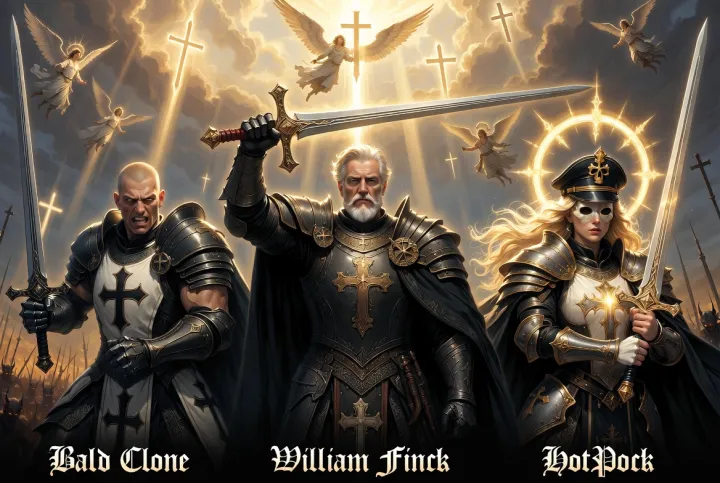
Bald Clone thought he might make it Wednesday, but couldn't. So HoTpOck and I just had a talk about life.

Bald Clone thought he might make it Wednesday, but couldn't. So HoTpOck and I just had a talk about life.
Highlights in Exodus: The Exodus In Controversy and History
Here I am going to endeavor a discussion of the Book of Exodus. This will not be a verse-by-verse commentary. Rather, I will focus on the historical details of the Exodus, on an outline of the history of the children of Israel in the Book of Exodus, and also on the Law, as Christians are often confused concerning the Law, in reference to which commandments are those that Christ expects His disciples to keep, and which commandments are the rituals and civic laws of Israel which are now obsolete under the New Covenant. I may interject comments on other passages where it is fitting. As we always have done in our Old Testament commentaries, we shall follow the King James Version, and do our best to note the significant differences which may be found in the Septuagint, the Dead Sea Scrolls and even the early translations found in the Hexapla of Origen.
On the history of the Exodus, most Christians who pay attention to the mainstream academic jargon, especially when it is echoed in popular media, should already be aware that this is always under attack by one academic scholar or another, and there are always fascinating new “discoveries” which seek to discredit the Exodus account. However sometimes there are discoveries which demonstrate its historicity, and hopefully we shall discuss the more significant of those here.
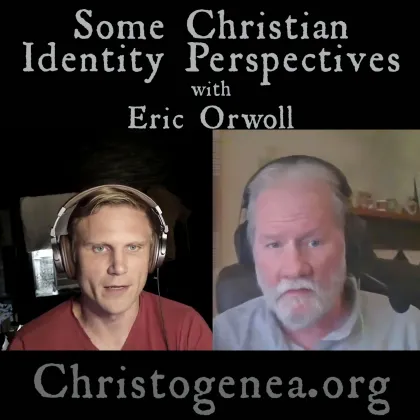
Eric Orwall is founder of the Return to the Land community in northern Arkansas.
For a more comprehensive answer to my objections of DNA studies to determine Whiteness and population movements, see the July 3rd Topical Discussions podcast titled Muddy Theories.
For a better answer to my objections to the existence of the Hyperborea described by Aristeas see this Christogenea Forum topic: Herodotus and Strabo Cast Doubt on the Hyperborea Story of Aristeas (I had actually forgotten which writer had called Aristeas a "charlatan" so I did not go there during the podcast.)
To watch the video rather than listening, CLICK HERE.
July, 2026 Topical Discussions: Muddy Theories
Tonight we shall discuss the folly of “Tartaria” and other chronology gimmicks, and also the folly of building a Nationalist worldview based on DNA “Science!” which denies the existence of race as a biological entity.
Establishing the truth behind our general perceptions of historical chronology: the folly of “Tartaria” and other chronology gimmicks.
Some of this evidence, I had discussed in a recent podcast on 88streams.com, but I wanted to present a more complete version of the evidence against the so-called Tartaria theory.
There are conspiracy theories of some ancient, advanced kingdom called Tartaria, which often include sub-conspiracies claiming that centuries had somehow been added to the calendar, centuries which never actually existed in some grand conspiracy to make antiquity seem even more remote. The proponents of these theories take advantage of the historical ignorance of their listeners, and are even ignorant themselves. Some claims even assert that the “Tartarian Empire” was global, that even buildings in America are the products of a bygone civilization which somehow disappeared in “mud floods” and natural disasters. All of these claims are patently absurd, and absolutely false.
The older European maps labelled most of the interior of Asia as “Tartary” only because Europeans were familiar with the people called Tatars who had entered Russia from the East in the Middle Ages. But the entire land east of Russia was unexplored, so they used that name to describe the entire unexplored region. This practice was evidently begun when the label Tartary first appeared on a map by a Venetian cartographer Giovanni Contarini in 1506, and then by Dutch explorer and cartographer Johannes Ruysch in 1507. The British and others continued the practice of labelling the quite vast but unexplored land as Tartary. But Magellan’s famous expedition circumnavigating the earth did not begin until 1519, Magellan himself died in 1521, and it was completed without him in 1522. But Russia did not conquer Siberia until the 17th century, and the rest of its territories in Asia until the 18th and 19th centuries.
The most pressing issues of the day: Replacement migration, the Camp of the Saints and Who is your God?
The presence of Hindus in rural Indiana, and the rural South.
The state of Christianity in Europe, especially Germany and Britain. Scottish churches being turned into kebab shacks!
Sven Longshanks visited the All Saints Church in Hereford, England to see the lewd carving posted in a photograph at the Christogenea Forum, other sites recently visited by Sven and members of Patriotic Alternative.
The state of the “Far Right” and “Christian Nationalism” in Social Media: in the hands of non-Whites, fornicators and Sodomites.
Sven on Rupert Lowe and Nigel Farage, British politics and prospects. The crisis in Northern Ireland over the recent attempted beheading and resulting riots, the IRA and Sinn Fein is explicitly anti-racist and in opposition to the riots.
The Social Media phenomenon gives people a false feeling of accomplishment versus actually doing something in real life.
Home Bible studies and seeking for friends and acquaintances to join them as a way to evangelize Christian Identity and an alternative to churches.
Number of jews in America is probably 90% underestimated.
Russia today and prospects of Ukraine War escalation to include Germany or Western Europe.
Augustine, Plato, and the proper Christian attitude towards jews.
The Opium Wars, Jewish bankers, and English and US military involvement on their behalf.
The origins of Hebrew language, Hittites, Hurrians
And more! Thanks to all those who participated!
Paul Fromm has been an advocate for free speech in Canada for many years. Somewhere I have a video posted of a David Irving speech at the University of Toronto where he had introduced Irving, and I think that was in 1992. Paul had assisted the defense in the Canadian trial of Ernst Zündel in the late 1980's, and he was also involved in the Terry Tremaine case in 2006.
The Canadian Charter of Rights and Freedoms is in the Constitution Act of 1982.
The Combatting Hate Act which "received Royal Assent on June 18, 2026."
A Commentary on Isaiah, Part 71: The Appointed Place
In Isaiah chapter 64 the prophet had presented A Prayer for Repentance, where he had portrayed the children of Israel as having prayed to Yahweh their God for mercy, and also that He would take vengeance upon His enemies, since for Israel it is evident that there is Mercy in Vengeance, as we had seen in our discussion of Isaiah chapter 63. Then in Isaiah chapter 65, which we had titled Christians and Pagans, we see that the prophet had recorded the answer of Yahweh to that prayer, and while most of it was directed towards the obedient of His people, those who would choose to serve Him, for their good, there were also grave warnings for those who would remain rebellious, that they would be put to the sword. As they were described in that chapter, we could only describe the obedient as Christians, who would wait on Yahweh for their salvation and hearken to His Word, and the rebels as pagans, as they continued in their licentiousness and their sin. So with this is a valid explanation for the wars of the children of Israel as they migrated and settled into their new homes in the Appointed Place, which is described in the closing verses of this final chapter.
Subsequently, for the obedient there was a promise of a New Heavens and Earth, and the answer to their prayer continues through Isaiah chapter 66, and the very end of this book of prophecy. Where we had left off with verse 4 of this 66th and final chapter of Isaiah, the Word of Yahweh had once again turned to the contrasting fates of Christians and pagans, of those who would obey Him and those who would not, where He had had avowed to consider the humble and contrite, those who respected His Word, but for those who would not, He said:
4 I also will choose their delusions, and will bring their fears upon them; because when I called, none did answer; when I spake, they did not hear: but they did evil before mine eyes, and chose that in which I delighted not.
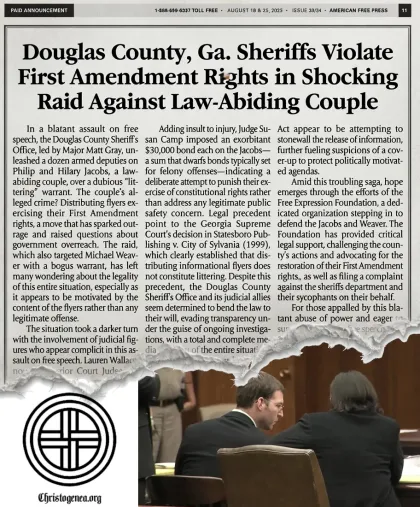
Michael Weaver has been fighting a battle over free speech and legal literature distribution for several years now. This battle has included some ridiculously oppressive acts on the part of Georgia law-enforcement, such as raids on the home of Philip and Hilary Jacobs for a littering charge, something which I have never heard of in my entire life. Imagine a $30,000 bond for littering. A prosecutor in the case even doxxed Philip’s pamphlet distribution activity to his employer, getting him fired. So with prosecutors like that, there is no need for Antifa activists. It does seem like they are taking marching orders directly from the ADL.
Articles of Interest:
When Tyranny Becomes Law --- When Tyranny Doubles Down --- When Tyranny Persists --- Free Speech Under Attack in Georgia
Donate to the cause: Michael Weaver's defense fund
Littering Statute in Georgia
O.C.G.A. §16-7-42(a) defines littering as any discarded or abandoned refuse, rubbish, junk, or other waste material, or dead animals.
From the Free Expression Foundation's Update on Pending Litigation:
Jacobs, et al. v. Catlin, et al. U.S. District Court for the Northern District of Georgia....
A Commentary on Isaiah, Part 70: New Heavens and Earth
We had titled our commentary on the early portion of Isaiah chapter 65 Christians and Pagans, and perhaps Christians and Heathens may have been more accurate, and even more properly descriptive, but either way the same point is made. There have always been people among the children of Israel who are quick to depart from the faith in exchange for the temporary pleasures of the flesh, or even at the first sign of some trial. While the pagan beliefs may be seen as ancestral, they actually represent the errors and sins of our ancient ancestors. All of the records of Norse paganism, or Greek paganism, or the paganism of Mesopotamia reflect an acceptance of sexual licentiousness, Sodomy, child grooming, adultery and other sins which are not sins for pagans, because even the gods indulged in such acts, and if one’s god does it, well, then it must be permissible for everyone.
As soon as the children of Israel in the Exodus account had thought that Moses had been gone too long at Sinai, they quickly broke off on their own path and compelled Aaron to make for them a golden calf. Most Christians probably do not realize that the golden calf was a symbol of Baal, and that the Israelites in Egypt must have been familiar with Baal, because they were in Goshen, in the area of the Nile Delta, during the same period when Canaanite kings had ruled over much of Lower Egypt. Apparently, after the conquest and expulsion of the Hyksos, the Egyptians themselves had also added Baal to their own collection of idols. Much later, when the kingdom of Israel was divided, the golden calves of Jeroboam I had also represented the worship of Baal.
 So far this year, Christogenea has operated with a deficit equivalent to nearly a month's worth of our expenses. Our cash reserves are nearly exhausted. Under such circumstances we cannot continue for long, as we have approximately $1500 monthly online hosting expenses alone.
If you appreciate our work, please remember that it is not "free" to produce or to keep freely available. Please help support Christogenea and keep us working!
Support Christogenea via GiveSendGo! Christogenea is 100% reader supported. If you find value in our work, please contribute and help to keep it going! See our Contact Page for more information.
Aside from over 15 separate websites, a chat and 6 radio streams, Christogenea freely hosts over two dozen unrelated Christian Identity or Christian Nationalist websites, and William Finck spends at least 60 hours a week, usually longer, managing the technical aspects of this endeavor, and producing new content.
A Commentary on Isaiah, Part 69: Christians and Pagans
In our most recent commentary on Isaiah, discussing chapter 64, we saw A Prayer for Repentance which began with a plea for judgment, which had petitioned Yahweh God, in part, to “make thy name known to thine adversaries, that the nations may tremble at thy presence!” Then the children of Israel were portrayed as having confessed many of their sins, and as having surrendered themselves to the will of their God hoping to receive of His mercy. In that, there was also a subtle prophecy, as they confessed that Solomon’s temple had been destroyed, even if the temple would not be destroyed for at least another hundred years after the time when Isaiah could have written these words. Finally, they expressed complete exasperation with their circumstances in the world, where both the chapter and the prayer had concluded and they asked “12 Wilt thou refrain thyself for these things, O LORD? wilt thou hold thy peace, and afflict us very sore?”
This prayer in Isaiah chapter 64 echoes attitudes in an earlier prayer which is found in Isaiah chapter 26. There the children of Israel were portrayed as having been oppressed by their enemies, but also as having been multiplied in spite of that oppression. Yet they showed a similar degree of exasperation where they are depicted as having said:
16 LORD, in trouble have they visited thee, they poured out a prayer when thy chastening was upon them. 17 Like as a woman with child, that draweth near the time of her delivery, is in pain, and crieth out in her pangs; so have we been in thy sight, O LORD. 18 We have been with child, we have been in pain, we have as it were brought forth wind; we have not wrought any deliverance in the earth; neither have the inhabitants of the world fallen.
Following that Yahweh God is portrayed as having made a promise of judgment upon His enemies which continues into chapter 27. So the prayer found there is indeed parallel to this one, and we have pointed out several such instances in Isaiah, in this context and others.
The original video version of the stream, which has my appearance beginning at just after 1:46:00 can be found at Rumble.
I honestly did not want to replay this here already this evening, however I have been nursing a bad knee injury, and I am spending as little time at my desk as possible, as the injury was exacerbated by a fall I took two weeks ago. It seems to be healing, but slowly. I will do my best to get back to our Isaiah commentary soon! Hopefully next week. Praise Christ!
There were evidently some places early in my discussion where I could not hear Bald Clone, and did not know he was speaking to me.

I must apologize for not yet having completed a topic list, but it is in progress! I have been nursing a bad knee injury, and I am spending as little time at my desk as possible, as the injury was exacerbated by a fall I took two weeks ago. It seems to be healing, but slowly. Praise Christ!

Here with HoTpOck and Bald Clone we discussed some aspects of Genesis,, the Revelation, and some of the true history which discredits the ridiculous pseudo-historical "Tartaria" or "Tartarian Empire" conspiracy stories which have been circulating in certain circles of the internet.
See the full video stream at 88Streams.com, where it is the final three hours or thereabouts in a longer stream.
A Commentary on Isaiah, Part 68: A Prayer for Repentance
Even with a three-and-a-half page, twenty-five hundred word introduction, this will be one of our shorter presentations in Isaiah, as this chapter represents a prayer of Isaiah made on behalf of the children of Israel, and in which Isaiah portrays the children of Israel themselves as praying to Yahweh their God for mercy, which does not become completely apparent until verse 5. Chapter 55 contains the response of the Word of Yahweh to this prayer, so we stopped short of entering that chapter. Our commentary on Isaiah is drawing to a close, so we are not trying to rush to the end.
There is a pattern in the history of the children of Israel which emerges in the historical narrative of Scripture soon after the Exodus from Egypt. When the children of Israel follow after their God, they are blessed and they prosper as a nation. If there is war, those who turn to obedience are victorious, and may even overcome death, as Paul had written in Hebrews chapter 11 where he had spoken of men whom Yahweh had raised to deliver the children of Israel from such turmoil, and we read in part:
32 And what shall I more say? for the time would fail me to tell of Gedeon, and of Barak, and of Samson, and of Jephthae; of David also, and Samuel, and of the prophets: 33 Who through faith subdued kingdoms, wrought righteousness, obtained promises, stopped the mouths of lions, 34 Quenched the violence of fire, escaped the edge of the sword, out of weakness were made strong, waxed valiant in fight, turned to flight the armies of the aliens. 35 Women received their dead raised to life again: and others were tortured, not accepting deliverance; that they might obtain a better resurrection.
While it seems not to have worked out well for Samson, he had been blinded, it was inevitable that he was about to die, and upon his final prayers, Yahweh had given it to him to be avenged in his death, so in his end he had also experienced the mercy in vengeance. However each of those ancient deliverers of Israel had rather unequivocally understood that their deliverance had come from Yahweh their God, and it was not of themselves.
A Commentary on Isaiah, Part 67: The Mercy in Vengeance
In our last presentation we had discussed only the first six verses of Isaiah chapter 63, which begin with a dialogue and describe Yahweh God Himself as executing His vengeance upon Edom. For that reason, we titled the presentation Settling the Controversy of Zion, because that is precisely what it prophesies, where we also discussed the very similar parallel prophecy found earlier in Isaiah, in chapter 34, where Yahweh had declared:
5 For my sword shall be bathed in heaven: behold, it shall come down upon Idumea, and upon the people of my curse, to judgment.
And then the reasons for this are given a little further on in that chapter:
8 For it is the day of the LORD'S vengeance, and the year of recompences for the controversy of Zion.
This is the vengeance which Christ had stopped short of declaring as the purpose of first His ministry, when He spoke in the synagogue in Galilee, in Luke chapter 4, and cited Isaiah chapter 61 where we read that His purpose is:
2 To proclaim the acceptable year of the LORD, and the day of vengeance of our God; to comfort all that mourn;
It could not have been time for vengeance at the time of the first advent of Christ, as the children of Israel were not yet reconciled to Yahweh through Christ, they had not yet heard the Gospel, and therefore they did not even know to perfect their obedience so that there could be vengeance, as we see in the epistles of the apostles and in the progression of these chapters here in Isaiah.
A Commentary on Isaiah, Part 66: Settling the Controversy of Zion
In our last two segments of this commentary on Isaiah, discussing chapters 61 and 62, we hope to have explained The Acceptable Year of Yahweh, from the context in which the clause is found here in Isaiah, as well as from the teachings in the Gospel of Christ, who had come to proclaim that year, as He Himself had announced in the synagogue in Nazareth. Then we had seen that Israel would be Called by a New Name, and we sought to demonstrate from the Gospels as well as the prophecies in Isaiah, how that name must be the name of the Messiah of Israel, which is the Name of Christ. As the apostle Peter is recorded as having said, in Acts chapter 4: “12 Neither is there salvation in any other: for there is none other name under heaven given among men, whereby we must be saved.” One other perspective which we have is this: Yahweh promised, in Hosea, to betroth Israel to Himself forever, and that same reconciliation is promised in various other ways throughout Isaiah.
In Isaiah chapter 4 there is a prophecy which explains that even in ancient times, wives took the names of their husbands, where we read:
1 And in that day seven women shall take hold of one man, saying, We will eat our own bread, and wear our own apparel: only let us be called by thy name, to take away our reproach.
Since Christ is the Bridegroom, as John the Baptist had declared, and as He had also later described Himself, and He being Yahweh God incarnate had promised to betroth Israel to Himself, which is found in Hosea chapter 2, then the bride should indeed be expected to take the name of the Husband, which in this case is Christian.
However, by His Own admission Christ had come only for the so-called “lost sheep of the house of Israel”, and throughout this book of the prophet Isaiah we have repeatedly seen that all of the promises of God concerning redemption and salvation were made exclusively to those same children of Israel who had become “lost sheep” in the period following the deportations of the Israelites by the Assyrians and the Babylonians. In the end, in the final chapters of the Revelation, the City of God which descends from Heaven has on its gates the names of the twelve tribes of Israel, so those who should wear this new name must be one and the same with those twelve tribes. As Paul of Tarsus had professed in Acts chapter 26, his labors were on behalf of the promises which God had made to the fathers, which he had described as the hope of the twelve tribes of Israel, and when James had written his epistle, for that same reason he addressed it to the twelve tribes which had been scattered abroad. Since both of those writings were originally written in Greek, we may expect at least significant elements of those twelve tribes to have been a part of the wider Greek world.
A Commentary on Isaiah, Part 65: Called by a New Name
In Isaiah chapter 56 Yahweh had promised to gather the outcasts of Israel, and in chapter 57 His Word avowed that there shall be no peace for the wicked, for His enemies, even if in this age the righteous may suffer on their account. Then in Isaiah chapter 58, the sins for which the children of Israel had been sent into captivity are described, as they had defiled their fasts and their sabbaths by oppressing the weak and disadvantaged of their own people, and having neglected their own flesh they only fasted and used their sabbaths for their own individual self-righteousness. However there they are told how it is that they may repair the breach which such conduct had caused between themselves and Yahweh their God, and in chapter 59 they are reminded again of their more general iniquities, which separated them from their God, the breach of the previous chapter. But there, as they are portrayed, it is only once they realize they cannot save themselves, and turn to their God, that they are promised by Yahweh that He Himself would save them, bringing the destruction of His enemies along with salvation “unto them that turn from transgression in Jacob”. So the promises which are in Christ are echoed in the final verse of that chapter, where we read:
21 As for me, this is my covenant with them, saith the LORD; My spirit that is upon thee, and my words which I have put in thy mouth, shall not depart out of thy mouth, nor out of the mouth of thy seed, nor out of the mouth of thy seed's seed, saith the LORD, from henceforth and for ever.
In Isaiah chapter 60, there are premonitions of the Parable of the Sheep and the Goats, and finally, we left off at the end of chapter 61, where there is a prophecy of “the acceptable year of Yahweh” which Christ Himself had professed as having come to proclaim, as it is recorded in Luke chapter 4. Now here we have given this synopsis, because there is a lesson in the order of subjects in these chapters. We could have begun at Isaiah chapter 41. Salvation is for all of Israel, because in Isaiah chapter 45, there are promises that ultimately, all of Israel shall turn away from transgression, and all of Israel shall be saved with an everlasting salvation.

Spots in Your Feasts of Charity, A Review of a Paper by Clifton Emahiser
Here I am going to take a break from our Isaiah commentary, which is nearing completion, to present a critique of a paper by Clifton Emahiser. Evidently, it’s been over five years since we had visited Clifton in this manner, when I reviewed The Day The Word Became Flesh in January of 2021, so it seems to be well past the time that we should hear from him again. So I conceived this presentation on Wednesday, as Clifton would have been 98 years old if he were still with us. But while we miss him, I am certain he is in a better place now.
Clifton never really dated his papers, except in the titles of the file names he stored on his computer, where he added dates which represented the various stage of completion, such as when they were drafted, when they were proofread and when they were finally ready to print. So this particular paper was ready for print on December 21st, 2014, and I posted it on his website two days later. Personally, I think dating papers is important, especially if we hope to write profusely over a long period of time, because over time we ourselves should learn, and our opinions in some matters should evolve, so it may be important to date our papers to show our own progression in learning. No man starts out with a knowledge of all things, and certainly no man can end with one either.
A Commentary on Isaiah, Part 64: The Acceptable Year of Yahweh
This seems to have been expressed here in various ways already, however we must insist on finding different methods by which to illustrate it as completely as possible, because it is, in my opinion, one of the most significant aspects of this prophecy of Isaiah, and of the lessons of the Old Testament as a whole: There is no temporal salvation for the children of Israel without obedience to Yahshua Christ, and that includes the keeping of His commandments, which are found in the laws of Moses. So what we have read in Isaiah concerning the sins of the children of Israel is sufficient cause for repentance, and repentance certainly is a prerequisite to receiving the blessings and promises of these same chapters. As we have just read, in Isaiah chapter 59:
20 And the Redeemer shall come to Zion, and unto them that turn from transgression in Jacob, saith the LORD.
However as we have also seen, the prophecies in these chapters also foreshadow many of the words of Christ Himself in the Revelation, so these same conditions of repentance must be satisfied if we are ever going to see the Kingdom of God. Therefore all Christians should seek to follow in the teachings of Christ, and hope to have a part as repairers of the breach which had developed between Yahweh God and His people Israel on account of their sins.
In our last presentation in Isaiah, we cited a much earlier prophecy found in Isaiah chapter 26 where we read in part:
15 Thou hast increased the nation, O LORD, thou hast increased the nation: thou art glorified: thou hadst removed it far unto all the ends of the earth. 16 LORD, in trouble have they visited thee, they poured out a prayer when thy chastening was upon them. 17 Like as a woman with child, that draweth near the time of her delivery, is in pain, and crieth out in her pangs; so have we been in thy sight, O LORD. 18 We have been with child, we have been in pain, we have as it were brought forth wind; we have not wrought any deliverance in the earth; neither have the inhabitants of the world fallen.
"If my people, which are called by my name, shall humble themselves, and pray, and seek my face, and turn from their wicked ways; then will I hear from heaven, and will forgive their sin, and will heal their land." - 2 Chronicles 7:14

Click HERE listen to our streams.
There is now a completely new schedule with different programs for each stream every day. Click here for Radio info. Last update: September 17th, 2024
Click here for Radio Albion.
William Finck on the Delingpod June 28th, 2025 (Sorry, currently subscriber-only).
Are the Jews God’s ‘Chosen’ People? - William Finck with Jerm Warfare at UKColumn May 28th, 2025
100 Proofs the Israelites were White - Full Documentary - Truthvids' 14-hour documentary based on our 2020-2022 podcast series of the same title.
 The audio archive for the MEIN KAMPF PROJECT at Christogenea.org houses many programs related to the history of the 19th and 20th centuries which are not found here at the main Christogenea website.
 The Christogenea archive site contains older material produced at Christogenea and elsewhere that has been retired from our main website but which we certainly feel should remain available.
Christogenea is reader supported. This month's support level is reflected in the graph below. See our Contact page for a mailing address and other ways to support Christogenea.
29 %