Topical Discussions, December, 2025


Topical Discussions, December, 2025

Here I am going to take another break from our Isaiah commentary and instead endeavor to treat a few subjects which arise continually, and although I have treated them in the past, in places such as the Christogenea Forum or from various perspectives in diverse commentaries, most of those are not as complete a treatment as I may be able to do here. However for some of these subjects, which are the pagan nature of Christmas and the inaccurate dating of the birth of Christ by the churches, it is also a discussion which is seasonable. We shall also discuss our reasoning for our interpretation of the Biblical Hebrew calendar. But first I want to address something which is taken for granted because it is repeated very often in social media, and even in print media and books.

Here we shall discuss three subjects, or actually four: By Way of Deception Christians Should Not Interpret Scripture, Reckoning the Dates for the Passover and the Day of the Sabbaths, How Christmas is Pagan and Dating the Birth of Christ. Our presentation of the last two subjects is hopelessly intertwined. 


By Way of Deception Christians Should Not Interpret Scripture

That is the motto of the subversive jewish agency known as the Mossad, which is typically said to read "By way of deception you shall wage war", and it seems that most people take for granted the jewish claim that this motto is a citation from Proverbs 24:6. So first, we shall cite Proverbs chapter 24:

1 Be not thou envious against evil men, neither desire to be with them. 2 For their heart studieth destruction, and their lips talk of mischief. 3 Through wisdom is an house builded; and by understanding it is established: 4 And by knowledge shall the chambers be filled with all precious and pleasant riches. 5 A wise man is strong; yea, a man of knowledge increaseth strength. 6 For by wise counsel thou shalt make thy war: and in multitude of counsellors there is safety. 7 Wisdom is too high for a fool: he openeth not his mouth in the gate. 8 He that deviseth to do evil shall be called a mischievous person. 9 The thought of foolishness is sin: and the scorner is an abomination to men. 10 If thou faint in the day of adversity, thy strength is small. 11 If thou forbear to deliver them that are drawn unto death, and those that are ready to be slain; 12 If thou sayest, Behold, we knew it not; doth not he that pondereth the heart consider it? and he that keepeth thy soul, doth not he know it? and shall not he render to every man according to his works?

Challenging Orthodoxy: Further Scriptural Witnesses Against the Trinity Doctrine

Challenging Orthodoxy: Further Scriptural Witnesses Against the Trinity Doctrine

Ever since I began the commentary on the Gospel of John back in 2018, which was an endeavor that took me nearly two full years to complete, I have wanted to do certain topical programs which condensed particular subjects that are prominent in the Gospel of John into single topical presentations. In my estimation, the Gospel of John was the last one written, and was purposely written in a way which sets it apart from the synoptic Gospels. The apostle John illustrated teachings both about Christ and from Christ which the synoptic Gospels only represent superficially, or had excluded entirely. So I view John as a retrospective account of the Gospel, as John seems to have read the others, and chose to fill in many of the gaps from the substance and ministry of Christ which were left unrecorded in the synoptic gospels. One of those subjects is the nature of Christ Himself, so that John provides much of the evidence against the later so-called trinity doctrine of the Roman Catholic Church. But for some time I procrastinated, having been busy with other projects, so it has been seven years, at least, since I first realized a need to do this, and when I finally began to prepare for this discussion, I honestly thought it would only be a single presentation. However doing that first presentation, I had to stop at about eleven thousand words, because I ran out of writing time, and that left several thousand words of notes for Scriptures that were left without mention. Therefore, here we are with a second discussion challenging the trinity doctrine, and I shall try not to repeat much of what I had said in the first discussion.

But when I finally resolved to discuss this subject of the so-called trinity here three weeks ago, it had been precipitated by a certain presumed friend who has continually accosted me, attempting to correct me for what he perceives to be my shortcomings. While we have been acquainted in social media for many years, he even joined the Christogenea Chat back in August, just to argue with me about his trinity doctrine, which he holds precious, and now he has once again badgered me in social media. But he also continually and rather consistently misrepresents me and my positions on the issue, probably because he has not actually read my papers. However, certain people seem to have a difficult time reading and grasping things which they find disagreeable, and now after several long back-and-forth discussions with this individual, I am convinced that he is one of them. He claims to admire my work, but he really only admires it to the point where he agrees, and then he thinks he has some divine commission to demand that I change where he does not agree. While I continue to disagree, in essence, his attitude is that he knows everything, and he can correct me because I don’t know what I am talking about. It is actually arrogant for such a man to keep confronting me when I refuse his correction.

Challenging Orthodoxy: Scriptural Witnesses Against the Trinity Doctrine

Challenging Orthodoxy: Scriptural Witnesses Against the Trinity Doctrine

Before I begin, I must repeat something I have stated very frequently over the past few decades, which is that no part of Scripture is a lie. One verse of Scripture does not disprove another verse. If there is a perceived conflict, sometimes it is a corrupt text, which, on occasion, can be rectified by examining ancient manuscripts. Sometimes it is merely a poor translation which is more easily corrected upon examining the original languages. Sometimes it is a poor understanding of the context in which . But much more frequently than any of these, is a poor understanding on the part of the reader, and a lack of knowledge which is rectified only through further study. Therefore all of the “gotcha” verses which a scoffer may pull out of his pocket to refute our claims here this evening, do not prove what the scoffers think they prove.

Yes, Christ, the man, often prayed to God the Father, and often spoke of God the Father, from the perspective of a man. But that which He had done, He did as an example to men. When He washed the feet of His disciples, He said, as it is recorded in John chapter 13: “15 For I have given you an example, that ye should do as I have done to you.” Then, in 1 Peter chapter 1 we read: “21 For even hereunto were ye called: because Christ also suffered for us, leaving us an example, that ye should follow his steps: 22 Who did no sin, neither was guile found in his mouth: 23 Who, when he was reviled, reviled not again; when he suffered, he threatened not; but committed himself to him that judgeth righteously”, so that likewise, we would strive to live as He had lived, without sin and committing ourselves to His judgment. For that reason, to serve as an example for men, during His earthly ministry He behaved just as a man should behave, and not as God. After His resurrection, he was recognized as God. Yahshua Christ did not become a god, but rather, He is God who became a man, and His Resurrection proved that He is God. When the apostle Thomas had realized that it was Christ who was resurrected from the dead, he responded by declaring “My Lord and my God!” The prophet Isaiah was read in the synagogues, Christ Himself read from Isaiah and declared one Messianic prophecy to have been fulfilled in Himself, so men knew the other prophecies concerning their promised Redeemer, and they understood that those prophecies were fulfilled in Christ.

On Biblical Exegesis, Revisited

On Biblical Exegesis, Revisited

Back in 2009, I wrote an essay titled On Biblical Exegesis. Then in July of 2011, I presented that paper in the opening portion of an Open Forum, and I do not know whether or not I had at that time expanded on the original essay. Knowing my own impulses, I probably did, but I left nothing in writing. So here I am going to expand on the essay, as there is much to add to the subject, and I have been wanting to revisit it for a long time, but at the present moment I feel a necessity to revisit this subject. So I will also state that, although I will speak for Identity Christians in general, my methods of Biblical Exegesis are just that, mine, and I cannot force them on other Identity Christians. These methods I began to develop at least twenty-five years ago, they were not taught to me, and I would not try to impose them on anyone else. But I would only suggest that others consider them, and perhaps they may even be improved. While I worked closely with Clifton Emahiser for many years, his methods were far different.

As far as I can tell, Identity Christians are the only Christians who seem to have a care for every word of God, and who also seek to reconcile with every word of God their faith, and what they believe about Scripture, and their worldview, and how they conduct themselves on their path through life. None of us can do that perfectly, but that is the endeavor to which we aspire, or, to which we all should aspire. If we do not have such an aspiration, we should not even call ourselves Christians. As Christ Himself had said, as it is recorded in Matthew chapter 4, “4 … Man shall not live by bread alone, but by every word that proceedeth out of the mouth of God.” If we seek to live by every word which comes from the mouth of God, we had better have such an aspiration.

A Basic Defense of Christian Identity, Part 1: Perspectives on the Development of Christianity

A Basic Defense of Christian Identity, Part 1: Perspectives on the Development of Christianity

I hope to make this an occasional series, in which I can illustrate our many differences with the various denominations, the organized Churches, and the early Christian writers, and explain why our Christian Identity profession is a more precise understanding of the Christian faith. So I will begin by saying that for the past 1800 years, Europeans have only known Christianity through a Jewish filter, in spite of the fact that Christ Himself was completely opposed to the Jews. As Identity Christians, we endeavor to strip away that Jewish filter, and see the world of Christ in accordance with His Word, and in its original cultural and historical context.

The typical response to that assertion the Christ was opposed to the Jews is usually “but Jesus was a Jew”, however we can refute that with historical facts, because it is not true. It is true that Jesus was of Judah, but the people whom we now know as Jews are not of Judah, so it is not just to identity Jesus with them. If that does not matter to you, then race does not matter, and you will forever stay ignorant as to the nature of God’s Creation and His plans for its ultimate future. By the time of Christ, Judaea had become a multi-ethnic Roman province, and the Edomites and other Canaanites, people who had been accursed by God, who dwelt therein had been forcibly converted to Judaism over the fifty from 125 BC through to about 75 BC. This is documented in great detail in the writings of Flavius Josephus, and it is also attested in the works of several Greek writers, the earliest of whom is Strabo of Cappadocia. This is also admitted in modern Jewish literature, in encyclopedias and books from throughout the 19th and 20th centuries, and even in articles found on Wikipedia. The history cannot be denied, but it is generally not taught to Christians, and when they hear it from us, they cannot even process it or realize its consequences.

The 50th Psalm - A Discussion from our friends Antioch and Lion of Patmos

Psalm 50 is About Jacob and Esau! (A Brotherly Discussion With Antioch About the Truth of Racial Salvation)

The podcast posted above is a sound-only version of the video:

Download the video here.

Lion of Patmos is joined by our friend Antioch for a discussion about the 50th Psalm! He wrote:

"We are convinced that the Psalm's primary theme is the judgement of the descendants of Jacob and Esau, and that the descendants of Esau are prophetically exposed in this Psalm for their fraud and slander. This was an unscripted discussion, and I realized afterwards that the Hebrew word for saint in Psalm 50 is not qôdesh. Regardless, our arguments still stand because the first group is defined as Israel in verses 4 and 7." Visit Lion of Patmos' channel for more videos.

Topical Discussions, September, 2024

Rejecting the Global Flood Fallacy, and the Folly of Jason von Laban

Topical Discussions, September, 2024

Rejecting the Global Flood Fallacy, and the Folly of Jason von Laban

Over the years, and especially this past year, I have encountered many supposed Identity Christians who believe that the flood of Noah had covered the entire globe. Upon confronting them, they dig themselves in, adhering to their own understanding of the phrase “the whole earth” and the description found in Genesis chapters 7 and 8, that the tops of the mountains were covered. So now we hope to offer a synopsis of our proofs as to why the flood of Noah could not have been global, and as we have already explained at length in Part 11 of our recent Genesis commentary, The End of Sinners, neither of these phrases necessitates a belief that the entire globe of the earth, as we may perceive it, had been covered by water, by water five-and-a-half miles deep, the minimum amount required for those statements to be true if one insists on interpreting them from that global perspective.

But first, we must state that from our experience, none of these people even seem to understand the ramifications of believing that the entire globe of the earth was flooded, and that even goes for many of them who correctly think that the flood was only a local phenomenon, yet they give place to people who profess a global flood. The global flood theory, which is a lie, is something that the enemies of Christ have leveraged against the White European world, a problem which Identity Christians, above all others, should be able to figure out. Once the concept of a global flood is accepted, any sound reason for distinguishing the various races of hominids on this planet is marginalized and opened to ridicule because after all, a global flood interpretation also necessitates an admission that all of races of men must have descended from Noah and his three sons. That is how the devil uses the global flood claim against White Christians, and those who fall for it are suckers opening the door to their own demise.

Shemitic Idioms and Genesis Chapter Three, Revisited

An update to a 2007 essay by William Finck

The essay which I am going to present this evening is an update of a paper which I first wrote some time in 2006 or 2007. At first, Clifton Emahiser had published it in December of 2007, in his Watchman's Teaching Letter #116, and although I never hesitated to send copies of my essays, translations, or other writings to him as soon as I had completed them, sometimes he needed awhile to verify them and get around to publishing them, if he was going to publish them at all. Later, this paper was presented here in a podcast on Saturday, January 7th, 2012, and I probably elaborated somewhat doing that. But I never updated the text to the original paper, and I did not keep a copy of any notes or other statements I may have added. Since the original text is nearly 5,400 words, and since that podcast was only an hour and twelve minutes, I probably did not add very much.

Doing this, I also want to speak somewhat about development, and by that, I mean the development of one’s Biblical understanding, and the worldview which may result from that understanding. Each of us may think that we know something about a subject, because we heard some teacher or read some article and maybe even did a little studying on our own which seemed agreeable, so we adopt what we learned and we incorporate it into our belief system, and our worldview. But when contradictory facts arise, we must be willing to examine them, and face a decision. It might be easier to continue in something which is not true, living with a more comfortable lie. But if we return to the subject and study more, then perhaps we can sort out what is the truth, and as the apostles themselves had explained in reference to the men of Berea, that is the more noble Christian approach to the Scriptures. Doing this, we must even be willing to challenge our teachers, if we have facts contrary to anything they may have taught.

Topical Discussions, June, 2024

The Story of Jephthah and his Daughter, David and Philistine Foreskins, Linen, and the Ethiopian Eunuch

Topical Discussions, June, 2024

Having just completed the Genesis commentary, I thought I might have a few weeks of distractions as I ponder a long journey into a commentary on Isaiah. So while I do not know how long this will last, there are quite a few things I have had on my mind. Perhaps I may further develop my Genesis chronology, at least so far as to bring it down to the period of the Kingdom of David, and perhaps I might have an addendum or two for Genesis, because I have already had some afterthoughts on subjects in that area which seem to merit elaboration, and which may be further discussed. If I ever do anything with Exodus through Joshua, it would probably only be highlights illustrating certain events, or certain important aspects of the law, because I am not persuaded that anything more is necessary.

This week, Melissa and I had traveled to see some of our friends in Central Florida, and we had a great time for four days. However if anyone has been visiting the main Christogenea website, they might have noticed that earlier this week, it was often slow, or would not even load properly. This problem has actually been persisting sporadically throughout the past six months. It is being caused by rather discrete DOS (Denial of Service) attacks intended to overload the server and prevent access to the site, which have been executed in several different forms for which reason each new attack requires a different solution. The latest culprit is some sort of application on Facebook, and for the past week or so the website has been getting several tens of thousands of hits per day from Facebook servers. Upon investigation, I have found that this is a known issue with Facebook, and that unsavory app developers use Facebook apps for such nefarious purposes. Evidently, many people have complained about this, and in Meta forums it is said that Facebook will not take action in such cases (Meta is the relatively new parent company of Facebook and Instagram).

Topical Discussions: Flat Earth and Four Corners, Philistines, and Fornicators

Topical Discussions: Flat Earth and Four Corners, Philistines, and Fornicators

Footnotes on Christogenea commentaries:

As I write my weekly Biblical commentaries, and especially since they are written each week as I go along, I get little time to self-reflect, or even to edit whatever I had prepared on Thursdays and Fridays in time for a presentation on Friday evening. Therefore I am bound to miss things that should be included, and I have already made several footnotes in comments in my current Genesis commentary. I am not trying to make excuses, but rather, I am only admitting that whatever I do, it can always be improved. While I would like to be the one who improves my work, often I have some help from my friends, for which I can only praise Christ.

An example of one of the things I had missed, I had discussed at length in our last Topical Discussion program in December, which was the fact that the name adam may translate into the phrase “I, blood”. That is certainly something which I wish I had realized just ten or eleven months sooner, when I presented my commentary for Genesis chapter 2, so instead I had added it to that presentation as a sort of footnote in a comment at the bottom of the page. That way if I ever get the time to make my Genesis commentary into a book, it will hopefully be included. I have added comments to some of my commentaries in the past, but both the Revelation and Genesis require the coverage of such a wide breadth of materials, that it is far easier to overlook things. This evening, we have addenda for each of them. In the future, there will very likely be more.

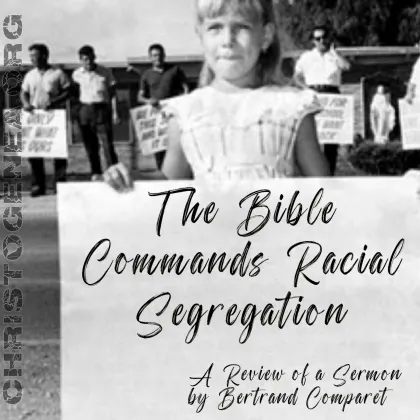
The Bible Commands Racial Segregation - A Review of a Sermon by Bertrand Comparet

The Bible Commands Racial Segregation - A Review of a Sermon by Bertrand Comparet

Here we are going to present and critique a sermon by Bertrand Comparet which has been presented under diverse titles in the past, for reasons we shall describe as we proceed. However doing this, I also hope to demonstrate why it is important for us, as Bible-believing and Bible-studying Christians, rather than as merely denominational Christians, to constantly investigate, refine and improve our own understandings of Scripture, its original languages, its historical context, and all of the various aspects of the context of words, verses and passages found in Scripture, so that we may come to a better understanding of our faith, and so that we may be able to better defend and explain our professions to others of our kinfolk.

Every passage of Scripture has a historical and situational context which must be understood before it may be properly interpreted, and the same is also true of Hebrew or Greek words and their definitions. If Christian Identity is the Elijah ministry, as its objectives certainly do fit the description of that ministry where it is found in the closing verses of the prophet Malachi, then it is of the utmost importance that we do present our case to our kinfolk. But if we profess things which can easily be disproven, we will be quickly mocked, and we will have failed ourselves and our people, as well as our God. When people hear an argument in support of a position or doctrine which is contrary to their own predisposed beliefs, they will scoff at the slightest mistake in the data supporting that argument, and dismiss all of it for that one small mistake. It is already quite difficult to get our kinfolk to even listen to our case, so we must strive to make it as airtight as possible.

Topical Discussions, December, 2023

I did not plan a topical discussion program this week, but I have been rather under the weather, having had a flu since Saturday, and heavy congestion, so if I disappear for a minute, it is only because I have been coughing rather consistently for several days, and hopefully it will not plague me too badly here this evening. Because I was sick, I decided to do this topical podcast, and even though each of the topics were at least partly prepared, it still took me nearly as long to complete as my last few Genesis commentaries. But maybe that is because I cannot focus up to my usual ability.

It also happens to be 15 years to the day that I arrived home from prison, in 2008. Technically, I was not really yes “out” of prison, but I was on home confinement for nearly the last three months of my sentence, which is a decision that was made at the halfway-house where I had spent about six weeks. Officially, my sentence was completed on March 6th, 2009. But by January 4th I was able to register the Christogenea.org domain name, and then start building my website. I had no idea how large of a project it would become, or how long I would be able to do it. But no matter how long I can do this, I praise Yahweh that I have been able to do it at all. Since Christogenea is also a costly venture, I will be here so long as I continue to get enough support to sustain it, and sometimes that is a challenge. So I still do not know how long I will be able to do it. Yahweh willing, I shall continue, and hopefully be at it at least as long as Clifton had persevered. I might need that much time just to be able to finish some of the things which I have already started.

Here I plan to discuss the meaning of the Hebrew word zuwr, which is often translated as strange or stranger, the true meaning of the word human, the meaning of the word adam, which expands on my recent offering in my Genesis commentary in several ways, and also the fact that the Greek word ἀρσενοκοίτης which was used by Paul in two of his epistles is Sodomy, or what we now call homosexuality, and it is forbidden in the New Testament just as it had been in the Old Testament.

Topical Discussions, October, 2023

Topical Discussions, October, 2023

If there is one thing which I have observed in many of the people with whom I have disputed aspects of Scripture or history over the last 25 years, it is the frequent attitude by which they feel that they can dismiss anything which they do not already know as being insignificant, and in that manner if they do not know it, it is easy for them to despise it, and just as often, they do not even want to hear it. People have a sense of pride in their own education, they often feel they have been taught everything they need to know by some school or church which they had attended at some point in life, and they generally feel that anything which they had not been taught in those places, or which they have not seen on television, is absolutely unnecessary and could not possibly improve on what they think they know, or even on what they really do know. What many men do not understand is that every educational program is biased in favor of its own constructs and opinions, which are presented as “facts”, and if you dispute any of the material along the way, outside of some narrow but acceptable corridors, you are very likely going to fail the course. Generally, schools are not corrected by any student, or even by any professor, at least without years of controversy and chastisement.

This is especially true among people with advanced university degrees. Men who may have a doctor’s title in some specific field often pretend to be an expert in other fields, and others often imagine them to be intelligent and therefore, to be learned in other fields. I have met several such men, but I have also met the opposite cases, men who had such degrees but who were humble and did not play doctor in other fields. No man can be learned in every field, and even the greatest polymaths only have time in a human lifetime to master and practice in a couple of fields, perhaps two or even three. Often, if you tell men something they have not figured out with their own expertise, or which was not included in their education, they despise it and dismiss it as fallacy. Often, they cannot imagine that someone with a lesser degree, or with no degree, can ever show them anything new. We even have such men among Identity Christians, where a man who is a doctor of some other unrelated field, often titles the correspondence or even the papers which he writes on the Bible with the word “doctor” attached to his name, as if that title should be considered authoritative in a field for which he has no doctorate. That is quite pathetic, and calling oneself a “doctor” outside of one’s own field of study is sort of like wearing a clown suit to a funeral. There are several others who write books related to Christian Identity, who use the title “doctor” attached to their names, and while they have worldly degrees in theology, they are only mingling Christianity with the perspectives of their worldly educations. One of them is currently teaching English to gooks in South Korea, as he writes books about the exclusiveness of the Bible for Israel. So should a double-minded man ever even be trusted?

Topical Discussions, June 2nd, 2023

Topical Discussions, June 2nd, 2023

Including Who's “Out-Jewing the Jew?”, Black Hebrew “Israelites” and Which is it, Lord or Yahweh?

Lately I have been considering and saving some of the short topics discussed at various venues at Christogenea which would serve as ten or fifteen or even thirty minute recordings for videos or for our radio streams. So while I have done a few of these topical discussion presentations in the past, hopefully we can do even more in the future.

But first I want to speak of some of the challenges I have operating Christogenea, so that listeners may better understand certain things, especially things like why it takes me so long to ship book orders. Lately I have missed shipping books on time for certain holidays, such as Christmas, a holiday which we don’t even really care much about. But at the same time, while I hate to disappoint our brethren, I don’t even pay much attention to the calendar. Right now all I know is that it is already June, and a couple of days ago I really thought May had only just begun.

Some readers or listeners seem to have the impression that we should operate as efficiently as Amazon or some other huge internet retailer. But Christogenea is a one person entity, which receives some help in some areas from my wife Melissa, or in some aspects, from certain close friends who believe in our cause. Until 2018 we used a third party to print and retail our books, and they probably made more money from the venture than we did, but I did not mind, so long as the books were available. Being a one-person entity, that is why I would rather just publish everything I write freely, as I feel that is an obligation, and electronically, because that is the easiest method for me, and provides the widest possible audience.

The Clergy Claims God Committed Fraud, and Adultery!

The Clergy Claims God Committed Fraud, and Adultery! A Review of a Paper by Clifton Emahiser.

Here we are going to present, critique and hopefully be able to elaborate upon a paper by our dear friend Clifton Emahiser, which, according to his own records, he had written in April of 2007. It has been 23 months since we have reviewed any of Clifton’s work, so it is well past time that we gave him a visit.

There are lies which Christian churches have taught for over 1,800 years, and when these lies are examined against Scripture, there is no way in which they could possibly be true or Christian, since the Scripture tells a completely different story. So all who perpetuate those lies in the name of Christ are basically accusing Him of fraud, and that is the point which Clifton shall make here. But they are also accusing Him indirectly of other sins, such as adultery, and here we shall endeavor to explain that as well. These lies are a system of Bible interpretation which we generally describe as “replacement theology”, which we can begin to identify in the writings of the so-called “Church Fathers” as early as Justin Martyr and the middle of the 2nd century of the Christian era. Justin lived as an adult and wrote his several works about one hundred years after the death of Paul of Tarsus.

Bible Blunders, Part 1

The original podcast file was somehow corrupted and would not play. It has now been replaced. I apologize for any inconvenience. Being on the road, the Monday following the podcast I was finally able to edit the notes, and there I was also able to add a few short clarifications and make a few minor corrections.

Bible Blunders, Part 1

Here I am going to present something that I will call Bible Blunders. Ultimately this may turn into something of a series, so I will even add “Part 1”. When I made several Forum posts addressing certain things in Scripture which are commonly misunderstood, a friend suggested that I compile them into a program called Bible Mysteries, but these really are not mysteries. Rather, they are blunders because the solution to understanding them is in the Scripture, and for that reason we really have no excuse not to understand them. But some of these traps I have fallen into myself, not necessarily because I made the mistakes, but because we often trust others to be correct, especially our teachers, and we repeat things that they say without investigating them for ourselves. So here we are going to discuss queen Athaliah of Judah, a trap which I managed to avoid, and also the identity of the Rechabites of the Book of Jeremiah, and the “Kenites” of 2 Chronicles chapter 2, a trap which I was caught in until recently, because I followed older teachers without giving the subject a sufficiently full consideration.

Proof that Athaliah queen of Judah was not the daughter of Jezebel:

A version of this was originally posted at the Christogenea Forum on 17th July 2022.

Years ago, in June, 2009, I made a presentation called Women in the Genealogy of Christ. Only rather recently did I realize that it needs an update. That is because I never had a “church” background, and therefore I never knew that the churches teach that Jezebel is an ancestor of Christ. That is what at least most of them teach, and it is absolutely wrong. So in that early podcast, I discussed Tamar, Rahab, Ruth and Bathsheba, three of which women are specifically mentioned in the genealogy of Christ as it is presented in the Gospel of Matthew, but I never knew there was a need to discuss Jezebel. (Bathsheba is also referred to in Matthew, but not by name.)

TruthVid's 100 Proofs that the Israelites were White, Part 77: 101, Dura-Europas, Huqqoq other early synagogues prove Judaeans were White; 102, Early Christian Art; 103, Phoenician Art of Iberia and the British Tin Trade

TruthVid's 100 Proofs that the Israelites were White, Part 77

Last week we discussed how the magi had been portrayed throughout history, and how all of the art of which they were the subjects had always portrayed them as three White men, until certain of the Dutch and Italian artists of the 15th century and later began to make innovations. We also discussed early Ethiopian Church art, and how up to the 10th or 11th centuries it depicted Christ and the apostles as being White, at least apparently, in wall paintings and printed illustrations. We found no such art which depicted Christ or the apostles as being black until the building of more recent churches during the colonial period. So here we made the assertion that these are both instances of cultural appropriation, first where White men injected blacks into a historical setting in which they had no part, and later where black Ethiopians changed the nature of early historical figures in order to suit themselves.

Now we shall discuss early Judaean and Christian art, dating generally from the 2nd or 3rd to the 5th centuries AD, where not only were Christ and the apostles always depicted as having been White and European-looking, but that is also how the Judaeans had depicted themselves. If early Judaeans portrayed themselves and their forbears as having been White, then White they must have been. While we had spoken of some of these discoveries in archaeology as part of Proof 5 in this series, they deserve a more thorough discussion and a proof of their own.

TruthVid's 100 Proofs that the Israelites were White, Part 76: 99, Reverse cultural appropriation: Magi who came to see Christ Always White until 15th century; 100, Cultural appropriation: Ancient Ethiopian Church Art vs. Colonial Ethiopian Church Art

TruthVid's 100 Proofs that the Israelites were White, Part 76

Last week we discussed the Parthian Empire and the Parthian interest and role in Judaea in the first century before Christ. What is more important to us, however, is the interest which Josephus had in the affairs of the Parthians, as he spent considerable time discussing them throughout his writings, and in many places makes statements supporting the fact that the Parthians were indeed a significant portion of those Israelites who had been taken into Assyrian captivity many centuries before. Presenting the statements made by Josephus in this regard, we also discussed the magi, and have hopefully demonstrated that the magi who came to Judaea in order to worship the Christ child were descendants of the ancient Levites who had gone into captivity, who remained priests, and who were ultimately known to the pagan world as magi. Now we shall discuss the magi as they were traditionally depicted in early Christian art, and how those depictions have been corrupted over time.

In our discussion last week, we may have spoken more about how well the various Hasmonean rulers, the high priests John Hyrcanus II and Antigonus, had been treated by the Parthians even if one of those men had employed them to help him supplant the other. On the surface, that may be attriubted to politics or political expediency, but that is not necessarily true. Rather than merely disposing of John Hyrcanus II, the high priest who had been deposed by Parthia and taken as a prisoner, the Parthian king Orodes II treated him kindly, supported him generously as he was held in Parthia, and released him to return to Jerusalem once his own son Pacorus was slain by the Romans. On the other hand, when Hyrcanus returned, Herod mistreated him and had him slain. We can only wonder whether Antigonus was ever able to warn his uncle about the danger of making deals with a devil.

TruthVid's 100 Proofs that the Israelites were White, Part 75: 98, Parthian Role and Interest in First Century BC Judaea. Why Josephus Wrote Wars, and for Whom, The Identification of the Magi

TruthVid's 100 Proofs that the Israelites were White, Part 75

Having finished our exposition on the linguistic connections between Hebrew and some of the languages of Europe, primarily English, there are only a handful of proofs left in our list. So now we will turn to another aspect of history, which is the relationship between the Parthians and Judaeans which predates Roman times, and then after discussing the identity of the Magi we shall move on to discuss various archaeological proofs of the ethnicity of the Israelites, that they were indeed White. There are at least four, traditionally five, and possibly more magi mentioned or referred to in the New Testament, and all of them are portrayed as Judaeans, or as having special knowledge of certain of the affairs relating to Judaea. In the end, I will also make a few assertions here with implications that I have restrained myself from making in the past, but some of them do have multiple witnesses even if the entire picture is not as complete as I would prefer.

98) Parthian role and interest in first century BC Judaea. Why Josephus wrote Wars, and for whom, and the interest which Josephus maintained in Parthia up through the end of his histories. The identification of the Magi.

Before discussing the Parthians and their interest in the history of Judaea in Roman times, perhaps we should first have some background on Parthia, and also on neighboring Hyrcania, as Hyrcanus was a name taken by several of the Hasamonaean high priests even a hundred years before Rome became involved in Judaea, and I doubt that is a coincidence. The name Hyrcanus, as it is applied to the high priest which we know by that name, is known only from Josephus, but not from Maccabees where he is referred to only as John the son of Simon. However there is also a later high priest named John Hyrcanus, who was slain by Herod in 30 BC, and in 2 Maccabees 3:11 another Hyrcanus is named, the son of Tobias, so the name Hyrcanus is not unusual in Judaea.

TruthVid's 100 Proofs that the Israelites were White, Part 74: 97, Similarities of words in European languages with Hebrew, continued

TruthVid's 100 Proofs that the Israelites were White, Part 74

This is now part four and hopefully the final part of our discussion of the Hebrew language and its relationship to the languages of Europe, which for us is mostly limited to English along with some Latin and Greek. Eventually we hope to add many more entries for those and other languages to this list, as soon as we can afford the significant amount of time it would require to continue this study. However for now, we certainly hope to have already demonstrated that many common everyday words which are found in each of these languages are similar or even identical to Hebrew words in both sound and meaning. There will always be skeptics, however the implications of the evidence which we have offered here cannot be overlooked, especially once they are considered along with the cultural similarities and historical links between these same nations. The affinities between the languages of the ancient Israelites and the nations of Europe go far beyond the fact that those nations used the same so-called Phoenician alphabet. These languages must be directly related, and were even derived or descended from Hebrew, albeit with other ancient influences. Here we shall continue that discussion.