This is Not White Supremacy, It is God Supremacy

This is Not White Supremacy, It is God Supremacy

Our Christian Identity profession is a belief in the supremacy of God and His Truth. I hope y’all have some time. Every once in awhile I am motivated to write a presentation introducing and explaining our Christian Identity beliefs, and this is it for 2020, but it is not going to be brief. This presentation includes a review of an essay by Clifton Emahiser titled When Will All of Israel be Awakened to Their Identity?

Four thousand years ago, Yahweh the God of Israel, the God of the Christian Old Testament as well as the New Testament, had called the Biblical patriarch Abraham out of the wider Adamic world, the entirety of which had wandered off into paganism and had begun to accept or develop many practices which are, for the most part, still considered abominations, or at least, have until recently been considered as objectionable, by White society unto this very day.

But because Abraham believed God, as we read in Genesis chapter 17, “3… God talked with him, saying, 4 As for me, behold, my covenant is with thee, and thou shalt be a father of many nations. 5 Neither shall thy name any more be called Abram, but thy name shall be Abraham; for a father of many nations have I made thee. 6 And I will make thee exceeding fruitful, and I will make nations of thee, and kings shall come out of thee. 7 And I will establish my covenant between me and thee and thy seed after thee in their generations for an everlasting covenant, to be a God unto thee, and to thy seed after thee.” Similar promises were given to Abraham, which were without condition, and were ultimately inherited by the patriarch Jacob, whose name was then changed to Israel.

From Yahshua to Jesus: the Evolution of a Name

From Yahshua to Jesus: the Evolution of a Name

In the early years of my Christian Identity studies, I became acquainted with a plethora of wild ideas, and I actually did evaluate them all as best as I could. Some of these came from British Israel writers, and others from more recent Americans such as Rand, Swift or Comparet, and even more recent writers who are still alive today. So with an open mind and with Scripture as my guide, along with various lexicons and many books of classical history and ancient inscriptions, and even many of the so-called apocryphal or pseudepigraphal books, as I studied I had considered just about everything that an Identity Christian could hear.

Among these were the Ephraim-Scepter heresy, and the Noon-to-Noon calendar day heresy, the No-Devil heresy, and all of these Clifton had written essays about before I ever had a chance, because he was also dealing with them for a long time. Both Clifton and my friend Ralph Daigle would send me all sorts of Christian Identity-related materials, and some of it I read for entertainment purposes, while other things I took more seriously. If I ever unpack the three remaining crates of notes and correspondence I had accumulated throughout those years, perhaps I will address some of the things which have merit, or at least those which seem to need further attention because the things they proposed are still in circulation.

Throughout those years, in my studies I naturally came to many conclusions which I did not have immediately, and which had long been debated in Identity Christian circles. Foremost among these were the debates concerning Two-Seedline, the origin of non-Adamic races, the identity of certain of the trees of Eden, and other important topics. Some of the conclusions which I have arrived at over the years actually took years for me to understand, and then even more years to formulate effective arguments based on the supporting evidence.

What’s in a Name?

What’s in a Name?

Identity Christians are sometimes perceived as Judaizers, at least those of us who often prefer to use certain Biblical Hebrew terms in place of more modern English or Greek terms. This is especially true where it comes to the use of certain Hebrew names and titles for the God of Israel, or for Christ. But to me, it is much more dangerous heresy to be a Judaizer in the implementation of certain doctrines and concepts that are really only derivatives of the Old Covenant reliance on ceremonies and rituals, rather than to be called a Judaizer on account of a preference for a couple of names or words. To Judaize is one thing, but to lay claim to a heritage which rightfully belongs to many White Europeans, and which never actually belonged to Jews, is something totally different.

So here we are going to present, and hopefully expand on, a paper written by Clifton Emahiser titled Which Is It, "Lord" Or "Yahweh"? But Clifton really did not write this paper. He only wrote the first paragraph, and the rest was simply a reproduction of an article from the 1910 edition of Encyclopedia Britannica. Then he sent this to me to proofread, in the Spring of 2004, and doing that, I made some brief comments which he then added as a conclusion to the article. Making this presentation, I will rearrange some of those notes this evening, and I will certainly also add many others.

Identifying the Tree of the Knowledge of Good and Evil

Identifying the Tree of the Knowledge of Good and Evil

In Genesis chapter 2, there are two trees mentioned which Yahweh did not plant into the ground, but which were “in the midst” of the garden. These trees are actually distinguished from literal trees, where we read in verse 9: “And out of the ground made the LORD God to grow every tree that is pleasant to the sight, and good for food; the tree of life also in the midst of the garden, and the tree of knowledge of good and evil.” So we have all the other trees which had been purposely planted “into the ground”, but these two particular trees are merely present, and not planted in that same manner.

Perhaps the first clue to identifying these trees is found in Ezekiel chapter 31, where we see nations of men described as trees and the Word of Yahweh says “3 Behold, the Assyrian was a cedar in Lebanon with fair branches, and with a shadowing shroud, and of an high stature; and his top was among the thick boughs. 4 The waters made him great, the deep set him up on high with her rivers running round about his plants, and sent out her little rivers unto all the trees of the field. 5 Therefore his height was exalted above all the trees of the field, and his boughs were multiplied, and his branches became long because of the multitude of waters, when he shot forth. 6 All the fowls of heaven made their nests in his boughs, and under his branches did all the beasts of the field bring forth their young, and under his shadow dwelt all great nations. 7 Thus was he fair in his greatness, in the length of his branches: for his root was by great waters. 8 The cedars in the garden of God could not hide him: the fir trees were not like his boughs, and the chestnut trees were not like his branches; nor any tree in the garden of God was like unto him in his beauty.”

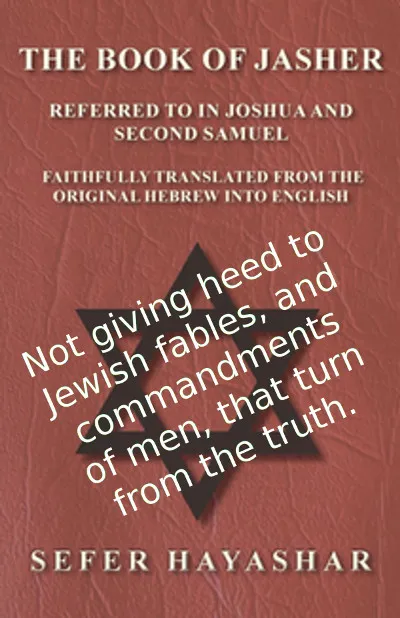
The Spurious Book of Jasher, with Sven Longshanks

Sven Longshanks and William Finck discuss some of the historical errors and anachronisms which expose the so-called "Book of Jasher" as a fraud, along with some of its many conflicts with Scripture. Do not be deceived by another medieval Jewish ploy to distort the Scriptures.

The Franks, the Lombards and the country called Italy did not exist by those names in the time frame which Genesis chapter 10 describes.

The Romans did not hold the land of Edom subject 750 years before Rome existed.

The Punic Wars did not take place during the time of Moses.

The invasion of Britain did not occur during the time of Joshua.

Many attitudes expressed and circumstances described in the Book of Jasher are contrary to both history and to our received Scriptures, and cannot possibly be true.

The Book of Jasher reads like a Jewish super-hero cartoon, and should not be considered any differently.

Spiritual Sperm?

Spiritual Sperm?

Here I am going to present and comment on a paper which was first published by Clifton Emahiser in September, 2006.

In my opinion, one important aspect of our New Testament commentaries here at Christogenea is a constant endeavor to illustrate the differences of Biblical Christianity, as it is evident in both the writings of the Old Testament prophets and the New Testament apostles, with the interpretations of Scripture which were accepted and institutionalized after Christianity had emerged from persecution in the 4th century, as a Roman-government approved Church began to take form. To a great degree, these interpretations are still found throughout the Roman Catholic and Eastern Orthodox as well as all of the Protestant churches.

While I am only offering a hypothesis, it is very likely that these differences resulted because Christianity was persecuted by Jews for several centuries, and by the Romans often at the instigation of the Jews, at the same time that it was being infiltrated by Judaizers, which is evident throughout the New Testament epistles and Acts of the Apostles. During this period of persecution, the Judaizers sought to corrupt Christianity, and as Judaic thought gained more and more traction on a persecuted Christianity, there is an evident transition which occurred within the first century of the dissemination of the gospel. The spread of the gospel began as a message to the scattered twelve tribes of Israel and ended by adopting what we may call replacement theology, which is the misguided concept that somehow mere “gentiles”, people of other races and nations, had replaced the actual children of Israel as the object of the promises of God. This happened during a murky period of Christian history from about 100 AD up to the time of Justin Martyr, a period about which little is known. But the apostles, as well as the prophets, had taught that the twelve tribes of Israel which were scattered abroad, and had already become many nations, were being called to Christ. But the Judaic form of Christianity which took root in Palestine and in Alexandria and which ultimately became dominant had taught that anyone who was baptized and believed in Jesus somehow became one of the children of a “new” Israel, which was the ecclesia, and later, the Church.

Who Are The Hunters?

Who Are The Hunters?

Here we are going to present what I always thought was one of Clifton Emahiser’s more important papers, because it helps to provide a Scriptural foundation for our Christian Identity profession. It helps to answer the challenges as to why Christian Identity does not reflect the traditional Roman Catholic or Eastern Orthodox views of Christianity. Of course, we would assert that those views were never correct in the first place, and according to Scripture itself, they were never supposed to be correct. In order to prove that assertion, I would need to present a long dissertation on the prophets, or I could simply discuss Clifton’s essay, based on a prophecy in Jeremiah chapter 16, and ask the question which Clifton asks here: Who are the Hunters?

To begin, some time after I originally posted this article at Christogenea, Clifton had me preface it with a notice concerning plagiarism. So this evening, in order to avoid beginning with a long digression, we will move that notice and an accompanying discussion to the end of this presentation. This is one of the first of the essays that Clifton had called brochures, or pamphlets, after the format in which he distributed them to his readers. The earliest date for this essay in his computer files is December 19th, 2000, and it is also one of the first papers which I had proofread for him, a task which I began some time in late 1999. Now I will present Clifton’s article, and add some of my own comments to it, without further introduction:

All the Kindreds of the Earth

One of the most misunderstood passages of Scripture is found in Genesis chapter 12, where Yahweh had said to Abraham that “I will bless them that bless thee, and curse him that curseth thee: and in thee shall all families of the earth be blessed.” Today, denominational Christians naively believe that this statement which God made to Abraham somehow applies to Jews. The misunderstanding of this passage is the driving force behind the wicked phenomenon which we know today as Christian Zionism, and its abuse has perhaps been even more dangerous to true Christendom than the popular misunderstanding of John 3:16. Christian Zionism is wicked, because its attitude towards Jews is absolutely contrary to the attitude which Christ Himself had towards Jews. Jesus hated Jews, and now Christians worship Jews instead of Jesus. Many Christians await the rule of an anti-Christ, while in reality the anti-Christ already rules over them while they themselves remain ignorant of it, and their churches are in collusion with the devil.

But there is another problem with the common interpretations of this passage, and that is where Christians imagine negroes, yellow and brown orientals, American and Australian aboriginals, Pacific islanders and other aliens to be reckoned among “all the families of the earth”, which is a concept that Scripture itself never expresses, and in some places even refutes. So here we shall present a two-part series of essays produced by Clifton Emahiser and titled as a question, All The Kindreds Of The Earth Be Blessed?, parts 1 and 2. From his records, it is evident that Clifton first wrote part 1 of this series in May of 2007, but finalized both parts in January of 2009, when they were apparently published to his mailing list. That is the same month that I started Christogenea, and I created the first version of his website just a short time later, perhaps in March or April of that year.

Bible Basics - Part 11

Bible Basics - Part 11

In this last of our planned segments of Bible Basics, William Finck and Sven Longshanks of Radio Aryan summarize and discuss the relationship between the Old Testament prophets and the New Testament, from a Christian Identity perspective. Once the prophets are understood, it may be realized that they are indeed the foundation of the Gospels and the New Covenant. We may consider doing further segments of this series in the future, if we see that there is a need for them.
 

Bible Basics - Part 8

Bible Basics - Part 8

In this segment of Bible Basics, William Finck and Sven Longshanks of Radio Aryan discuss what is commonly called "two-seedline" among Identity Christians, and the Biblical evidence behind the distinct nature of the races, especially the nature and origins of the White race in contrast to that of the Jews and other ancient mongrels. 

Bible Basics - Part 7

Bible Basics - Part 7

Picking up from where we left off last September, William Finck and Sven Longshanks of Radio Aryan discuss the nature of the Jews and their actual descent from Cain, the Rephaim, Canaanites and Edomites of the Bible, as we are informed in the New Testament, the pages of Flavius Josephus and elsewhere, such as in the writings of Greek historians such as Strabo of Cappadocia. 

Be Kind to Your Kind

This evening we are going to present a short paper from Clifton Emahiser titled Be Kind to Your Kind. Clifton had originally prepared this paper for publication on June 24th, 2006.

I am presenting this at the current time because I tried to rush the last presentation in my commentary on the Gospel of John, and I made a serious error which was pointed out to me by a friend at the Christogenea Forum. So I will present that afresh, and with much more time and consideration, hopefully next Friday. I also hope that having taken some time off this week, I have had some needed rest. Otto, our Weimaraner, benefited because I was able to assemble a dog house and a few other things he desperately needed in his new kennel.

So I would also like to say that while it seems that I have been close to completion for awhile now, my tasks in the aftermath of the hurricane are finally actually getting there, and I expect to be done moving out of the old house by early next week, so long as the weather is fair. I thought that we would be finished at least a few weeks ago, but we have had some obstacles to our progress. We still have a lot of work to do to settle in here at our new place, but we are close to accomplishing that as well.

We have found over the last five or six months that a certain supposed friend to whom we had extended our charity had really only sought to take advantage of us, thinking that perhaps he had some permanent license and entitlement, while at the same time he never complied with the terms which we had agreed upon when we first gave him shelter. More recently, this man even went so far as attempting to exalt himself as an elder above me in my own home, and claiming that he did not have to live by the few simple house rules that I had imposed upon him, and which he constantly and willfully disregarded. He professed this idea several times since the recent hurricane, that he did not have to obey my wishes in my own house. But even with that, my charity towards him continued until he began slandering me secretly, and now he slanders me openly. He is resentful that we discontinued our charity in the face of his arrogance, as if he had some sort of entitlement.

Divers Seed Defiles Families, or How Angels Become Chained in Darkness

This was not recorded with my usual equipment, and I apologize for the often-audible feedback squeal.

Divers Seed Defiles Families, or How Angels Become Chained in Darkness

This evening I am going to present a paper by Clifton Emahiser titled Divers Seed Defiles Families, which he had first written in February of 2012. Clifton had originally added a notice to the title which indicated that this would be part one of a series, and that is how it is published at his website. But he never sent me a second part, he never really elaborated on the subject which is suggested by the title, and I have no further evidence that he attempted to do so among any of his papers. Clifton was often diverted from subjects to address things which he felt were more important, or at least more urgent, and often he never went back. He did create an abbreviated version of this paper that could serve as a one-page handout, which added a couple of ideas and made some minor clarifications of what he had written here. Presenting this here, we shall include Clifton’s clarifications, and add his new additions at the end of this expanded version of his paper.

This paper discusses an important Biblical concept which is found only in the meanings of words in the original Hebrew language of Scripture, but which is not explicitly spelled out in the language of Scripture itself. However, I am convinced, as Clifton had also pointed out here, that an understanding of this concept serves to clarify certain remarks by the apostles, where Peter and Jude had both referred to angels “chained in darkness”. Here Clifton expresses the realization that certain references to seed or kind in Scripture actually have a deeper meaning than the English or Greek translations suggest. Until this time, neither Clifton nor I had taken the time to elaborate outside of this paper on the importance of this realization in relation to how it substantiates other aspects of our work. But the fact that Clifton certainly realized the implications shall be fully evident as we proceed with his discussion of a certain Hebrew word for seed which appears in just a couple of passages in Deuteronomy and Leviticus.

John 3:16, What It Says And What It Doesn't

This evening, rather than present my commentary on the balance of John chapter 3, something which I am not yet quite prepared to do, I decided to present a related paper by Clifton Emahiser, and offer an expanded commentary on that. The paper is titled John 3:16, What It Says And What It Doesn't, and was finalized by Clifton on March 8th, 2004. Doing this, I will necessarily repeat several things which I said in Part 9 of my commentary on the Gospel of John, and also some things which I hope to state in Part 10, which is soon forthcoming. Doing this, the evolution of our opinions on John 3:16 may also be better understood, although I wish that Clifton were here to share that. In this paper, Clifton employed several of my own notes which I had sent to him on the subject, but also, because he was copying something I wrote to him in a letter, he referred to several other of my writings, which I shall endeavor to include or elaborate upon here.

John 3:16, What It Says And What It Doesn't

Most of Clifton’s pamphlet-sized essays were written in response to someone that he had questions from, or someone whom he questioned, or sometimes something he saw in the media. I do not remember the specific reason why Clifton had written this essay, but because he included a couple of paragraphs from a letter I wrote to him on the subject, and because they discussed the errors of a certain individual whom Clifton addresses here, we must have had an ongoing dialog leading up to this publication. As the impetus for this essay, Clifton recalls a trip he made to Louden, Tennessee, for a Christian Identity gathering in 1996. During the course of his nearly 20-year ministry, Clifton had made quite a few responses to what he had seen and heard at that particular gathering, and this was perhaps the last of them. Among those responses, he was compelled to write his papers on the Ephraim-Scepter Heresy, a Defense of Matthew & Luke and more significantly, the first 21 of his Watchman’s Teaching Letters, which were all subtitled with the question Just Who is This Patriarch, Judah? So it might even be safe to say that the single gathering in Louden was also the real impetus for Clifton’s starting his ministry.

Identifying the Biblical “Beast of the Field”, Part 7

As long as eighteen centuries ago, certain men who were highly influenced by Jews as well as by pagan Greek philosophies had become Christians, and began writing voluminous works, many of which have been preserved to our time, although no one can claim with any great degree of confidence hat they are without corruption as we have them today. A couple of the more notable of these men are Justin Martyr and Clement of Alexandria. We mention these two here as examples. While it is always beneficial to see how some early Christians understood the faith of Christ, we must understand their writings in the context in which they were made, and can never accept them as replacements for Scripture in the formulation of Christian doctrine. They were never even universally recognized or disseminated for that purpose in their own time, and they were often disagreed with by other early Christian writers. But in these aspects, they were not alone: Tertullian, Irenaeus and others also shared this same plight, and deservedly so. There was no commonly accepted doctrine among the Christian assemblies until it was forced, for political expediency, beginning in the early 4th century at Nicaea and culminating with the decrees of Justinian establishing the Papacy as we know it in the 6th century, which elevated the bishop of Rome to primacy, and the bishop of Constantinople to the second place among all the bishops of the empire. Five hundred years later, the bishop of Constantinople led the first Protestant uprising against the Papacy, forming the separate Orthodox Church.

Identifying the Biblical “Beast of the Field”, Part 6

It has been nearly a month since my last presentation here, which was the last monthly End Times Update on The Weekend Report back on October 6th. I am still not ready to produce much new material, still having far too many tasks to attend to, but here I am in spite of the circumstances caused by the recent hurricane.

As for Melissa and I, we are fine. Our house is badly damaged, but Yahweh has blessed us with another place to live. My library, computer equipment, and most of our other possessions are all safe, and we suffered relatively minimum losses which should be fully covered by our insurance. So I fully expect my work and ministry to be back on a regular schedule as soon as I can finish getting moved and settled in and getting my other affairs in order, such as dealing with the insurance companies and smaller chores such as obtaining a new PO Box.

The building where we had our post office box, which was actually a UPS store, was badly damaged in the storm. A large portion of the roof caved in and several stores were destroyed in the strip mall where it was located. So I have not been able to get my mail in nearly a month. If anyone has sent me anything, including the payments which we await for new book orders, I probably won’t have it at least until the end of next week. Soon I will publish a new PO Box address on the Contact page at Christogenea.

Identifying the Biblical “Beast of the Field”, Part 5

This past Saturday Melissa and I attended an unannounced League of the South demonstration in Tennessee, which I could not indicate in my announcement for last week’s program. Of course, the scheduled demonstration at Sycamore Shoals State Park in Tennessee was canceled, and I hope to write about that soon. Christogenea is not a news outlet, and I have no compulsion to do so immediately. The demonstration went very well, and we were very well received by the local population of Newport, Tennessee. Nevertheless, for us it was a difficult road trip, as our jeep suffered a mechanical breakdown, nearly a second after having that repaired, and we had some other challenges along the way. We made it home a day later and one visit shorter than we had originally planned, as we had hoped to stop in North Georgia to see some friends there. Yahweh willing, we will have another opportunity to do that in a few months.

I have had some people who criticize us, meaning Identity Christians, on the basis that Christian Identity is something which is relatively new in history. So the other day in social media I explained Why Christian Identity is such a "new" denomination, and of course we know that it is not really a denomination, but they call it that. We know that it is The Way. Here are five simple reasons why it is so new:

Identifying the Biblical “Beast of the Field”, Part 4

Although the planned League of the South demonstrations that were scheduled for the 29th at Sycamore Shoals State Park in Tennessee have been canceled, Melissa and I have come to the area anyway, as in our plans to attend the event we made other commitments which we wanted to keep. So this presentation is being prerecorded Friday afternoon for tonight's program and publication at Christogenea. I hope to write about the cancelled event and the implications of that cancellation in the weeks to come. The State of Tennessee has made itself an agent of the Antifa.

Identifying the Biblical “Beast of the Field”, Part 4

In my presentation from chapter 2 of the Gospel of John which I made here last week, which was subtitled Challenging Orthodoxy, I strongly criticized the so-called “Church Father” who is popularly known as John Chrysostom. Some people, mostly Orthodox Christians, took offense to that. They should be ashamed. They simply do not understand that their “Church Fathers” are not God, but men. Yahweh our God cannot righteously be criticized. Jesus, or Yahshua Christ, who is God Incarnate, cannot righteously be criticized. His chosen apostles were mere men and each had their faults, but their message, which is directly from Him, should not be criticized. But whenever we elevate a man to that level of veneration by which the man cannot be criticized, we engage in idolatry. I will not engage in or be subject to Orthodox or Roman Catholic idolatry.