Special Notices to All Who Deny Two-Seedline, Part 4

Special Notices to All Who Deny Two-Seedline, Part 4
I have decided to continue the presentation of Clifton Emahiser’s 24 Special Notices to All Who Deny Two Seed-line for just one more week, and next week I plan to resume our ongoing presentations of the Epistles of Paul with 1 Timothy. Following that, we shall return to a continuation of this series again in the near future, as we plan to travel later this Spring.

But before we begin with Clifton’s essay I want to take a short digression. I am going to try to take at least one of these digressions throughout each episode of this series, as they give me an opportunity to discuss certain things which I do not frequently have a good context to discuss. I am certain Clifton would not mind that I do this. Not everyone who calls themselves “Two-Seedline” is our friend, or a friend of truth, and not all of those who neglect to use the label are our enemies. Last week I had discussed a paragraph from a book written by Joseph November, who writes and plays at being a Christian Identity pastor under the pseudonym of Eli James. Now I am going to discuss one aspect of a paper he wrote over 5 years ago, entitled Crumbs. In that paper, Eli, as I will reluctantly call him, referred to Clifton Emahiser and I as “exterminationists”, using this term to describe our exposition of Scripture just as if it were some sort of slander coined by the Anti-Defamation League or the Southern Poverty Law Center. Like it or not, it is important to elucidate these things, because we Identity Christians need to pursue the truth, and we need to be able to recognize the lies. That is our Christian obligation.

Eli likes to flippantly brag that I never refuted his paper, Crumbs, but in reality there are a hundred podcast and essay presentations at Christogenea which do refute his paper. But if I were to address the paper directly, there are so many false premises upon which it is predicated that I would have to write an entire book, and Eli James simply is not worth such an effort. I would rather believe that the people who actually follow our work at Christogenea and study behind us should easily recognize his many errors. But here we shall briefly address a couple of aspects of Eli’s paper which display his absolute dishonesty as an interpreter of Scripture.

Special Notices to All Who Deny Two-Seedline, Part 3

Special Notices to All Who Deny Two-Seedline, Part 3
There are a lot of people who are rather new to Christian Identity, who have just learned of Christogenea or other related or associated websites and ministries within the past couple of years. Often these people wonder why we have divisions with other supposed Christian Identity teachers or pastors. Some of them call these divisions “teacher wars”, and that is patently unfair. Christogenea itself is not merely a website, it is also a publishing and information technology project in its own right. I host the writings of Clifton Emahiser, Bertrand Comparet, Wesley Swift and other writers on the Christogenea domain, and I myself do not necessarily agree with everything that each of these teachers of Scripture have written. I also host and I have even developed websites for dozens of other Christian Identity pastors and writers on other domains, as well as for several European and American Nationalists who publish information on exclusively historical topics. Although some of the people we host sites for often reimburse us in one way or another, we always host and develop these sites at entirely our own expense, free and without charge to many other Christian Identity ministries. I do not say these things to brag about what we do for others. But I have to say this, if I were interested in “teacher wars”, I would do no such thing, I would not spend time helping to enable other teachers, and this alone should prove that I am not interested in any so-called “teacher wars”. I have much more productive things to do.

But sometimes I am compelled to elucidate problems in the words of others, and especially when I fell they are damaging to our Christian Identity cause. Christ comes first, and we must always be cognizant of the fact that we should be contending for the Faith. So when I do speak poorly of other Christian Identity pastors or teachers, it is not for my own ego, and it is not because I desire to uplift myself. Pity us if we choose to exalt ourselves at the expense of others. Rather, it is only on account of truth. These are not “teacher wars”, but rather, they are truth wars. As Paul of Tarsus wrote to the Ephesians: “For we wrestle not against flesh and blood, but against principalities, against powers, against the rulers of the darkness of this world, against spiritual wickedness in high places” (Ephesians 6:12). Some of those high places are infiltrated into Christian Identity.

I am going to read part of a paragraph from a book. This book is promoted by its author within Christian Identity circles to this very day. I will read from the paragraph before revealing its source, and it is in reference to the encounter of Christ with the Canaanite woman as it was described in the Gospel of Matthew. The writer says:

Jesus was not preaching truth, justice, love, and mercy for one group of people only, namely, the tribal in-crowd. He was preaching these things for all people. Yet, there is a special role to be played by the Israelites: that of leadership by example. This is what the crumbs represent in the story. Non-Israelites are to learn from us by our example of justice, obedience and charity - and all of the blessings that proceed therefrom. And it can be truly said that the descendants of Israel have civilized the world and have done their best – despite all their faults – to spread this gospel around the world. It is not the Jews who have provided the world with the Magna Carta, the U.S. Constitution, freedom of religion, cross-cultural charity and other acts of nobility on a mass scale….

Special Notices to All Who Deny Two-Seedline, Part 2

Special Notices to All Who Deny Two-Seedline, Part 2

Here we are going to continue with our presentation of Clifton Emahiser's series of special notices challenging all of those who deny what we often refer to as Two-Seedline. For my part, I would often rather call it two-treeline, as the Bible begins with a story of two trees and we may quite confidently assert that those trees must represent races of people: the Tree of Life, and the Tree of the Knowledge of Good and Evil. In the end, there is only one tree left standing, and all of the goat nations are thrown into the Lake of Fire. Anyone who looks at these things objectively must understand that the account of the end clarifies the purposeful obscurity of the account of the beginning, as Yahshua Christ had come to “utter things which have been kept secret from the foundation of the world. ”

For the short term, we plan to continue this presentation next week, when we will present part 3 of Clifton's series. Then over the months or years to come we will continue to present Clifton's 24-part series until we see it through to completion, if Yahweh God affords us the opportunity. Doing this, we believe it will be a useful presentation explaining the many fundamentals of our two-seedline understanding of Scripture, which we believe is the only true understanding, and we hope it will give us the opportunity to help to clarify as well as to augment Clifton's important work.

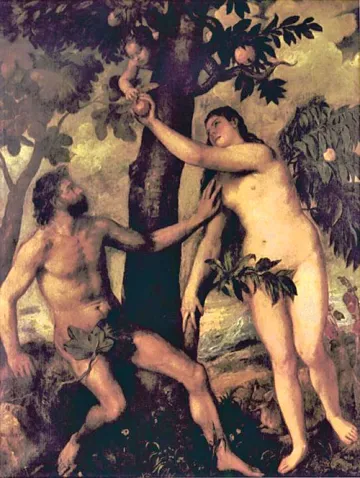
As Clifton had adeptly pointed out in part one of this series, the wheat were planted in the garden by Yahweh at the beginning, and that wheat represents the race of Adam. The devil came in rather immediately and planted tares among the wheat. In another place Yahshua Christ, in Revelation chapter 12, identified that that devil, the old serpent, with the fallen angels which therefore must have been here on earth as Yahweh created the Adamic man. Therefore while the serpent was representative of the Tree of the Knowledge of Good and Evil, the tree itself must represent that entire cast of fallen angels and whatever corruptions they may have introduced ever since their fall. It is for that reason that we believe all of the world's non-Adamic races, the goat nations of the parable of Christ, have the same exact fate as “the devil and his angels” in Matthew chapter 25. Yahweh never took credit for the creation of the goat nations in Genesis or in any later Scripture. All of those who deny these Scriptural basics purposely cloud the issues and seek to obscure the battle-lines in this great war which our race has been confronted with ever since the events described in Genesis chapters 3 and 6 took place.

Special Notices to All Who Deny Two-Seedline, Part 1

Special Notices to All Who Deny Two-Seedline, Part 1

We have just finished a commentary on the epistle of Paul to Titus, and that leaves just two epistles remaining to complete our commentary on the letters of Paul, which has already run for 108 weeks, and we only have remaining the two epistles written to Timothy. But because Titus and 1 Timothy are so similar in content, we have thought to take an intermission before making a presentation of it, and to do something else in the meantime. Furthermore, because we plan to travel soon and that places some restrictions on us, we have thought about what we are going to present while we are on the road later this Spring. So here we are going to begin a presentation and critical review of Clifton Emahiser’s series of short essays which he titled Special Notices to All Who Deny Two-Seedline, and which he concluded after 24 parts. If my own memory serves me correctly, Clifton wrote these from 2000 through 2002, and they were among some of the very first materials which he had asked me to proofread.

There is another reason why I chose to begin presenting these Special Notices at this time, and that is to once again review many of the basic principles upon which our version Christian Identity faith is grounded. Looking around for a topic for this evening’s program, I came across a quote I had saved wherein Ted Weiland, a supposed Christian Identity pastor and former rodeo clown, was pontificating about the election of God, and had quoted William Cameron’s book, The Covenant People. Here are the quotes he offered:

The Bible is not a history of the human race at large, but one distinct strain of people amongst the family the races. All the other races are considered with reference to it…. The Bible deals with one race which flows like a Gulf Stream through the ocean of humanity. As the actual Gulf Stream touches two continents and blesses the nations, so this race, in its origin, history and destiny, was selected and equipped for the service of the [other] nations.

The Importance of the Song of Solomon to Biblical Anthropology

The Importance of the Song of Solomon to Biblical Anthropology

Tonight’s program is going to serve two purposes. Firstly, it is a defense of the Song of Solomon, which is also sometimes called Canticles or the Song of Songs, as a Biblical book which belongs in our Scripture. Secondly, it will serve as an exposition of a paper recently published by Clifton Emahiser, which was titled It is Biblical to be Caucasian, Song. Chapters 4 to 7. Clifton’s paper was published at his website in four installments from August 2014 through February 2015.

The word anthropology is defined in Collins’ English Dictionary as “the study of humans, their origins, physical characteristics, institutions, religious beliefs, social relationships, etc.” Here we shall concern ourselves with only one aspect of the term: the physical characteristics of certain people in the Bible. Once we determine these characteristics, there is little doubt we may determine the general race of the ancient Israelites of Scripture.

Beginnings and Ends, Part 4

This was originally recorded June 28th, 2016.

The original recording had an annoying beep in the background, caused by a battery charger. We did not notice it during the program. After 246 downloads here, we replaced the recording with one that was filtered for us by a friend, to remove at least much of the beeping.

Topical Discussions, July 30th, 2016

Among the topics discussed were a general discussion of our functions at Christogenea, along with:

Perspectives and some self-criticisms of our Biblical exegesis,

Universalism by the Back Door (Finally posted October 4th, 2016)

Christian Love, and Christian Judgement

I will post links to the notes here sometime this week, as they are spread out in different sources or not quite ready to post.

Born Under Contract

A presentation of Born Under Contract, a paper written by Clifton Emahiser

Here we are going to present an article written perhaps 12 years ago by Clifton Emahiser, which is entitled Born Under Contract. This article aims to demonstrate that the promises made to the Old Testament patriarchs by Yahweh had confined all of their legitimate descendants under a covenant, which is essentially a contract, and that they themselves would have no choice in the matter. In the ancient world, a father had property rights and the power to make such life and death commitments over his offspring, and the offspring had no say in the matter. So, for example, Abraham had an inherent right to place his son Isaac on the altar and sacrifice him to the will of his God. Now, I said legitimate descendants, because the contract was accompanied by a law which forbade illegitimate descendants from reaping its benefits.

Here the sophists and scoffers may say something like, ‘oh, that is not true, the law was not given until Mount Sinai.’ However the Scripture proves otherwise. Abraham was chosen by Yahweh, as we read in Genesis chapter 26: “5 Because that Abraham obeyed my voice, and kept my charge, my commandments, my statutes, and my laws.” So a little more must have been given to Abraham than what the Scripture describes. The proof is in the fact that Abraham had every concern over who his son Isaac, who would inherit the covenant, would marry. This is found in Genesis chapter 24: “1 And Abraham was old, and well stricken in age: and the LORD had blessed Abraham in all things. 2 And Abraham said unto his eldest servant of his house, that ruled over all that he had, Put, I pray thee, thy hand under my thigh: 3 And I will make thee swear by the LORD, the God of heaven, and the God of the earth, that thou shalt not take a wife unto my son of the daughters of the Canaanites, among whom I dwell: 4 But thou shalt go unto my country, and to my kindred, and take a wife unto my son Isaac. 5 And the servant said unto him, Peradventure the woman will not be willing to follow me unto this land: must I needs bring thy son again unto the land from whence thou camest? 6 And Abraham said unto him, Beware thou that thou bring not my son thither again.” A generation later, Esau had disregard for this, and his mother made certain that it cost him his share in the inheritance of Jacob. She is recorded in Genesis chapter 27 as having exclaimed: “46 And Rebekah said to Isaac, I am weary of my life because of the daughters of Heth: if Jacob take a wife of the daughters of Heth, such as these which are of the daughters of the land, what good shall my life do me?” To this we see Isaac’s response, in Genesis chapter 28: “1 And Isaac called Jacob, and blessed him, and charged him, and said unto him, Thou shalt not take a wife of the daughters of Canaan.” So the patriarchs, and the matriarchs, were properly racists.

A Presentation of Clifton Emahiser's Nine Covenants with Adam-Man

Christogenea Saturdays, December 26th, 2015. This is our final program for this year. Next week, or technically on January 4th, Christogenea.org turns 7 years old. It was founded the first week of January, 2009. We pray that this is only our beginning, and praise Yahweh for what we have been able to do thus far.

Tonight we are going to present the short essay Nine Covenants with Adam-Man by Clifton Emahiser. We remember that this is one of Clifton's first essays which he had distributed to his prison ministry as a brochure, probably back in 2001 or 2002. I remember proofreading this essay for him way back then, and it contains some concepts which in the narrower historical focus of the history of the children of Israel and the New Covenant, are often forgotten among Identity Christians today. We will present Clifton's paper, and hopefully edify it in some degree, by addressing some of the questions it may raise.

Methods of Interpreting Prophecy, Part 2

Methods of Interpreting Prophecy, Part 2: An Examination of Matthew Chapter 24

In our last presentation on this topic, I had said that none of the Preterists had produced an exegetical commentary proving their position. That is not entirely true. V. S. Herrell supposedly has produced such a commentary, titled “The Apocalypse of Jesus Christ”, a book said to number 300 pages. But I cannot find it anywhere. So my statement may as well stand. This is a man who, in one of his own articles titled What is White? had referred to himself as “God's anointed minister in this generation”. So God's anointed minister wrote a book on the Revelation that supposedly proves the preterist position, and it cannot be found. You would think that God's anointed minister would want to make his work available for anyone to read.

Methods of Interpreting Prophecy, Part 1

Methods of Interpreting Prophecy, Part 1: A Review of Clifton Emahiser's article Roman Catholic Origin Of Both Futurism & Preterism

We are going to begin a new endeavor, and continue it, as we have time, interspersed with the other ongoing projects we have here on Christogenea Saturdays. We will simply call this series Interpreting Prophecy. We do not know if it will be two, or three, or fifteen segments. But we will continue this until we feel we have said the things which are necessary to say.

Tonight we shall start this series by presenting Clifton Emahiser's fall, 2010 article titled Roman Catholic Origin Of Both Futurism & Preterism Clifton begins by referring to another paper he had written at the time, answering the heresies of Ron Wyatt. We shall present the text of Clifton's paper, add some of our own comments, and also add some material from early Christian writers to show, in part, their view of Biblical prophecy.

Ruth was an Israelite; Ruth was not a Moabite by Race

Here we will make a critical presentation of Bertrand Comparet''s sermon, Ruth was an Israelite, offering our own commentary on Comparet's original material, Clifton Emahiser's notes on the sermon, and our own research in addition to theirs, hoping to edify and substantiate Comparet's premise. This version of the sermon is available at Christogenea. It is from the book Your Heritage, which was digitized with critical notes by Clifton A. Emahiser:

It is unfortunate that many preachers, in their ignorance, teach so many false doctrines. One such false doctrine is the statement that Yahshua was not of pure Israelite blood, they say one of His ancestors was Ruth, a Moabitess. From the use of this term they believe that she was racially, not just geographically, a Moabite, in this they are greatly mistaken.

The territory of the Moabites was originally east and northeast of the Dead Sea. It extended from the Arnon river on the south to the Jabbok river on the north. Then their territory went from the Dead Sea and the Jordan river on the west, across the plains and foothills, into the mountains to the east. From the name of the people who lived there, it was called Moab. It kept that name for many centuries after all the Moabites were gone from it.

Topical Discussions, September, 2015

Our streams are set to cut over to re-runs at 10:30 PM EST, and we ran twenty minutes past that without even realizing it. We are sorry for the inconvenience to those who were listening!

Some of the topics discussed:

Does Acts 16 teach Personal Salvation? Not by any means!

Why did John the Baptist rebuke the Edomite Herod according to the law?

Is there a cookie-cutter method by which to introduce people to Christian Identity?

Russians and White

Brunettes and White

Who may be Jew: the de Medicis, Calvin, Putin, the questions often raised.

A short answer to Calvin's error, and that of Arminius as well.

Esther: Fraud or Fable? Part 3

Christogenea Saturdays, June 6th, 2015 - Esther: Fraud or Fable? Part 3

In the first part of our presentation refuting the canonical status of the Book of Esther, we showed that historically, the Esther narrative does not fit into the rule of any of the kings of Persia, from the earliest of them all the way down to the last of them, for the entire 200-year span of the Persian empire. We also presented textual evidence of the rejection of Esther by the writers of the Dead Sea Scrolls and the sect of Judaeans at Qumran. Additionally, we showed that the supposed events portrayed in Esther are impossible in light of the records of Ezra, Nehemiah, Daniel, and the minor prophets of the second temple period, which are Haggai, Zechariah and Malachi.

Then in the second part of our presentation of the arguments against the veracity of the Book of Esther, we began following Bertrand Comparet's sermon against the book. Doing this, along with Comparet we pointed out several inconsistencies in the story itself, as well as several historically ridiculous situations which the book expects us to accept. Among the inconsistencies is the fact, recorded by both the prophet Daniel and by the Greek historian Herodotus, that the Kings of Persia were forbidden to change any laws or decrees which had been made before-time. Yet in the Esther story, even though the story itself also informs us of this Persian custom, the king is seen making such changes which are impossible because of the custom. Among the historically ridiculous situations, we saw that the king had issued a lengthy proclamation that all of the Jews throughout the empire would be put to death, on a specific date eleven months from the date that the proclamation was made. Yet there was no Exodus, and no uprising. Among the inconsistencies we pointed out, the story purports that only two months later the King of Persia had apparently forgotten that he made such an important proclamation.

Esther: Fraud or Fable? Part 2

Esther: Fraud or Fable? Part 2

In Part 1 of Esther: Fraud or Fable? this past Saturday we hope to have established as fact that the Esther narrative does not fit into the histories of any of the kings of Persia, especially taking into consideration the circumstances of Ezra and Nehemiah and some of the internal circumstances of the Esther story, such as the chronology which the book itself provides. We had walked through each of the Kings of Persia, from Cyaxares all the way down to Darius III, the last Persian king, and illustrated the problems which materialize with identifying any one of them as the King of Esther.

We also spoke at length about the Dead Sea Scrolls, and the fact that not only is any portion of Esther entirely missing from those scrolls, but in addition, the Feast of Purim is not mentioned in any of the extensive calendrical writings found among the scrolls. Now, as we have often discussed before at Christogenea, the Dead Sea Scrolls can with certainty be dated to the time of Roman rule over Judaea and while Jerusalem was still intact, to the 130-year period between 65 BC and 65 AD. So the sect which created those scrolls obviously did not have the Esther story among their holy scriptures.

Esther: Fraud or Fable? Part 1

The Book of Esther, Fraud, or Fable? Part 1

“Oh no”, some would say, “now he's attacking the Bible!” Well, whose Bible is that? And what is the Bible? The books which we call the Bible were compiled into a single volume by men, and originally many of them were argued over at great length. Of the 66 books (they are not all “books”, but we will call them “books” for our purposes here) in the King James Version of the Bible, 65 certainly belong there. However the original King James Version of the Bible contained 80 books. The Geneva Bibles which were published in the 16th century and which were the Bibles of the first American protestants also contained 80 books. Someone before us must have attacked the Bible 14 times, because 14 books are already missing! Those 14 books are sometimes published separately and are called the “Apocrypha”. Reportedly, Martin Luther was the first to have published a Bible with these 14 books placed under that special designation, and the Geneva and King James Bibles followed his lead. The typical Catholic Bibles have 72 books, because they retain 6 books from the Apocrypha as well as the 66 found in the King James Version.

But other ancient scriptures exist which are not in the Bible, and were quoted by the apostles as scripture, yet they are not found in the Apocrypha. For a clear example of this, there is Jude 14, where the apostle quotes Enoch. The passage is famous, where it says “14 And Enoch, seventh from Adam, prophesied to these saying 'Behold, the Prince has come with ten thousands of His saints 15 to execute judgment against all and to convict every soul for all of their impious deeds which they committed impiously and for all of the harsh things which the impious wrongdoers have spoken against Him!'” But no such prophecy from Enoch is found in the Old Testament as we have it today. So there are books which the apostles themselves esteemed as Holy Scripture, which never made it into our Bibles at all.