On the Epistles of John, Part 7: Dichotomies, False and True

1 John 3:16 – 1 John 4:3

On the Epistles of John, Part 7: Dichotomies, False and True

This may be an unusual title for a Bible commentary, but the world today is full of traps – prisons both intellectual and psychological – which keep men locked into false dichotomies, while the true dichotomies which actually define or govern our very existence as it is mandated by our Creator are virtually ignored. Then, by the grace of God, once we are able to recognize those true dichotomies, we are despised by the world. Yet the world often stands in contradiction of itself, as hypocrisy and the tendency to lie are qualities which are part of the Intrinsic Character of the enemies of God. Since “the whole world lies in the power of the Evil One”, as John had said in the closing verses of this epistle, we should expect the world to reflect those same qualities which the Devil innately possesses as a part of his own character. But of course, when I refer to the Devil I speak collectively of all of the enemies of God, and regardless of their professed religion.

On the Epistles of John, Part 6: Separating the Wheat

1 John 3:9-15

On the Epistles of John, Part 6: Separating the Wheat

We began our last presentation in this commentary, The Authors of Sin, with a discussion of the Parable of the Wheat and the Tares which is found in chapter 13 of the Gospel of Matthew. That is because here in chapter 3 of the first epistle of John, the apostle teaches his readers in his own words how to separate the wheat from the tares, ostensibly from lessons that he himself had learned while hearing the teachings of Christ. By the time he wrote this epistle, John evidently had many decades of experience contemplating those words and putting them into practice. And although John did not use the same terms which are found in the parable, examining his words here we may notice that in keeping the commandments of Yahweh through the instruction of the Gospel of Christ, and loving one’s own brethren, Christians are afforded the ability both to separate the wheat and to discern the identity of the tares.

On the Epistles of John, Part 5: The Authors of Sin

1 John 3:8

On the Epistles of John, Part 5: The Authors of Sin

In our last presentation in this commentary, titled The Children of Yahweh, we presented some of the Biblical evidence that those who were declared to be the children of God in the Old Testament are the exclusive beneficiaries of the Old Testament promises of forgiveness, reconciliation, mercy, salvation and redemption for Israel which are fulfilled in Christ, that Christ Himself and His apostles had declared that He had come to fulfill those same promises to those same people, and therefore also that it is those very same people who are exclusively considered to be the children of God in the New Testament. As Paul of Tarsus had attested in Romans chapter 11, “29… the gifts and calling of God are without repentance”, meaning that the promises of God did not change, and he also said in Galatians chapter 3 that no man may disannul or add to the promises of God. The New Covenant having been made exclusively with the ancient children of Israel, with the house of Israel and the house of Judah, as Paul also cited the words of Jeremiah in Hebrews chapter 8, under no circumstances may any other man from outside of the children of Israel ever legitimately claim to be a party to that covenant.

On the Epistles of John, Part 4: The Children of Yahweh

1 John 3:1-7, 3:9

On the Epistles of John, Part 4: The Children of Yahweh

In our last presentation in this commentary, which discussed the final verses of John chapter 2 and which was titled Christ and Antichrist, we sought to describe what it was that the apostles and others had believed the Christ to be from their own professions as they are recorded in the Gospel accounts, and which they themselves must have attained through their understanding of the words of the prophets. So by understanding what the apostles had believed the Christ to be, only then can we properly understand what John could have meant where he wrote in that chapter and asked: “22 Who is a liar, if not he denying that Yahshua is the Christ? He is the Antichrist, who denies the Father and the Son!”

Jim Rizoli Interviews William Finck

We have been familiar with Jim Rizoli from our Social Media  circles for many years, but I have never before spoken with him. This week he wrote asking if I would like to do an interview, so I got together with him this Wednesday afternoon. While I cannot explain all of the details supporting everything which I believe in one hour, it was nevertheless an enjoyable conversation.

See Jim Rizoli's channel on Bitchute, especially for the parade of clowns he had on after this interview, and his virtue signaling ever since speaking to me. Jim is essentially a social justice warrior disguised as a holocaust denier. Jim claims to be opposed to World Jewry, yet he has accepted the entire Jewish agenda of egalitarianism and race-mixing.

EDIT 2023-3-12: Jim now denies being a race-mixer, but he is too stupid to even see how he advocates egalitarianism and race-mixing. The truth is that once a man thinks "people" of other races can be Christian, he is advocating race mixing. If he won't marry a gook, how does he think God would marry a gook? (Romans 7:1-4, Revelation 19:7-9) And once a man gets his information about Christianity or anything else based on the opinions of a woman, he is also advocating feminism! Jim, stop being a bitch.

On the Epistles of John, Part 3: Christ and Antichrist

1 John 2:18-29

On the Epistles of John, Part 3: Christ and Antichrist

In our last presentation in this commentary on the epistles of John, which we had titled The Propitiation for Sin, we sought to explain how the law stood in the way of any reconciliation between Yahweh God and the divorced children of Israel. Among other things, we cited the law where it says that every man (which includes every woman) must die for his own sin. When a man sins a sin for which he is liable to death, then he himself must die, and there is no other option under the law. But the ways in which the law obstructed the reconciliation of Yahweh and Israel is evident in even more ways than we had explained. For example, once the divorce of Israel was announced in the words of the prophet Hosea, Yahweh instructed the prophet, in Hosea chapter 3 where we read “1 Then said the LORD unto me, Go yet, love a woman beloved of her friend, yet an adulteress, according to the love of the LORD toward the children of Israel, who look to other gods, and love flagons of wine.” In Hosea chapter 2 Yahweh had already spoken of Israel and said: “7 And she shall follow after her lovers, but she shall not overtake them; and she shall seek them, but shall not find them: then shall she say, I will go and return to my first husband; for then was it better with me than now.” In spite of that, Yahweh had also sworn later in that same chapter that He would betroth Israel once again, and betroth Israel forever. This is a paradox, as we must know that Yahweh would not transgress His Own law.

On the Epistles of John, Part 2: The Propitiation for Sin

1 John 2:1-17

On the Epistles of John, Part 2: The Propitiation for Sin

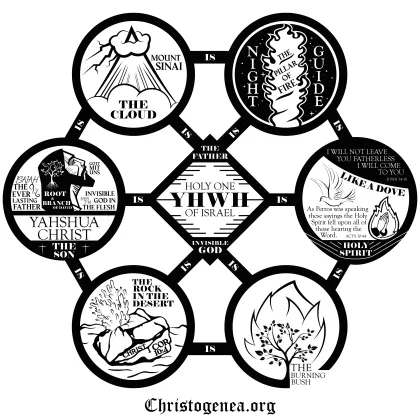
In our opening presentation in this commentary, discussing 1 John chapter 1, we saw the apostle repeat particular themes from his Gospel in relation to the nature of Christ, that, among other things, He is the Word of Life, and He is the true Light come into the World. Doing that, we used an accompanying illustration which seeks to describe the various ways in which Yahweh, the Invisible God, chose to manifest Himself in the world. Among these are the burning in the bush which appeared to Moses, the pillars of cloud and fire which led the Israelites out of Egypt, the Rock in the desert, and finally, as the man Yahshua Christ, who is also the Son. Sadly, there are trinitarians who also call themselves Christian Identity, but who do not realize that the concept of the trinity is contrary to the truth of God.

On the Epistles of John, Part 1: Light and the Word of Life

1 John 1:1 – 1 John 2:2

Now we shall endeavor a commentary on the epistles of John, which is the very last portion of a New Testament commentary that we began to write and present on Friday evenings here in early 2011. When I began my commentary on the epistles of Paul in March of 2014, I wrote in part that “Even though this marks the mid-point of the New Testament Commentary which I hope to complete here on these Friday evenings, which I had begun in early 2011 with the Gospel of Matthew, a translation of Paul is where I actually began the work which had eventually become the Christogenea New Testament, about 15 years ago.” Now it has been 22 years, as I began studying Greek in early 1999 with the sole intent of one day translating Paul’s epistles, and actually completed that endeavor in 2004. Then in 2005 I translated the New Testament books written by Luke, and by the Summer of 2007 those written by John. I finished the project, which I never really imagined I would finish, with translations of the other Gospels and epistles by the end of Spring, 2008.

On the Wisdom of Solomon, Part 30: Requiem for the Wicked

Wisdom 19:13-22

On the Wisdom of Solomon, Part 30: Requiem for the Wicked

While this last presentation in our commentary On the Wisdom of Solomon is titled Requiem for the Wicked, we certainly are not going to sing dirges for bastards. However we are compelled to illustrate the overarching theme in this Wisdom of Solomon which was purposely designed to impart an essential lesson, a lesson which in itself also contains many smaller lessons. Solomon’s intention here has not been to ramble on about unrelated subjects, where he may appear to have forsaken his first comparisons of the wicked and the righteous and had randomly changed to a discussion of the beginnings of idolatry and its consequences, and then again to a discussion of the Exodus account while presenting the initial prayer in which he had supplicated Yahweh for wisdom. Rather, his prayer illustrates what true wisdom is, which is the fear and the knowledge of God, and culminates by comparing the destinies of two nations, one of them wicked and one of them righteous, at least, in the eyes of God. In the end what is righteous is what Yahweh considers righteous, and not what men consider righteous.

As we read in the 111th Psalm, “10 The fear of the LORD is the beginning of wisdom: a good understanding have all they that do his commandments: his praise endureth for ever.” This is the lesson which Solomon conveys throughout this work, while making illustrations of the motives, methods and folly of all of those who depart from it. Therefore all of the changes of course throughout this work were calculated, and all of the themes which he presented here are woven together into a single cohesive lesson. However for reason of its length, for the many analogies which it contains, and for its frequent turns of course, the overarching lesson may be easily overlooked by casual readers. But clearly, by enveloping this work with discourses concerning the beginnings and the ends of the wicked, we see that the Exodus account has been set forth here as an example for both men and nations, that the ungodly, or impious, put themselves on a path to destruction, that wicked men who desire to rule by their own strength become unrighteous rulers, and they ultimately bring entire nations down that same destructive path, where in the end, the righteous will escape their destruction only by the grace of God, as the righteous are in the hand of God whether they themselves realize it or not.

On the Wisdom of Solomon, Part 29: Born From Above

Wisdom 19:1-12

On the Wisdom of Solomon, Part 29: Born From Above

In the last portion of this commentary, throughout chapter 18 of the Wisdom of Solomon, we saw a description of The Emergent World, as Solomon himself had described the world as being represented by the long garment of the high priest of Israel which had contained twelve gemstones representing each of the twelve tribes of the children of Israel. The breastplate of the garment contained little else besides those gemstones and the Urim and Thummim, which ostensibly represented the twelve tribes under the judgment and counsel of Yahweh their God. Yet Solomon described that as “the whole world” where he said in verse 24: “For in the long garment was the whole world, and in the four rows of the stones was the glory of the fathers graven, and thy Majesty upon the diadem of his head.” This world, referring to the particular κόσμος or society and not to the entire planet, was formed by God Himself as He chose the children of Israel, the seed of Abraham, to endure the trials which they had experienced in Egypt, and coming out of Egypt to be established in His laws and to be organized according to His Word. Solomon will repeat that same profession in another way here in Wisdom chapter 19, whereby he also reveals the meaning of the phrase “born from above”.

In Genesis chapter 15, Abraham was forewarned of this by God, where after Yahweh God had made many other promises to him, we read “13 And he said unto Abram, Know of a surety that thy seed shall be a stranger in a land that is not theirs, and shall serve them; and they shall afflict them four hundred years; 14 And also that nation, whom they shall serve, will I judge: and afterward shall they come out with great substance.” The four hundred years, as it had been reckoned by Paul of Tarsus and as it is evident in the historical narrative of Scripture, included the time from Abraham’s arrival in Canaan to the subsequent sojourn of Jacob in Egypt and the period during which the Israelites were actually enslaved by the Egyptians, which was only something less than 180 years. This method of counting is verified where in verse 16 of that same chapter of Genesis, it says that “in the fourth generation they shall come hither again”, and in the genealogies it is evident that when Jacob went to Egypt with Levi, his son Kohath was already born, and Kohath was the father of Amram, the father of Moses. So Moses was the fourth generation from Jacob, and although several generations were born after him, he led them back “hither” to the land of Canaan.

On the Wisdom of Solomon, Part 28: The Emergent World

Wisdom 18:12-25

On the Wisdom of Solomon, Part 28: The Emergent World

Throughout these late chapters of Wisdom, Solomon had described at length particular elements of the account of the Exodus and the punishments which had come upon Egypt, while contrasting those to the various trials and blessings which were experienced by the Israelites both during and after their own flight from Egypt. Making this comparison, Solomon asserted that Yahweh God had punished the Egyptians for their destruction. However in the process of doing so, He had sheltered Israel from those plagues, although in the preservation of Israel they were also often chastised for their correction. So in his analogy, and especially the manner in which he described the account of the serpents which had beset the children of Israel in the desert, or how they were once fed with the strange-tasting meat of quail-mothers, Solomon conveys the lesson that even when Israel is punished it is to effect their ultimate preservation.

Now, in this 18th chapter of Wisdom, Solomon remains focused on that first Passover upon which the Egyptians had suffered the death of their firstborn. So where he presented an account of this event as an analogy, which continues throughout this chapter, we see that the Egyptians had died of fear in darkness while in the dark of night the children of Israel were preserved in a great light. That light evidently represents the presence of Yahweh God over Egypt, as He both punished the Egyptians and preserved His people Israel. So where we had left off midway through the chapter in our last presentation in this commentary, we had also concluded that: “once The Dark of Night had stricken the Egyptians, the nation never again recovered its former glory, but instead had entered a long period of stagnation and decline. At that same time, the Israelites having enjoyed The Light of Day went on to become a great kingdom.” As Solomon concludes this chapter, we shall indeed see that this was the emergent world, and that in this manner Egypt, representing the old world, also stands as a type, or model, for the future.

League of the South Challenges and Directions, with Dr. Michael Hill

League of the South Challenges and Directions, with Dr. Michael Hill

Here Dr. Michael Hill discusses the need for White Nationalists to be part of an organization such as the League of the South and the challenges faced by the League in the near future, as well as efforts to meet its objectives. What follows are some of William Finck’s remarks and prepared notes:

Disappointingly, in my opinion, some of the members of the League of the South see the League merely as an activist group, and they are upset that since 2018 and the resulting Charlottesville lawsuit there has been very little activism. I think these people are short-sighted, and are not committed to the proper objective, which is the spiritual battle we face, a battle which is not found on the front pages of newspapers, for the hearts and minds of Southerners who still care for their own culture and heritage. So the networking and community-building efforts within the League are to me much more important than the next Charlottesville, and will serve us much better in the long term.

On the Wisdom of Solomon, Part 27: The Light of Day

Wisdom 18:1-11

On the Wisdom of Solomon, Part 27: The Light of Day

Before we begin our commentary on this 18th chapter of the Wisdom of Solomon, I would like to make a few notes regarding its timeliness, since here Solomon continues to discuss the very first Passover. By my reckoning, the ancient Israelite calendar had to be fixed to the agricultural cycle of the land in which they lived, or it would not serve them. So the feast of first fruits, or the feast of weeks as it was called, being seven weeks after the Passover, had to come at the same time every year, or the first fruits would not be available at the proper time for the feast. Likewise, the feast of tabernacles had to correspond with the time of the harvest, or there would not have been food sufficient for such a holiday. In Exodus chapter 23 we see in a reference to the feast of tabernacles that it was also called “the feast of ingathering, which is in the end of the year, when thou hast gathered in thy labours out of the field.” There is another reference to Tabernacles as ingathering at Exodus 34:22, which also shows that it was a feast related to the harvest, and dependent upon the harvest.

So for this reason, that the calendar and the cycle of agriculture had to remain in consistent harmony with one another, the year itself must have started at the same time, on the same date, from one year to the next. The feasts were set to fixed dates in the year, so there was no waiting around for the fruits to ripen. Therefore while it is not mentioned in Scripture, that date must have been the day following the observation of the vernal equinox, which for us marks the first day of Spring. It has long been recognized by archaeologists that ancient stone circles and other stone monuments such as those at Stonehenge or Newgrange in Ireland were constructed with features marking the dates of equinoxes and solstices. The Vernal Equinox occurred on March 20th this year. Then, as the Scriptures command, the fourteenth day from that day would be April 3rd on our calendars, and therefore on this very evening, April 2nd, the Passover should begin, in spite of whatever calendar is kept by the Jews or the Roman Catholics or other denominations.

On the Wisdom of Solomon, Part 26: The Dark of Night

Wisdom 17:1-21

On the Wisdom of Solomon, Part 26: The Dark of Night

In our last presentation in this commentary on Wisdom, presenting chapter 16, we discussed Solomon’s narrative as a Tale of Two Torments, wherein he made continual analogies which compare the punishment of the Egyptians for their destruction to the frequent punishments of the children of Israel for their correction. Solomon having done this, there must be something of substance to these comparisons which the ancient Israelites of his own time, who were much closer to the actual history of the post-Exodus period, could have understood and from which they could have learned.

In the centuries before and during the approximately 200 years that the children of Israel were in Egypt, it was a great empire which exerted its control or influence far beyond its own borders, and also held subject many of the city-states of the Levant as vassals. But from the time of pharaoh Thutmose III, which is when the Exodus had occurred, to the time of Akhenaten not even a hundred years later, Egypt had rather quickly decreased in power to the point where, as the Amarna Letters fully reflect, it would not even care to defend its vassal states in Palestine against the invading Hebrews.

On the Wisdom of Solomon, Part 25: A Tale of Two Torments

Wisdom 16:4-29

On the Wisdom of Solomon, Part 25: A Tale of Two Torments

One thing which we find most striking in Solomon’s descriptions of the origins and practice of idolatry here in Wisdom is that the general patterns of behavior which lead to idolatry do not change, and they have not changed even over the last three thousand years. In ancient times men, worshipping the works of their own hands, had created idols which they said to be gods. Then whether they were artificers seeking to make more money from their craft or whether they pretended to be priests of some god, for their own profit they deceived others into worshipping their idols while offering them vain hope in a dead object. Of course a third way is the idolatry of kings, who compelled men by threat of force to worship idols of their choosing.

So today men worship commercial icons such as Santa Claus and the Easter Bunny, or perhaps some sports figures who endorse certain products. Men worship these idols by going out and engaging in commerce on account of those images which were created by others for the sake of their own profit. At the same time they teach their children to worship those images through the anticipation that they may receive things from them, and when the children find that they are not real, or that they are only mere men who often fail to live up to their expectations, and who cannot really do much beyond playing a game anyway, the children may wonder why their parents taught them lies.

On the Wisdom of Solomon, Part 24: The Root of All Evil

Wisdom 15:12 – Wisdom 16:4

On the Wisdom of Solomon, Part 24: The Root of All Evil

As we had noted in the first portion of our commentary on Wisdom chapter 15, when Solomon began his discourse on the subject of idolatry he used the example of a woodworker who in his spare time had made an idol from leftover and otherwise useless wood, and the result of his leisure was that he began to worship the works of his own hands. Now where we had left off in this chapter, Solomon had made a similar analogy of a potter, who purposely and deceitfully crafted and painted images of false gods for men to worship. As a result, men who worship the gods which are made in their own image, or in the images of other men, are led astray into all sorts of other sins which are much more grievous, and ultimately they are led to their own destruction.

So we had also noted that the will to commit idolatry is rooted in pride and arrogance, even when the motive is profit, but that true humility is a willingness to be obedient to God. So even before we began our commentary on chapter 15 of Wisdom, we had concluded that “… forsaking Yahweh we cannot help but sin, and we sin arrogantly as we have purposely forsaken God.” But now as we proceed with Wisdom chapter 15, we may see that even Solomon understood the Christian concept of humility which the apostles had also taught, which is to acknowledge one’s sin and seek forgiveness without imagining that one may escape the judgments of God.”

March 2021 Open Forum Discussion

Being on a road trip which has kept us much busier than we could have anticipated, this evening we decided to host another Open Forum. Here we discussed certain heresies which have been introduced into some supposedly Christian Identity circles, and the need for maintaining consistent fundamental principles in Biblical interpretation and in the formulation of sound Christian doctrine, among other things.
 

Thanks to all who participated, you certainly are appreciated. Praise Yahweh!

Who is Your Savior? A Review of a Sermon by Bertrand Comparet

Who is Your Savior? A Review of a Sermon by Bertrand Comparet

Perhaps six or eight weeks ago, we learned of a group which claimed to be Christian Identity, but which has been led off into believing a Roman Catholic heresy which is called “trinity”, which is of course a word, and a concept, that is not found in Scripture. Some members of this group are, or were, also participants in Christogenea forums. So at first we addressed this by presenting a paper from Clifton Emahiser titled The Day The Word Became Flesh, and now we shall address it further by presenting a Bertrand Comparet sermon titled Who is Your Savior? Doing this, our main point is to show that traditional Identity Christians such as Comparet understood that the “trinity” heresy is incompatible with Biblical Christianity.

For many simple reasons, the Roman Catholic trinity heresy, and we will call it Roman Catholic because that is where it began, with the development of the Roman Catholic Church, is absolutely incompatible with what we call Covenant Theology, and therefore it is incompatible with our view of Christian Identity, as Identity is based on Covenant Theology. It is also idolatry, as it forms the One True God into three different persons, perverting the Biblical perception of elements of His Being into the image of man. The worst aspect of this is the Catholic claim that the Holy Spirit, which is the Spirit of God, somehow becomes a person separate from God the Father and His Christ, simply because of “love”. From here, the possibilities for continued sophistry and idolatry are endless.